
As your SaaS company scales past 50 quota-carrying reps, compensation becomes a core part of your go-to-market infrastructure.
What worked for 10 reps breaks at 50.
Spreadsheets create bottlenecks. Edge cases multiply. Disputes creep in. And if you’re not careful, your SaaS sales comp structure starts slowing growth instead of fueling it.
So how do you design comp plans for SaaS sales teams that scale?
Let’s break it down.
Design, track, and manage variable incentives with QuotaPath. Give your RevOps, finance, and sales teams transparency into sales compensation.
Talk to SalesWhy Comp Plans Break at 50+ Reps
First, it’s important to recognize that growth adds complexity. More roles. More territories. More deal types. More exceptions.
At this stage, most teams are juggling:
- SDRs, AEs, CSMs, channel partners, and overlays
- Multi-product pricing
- Expansion and renewal revenue
- Multi-year contracts
- Revenue recognition requirements
We’ve found that 70% of organizations still rely on spreadsheets to manage commissions. And 80% admit they’ve paid reps incorrectly at some point. That’s both an admin problem and a trust problem.
Kim Stithem, a controller at CFI, experienced this problem firsthand.
“We were doing very manual calculations for simple plans,” Kim said. “But as we started introducing new quotas and initiatives, you can’t scale that on a spreadsheet.”
When compensation becomes hard to follow, reps stop focusing on performance and start questioning math, and you compromise trust.
That’s when you know your comp plan needs structure.
Before layering in bonuses and accelerators, you need the right foundation. Below, we take you through the steps of building the right structure from the ground up.
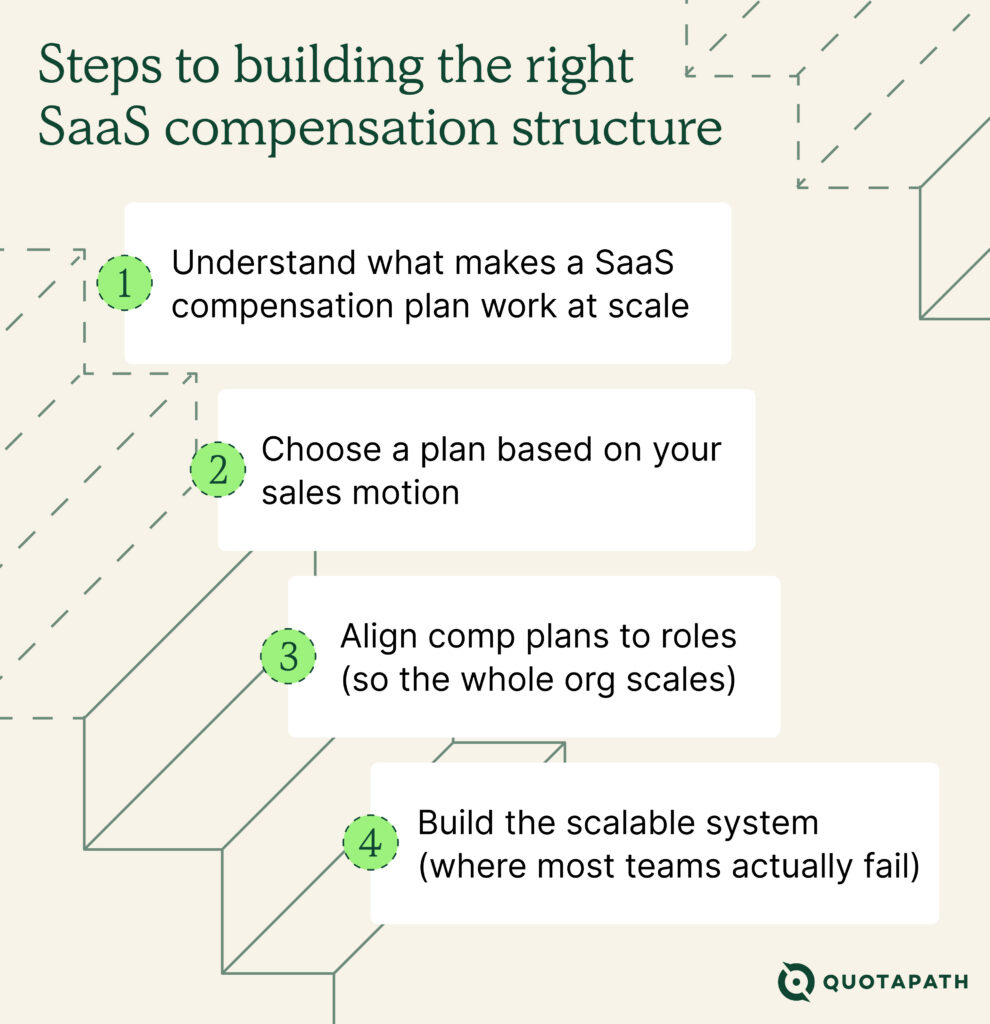
Step 1: Understand what makes a SaaS compensation plan work at scale
A scalable SaaS sales comp structure for 50+ reps comes down to three principles: simplicity, logic, and fairness.
Simplicity: reps should understand it instantly
If a rep can’t explain their plan in 30 seconds, your plan is too complex. Complexity creates two problems:
- Reps don’t know what to prioritize.
- Disputes become inevitable because the math feels mysterious.
Logic: incentives must reflect how you grow
Your B2B SaaS commission model should match your business model—whether you optimize for bookings, retention, expansion, or usage.
If your growth engine is multi-year ARR, reward it. If your growth engine is NRR, pay for it. “Motivating software sales teams” isn’t about hype…it’s about alignment.
Fairness: the plan must be defensible
Fairness isn’t just “nice.” It’s what makes compensation sustainable when your org is large enough that exceptions and edge cases happen weekly.
Mike described the benefit of a clear commission system like this: “You create trust, you create accountability.” And when comp is transparent, there’s a defensibility to it—“the numbers don’t lie.”
That’s the standard. If your plan can’t hold up in a screen-share conversation with a rep, it’s not ready for 50+ reps.
Step 2: Choose a plan based on your sales motion
Once your foundation is solid, you can choose the right structure based on how you sell.
Revenue-based plans
These are common for outbound-heavy SaaS motions and quota-carrying AEs.
Options include:
- Single-rate commission (simple, predictable)
- Tiered commissions or accelerators (drive overperformance)
- NRR-based compensation (align AEs/CS to expansion + retention)
If your team is running SaaS quota-based compensation, the key is to keep the plan consistent and repeatable across reps and teams, especially as you introduce territories and segment differences.
Commission + bonus models
These work well when you need to shape behavior beyond “close more deals.”
Examples:
- Accelerators (pay more above quota)
- Milestone bonuses (reward specific achievements)
- Cliff bonuses (activate payouts after thresholds)
For scaling teams, the trap is adding “one more bonus” every quarter. Bonuses should reinforce strategy (not patch holes).
Report: Usage-Based Compensation Plans
We analyzed dozens of conversations with Revenue and RevOps leaders from our own compensation consultation calls and external interviews to learn what’s working (and not) when it comes to usage-based compensation models.
Read ReportUsage- or activity-based plans (for PLG teams)
If you’re operating a product-led growth motion, revenue is often downstream of usage.
That’s where activity-based incentives or usage-based comp plans can work, like:
- Paying for product-qualified lead (PQL) conversion
- Bonuses for usage-based expansion events
- Small rewards tied to activation milestones
These models can be especially effective as comp plans for product-led growth, but the same rule applies: keep it transparent, or it won’t scale.
Step 3: Align comp plans to roles (so the whole org scales)
At 50+ reps, you don’t just have one sales team—you have multiple comp audiences. Plans should be role-specific and easy to administer.
SDRs / BDRs
Focus on controllable outcomes and fast feedback loops:
- $50 per qualified meeting
- $200 per SQL
- Optional kicker for influenced closed-won deals
This avoids the common trap of paying only for volume without quality.
AEs
AEs usually perform best with a commission plan that rewards quota attainment and overperformance.
Common options:
- Commission with accelerators
- Accelerators + decelerators (protect downside performance)
- Multi-year accelerators (drive longer terms)
Managers and executives (the part many teams forget)
This is where the real scale problem shows up: once you have layers of leadership, you need rollups.
Our customer, Keen, for example, built a three-level structure:
- “The VP gets paid commission on everything that the team does,” said their COO Mike Althoff.
- Team leaders earn on their deals and the team they support.
Clarity will be key.
“Who’s getting what for every deal and why” has to be visible. Otherwise, your comp plan becomes political.
Step 4: Build the scalable system (where most teams actually fail)
At 50+ reps, it’s not enough to have the right plan. You need a system that runs it reliably, end to end.
For Keen, the turning point was moving from spreadsheets to a platform that could scale with their team’s complexity.
“We needed a system that would scale with us,” Mike said, as “go-to-market complexity increased.” QuotaPath gave them “structure… auditability… a consistent process.”
CRM integration is non-negotiable
Keen runs HubSpot, and Mike was blunt about how important the integration is: “Almost essential.”
Why? Because closed-won data isn’t always clean until it’s tied to commissions. That connection creates “day-to-day confidence” that every deal and account is being managed accurately.
For a 50+ rep org, that’s the difference between “I think this is right” and “I know this is right.”
Payroll integration removes the last-mile risk
Keen also uses Rippling, and the outcome is exactly what you want payroll to be: boring.
Mike joked that it “hasn’t changed anything” for him—but the payroll manager loves it. “I literally just say, ‘I sent the commissions,’ and she’s like, ‘cool, thanks.’”
That’s the goal: fewer handoffs, fewer mapping errors, and less room for “did I type every number correctly?”
What ROI looks like at scale
When you ask leaders what the biggest value is to a scalable system, they rarely say “faster math.”
Mike put it simply: “Transparency is… the number one thing.”
Nancy McBee, VP of Finance at Seekout, shared a similar sentiment on QuotaPath’s impact on scaling: “QuotaPath has really helped us at SeekOut in creating additional scale, transparency, and ensuring that everyone’s on the same page for targets, comp plans, to drive the right behavior and ultimately grow the business.”
Because once you have a shared system of record, the organization stops fighting about spreadsheets and starts focusing on performance.
And when comp plans evolve (as they should), you don’t start from scratch. Keen adjusted their mix between expansion and renewal heading into 2026 by duplicating plans and updating rates, giving reps continuity between years: “This is how I earned last year… now I can see how I’m earning this year.”
That continuity matters more than most leaders realize.
Try the most collaborative solution to manage, track and payout variable compensation. Calculate commissions and pay your team accurately, and on time.
Start TrialThe takeaway for SaaS teams scaling past 50 reps
If you’re outgrowing spreadsheets, you’re not alone, and you’re not behind. You’re right on schedule.
As Mike told it, if you want “confidence, consistency, tighter operational control,” and you care about CRM connectivity, you need “one seamless end-to-end engine.”
At 50+ reps, comp is about accurate payouts that build trust and accountability and keep your growth machine running without friction.
And if you want comp plans that scale, across AEs, SDRs, managers, and executives, build them like infrastructure. Not like a quarterly spreadsheet project.