Most comp plans have at least one accelerator or SPIF that nobody can fully explain anymore. It shipped because a VP asked for it, or a competitor’s plan had one, or the team hit a rough quarter and needed a lever fast.
Eighteen months later, it’s still running, still costing dollars every payout cycle, and still doing something.
But is it, though?
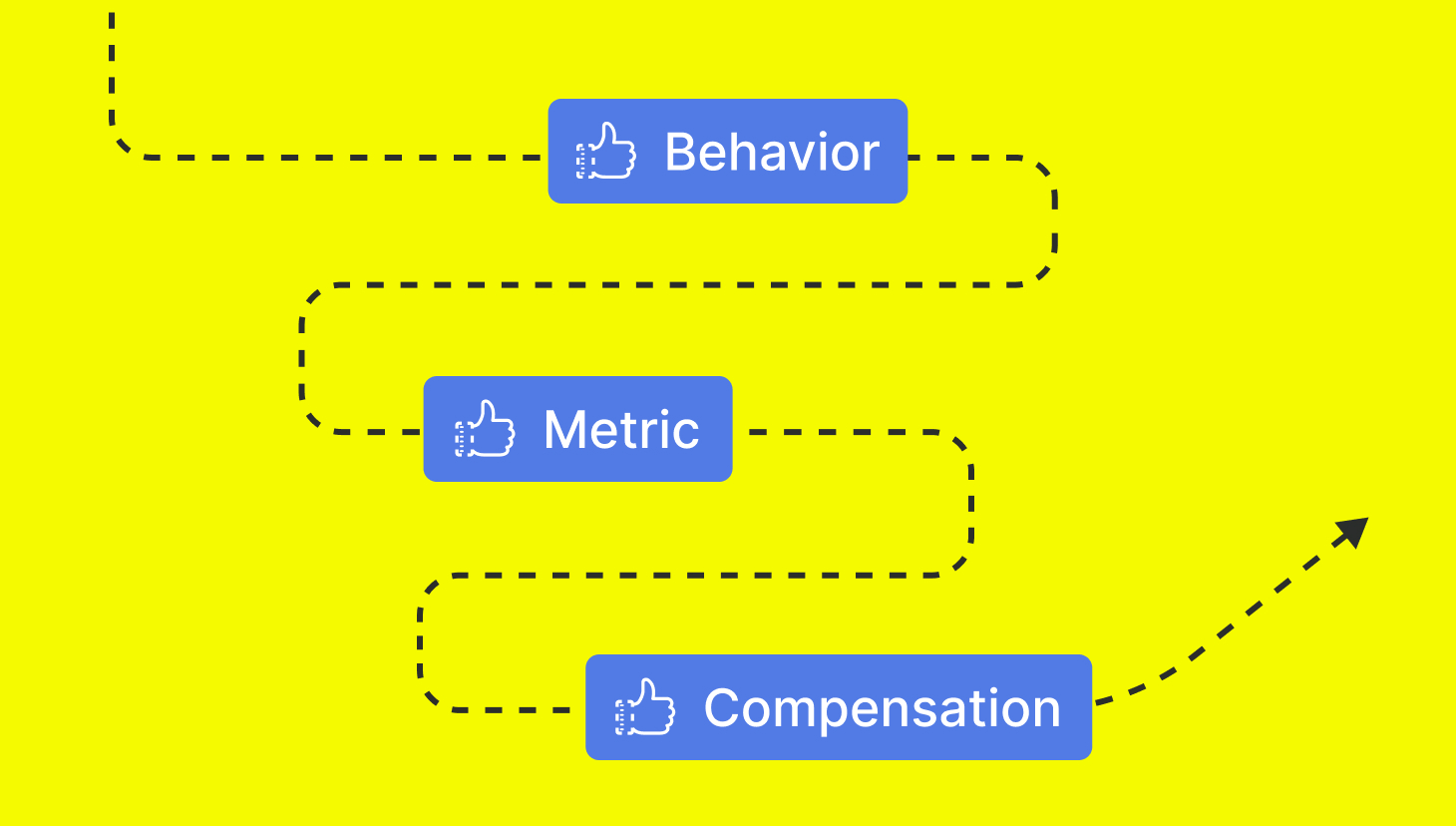
That’s the gap between an incentive and a strategy. A strategy answers three questions before a single dollar moves:
- What behavior needs to change?
- What metric proves it changed?
- And what payout is large enough to move the needle without paying for revenue that would have closed anyway?
Companies that skip the last question end up rewarding what Harvard Business Review calls “free sales.” You know, deals a rep would have closed with or without the incentive attached.
This framework, modeled through Atlas, walks through three plan structures built on the logic of increasing multi-year bookings, shifting AE effort toward ICP and self-sourced revenue, and growing expansion without putting retention at risk.
Each one prioritizes behavior over budget.

The framework: Behavior, metric, compensation
As mentioned above, a strong incentive earns its place on the comp plan by answering three questions noted.
You have to answer these in order, though. Because if you skip the first two, then you’re answering question 3, “what payout is large enough to move the needle,” based on guesswork.
The plans that survive the next comp planning cycle intact are built in order, starting with the metric the business actually needs to move.
Start with your North Star Metric, not your comp plan
First, note that revenue is a lagging indicator.
It tells you what already happened vs. what to do next.
A North Star Metric, the measurable, cross-functional number that best reflects how the business creates long-term value, is the better starting point, because it forces the question RevOps should ask before any accelerator goes live: if this number moves up and to the right, does the business actually get healthier?
Every example below pairs at least one leading metric (mix, win rate, health score) with at least one guardrail metric (discount rate, retention floor). That’s deliberate.
Most sales organizations already build plans this way: 71% use two to three performance measures per plan rather than a single number, because one metric alone is too easy to game and too narrow to catch the downside.
Design, track, and manage variable incentives with QuotaPath. Give your RevOps, finance, and sales teams transparency into sales compensation.
Talk to SalesAE Example 1: Increase Multi-Year Bookings
Selling behavior
Encourage AEs to sell two- and three-year contracts instead of defaulting to one-year agreements.
Metrics to measure
| Metric | Purpose |
|---|---|
| Multi-year mix | Percentage of new-business ARR from contracts of 24+ months |
| Average contract term | Confirms the behavior is broad-based, not driven by one deal |
| Discount rate | Prevents term length from being purchased through excessive discounting |
| Early churn or contraction | Ensures longer contracts produce durable revenue |
Compensation design
Core commission: Pay standard commission on year-one ARR only. Don’t pay commission on full TCV. Crediting the whole contract value up front pays for years that haven’t happened yet and disconnects payout from what the AE actually delivered this period.
Term accelerator:
| Contract term | Commission treatment |
|---|---|
| 12 months | 1.0x base commission rate |
| 24 months | 1.15x base commission rate |
| 36+ months | 1.25x base commission rate |
On a 10% base commission rate, a $100,000 year-one ARR deal pays $10,000 at a 12-month term, $11,500 at 24 months, and $12,500 at 36 months.
Guardrails
- The uplift applies only when discounting stays below the approved threshold.
- Pay 50% of the term uplift at booking and 50% after the customer reaches a defined renewal or payment milestone. That split is worth weighing against the alternative: QuotaPath’s own guidance on multi-year deal compensation argues for paying the full term uplift at signature instead, since splitting commission over time can push AEs right back toward the shorter deals you’re trying to move them away from. If you go that route, handle retention risk separately, through clawback clauses and post-sale GRR ownership, rather than delayed AE pay.
- Review the program after one or two quarters against multi-year mix, discount rate, and early churn.
Business logic: The incentive rewards contracted revenue quality without encouraging AEs to inflate payout through TCV crediting or uneconomic discounts. This reflects a data point from QuotaPath’s own SPIF Report: multi-year accelerators generate 25% of revenue while representing only 15% of plans. Reps chase whatever the plan makes visible, and rewarding term length, not just deal size, changes what they chase.
AE Example 2: Improve ICP and Outbound-Sourced Revenue
Selling behavior
Shift AE effort toward high-fit accounts and self-sourced opportunities rather than relying primarily on lower-conversion or lower-value inbound volume.
Metrics to measure
| Metric | Purpose |
|---|---|
| ICP win rate | Measures whether targeting improves conversion |
| New-business ARR from ICP accounts | Connects behavior to revenue |
| Self-sourced pipeline | Measures prospecting activity without paying for activity alone |
| Self-sourced closed-won ARR | Confirms pipeline quality |
| Sales cycle and discount rate | Prevents low-quality or uneconomic deals |
Compensation design
Core commission: Pay the standard new-business rate on all eligible ARR.
Targeted rate differentials:
| Deal attribute | Incremental payout |
|---|---|
| ICP account | +1 percentage point |
| Self-sourced opportunity | +1 percentage point |
| ICP and self-sourced | Maximum +2 percentage points |
At a standard 10% rate, an ICP, self-sourced deal pays 12%. On a $75,000 ARR deal, that’s $9,000 in commission instead of $7,500.
Optional quarterly SPIF: Pay a fixed $1,000 to $2,000 bonus when an AE hits both conditions in the same quarter: at least 30% of closed-won ARR is self-sourced, and at least 70% of that self-sourced ARR comes from ICP accounts.
Guardrails
- Define “self-sourced” with a CRM attribution rule, such as a documented outbound touch before opportunity creation, not a rep’s word for it.
- Require the account to meet a pre-approved ICP definition.
- Exclude deals below a minimum margin or discount threshold.
- Cap the SPIF at one payout per quarter rather than paying per activity. A SPIF that pays per activity stops being a SPIF and becomes a standing rate increase with extra steps, one of the design mistakes QuotaPath’s guide to building accelerator plans flags directly.
Business logic: The rate differential rewards revenue quality and source ownership. The SPIF creates a temporary push without permanently complicating the plan: run it for a quarter, measure it, and let it expire on schedule rather than becoming a line item nobody remembers approving.
AM/CS Example: Grow Expansion Without Risking Retention
Selling behavior
Encourage account managers or customer success managers to identify qualified expansion opportunities without sacrificing renewal quality or customer health.
Metrics to measure
| Metric | Purpose |
|---|---|
| Gross retention rate | Protects the existing revenue base |
| Expansion ARR | Measures cross-sell and upsell production |
| Net revenue retention | Captures the combined retention and expansion outcome |
| Expansion win rate | Tests opportunity quality |
| Customer health or adoption | Reduces the risk of selling expansion into unhealthy accounts |
Compensation design
Use two separate components instead of paying only on NRR. A single blended number hides which half is doing the work.
1. Retention component, 70% of variable compensation: Pay against gross renewal attainment. Below 70% retention attainment: reduced payout or no payout. At 100% attainment: full target payout. Above 100%: a modest accelerator, if appropriate.
2. Expansion component, 30% of variable compensation: Pay 4% to 6% of expansion ARR. Pay 50% at signature or booking, and the remaining 50% after a payment, implementation, or adoption milestone.
Expansion quality kicker: Add a 10% to 20% uplift to the expansion payout when the customer meets the minimum health threshold and the expansion is live or adopted within the defined measurement window. On $50,000 expansion ARR at a 5% base rate, that’s a $2,500 base payout plus a 20% healthy-account kicker for $3,000 total.
Guardrails
- No expansion accelerator if gross retention falls below the minimum floor.
- Separate renewal and expansion credit so a large upsell can’t hide churn elsewhere in the book.
- Attribute expansion to the AM/CSM only when the opportunity was documented and materially influenced by that role.
- Use a fixed ownership window, such as 6 to 12 months after the initial sale.
Business logic: This structure balances growth against the installed base it’s built on. It keeps the plan from rewarding expansion activity that books near-term revenue while quietly raising downstream retention risk, the exact trade-off a RevOps metrics program should be built to catch by tracking gross retention and net revenue retention as separate signals rather than one blended number.
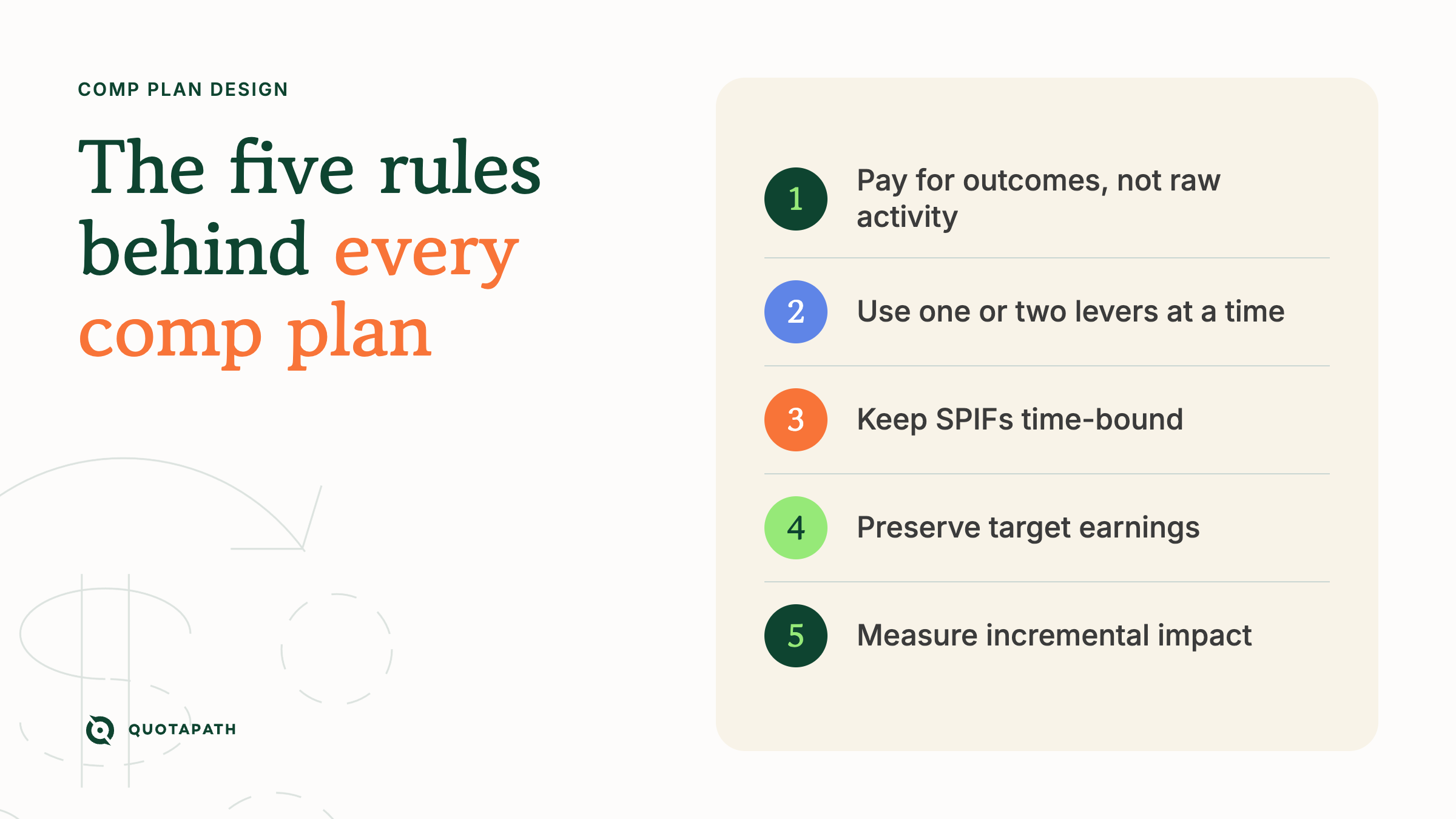
The five rules behind every one of these plans
- Pay for outcomes, not raw activity. Meetings, calls, and emails are leading indicators. Closed ARR, retention, margin, and adoption are the metrics worth paying on. Research on sales compensation design backs this up: outcome-based pay works best when a seller’s effort maps clearly to the result, while behavior-based pay earns its place only when it’s serving a specific strategic objective, not standing in as a proxy for effort nobody wants to measure directly.
- Use one or two levers at a time. Every added modifier is one more thing a rep has to hold in their head to know what they’re chasing, and one more line item for RevOps to explain at the next plan review.
- Keep SPIFs time-bound. A 60- to 90-day test beats embedding every strategic priority into the base plan permanently, a distinction QuotaPath draws out fully in SPIFs vs. Bonuses: When to Use Each.
- Preserve target earnings. When you add an accelerator, cut another payout element if you need to, so the plan doesn’t quietly raise cost at target.
- Measure incremental impact. Compare behavior and results against the prior period or a similar control cohort, not against a feeling that the new incentive seems to be working. QuotaPath’s guide on how to measure sales commission effectiveness lays out what that comparison should actually track.
Not every seller responds to these levers the same way, either.
Research summarized in Harvard Business Review’s “Motivating Salespeople: What Really Works” found that top performers, core performers, and underperformers each move for different reasons.
Stars need uncapped upside. Core performers respond to varied, achievable tiers, and underperformers need shorter feedback cycles than an annual bonus provides.
A plan built for the average rep is really built for nobody.
Try the most collaborative solution to manage, track and payout variable compensation. Calculate commissions and pay your team accurately, and on time.
Start TrialThe finance test
Every incentive on this list has to clear one bar before it ships:
- a defined behavioral objective
- a measurable revenue or retention outcome
- and a maximum cost that can be weighed against the incremental gross profit it creates.
The old comp model, one quota and one commission rate applied uniformly across the team, is losing its grip as more of the buying process moves outside any single seller’s control.
The fix is incentives that can prove which behavior they paid for.
Modeled through Atlas
Every structure above- the term accelerator math, the rate differentials, the two-component AM/CS split- was run through Atlas before it made this framework.
Atlas combines QuotaPath’s benchmark intelligence with your own commission data, so instead of guessing whether a 1.25x term accelerator is generous or thin for your market, you can see how it measures up against what similar teams actually pay.
If your comp plan has an accelerator nobody can fully explain anymore, that’s the one to run through Atlas first.