REPORT Clawback Policy Playbook for RevOps and Finance

Clawbacks are one of the most debated elements of sales compensation: unpopular with reps, essential for Finance, and a constant balancing act for RevOps.

They’re also common.

In our analysis of 20,747 customer and prospect conversations, 12.1% included clawbacks, typically tied to conversations on cancellations, nonpayment, or early churn.

This report shares clawback policy best practices according to our data.

What does an effective clawback policy actually look like in practice?

Policies vary widely across:

• Time windows
• Trigger events
• Recovery methods
• Rep visibility

The result is predictable: rep frustration, operational complexity, and ongoing disputes.

At their core, clawbacks are about managing revenue risk. The higher the uncertainty in revenue (e.g., usage-based, implementation-heavy, or uncollected deals), the more likely companies are to introduce recovery mechanisms like clawbacks or holdbacks.

This report examines compensation data and will focus on these areas:

Clawback process tips
Policy best practices
Rules based on company size, cash, and balance sheet

Commission Clawbacks: 5 Practices RevOps and Finance Leaders Are Doing

First, it’s good to remember that clawbacks are rarely the problem in and of themselves.

Much like compensation plans in general, poorly designed clawback policies are the issue. Across compensation data and customer conversations, five consistent practices separate policies that create friction from those that effectively manage revenue risk. See below.

Design Clawbacks as a Standard Mechanism, Not an Exception

High-performing teams don’t treat clawbacks as rare exceptions. Rather, they design for them as a normal part of how commissions work.

Operational data shows that clawbacks most often occur due to early churn, refunds, or non-payment (situations in which commissions are paid before revenue is fully realized).

In practice, this shows up across common scenarios:

  • Customers cancel shortly after signing
  • Invoices go unpaid
  • Deals fail to go live or complete 
onboarding
  • Contracts are reduced post-sale

These are not edge cases. They are predictable outcomes in most revenue models.

Examples from compensation conversations include:

  • A SaaS company clawing back commissions when customers churn within 90 days of onboarding
  • A lead-generation platform applying a 60-day clawback window for rescinded sales
  • A digital advertising company recovering commissions on deals that never go live within three months

For RevOps and Finance teams, the implication is clear: Clawbacks should be built into the system by default (not layered on reactively).

Effective Policies Align Payout Timing With Revenue Risk

One of the most consistent patterns across companies is payout timing and clawbacks.

The earlier commissions are paid, the more formal clawback rules are needed to protect revenue.

For instance, many companies reduce clawback risk by staging payouts instead of paying 100% at
booking.
This visual below lays out risk vs. commission payout.

Commission Payout Timing by Revenue Risk

REVENUE RISK LEVEL EXAMPLE DEAL TYPE AT SIGNATURE DEFERRED / HOLDBACK AT FIRST INVOICE OR CASH
Low risk Annual SaaS, strong billing reliability 70% 0% 30%
Moderate Risk Multi-year SaaS contracts 50% 25% 25%
High risk Usage-based or implementation-heavy deals 25% 40% 35%

Most Policies Use Short Clawback Windows 
(60–120 Days)

Across companies, clawback policies tend to converge around short, clearly defined windows.
The most common range is 60–120 days after the sale.
Short windows serve two important purposes:

  1. They protect the business from early churn or non-payment.
  2. They give sales reps confidence that deals become “safe” after a predictable period.

Examples from compensation conversations include:

  • A SaaS company applying a 90-day clawback policy for customers who cancel after onboarding
  • A sales team using a 60-day clawback window for rescinded deals so commissions net out quickly
  • A home services platform implementing a six-month clawback window, which leadership later noted increased rep anxiety

Sales leaders consistently report that shorter windows create less friction.

As one CRO explained: “Policies tied to a specific, reasonable window, usually 90 days or less, tend to work well. Reps can stomach it when they know the rules going in.”

Conversely, when clawback windows extend too long, commissions begin to feel uncertain.

One AE described a previous policy this way: “When commissions could be clawed back for a year, it felt like monopoly money. Big decisions like buying a home or a car became scarier.”

Clear Triggers and Documentation Prevent Disputes

One of the fastest ways to cook up a clawback dispute between Finance and your reps are unclear rules around the policy.

Effective policies define and outline exactly what events trigger a clawback, typically including:

Customer cancellation
Refunds
Non-payment of invoices
Failure to complete onboarding or go live

Clear documentation in compensation plans is essential. A typical clause might state:

“Any commissions paid on deals that are refunded or canceled within four
months will be deducted from future payouts.”

This level of specificity removes ambiguity and helps both Finance and Sales teams apply the policy
consistently.

Automation Reduces Administrative Burden and Errors

Lastly, the teams with the cleanest (and least combative) clawback rules are automating the process.

That’s because the clawbacks themselves are often riddled with complexities, requiring teams to track:

  • Original Commission Payouts
  • Deal Status Changes
  • Billing Outcomes
  • Clawback Windows
  • Adjusted Earnings
A a result, errors often follow these manual adjustments.

One operations leader described their experience managing clawbacks in spreadsheets: “Our biggest challenge was clawbacks… if the company wants them, we need a system. I’m absolutely not doing that manually.”

Automation helps by:

Flagging deals that fall
within clawback windows
Detecting discrepancies when
deal values change
Automatically adjusting
commission payouts
Maintaining a full
audit trail

Just as important, they make clawbacks visible to reps, by showing which deals are still at risk, surfacing clawbacks in real-time earnings views, and allowing reps to anticipate and act on potential churn.

This combination of turns clawbacks from a surprise penalty into a predictable system.

Policies tied to a specific, reasonable window — 90 days or less — work well. Reps can stomach it when they know the rules going in.

CRO at a mid-stage SaaS company

What Good Clawback Policies Look Like

POLICY ELEMENT COMMON BEST PRACTICE
Clawback Window 60–120 days
Recovery Method Deduct from future commissions
Recovery Cap 25–50% of variable pay per cycle
Quota Treatment Do not revoke quota credit
Rep Visibility Show clawback risk in dashboards


While clawback policies vary by company, the most effective ones share a common structure consisting of five components.

1. A Short, Defined Clawback Window

Most effective policies fall between 60–120 days. This protects the company while limiting income uncertainty for reps.

2. Clearly Defined Triggers

Policies explicitly define events that trigger clawbacks, such as:

  • Customer Cancellation
  • Refunds
  • Non-payment
  • Failure to Complete Onboarding

Clear triggers eliminate interpretation disputes.

3. Partial Commission Recovery (Not Quota Reversal)

Most companies recover commission dollars only, rather than revoking quota credit.

This prevents reps from starting future periods behind quota while still protecting the business financially.

And we recommend partial commission recovery as it is fairer than full reversals.

If a customer only pays for the first few months, we usually just pay the rep for what actually came in and claw back the rest,” said a sales leader discussing prorated clawbacks tied to revenue received

Many organizations now adjust commission payouts based on actual revenue realized rather than revoke the entire commission.

4. Predictable Recovery Methods

Most clawbacks are recovered through future commission deductions.

For example, if a rep earned $2,000 this month but has a $3,000 clawback, companies typically deduct the available commission now and carry the remainder into future payouts.

Some companies also cap clawback recovery so it does not exceed a percentage of variable pay in a single payroll cycle, preventing extreme income volatility.

5. Clear Rep Visibility

Finally, the best policies ensure reps can see:

  • Which Deals Are Still Inside Clawback Windows
  • When Those Windows Expire
  • How Clawbacks Affect Future Payouts

When reps can track this information, clawbacks feel fair and predictable rather than punitive.

Clawback Rules Based on Company Size, Cash, and Balance Sheet

Clawback rules should become stricter as cash sensitivity rises, deal risk increases, and balance-sheet flexibility declines.

A simple CFO rule of thumb: the weaker the cash position, the more compensation should follow cash realization rather than bookings.

COMPANY PROFILE CASH/BALANCE SHEET REALITY CLAWBACK POSTURE PRACTICAL STRUCTURE
Well-capitalized, strong balance sheet, predictable collections Can absorb some reversals Light clawbacks Pay mostly at booking, claw back only for non-payment, fraud, or early termination within a defined window
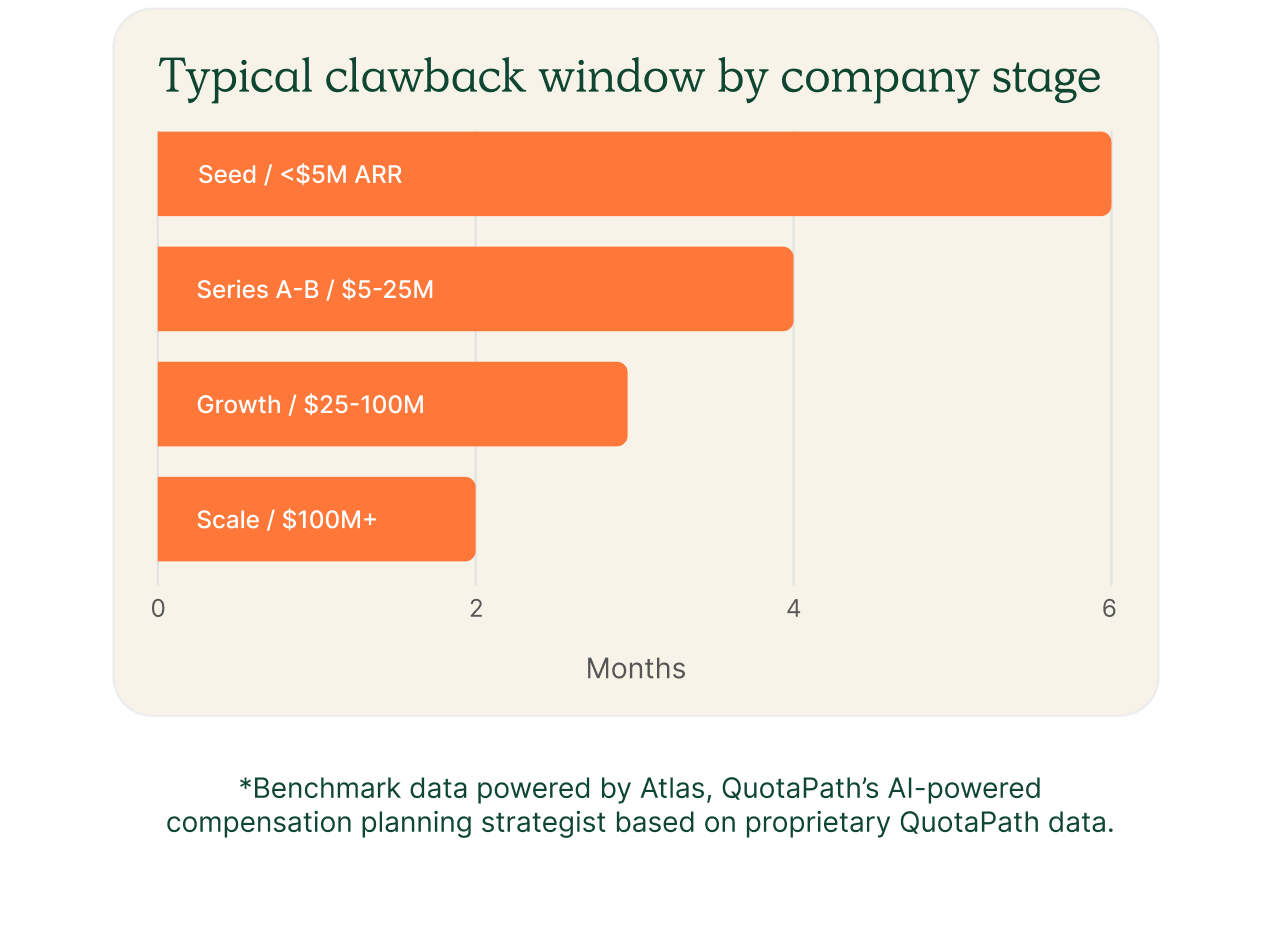
Mid-stage SaaS, decent cash but watching burn Some tolerance, but misses matter Moderate clawbacks Split payout: part at signature, part at first invoice/payment/go-live; claw back unpaid or cancelled deals within 90–180 days
Cash-constrained, venture-backed, negative free cash flow Cannot fund commissions on revenue that may not collect Stronger clawbacks Smaller upfront payout, larger deferred tranche tied to cash collection or retention milestone
Thin-margin or balance-sheet-sensitive business Reversals hit EBITDA and working capital fast Tighter clawbacks Pay on collected cash or gross margin realization; use holdbacks rather than full upfront payout
Usage / consumption / implementation-risk model Revenue realization uncertain after booking High caution Avoid large upfront payouts; use true-ups based on actual usage, activation, or invoice collection

How QuotaPath Helps Teams Manage Clawbacks

Even well-designed clawback policies break down without the right systems.

QuotaPath automates clawback management by connecting compensation logic directly to CRM and billing data.

With QuotaPath, teams can:

  • Automatically Detect Clawback Events
    Deal changes, cancellations, or payment issues trigger real-time commission adjustments.
  • Apply Clawbacks to Future Commissions
    Deductions are applied based on policy—no manual recalculation required.
  • Track Overpayments and Calculate Clawbacks
    If a deal changes after payout, discrepancies are identified and clawbacks are calculated automatically.
  • Give Reps Real-Time Visibility
    Reps can see which deals are at risk, when windows expire, and how earnings are impacted—reducing surprises and disputes.
  • Maintain a Complete Audit Trail
    All calculations, adjustments, and payouts are tracked for accurate reporting and ASC 606 compliance.

Clawback Policy Playbook for RevOps and Finance

Want this report accessible via PDF? Fill out the form to the right, and we’ll send one your way for easy sharing.

Download the Report