To handle commission disputes with sales reps, ground each ruling in the signed plan and the deal record, and explain each payout to the rep line by line. Because that ruling binds anyone with the same facts, correct their next statements and update the plan.
QuotaPath publishes this guide. Every step works in a spreadsheet, and we note each QuotaPath feature’s limits.
Key takeaways
- Route each new commission dispute through a reviewer uninvolved in the payout, and enter the outcome in your ruling log as precedent for later cases of the same kind.
- A ruling on one rep’s dispute may shift pay for their peers too. How far it spreads differs by category, from the deals in one faulty CRM sync to all reps under an unclear plan clause.
- Clawbacks depend on a plan’s earning trigger. Once it’s met, state wage rules restrict what you can reclaim.
- In the step 5 hypothetical, a retroactive deal-timing ruling increases a rep’s commission and turns part of another’s into a clawback.
Sales commission disputes and what they cost
The 2024 QuotaPath compensation report surveyed more than 450 finance and revenue leaders in the US and UK. On average, respondents estimated that 22% of their reps have at least one commission dispute a year and 9% quit over commission errors or disputes.
Design, track, and manage variable incentives with QuotaPath. Give your RevOps, finance, and sales teams transparency into sales compensation.
Talk to SalesWhat to have in place before a dispute arrives
Commission dispute resolution draws on four pieces of groundwork:
- Every rep’s signed plans, current and past
- Deal records with field-change tracking
- A ruling log in a searchable drive, one column per field in step 6
- A decision owner for each dispute type
QuotaPath’s Plan Verification handles rep sign-off on comp plans: reps type their name to confirm the plan is clear to them, and admins can print a copy with the typed name and date. Counsel should judge an in-app signature against your state’s signing requirements.
Finally, add a dispute clause. Paste this sample into QuotaPath’s commission payment agreement template and adjust the bracketed terms:
Reps may dispute a commission within [60] days of the statement date by [flagging the deal or emailing comp@yourcompany.com], with the deal, period, expected amount, and reason. [RevOps] will acknowledge within one business day and decide within [10] business days. The deadline governs our internal process and doesn’t limit any rep’s legal rights.
The six-step commission dispute process
1. Acknowledge the dispute in writing
Open a ticket or flag for every dispute, in your queue or on the deal itself, so the rep and the reviewer follow one thread. Capture every field from your clause, then provide the decider’s name and a target date in your reply.
Deal Flagging lets QuotaPath reps mark a deal with a reason and comment. The flag stays open until an admin resolves it. Flags attach to single deals. Quota or territory questions go in a separate ticket.
2. Gather the evidence for the ruling
Pull the signed plan for that period, the deal record and its past edits, the rep’s quota at the time, the payout’s commission statement, and any documented exception for the deal. Assign the review to someone independent of the original calculation. A second reviewer should reach the same answer from the file alone.
3. Classify the dispute and find the reps it involves
Match the dispute to a row in Table 1. For a tie between two rows, pick the one with more affected reps. List the other reps whose deals share the disputed facts. You’ll recheck each of them in step 5.
Table 1. Five dispute types, from data errors to one-off exceptions
| Type | Typical example | What settles it | Who decides | Who else is affected |
|---|---|---|---|---|
| Data error | Wrong owner or close date | Signed order form and change log | RevOps | This rep, plus deals from the same source |
| Calculation error | Accelerator set at the wrong threshold | Plan text against configured logic | RevOps and finance | Everyone paid under that component |
| Interpretation dispute or plan gap | Unclear or silent wording, such as on splits | The plan and prior rulings | A standing comp committee | Every rep in the same position |
| Expectation gap | Rep expected more than the plan pays | Plan section and statement | Rep’s manager and RevOps | Pay is unchanged |
| One-off exception | Leadership pays outside the plan | Written approval above the manager | An executive | Nobody else |
4. Walk the rep through the calculation
Show the math in the plan’s own order: the plan section, the deal inputs, the commission rates, and the payout. For a tiered plan, include the booking band and the percentage paid on it. Expectation gaps are common, since nearly four in five revenue leaders in QuotaPath’s survey said their reps find comp plans difficult to understand. Record the walkthrough in a close-out note for the rep.
In QuotaPath, a deal’s earnings explanation breaks down each component’s rate or tier and the step-by-step calculation behind the final figure. The explanation inherits any CRM input error. Trace each value to the deal record from step 2.
5. Apply the ruling across the team
Recalculate commission for everyone on your step 3 list ahead of the announcement, and issue one dated correction per rep. Each rep should see only their own pay.
Here’s a hypothetical. Suppose a plan pays 10% of quarterly bookings up to a $300,000 quota and 15% above it. A CRM edit moved Rep A’s September deal into October. The comp committee rules that a deal counts in the quarter it was signed, and Table 2 has the numbers.
Table 2. Three reps’ commission under each dating rule (hypothetical)
| Rep | Deal facts | Paid by CRM close date | Paid by signature date | Change |
|---|---|---|---|---|
| Rep A | Other Q3 bookings $290,000. $40,000 deal: signed Sept. 29, CRM date Oct. 2 | $33,000 | $34,500 | +$1,500 |
| Rep B | Other Q3 bookings: $250,000. $30,000 deal: signed Sept. 30, CRM date Oct. 1 | $28,000 | $28,000 | $0, paid a quarter earlier |
| Rep C | Other Q3 bookings $285,000. $25,000 deal: signed Oct. 3, CRM date Sept. 30 | $31,500 | $31,000 | -$500 |
Method: Q3 pay plus the moved deal’s Q4 pay, assuming no rep passes quota in Q4. Our calculation.
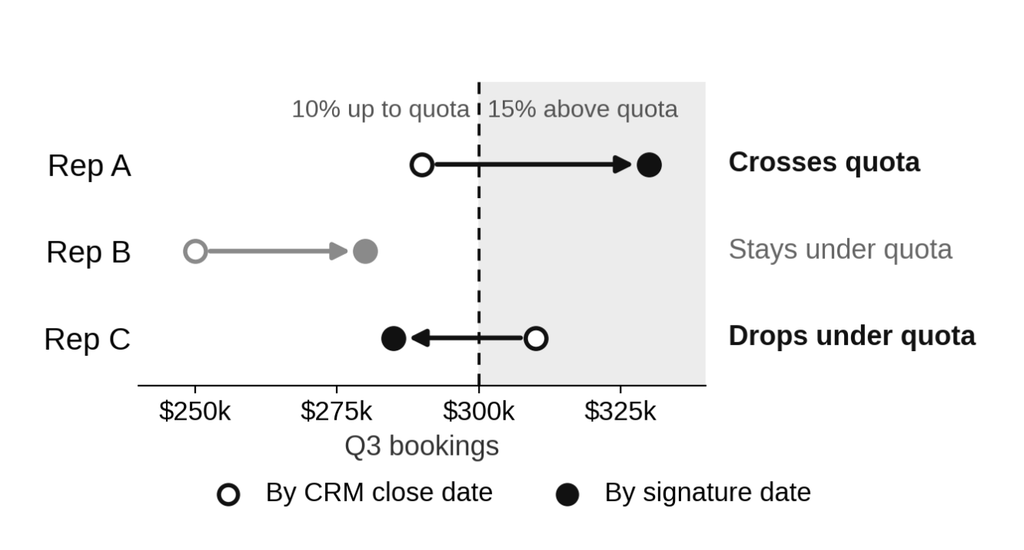
Figure 1. Which reps cross quota in Q3 under the signing-date ruling (hypothetical).
Backdating the ruling to Q3 cuts Rep C’s total by $500 through a clawback. Name an effective date in the ruling.
6. Fold rulings into the plan
Log each ruling immediately: date, dispute type, plan section, ruling, reps affected, total amount, effective date, and precedent status.
At the next plan revision, insert each ruling’s wording and have reps verify the amended plan. Frequent disputes are one of the signs your sales compensation plan needs an update.
When a rep disputes a clawback
A clawback recovers paid commission, for example, on a churned account or an unpaid invoice.
If the plan ties earning to customer payment or a minimum retention period, earlier payouts can qualify as advances. For earned commission, taking money back is a wage deduction subject to the limits in Table 3. Treat reps with identical earning terms alike, and give written notice of any recovery in advance. Put each clawback on the statement as its own item, and spell out the deal and its cause.
Any change to an approved deal’s earnings appears in QuotaPath as a discrepancy. You can approve the new amount and claw back anything already paid out, or dismiss it, which keeps the approved amount and blocks future discrepancies on that deal. Neither option tests whether the deduction is lawful.
State laws that shape commission disputes
Compare your plan with the row for each state on your payroll:
Table 3. Signed-plan and pay-recovery rules in three states
| State | What the law requires | What it means in a dispute |
|---|---|---|
| New York | Commission terms in a writing signed by both sides, kept for at least three years. Clerical overpayments are deductible only under state rules. | Failing to produce the signed terms on request creates a presumption that the rep’s stated terms were agreed. New York’s top court left the earning point of commission to the parties’ agreement. |
| California | A written contract with the method for computing and paying commission, plus a signed receipt from each rep. Employers can’t collect back wages already paid. | A court upheld charging back commission advances on subscriptions canceled within 28 days, as the signed agreement allowed. |
| Massachusetts | The Wage Act covers commissions that are definitely determined and due and payable. | Claims carry mandatory triple damages and attorneys’ fees. |
Common commission dispute mistakes
- Rewriting a plan mid-period over one dispute alters the terms for deals already in progress.
- Full commission to both reps on a shared deal doubles its cost. Award the credit by the plan’s split terms.
- At the acknowledgment stage, a promised outcome can commit you to an unsupported ruling.
- Other reps will cite an informal answer to a small dispute as a rule.
Audit your past disputes with QuotaPath
Start from the last quarter. Label each dispute by its Table 1 type, and backfill every multi-rep ruling into the ruling log.
The mix tells you what comes first: data and calculation errors send you to the CRM records and plan configuration, and interpretation disputes to your agreement language.
Book a QuotaPath demo to manage flags and clawbacks in one workspace.
Try the most collaborative solution to manage, track and payout variable compensation. Calculate commissions and pay your team accurately, and on time.
Start TrialFrequently asked questions
Do you have to pay commission after a sales rep quits or is fired?
Yes. Commission a rep earned under the plan during employment is owed. In California, those commissions belong in final pay. The Labor Commissioner’s 1999 opinion letter holds that employers can’t wait for the usual commission run. Under the letter, amounts pending at departure are due as soon as their conditions are fulfilled.
How long should a commission dispute take to resolve?
Aim for a decision in 10 business days or fewer, the cap in our sample clause. For disputes over plan wording, book the comp committee inside that window. A slow review can become a late payment in New York, where commissions must be paid by the last day of the month after the month they’re earned.
Can a plan deadline stop reps from raising a commission dispute?
Yes, for your internal review, per the sample dispute clause’s last sentence. California bars private agreements that set aside its wage-payment rules, and Massachusetts forbids exemptions by special contract. Ask employment counsel to vet your deadline clause.
Disclaimer: Sources and laws checked October 26, 2026. Wage laws vary by state, and this guide is not legal advice.
Sources
- QuotaPath, How poor compensation management impacts rep turnover: https://www.quotapath.com/blog/poor-compensation-management/
- QuotaPath, Solving the Biggest Sales Compensation Challenges: https://www.quotapath.com/resource/report-solving-biggest-compensation-challenges/
- QuotaPath Help Center, Request Plan Verification: https://help.quotapath.com/en/articles/10443634-request-plan-verification
- QuotaPath Help Center, Deal Flagging: https://help.quotapath.com/en/articles/5920295-deal-flagging
- QuotaPath Help Center, Deal Details: https://help.quotapath.com/en/articles/7919619-how-to-view-and-manage-deal-details
- QuotaPath Help Center, Discrepancies Overview: https://help.quotapath.com/en/articles/15325214-discrepancies-overview
- New York State Senate, Labor Law §191: https://www.nysenate.gov/legislation/laws/LAB/191
- Cornell LII, 12 NYCRR 195-5.1: https://www.law.cornell.edu/regulations/new-york/12-NYCRR-195-5.1
- New York State Law Reporting Bureau, Pachter v Bernard Hodes Group (corrected official text): https://www.nycourts.gov/Reporter/3dseries/2008/2008_05300.htm
- Justia, California Labor Code §2751: https://law.justia.com/codes/california/code-lab/division-3/chapter-2/article-1/section-2751/
- Justia, California Labor Code §221: https://law.justia.com/codes/california/code-lab/division-2/part-1/chapter-1/article-1/section-221/
- Justia, California Labor Code §219: https://law.justia.com/codes/california/code-lab/division-2/part-1/chapter-1/article-1/section-219/
- California Labor Commissioner, Opinion Letter 1999.01.09: https://www.dir.ca.gov/dlse/opinions/1999-01-09.pdf
- FindLaw, Steinhebel v. Los Angeles Times Communications: https://caselaw.findlaw.com/ca-court-of-appeal/1445632.html
- Justia, Massachusetts General Laws c.149 §148: https://law.justia.com/codes/massachusetts/part-i/title-xxi/chapter-149/section-148/
- Justia, Massachusetts General Laws c.149 §150: https://law.justia.com/codes/massachusetts/part-i/title-xxi/chapter-149/section-150/