Capabilities Sales Capacity Planning Capabilities
Explore how Atlas provides forecasting for headcount needs, model seller productivity, and aligns capacity plans to revenue goals.

Forecast hiring needs, seller ramp, quota coverage, and revenue capacity with a planning model built to give Finance and GTM teams confidence.
See how many fully ramped sellers you actually need to hit your target, according to quota, ramp time, and performance data. Atlas identifies:
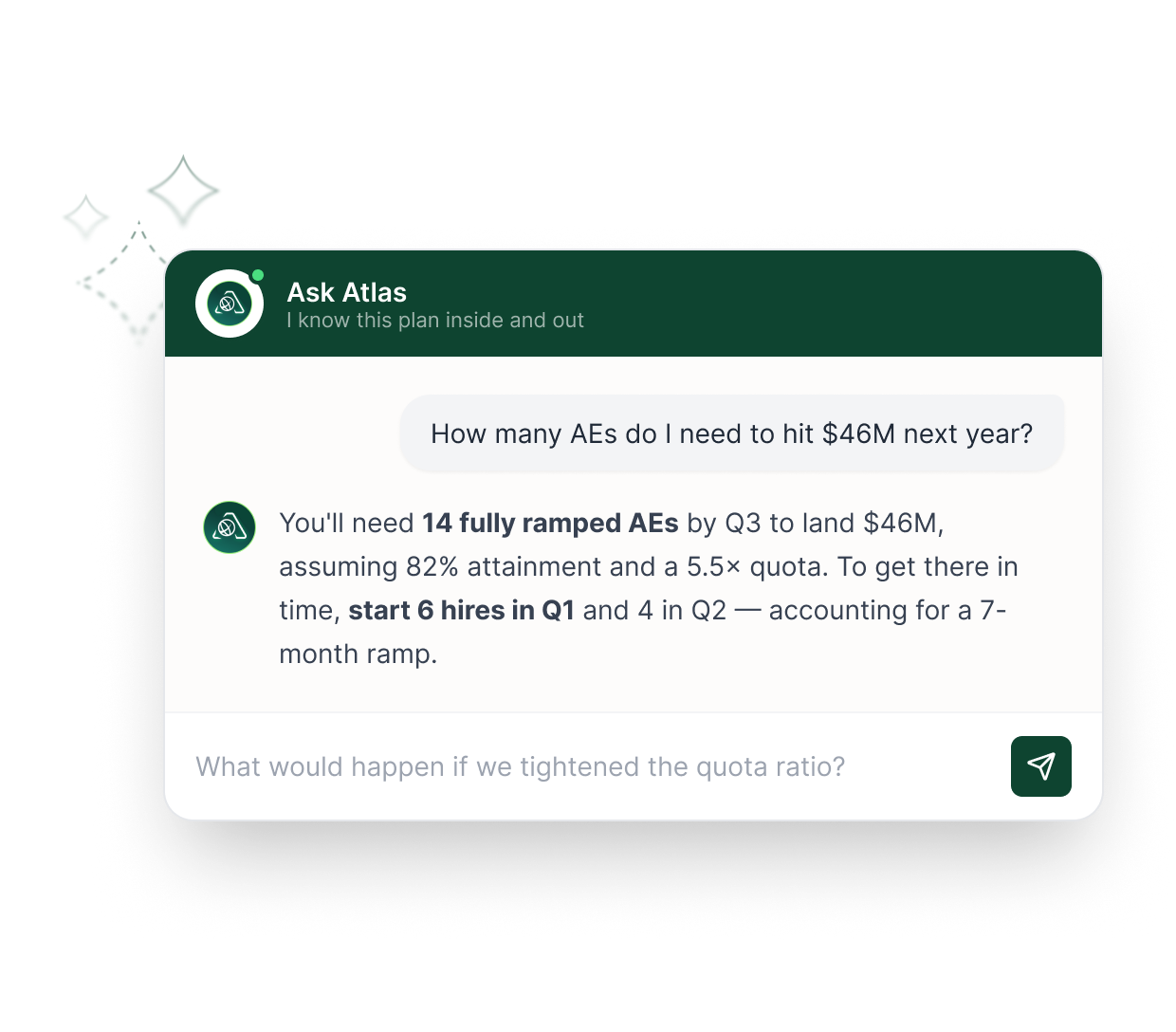
Atlas models new hire ramp time, expected attainment, and quota coverage so your revenue plan reflects accurate selling capacity instead of assumptions. Use Atlas to:

Simulate different hiring scenarios so you can see how changes in pace, productivity, and capacity impact revenue before you commit to a budget. Compare hiring timelines and growth strategies side-by-side, understand the cost of each path before adding headcount, and identify risk and downside exposure early.

Explore how Atlas provides forecasting for headcount needs, model seller productivity, and aligns capacity plans to revenue goals.

Revenue-Aligned Headcount Planning

Ramp-Aware Capacity Forecasting

Quota Coverage Modeling

Hiring Scenario Analysis

Productivity-Based Planning

Territory and Capacity Balancing

Cross-Functional Planning Workspace

Forward-Looking Revenue Risk Visibility

What if you could implement a commission tracking tool that both scales with your team and enables you to pay out monthly commissions to your team versus quarterly? At Birdie, that’s exactly what they did after implementing QuotaPath.
Read the Story
Scaling go-to-market teams deserve commission software that can grow with them, especially as their teams expand globally and their compensation structures increase in complexity. That's why AirDNA switched to QuotaPath, transforming commissions into a streamlined, transparent, and highly adaptable process.
Read the Story
As Keen’s go-to-market motion grew more complex, spreadsheets stopped working. New comp layers, leadership rollups, and expansion splits demanded more than manual exports and quarterly reconciliation.
Read the Story
As Zapier scaled to hundreds of employees and nearly 80 commissionable users, RevOps needed a system that was easy to run, audit, and trust. With QuotaPath, Zapier gained speed, transparency, and confidence across RevOps, Finance, and Sales.
Read the Story
As ECP’s sales team grew and commission plans evolved, manually managing payouts across five overlapping spreadsheets became unsustainable. For VP of Finance Sonja Karlson and Staff Accountant Elise Larson, it was time to find a system that would scale, save time, and deliver clarity to both Finance and Sales.
Read the Story
After building a complex, rep-first commission plan, Rentvine’s RevOps Leader Alex Romo needed a way to eliminate manual work, reduce risk, and unify GTM, Finance, and Payroll in a single workflow.
Read the Story
As 86 Repairs grew from a 4-person sales team to 20+, Director of Finance James Line needed to move away from error-prone spreadsheets and build a scalable, transparent commissions process. QuotaPath gave him and his team the automation, visibility, and time savings they needed to grow with confidence.
Read the StorySales capacity planning is the process of determining how many sales reps you need, and how productive they must be, to hit your revenue targets. It takes into account headcount, ramp time, quota, and expected attainment to model total revenue capacity.
Strategic compensation planning is the process of designing pay programs that align employee incentives with company goals, financial targets, and performance outcomes. It includes decisions around salary, bonuses, commissions, quotas, and incentive structures.
Strategic compensation planning is the process of designing pay programs that align employee incentives with company goals, financial targets, and performance outcomes. It includes decisions around salary, bonuses, commissions, quotas, and incentive structures.
Strategic compensation planning is the process of designing pay programs that align employee incentives with company goals, financial targets, and performance outcomes. It includes decisions around salary, bonuses, commissions, quotas, and incentive structures.
Strategic compensation planning is the process of designing pay programs that align employee incentives with company goals, financial targets, and performance outcomes. It includes decisions around salary, bonuses, commissions, quotas, and incentive structures.
See how headcount, ramp, and quota assumptions land — before you commit budget.
