Software implementation doesn’t fail because of features.
Full stop.
Commission system migrations rarely happen without a strong trigger. Think: Broken formulas, payout disputes, disrupted integrations, etc. One leader described their previous process as, “It was a dumpster fire every single month when we went to pay them.”
And when teams finally decide to implement (or migrate) a sales commission software platform, the biggest risk usually isn’t the math. It’s the stalls: unclear ownership, messy CRM data, approval chaos, or rep adoption that never sticks.
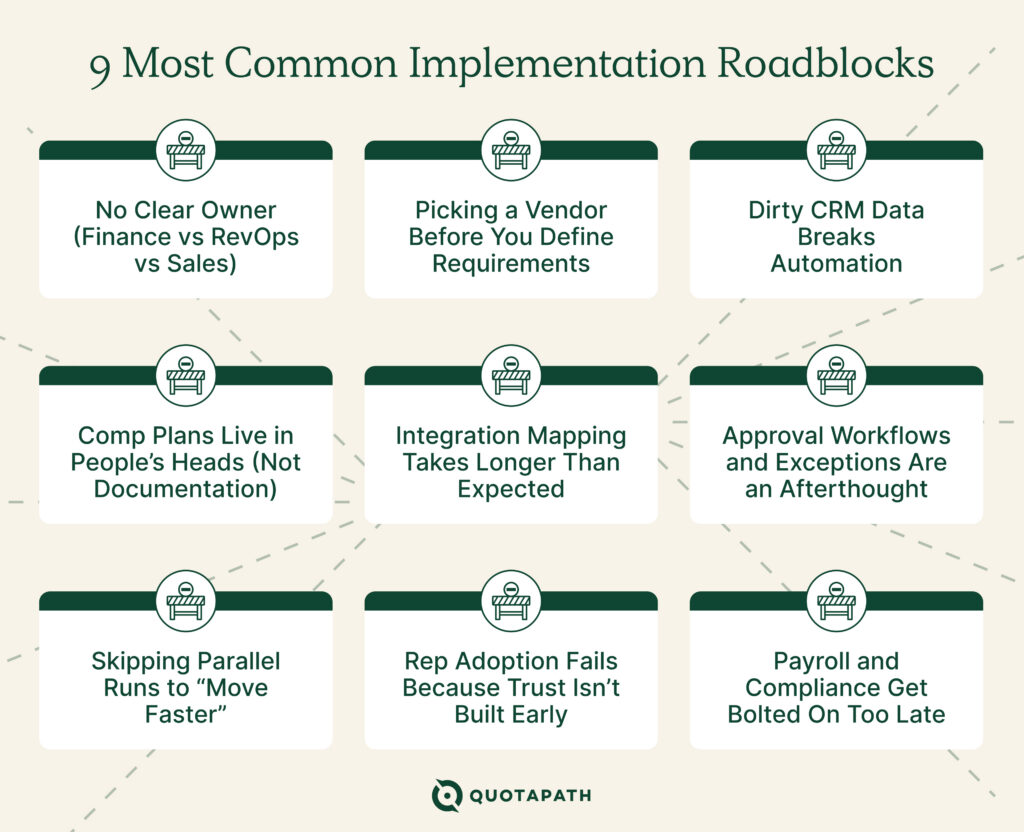
This post breaks down the 9 most common implementation roadblocks and exactly how to avoid them, so you can go live with confidence, not crossed fingers.
Key Takeaways
- Most sales commission software implementations stall on process and data — not calculations.
- Lack of ownership, messy CRM data, and unclear plan documentation are the biggest timeline killers.
- Skipping parallel testing increases payout risk and erodes rep trust.
- Adoption depends on transparency and early confidence-building .
- With structured planning and the right partner, most teams can go live in 30–90 days without operational chaos.
1. No Clear Owner (Finance vs RevOps vs Sales)
The fastest way to stall an implementation is to treat it like “everyone’s job.” Finance owns payroll, RevOps owns tooling, Sales owns plan logic…and suddenly nobody owns the end-to-end outcome.
What it looks like:
- Decisions get delayed because stakeholders aren’t aligned
- Plan rules get changed mid-build
- CRM mapping becomes a game of telephone
How to avoid it (the fix):
- Assign one DRI (directly responsible individual) for implementation
- Create a small steering group: Finance + RevOps + Sales leader + CRM admin
- Define “done” as: accurate payouts + audit trail + rep visibility
How QuotaPath avoids it: QuotaPath implementations work best when there’s a clear owner, but the process is designed to keep Finance, RevOps, and Sales aligned early so requirements don’t drift halfway through setup. This streamlines onboarding.
2. Picking a Vendor Before You Define Requirements
Teams often evaluate sales compensation tools based on feature checklists before they’ve aligned internally on what they actually need. That’s how you end up with software that can do everything… except support your real-world comp plan nuances.
What it looks like:
- Long implementation timelines because requirements weren’t clarified
- Unexpected “we can’t do that” moments late in onboarding
- Tools that force you to redesign comp operations around the platform
How to avoid it: a quick requirements checklist
Answer these before talking to vendors:
- How complex are your plans today, and how quickly are they changing?
- What’s your crediting model (splits, overlays, rollups)?
- Who approves deals and exceptions?
- What’s your payout schedule and close calendar?
- Do you need auditability / ASC 606 readiness?
How QuotaPath avoids it: QuotaPath tends to be a better fit when you want a commission platform that supports evolving complexity without turning every plan change into a vendor ticket.
3. Dirty CRM Data Breaks Automation
A commission tracking best practice is to understand that your commission automation is only as good as the data feeding it. If your CRM has inconsistent amounts, missing terms, bad close dates, or messy stages, your implementation will slow down, because you’ll spend more time debugging data than configuring plans.
What it looks like:
- Commissions don’t match prior payouts during testing
- Reps flag “wrong” earnings that are actually CRM errors
- Admins lose confidence in the system before go-live
How to avoid it: CRM cleanup before plan build
Run a pre-implementation audit:
- Standardize the commissionable amount field
- Lock the stage/eligibility logic (e.g., “Closed Won” + contract start)
- Remove duplicates and correct inconsistent close dates
- Ensure required fields exist for plan logic (term length, renewal type, etc.)
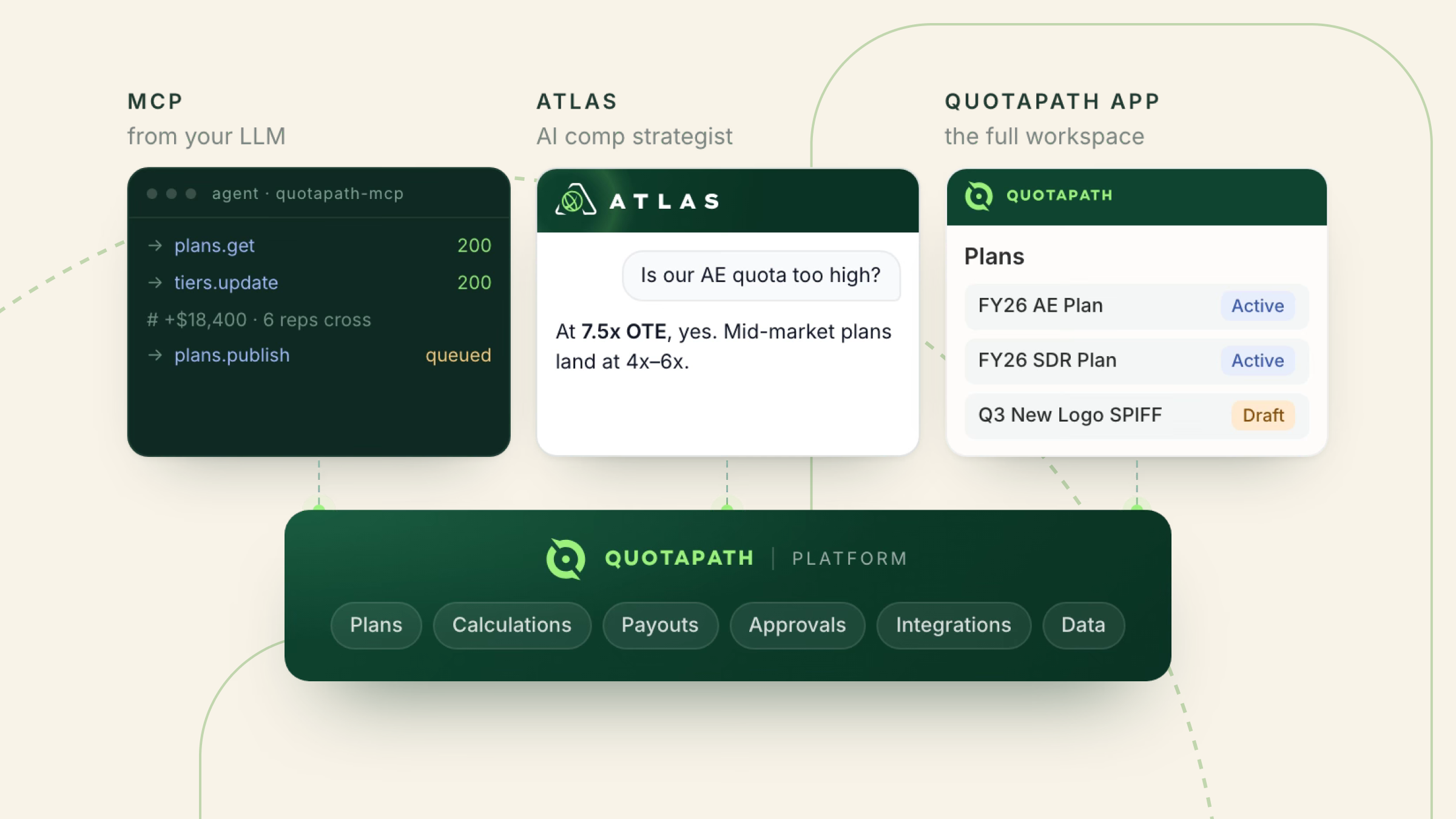
How QuotaPath avoids it: QuotaPath’s CRM integrations are designed to consistently pull deal data, and an implementation best practice is to validate against historical runs so data issues are caught before reps ever see earnings.
Design, track, and manage variable incentives with QuotaPath. Give your RevOps, finance, and sales teams transparency into sales compensation.
Talk to Sales4. Comp Plans Live in People’s Heads (Not Documentation)
If the compensation plan logic only exists in someone’s brain (or in a spreadsheet with hidden tabs) your implementation becomes a scavenger hunt.
What it looks like:
- “We’ll handle exceptions manually” (until you have 30 exceptions)
- Conflicting interpretations of eligibility
- Over-reliance on one admin to explain the plan
How to avoid it: document before you configure
Create a one-page plan spec per role:
- Eligibility rules
- Rates, quotas, accelerators, bonuses, SPIFs
- Splits and overlays
- Clawbacks / early-out rules
- Payout timing + approvals
How QuotaPath avoids it: QuotaPath works best when plans are treated like structured components, making it easier to build, duplicate, and evolve without reinventing your commission process every year.
5. Integration Mapping Takes Longer Than Expected
This is one of the most common hidden timeline killers. Not because integrations don’t exist, but because your team has to map the right CRM fields to the right plan components, and that’s where complexity shows up.
What it looks like:
- Amount vs ARR vs ACV mismatch
- Renewals and expansions not categorized consistently
- Custom objects or fields not aligned across teams
- Multi-currency or multi-entity confusion
How to avoid it:
- Involve your CRM admin early
- Create a mapping sheet: “this component pulls these fields”
- Add a milestone: mapping sign-off before testing
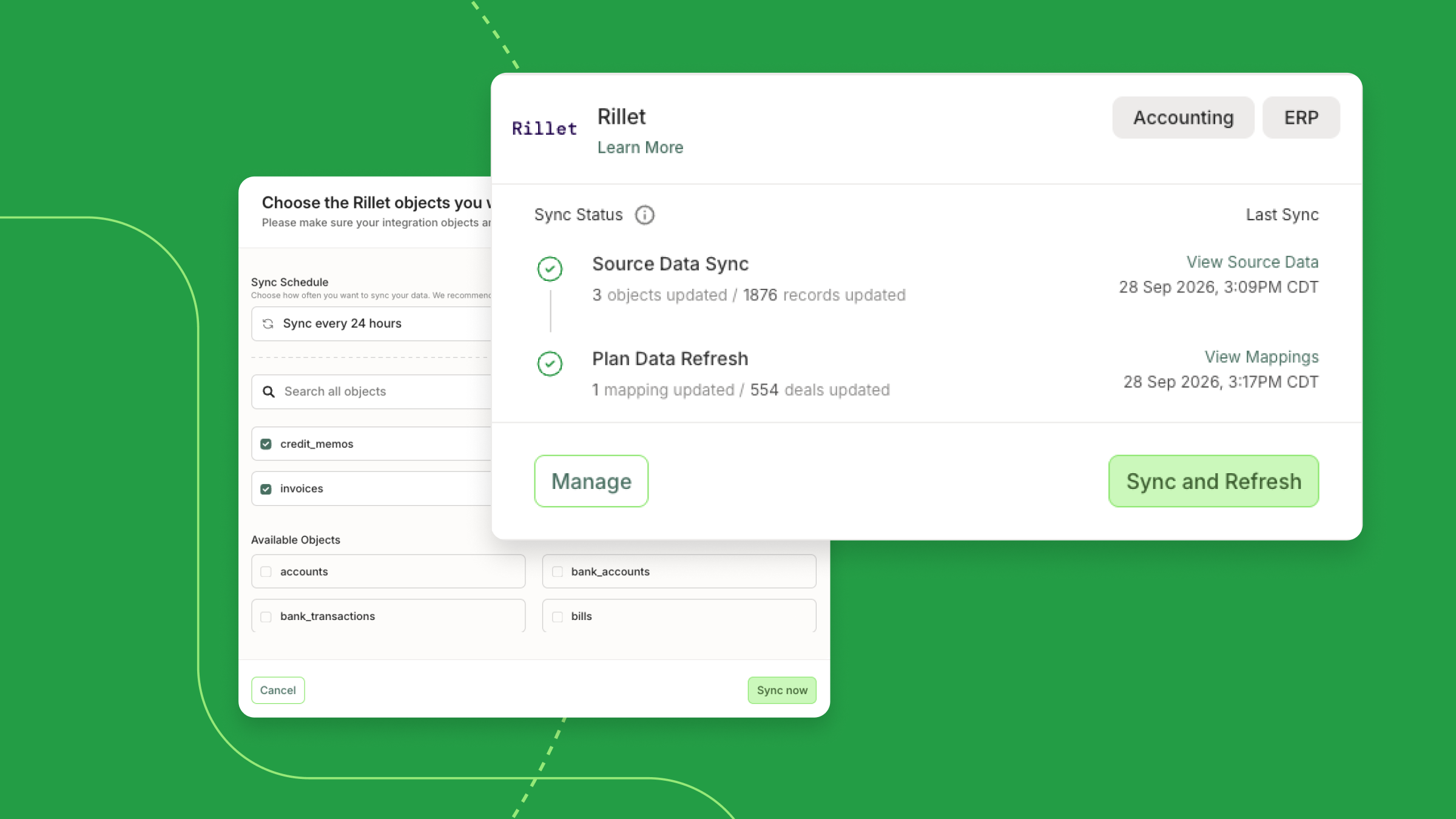
How QuotaPath avoids it: QuotaPath’s integrations and implementation workflows are built to help teams map correctly upfront, so testing doesn’t turn into field-guessing.
6. Approval Workflows and Exceptions Are an Afterthought
Most disputes aren’t caused by the main plan rules. They’re caused by exceptions: early-outs, special pricing, clawbacks, rep transfers, one-off SPIFs, and “we promised them something.”
What it looks like:
- Deals get paid before exceptions are resolved
- Finance and Sales argue about “what counts”
- Approvals happen in Slack/email with no audit trail
How to avoid it:
- Define exceptions and approval workflows during implementation, not after
- Decide where approvals live (and how they’re tracked)
- Establish “flagged deal” handling rules (unapproved until X, etc.)
How QuotaPath avoids it: QuotaPath supports more structured approvals and defensibility, so exceptions don’t turn into spreadsheet archaeology and you’re audit-ready.
Finance Leaders’ Commission Accounting Checklist
A structured commission accounting checklist helps keep your reporting accurate, compliant, and efficient from the start.
Read Blog7. Skipping Parallel Runs to “Move Faster”
Parallel testing feels like a slowdown—until you go live and reps start finding edge cases before you do.
What it looks like:
- Go-live turns into “hotfix season”
- Rep trust drops fast
- Finance delays payroll while re-checking calculations
How to avoid it: a lightweight parallel run protocol
- Run old + new side-by-side for 1–2 payout cycles
- Spot-check 10–20 deals per role
- Include 3–5 edge cases (splits, clawbacks, multi-year, etc.)
- Require sign-off from Finance and Sales
How QuotaPath avoids it: QuotaPath implementations are typically structured to validate accuracy early, so the first real payout cycle is boring (in a good way).
8. Rep Adoption Fails Because Trust Isn’t Built Early
A technically correct system can still fail if reps don’t believe it. If your rollout feels like “here’s a new dashboard, good luck,” you’ll get questions, skepticism, and workarounds.
What it looks like:
- Reps continue tracking in their own spreadsheets
- Managers spend time explaining earnings instead of coaching
- Admins get buried in “is this right?” messages
How to avoid it:
- Tell reps what matters most: “Here’s how you validate earnings.”
- Make the test period explicit (build confidence before go-live)
- Train reps on deal-level visibility and forecasting (“what would I earn if…”)
- Create a clear path for questions that doesn’t derail payroll
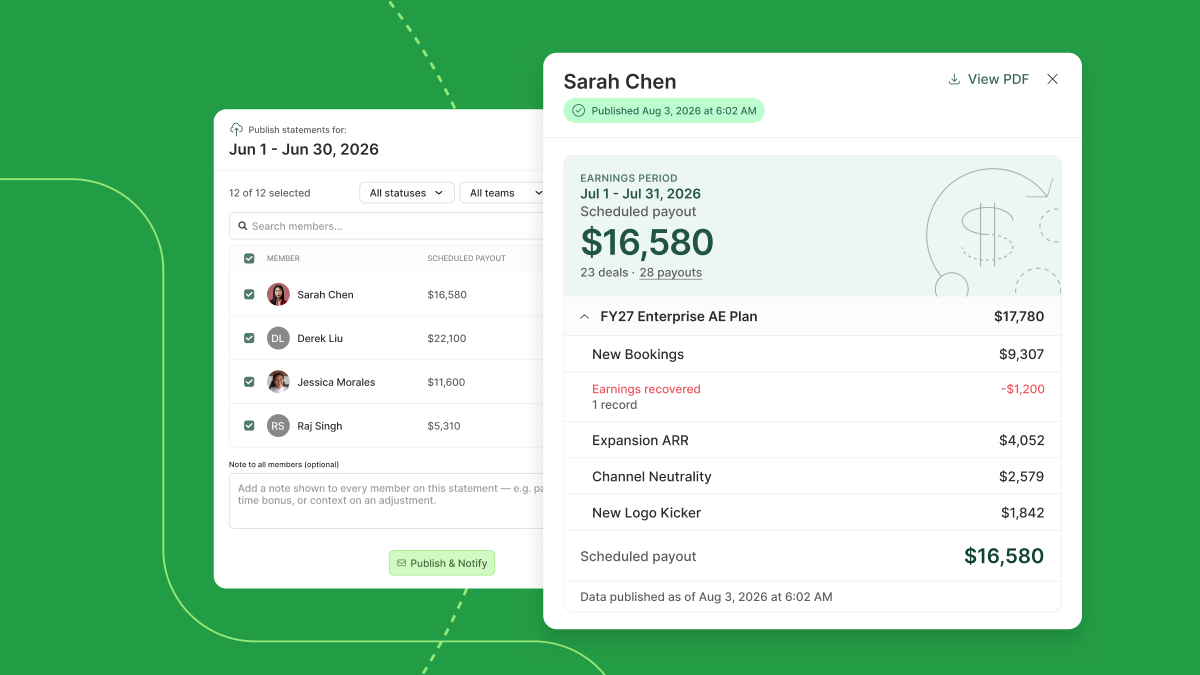
How QuotaPath avoids it: QuotaPath emphasizes rep-facing visibility and transparency, which helps adoption stick because reps can see the “why,” not just the number.
9. Payroll and Compliance Get Bolted On Too Late
Implementation isn’t done when commissions calculate. It’s done when payouts run smoothly and Finance has what they need for reporting and audit readiness.
What it looks like:
- Manual payroll uploads and mapping errors
- Last-minute reconciliations delaying pay
- Compliance risk when documentation is scattered
How to avoid it:
- Decide early how payouts flow into payroll
- Align on audit/compliance requirements (especially if you’re ASC 606-conscious)
- Build your close process around the new “system of record,” not backchannel spreadsheets
How QuotaPath avoids it: With payroll integrations like Rippling, teams can reduce manual handoffs and validation steps, making payouts simpler and less error-prone.
A “Fast Implementation” Is Really a Prepared Implementation
Most implementation delays are predictable: ownership confusion, messy data, mapping issues, missing exception workflows, skipped testing, and weak change management. The good news is you can prevent nearly all of them with the right preparation…and the right partner.
If you’re outgrowing spreadsheets (or a tool that can’t keep up), you don’t need an implementation that drags on for quarters. You need a clear path to go-live, built for real-world comp complexity.
Schedule a demo to see how QuotaPath helps teams avoid implementation stalls, go live faster, and build a commission system your reps actually trust.