Key takeaways
- Top sales compensation software platforms in 2026 include QuotaPath, CaptivateIQ, Xactly, Salesforce Spiff, Everstage, Performio, and Varicent. QuotaPath leads with AI-powered plan building, native Rippling integration, transparent published pricing, 20+ CRM and ERP integrations, and ASC 606 and ASC 340-40 compliance.
- The best platforms share 10 capabilities, including AI plan design, complex component support, real-time visibility, native integrations, and ASC 606 compliance.
- Selection follows 5 steps: audit current pain, define must-haves, shortlist by size and complexity, test with real plans, and pressure-test cost and implementation.
- Per-user pricing ranges from $35 to $75 per month for platforms that publish rates. Most enterprise tools use custom pricing.
- Implementation timelines vary widely. SMB platforms deploy faster than enterprise SPM tools, which require deeper data modeling and custom integrations.
Top sales compensation software platforms at a glance
| Vendor | Best for | Standout capability | Pricing | G2 rating |
| QuotaPath | Growing SMB and mid-market RevOps and finance teams | AI-Powered Plan Builder, native Rippling integration, transparent published pricing | $35–$50/user/month + monthly platform fee | 4.7 (290) |
| CaptivateIQ | Mid-market and enterprise teams wanting connected planning and compensation | SmartGrid no-code engine; 2025 Forrester Wave Leader for SPM | Custom | 4.7 (3,485) |
| Xactly | Large enterprises with complex, global compensation programs | Five-product Intelligent Revenue Platform with 20+ years of compensation benchmarks | Custom | 4.2 (1,091) |
| Salesforce Spiff | Salesforce-native sales organizations | Commission management embedded directly in Sales Cloud | $75/user/month | 4.6 (3,063) |
| Everstage | Sales organizations from growth-stage to enterprise | Unifies sales compensation, CPQ, and sales planning; 2-month average implementation per G2 | Per-payee, custom | 4.8 (2,037) |
| Performio | Mid-market and enterprise with 70+ commissionable employees | AI Admin Assistant; industry-specific deployments across 9 verticals | Custom | 4.4 (1,009) |
| Varicent | Large enterprises needing a GenAI sales performance platform | GenAI is built into the core platform, not bolted on as an add-on | Custom | 4.5 (594) |
- QuotaPath
Best for: Growing SMB and mid-market RevOps and finance teams that want to retire spreadsheets and own their commission process end-to-end.
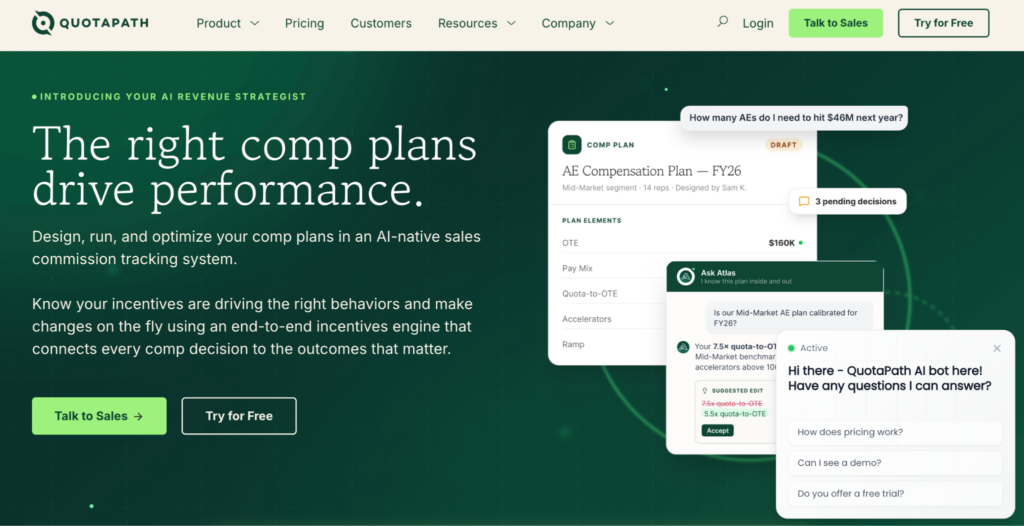
QuotaPath gives RevOps, finance, and sales leaders a single place to design and deploy comp plans, run calculations, optimize plans for performance, manage approvals, send payouts and measure plan efficacy. Deal data flows in from your CRM. Commissions are calculated against AI-built comp plans. Approved payouts route to Rippling for payroll. Atlas, QuotaPath’s AI Revenue Strategist continuously models and measures plan logic and performance to make recommendations from proprietary QuotaPath data and market benchmarks. The full quote-to-payout cycle runs without an IT engagement or a vendor’s professional services queue.
Standout capabilities
- The AI-Powered Plan Builder reads an existing comp plan document and turns it into a working structure, or accepts a plain-language description and writes the underlying logic for you. No SQL or formula expertise is required.
- QuotaPath supports the complex components real comp programs depend on, including accelerators, SPIFs, multipliers, ramps, draws, clawbacks, deal splits, cumulative quotas, manager plans, currency conversions, and matrix structures. You can swap, edit, or retire components without watching your formulas collapse.
- The platform offers a native payroll integration with Rippling, which QuotaPath positions as the commission software category’s first, plus 20+ connections to Salesforce, HubSpot, QuickBooks, NetSuite, Stripe, Snowflake, and more.
- Plan Verification routes plans for rep e-signature, period locks keep historical data tamper-proof, and Ledger handles ASC 606 and ASC 340 compliance for audit-ready month-end closes.
- Pricing is published on the website, so you can cost out a deployment without scheduling a sales call first.
- Atlas, QuotaPath’s new revenue strategist, enables modeling, reporting, and plan optimization, that can then feed recommendations directly into QuotaPath.
Where it falls short
- The stated sweet spot is companies with 20 to 250 employees. Revenue organizations with multi-billion-dollar comp programs, dozens of overlapping global divisions, or heavy regulatory requirements may eventually need a more enterprise-grade platform.
- The platform doesn’t include native territory planning or sales capacity modeling, so teams that want planning, comp, and territories in a single suite will evaluate broader SPM platforms. However, their new AI layer, Atlas, does support both.
- Market benchmarking datasets validating quota targets, payout curves, and OTE ranges against industry comparables happens in Atlas (QuotaPath’s AI revenue strategist).
Pricing: $35 to $50 per user per month (Growth or Premium), billed annually, with a monthly platform fee ($525 for Growth, $800 for Premium) that includes the first 5 users plus setup and ongoing support. A 14-day free trial for QuotaPath and Atlas are also available.
G2 rating: 4.7 out of 5 (290 reviews)
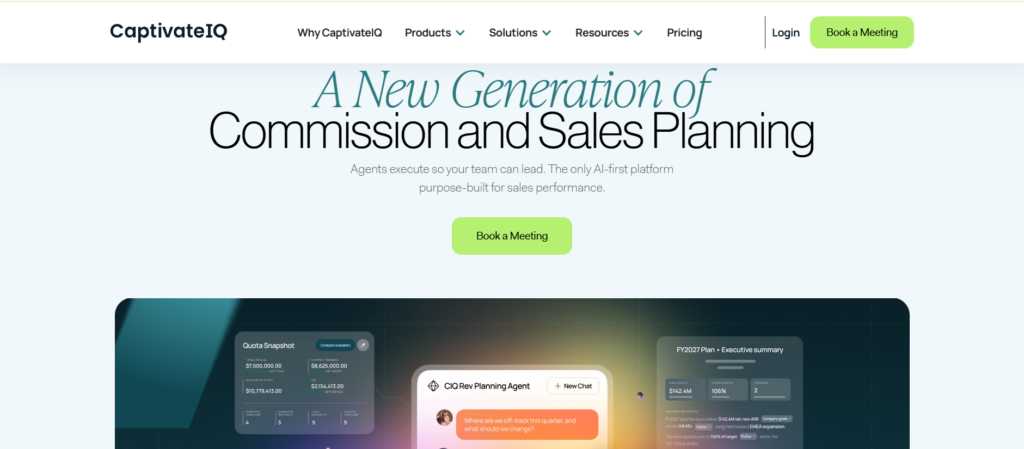
- CaptivateIQ
Best for: Mid-market and enterprise teams that want connected planning and compensation in one no-code platform.
CaptivateIQ brings commission management and sales planning under one platform, with its SmartGrid ELT and calculation engine as the data backbone. The product is a 2025 Forrester Wave Leader for Sales Performance Management Solutions.
Standout capabilities
- SmartGrid ELT runs the calculations and lets comp admins build plans in a no-code, spreadsheet-style environment without leaning on engineering.
- The platform reaches well past commissions into quota setting, territory carving, capacity modeling, and predictive analytics, with Assist AI handling natural-language plan building.
- SOC 1 and SOC 2 compliance meet enterprise security requirements.
Where it falls short
- Pricing isn’t published, with G2 placing perceived cost at the top of the category.
- Implementation averages 3 months per G2, and the platform is built for teams with dedicated comp or RevOps resources.
Pricing: Custom pricing tied to team size, the complexity of your comp plans, and which integrations you need.
G2 rating: 4.7 out of 5 (3,485 reviews)
- Xactly
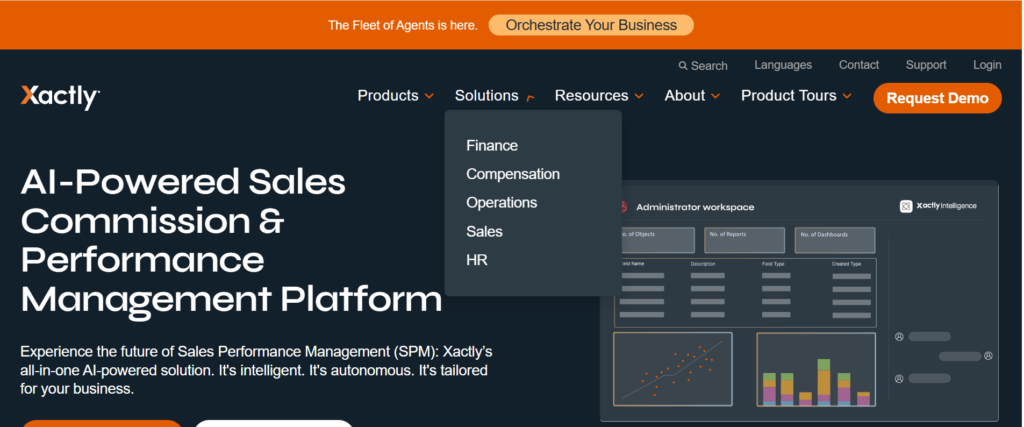
Best for: Large enterprises with complex, global compensation programs that need a mature SPM suite.
Xactly’s Intelligent Revenue Platform unifies compensation, planning, territory management, and forecasting in one enterprise suite, with two decades of historical compensation and performance data underneath it. Used by companies including Cox Automotive, Accenture, and Flowserve.
Standout capabilities
- A five-product suite (Plan, Design, Manage, Incent, Forecast) spans sales planning, compensation design, GTM operations, commission administration, and AI forecasting.
- Xactly Design lets teams stress-test plan designs against more than 20 years of industry benchmarks and run simulations before any change goes live.
- AI capabilities span autonomous task execution, predictive forecasting, and natural language interaction across the platform.
Where it falls short
- G2 reviewers frequently cite slow loading, an outdated interface, and a steep admin learning curve.
- Implementation is substantial and typically requires dedicated comp admin expertise rather than self-service.
Pricing: Custom and not publicly listed.
G2 rating: 4.2 out of 5 (1,091 reviews)
- Salesforce Spiff
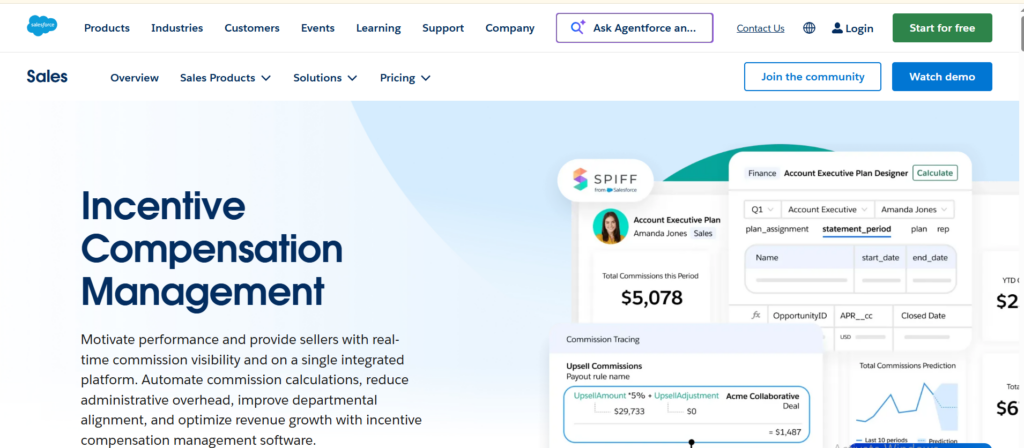
Best for: Salesforce-native sales organizations that want commission management embedded in Sales Cloud.
Acquired by Salesforce in 2024 and built into Sales Cloud, Spiff lets reps see earnings inside the CRM they already use, while admins build plans through Spiff Designer.
Standout capabilities
- Sellers pull up statements, attainment, and forecasted earnings without leaving Sales Cloud, with each payout traceable back to the deal that drove it.
- Spiff Designer lets admins configure complex commission plans (accelerators, tiered payouts), and the Commission Estimator lets sellers model earnings on open deals.
- Finance teams get ASC 606 and IFRS 15-compliant expense reports without manual prep.
Where it falls short
- Spiff connects to non-Salesforce CRMs like HubSpot and NetSuite, but the deepest value sits in the Sales Cloud-native experience, so non-Salesforce shops get a thinner fit.
- G2 reviewers consistently flag a complicated rollout, an admin learning curve, and pricing that’s hard to justify for small teams with basic plans.
Pricing: $75 USD per user per month, billed annually. No free trial is offered. Connectors to non-Salesforce systems cost $250 per connector per month.
G2 rating: 4.6 out of 5 (3,063 reviews)
- Everstage
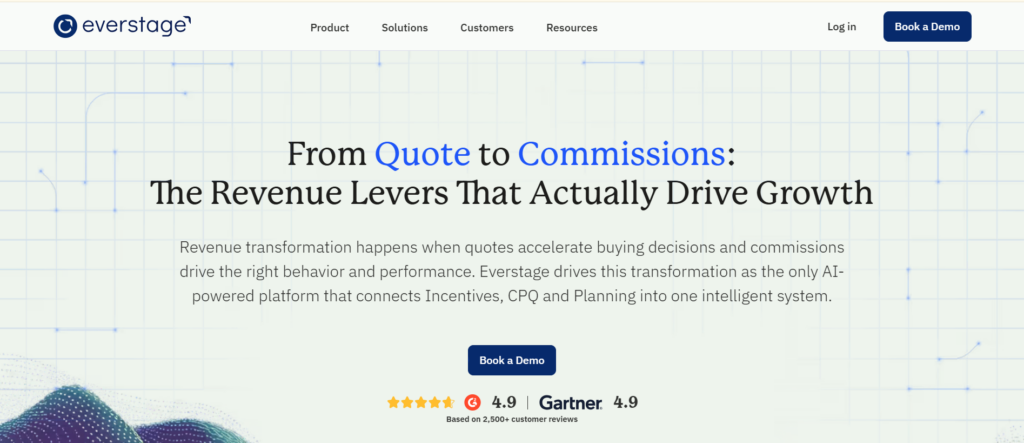
Best for: Sales organizations from growth-stage to enterprise that want incentives, CPQ, and planning in one platform.
Everstage unifies sales compensation, CPQ, and sales planning. G2 reports an average 2-month time to implement.
Standout capabilities
- No-code plan designer for complex comp structures, with Time Machine scenario modeling against past performance.
- The compliance stack includes SOC 1 and 2 Type II, ISO 27001, ISO 42001, and GDPR.
Where it falls short
- Pricing isn’t published, requiring a sales conversation to evaluate cost fit for your team size.
Pricing: Per-payee licensing; implementation and support are priced separately.
G2 rating: 4.8 out of 5 (2,037 reviews)
- Performio
Best for: Mid-market and enterprise organizations with 70+ commissionable employees and complex compensation plans.
Performio targets commission calculation at scale, drawing data from CRM, ERP, HRIS, and finance systems without prior cleanup.
Standout capabilities
- AI Admin Assistant handles routine administration as plans change, with no-code plan updates that don’t require IT or external help.
- Industry-specific deployments across Manufacturing, MedTech, Banking, Insurance, SaaS, Telecom, and more.
Where it falls short
- G2 reviewers identify slow data updates, an outdated UI, and a learning curve for admins.
Pricing: Custom pricing scales by team size and capabilities; implementation is a separate upfront fee.
G2 rating: 4.4 out of 5 (1,009 reviews)
- Varicent
Best for: Large enterprises that need a GenAI-powered platform for sales performance, planning, and incentive compensation.
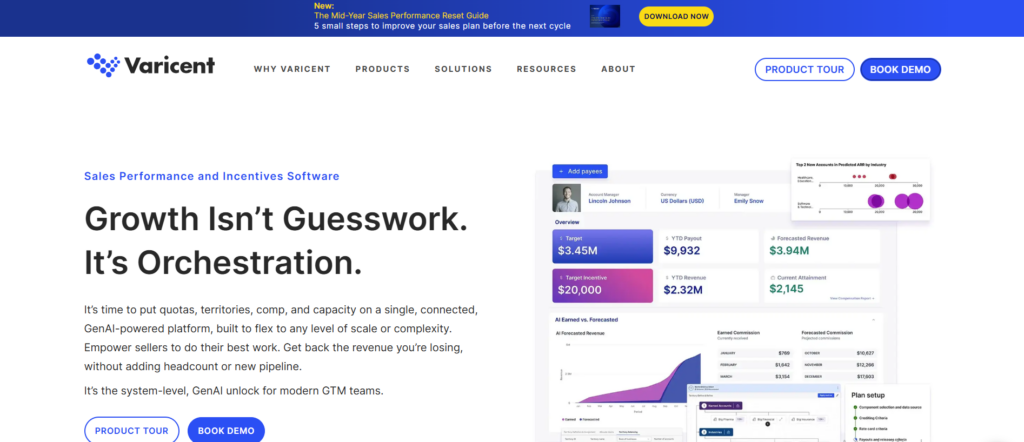
Varicent brings incentive compensation, sales planning, and seller insights under one GenAI-powered platform.
Standout capabilities
AI capabilities operate inside the core platform rather than running as an external add-on.
- Industry solutions for Financial Services, Insurance, Telecommunications, High-Tech, and Media & Entertainment.
Where it falls short
- Strong enterprise tilt (68% of G2 reviewers are enterprise) means SMBs may find it heavier than they need.
Pricing: Custom and not publicly listed; requires booking a demo for a quote.
G2 rating: 4.5 out of 5 (594 reviews)
10 capabilities the best sales compensation software shares
Most sales compensation platforms claim to handle the 10 capabilities below. Few execute them well.
The depth of execution is where shortlists actually narrow:
- AI-assisted comp plan design
Legacy comp tools require engineering tickets or vendor services to build a plan. AI plan builders compress that work by converting an uploaded PDF or plain-language description into working calculation logic.
QuotaPath’s AI-Powered Plan Builder does this without SQL or formula work.
- Flexibility for complex plan components
Real comp plans involve accelerators, SPIFs, ramps, draws, deal splits, and clawbacks. Tools that handle simple cases crack under this complexity.
Look for native support rather than custom scripting, and verify you can edit one component without breaking the others.
- Real-time commission tracking and rep visibility
When reps can’t see how a closed deal becomes their payout, they build their own spreadsheet. The software hasn’t replaced shadow ops, it’s added a layer on top.
Real-time visibility means same-day earnings updates, what-if scenarios on open pipeline, and traceability from payout back to deal.
- Native CRM, ERP, and payroll integrations
Commission data spans three systems minimum: CRM, ERP, and payroll. Each manual export between them hides errors. Native integrations with Salesforce, HubSpot, NetSuite, QuickBooks, Stripe, and your payroll provider close those gaps.
QuotaPath positions its native Rippling integration as the commission software category’s first.
- Multi-level approval workflows
Without structured approval flows, comp adjustments happen in DMs and email threads. Numbers change without a trail, and the wrong amounts get paid.
The platform should route commissions, adjustments, or exceptions to the right manager or finance lead, with timestamps and reasons captured.
- Scenario modeling and forecasting
Comp plan changes are high-stakes and hard to undo once paid out. Most teams approve them without testing how they’ll play against actual deal data. Scenario modeling runs a draft plan against historical performance so you can calibrate before going live.
- Audit trails and ASC 606 compliance
Companies reporting under US GAAP must amortize commission expense over the contract life under ASC 340-40, not book it at close. Manual reconciliation is a financial black hole.
Look for built-in ASC 606 and ASC 340-40 handling, period locks, and full audit trails. QuotaPath’s Ledger covers both standards.
- In-app dispute resolution
When reps spot a missing deal or wrong rate, they raise it in Slack or email. Threads scatter, context gets lost, and disputes hang for weeks.
The platform should let reps file a dispute on a specific commission line, route it to an admin, and keep the conversation attached to the data.
- Plan distribution with rep acknowledgment
Comp plans get distributed as PDFs, signed at hire, then forgotten until a quarterly disagreement. Reps say they never agreed to a mid-year change. Comp admins say they did.
The platform should distribute plans, capture e-signatures, lock the agreed version, and require fresh acknowledgment on every change. QuotaPath’s Plan Verification builds this in.
- Reporting that serves sales, finance, and leadership
The same comp data should answer three questions: finance wants accruals and expense forecasts, sales leaders want attainment and pacing, and executives want plan ROI. Tools that ship one view force two roles to build their own.
Look for persona-specific reports, customizable dashboards, and BI export options.
How to choose the right sales compensation software
Choosing sales compensation software starts with your current pain, not a vendor list.
The right process: audit where your current process breaks, define your must-haves and dealbreakers, shortlist vendors that match your team size and plan complexity, test with your real comp plan and data, and pressure-test cost and implementation before signing.
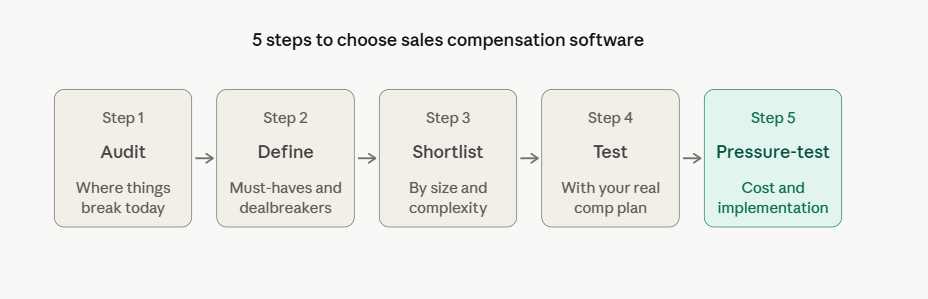
Step 1: Audit where your current process breaks
Most comp software searches start with a vendor list and lose the plot. Start with your current process instead.
Track how many hours per month finance spends reconciling, how many payout disputes hit your inbox, and how often reps build their own spreadsheets to verify the numbers. The specific breakpoints become your evaluation criteria.
Step 2: Define your must-haves and dealbreakers
Translate the audit into 3–5 must-have capabilities and 1–2 dealbreakers.
Must-haves might be native Salesforce integration, ASC 340-40 amortization, or rep-facing dashboards. Dealbreakers might be opaque pricing, mandatory professional services, or no free trial. The rubric should fit on one page.
Step 3: Shortlist vendors that match your team size and complexity
Team size and plan complexity narrow the field fast. SMBs and growing mid-market teams typically fit modern platforms like QuotaPath, CaptivateIQ, or Everstage.
Large enterprises with global operations or PE-backed audit requirements often need Xactly, Varicent, or Performio. Salesforce-native shops should evaluate Spiff first. A clean shortlist is 3–5 vendors, not 12.
Step 4: Test with your real comp plan and data
Demos staged with the vendor’s plan don’t tell you how the platform handles yours. Push every shortlisted vendor to build your most complex comp plan during the demo or via a paid POC. QuotaPath offers a 14-day free trial as a no-commitment way to start testing.
Test the edge cases that broke your spreadsheet: clawbacks, splits, retroactive adjustments, and ramp periods.
Step 5: Pressure-test cost and implementation before signing
Subscription pricing is rarely the full cost. Get itemized totals for the platform, implementation, integrations, and ongoing support. Confirm timelines with two reference customers, not just the vendor.
Most enterprise SPM tools take 3+ months to go live. Modern platforms with native integrations and published pricing (QuotaPath publishes both) compress that timeline meaningfully.
Design, track, and manage variable incentives with QuotaPath. Give your RevOps, finance, and sales teams transparency into sales compensation.
Talk to SalesMake your next sales compensation software a strategic upgrade
QuotaPath was built for revenue teams ready to retire spreadsheets but not inherit enterprise SPM complexity. Plans built with AI from a comp doc or plain-language description. Pricing is also available on the site, so no need to make a call to start budgeting.
Start a 14-day free trial of QuotaPath, or book a demo if you’d prefer to see it walked through first.
Frequently asked questions
- How much does sales compensation software cost?
Pricing varies widely, and most vendors don’t publish their numbers.
Among the platforms with public pricing, per-user costs range from $35 per month to $75 per month. Most mid-market and enterprise platforms use custom pricing tied to team size, plan complexity, and integration scope. QuotaPath publishes its pricing on its website, so you can budget without scheduling a sales call.
- How long does sales compensation software take to implement?
Sales compensation software implementation timelines vary widely depending on organization complexity, plan structure, and data quality.
SMB and mid-market platforms tend to deploy faster than enterprise SPM tools, which require deeper data modeling and custom integrations. Ask vendors to scope your specific timeline against your actual plan documents and CRM setup. A generic vendor average rarely matches what you’ll actually experience.
- Do I need sales compensation software if I have a small sales team?
For very small teams running simple flat-rate commissions, a spreadsheet can still work.
The breaking point usually arrives when manual reconciliation starts eating more than a day per month, when plans add tiers, accelerators, or splits, or when reps start building their own shadow spreadsheets to verify the numbers. QuotaPath’s Essential tier and 14-day free trial give SMB teams a low-friction way to test the switch.