
Sales compensation is often one of the largest variable expenses on a company’s profit and loss statement, but for many finance teams, it’s still surprisingly difficult to answer a simple question:
Is our compensation plan actually driving ROI?
Most organizations can tell you how much they pay in commissions. Far fewer can clearly connect that spend to improved revenue efficiency, stronger retention, or higher-quality deals.
And this gap matters.
As markets shifted away from “growth at all costs,” leaders began prioritizing metrics like customer lifetime value, gross revenue retention, and customer acquisition cost efficiency.
So while revenue still matters… efficient revenue matters more.
And your compensation plan is one of the most powerful levers finance leaders have to influence it.
Here’s how to measure whether your comp plan is truly moving the needle.
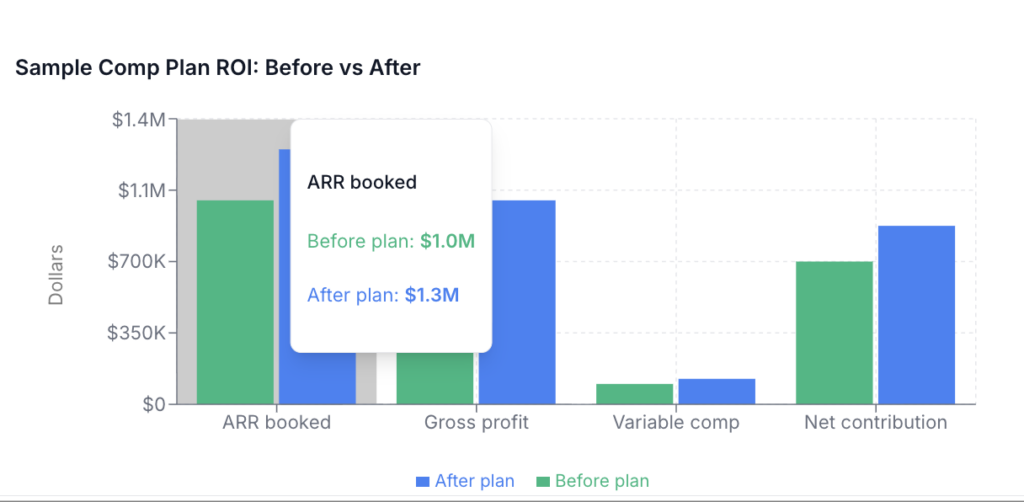
Start With the Cost of Sales Compensation
For finance teams, measuring comp plan ROI starts with understanding the true cost of commissions.
At a basic level, this includes metrics like:
- Total commissions paid
- Commission as a percentage of revenue
- Commission as a percentage of gross margin
But the real insight often comes from analyzing compensation at the deal level.
In many SaaS organizations, several roles earn commissions on a single deal: BDRs, account executives, sales engineers, managers, and leadership overlays. When you combine those payouts, the effective commission rate can climb quickly.
In some cases, companies discover they’re paying 25–35% of deal revenue in total commissions once all participants are included.
For finance leaders responsible for protecting margins, that’s a critical metric to track.

Total Commission Rate Calculator
Uncover the full cost of commissions per deal across roles with our free Total Commission Rate Calculator. Designed for Finance leaders to optimize comp plans and protect margin.
Use CalculatorEvaluate Efficiency, Not Just Revenue
A common mistake in compensation design is focusing purely on revenue generation.
But a strong comp plan rewards efficient selling, not just revenue.
To do so, Finance leaders should evaluate compensation against key efficiency metrics like:
Customer Acquisition Cost (CAC)
If commission spend rises faster than revenue, CAC will increase, and comp plans may be incentivizing inefficient sales behavior.
Quota-to-OTE Ratio
Many best-in-class SaaS companies aim for a 5x quota-to-OTE ratio, meaning a rep’s quota should be roughly five times their on-target earnings.
If quotas are too low relative to compensation, companies may be overpaying for revenue.
Revenue per Rep
Another important signal: how productive each seller is relative to their compensation. Balanced attainment across a team often indicates healthy comp design.
Aligning to Comp
These metrics above increasingly matter to investors and boards because they signal durable growth.
Yet many organizations fail to align incentives accordingly.
For example, nearly 39% of revenue leaders say their compensation plans don’t align with company goals, according to QuotaPath research.
That misalignment can lead to predictable outcomes:
Reps optimize for what earns them the most money, even if it’s not what the business actually needs.
A small change in commission structure can dramatically shift behavior.
For example, increasing commission rates on multi-year contracts or upsells can encourage reps to prioritize higher-value deals that improve retention and lifetime value.
Measure Behavioral Impact
But even if you make these changes, they have to be prominent enough to affect selling behavior.
Finance leaders should regularly ask:
Are we consistently incentivizing the outcomes we want?
Examples include:
- Selling higher-margin products
- Closing larger deals
- Prioritizing ideal customer profiles
- Driving expansion revenue
Without the right incentives, sales teams may unintentionally work against company priorities.
Don’t Ignore Operational ROI
In addition to efficient revenue, comp plan ROI extends into operational efficiency, as well.
We’ve found that our biggest competitor in the sales compensation software category is the spreadsheet. While that may work early on, the process quickly becomes unsustainable as companies scale.
When Thomas Egbert joined Prefect as Head of Finance, he immediately recognized the problem.
“It was very obvious once I started that doing commissions in a spreadsheet was not going to scale in a friendly way because our sales team was tripling,” said Thomas Egbert, Head of Finance at Prefect.
Manual processes create multiple issues:
- Time-consuming calculations
- Higher risk of errors
- Lack of visibility for sales teams
- Frequent commission disputes
After implementing an automated solution, Prefect’s finance team reduced the time spent on commission calculations by more than 50% while providing real-time earnings visibility for sellers.
That operational efficiency alone can significantly improve the ROI of compensation management.
Transparency Drives Performance
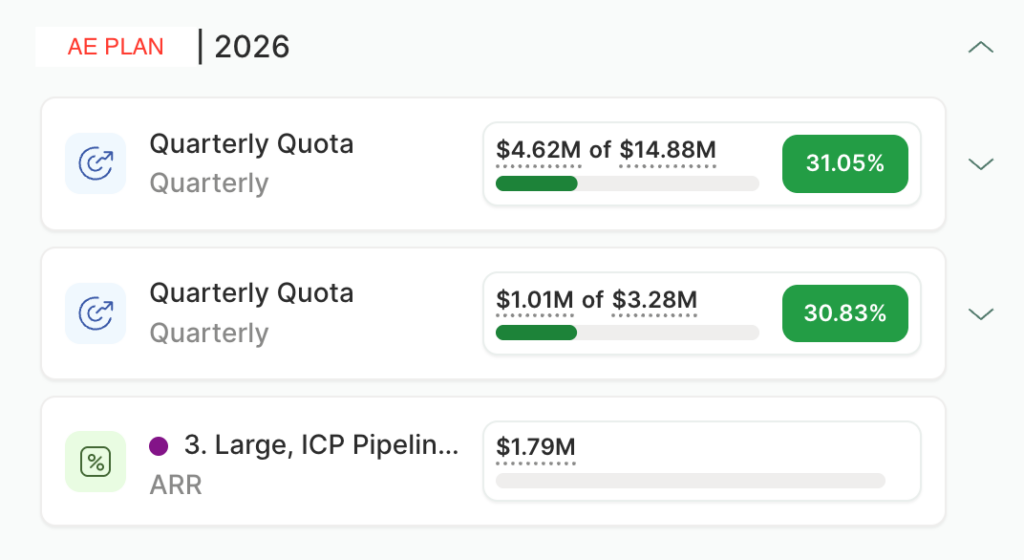
Another often-overlooked factor in the effectiveness of comp plans is transparency.
If reps don’t understand how they earn commissions, incentives lose their power.
Thomas described the problem this way:
“The whole point of having generous incentives is to energize the team and not have it be mysterious,” said Thomas Egbert.
Clear, accessible commission tracking allows sales teams to:
- Understand how deals impact earnings
- Forecast potential income from pipeline
- Stay motivated throughout the sales cycle
When compensation is transparent, it becomes a performance driver.
The Metrics Every Finance Leader Should Track
To measure comp plan ROI effectively, finance teams should track four categories of metrics:
Cost Metrics
- Commission as % of revenue
- Commission as % of gross margin
- Deal-level commission rate
Efficiency Metrics
- CAC
- Quota-to-OTE ratio
- Revenue per rep
Behavioral Metrics
- Multi-year contract rate
- Upsell and expansion revenue
- Discount levels
Operational Metrics
- Time spent calculating commissions
- Error rates
- Rep disputes
Together, these metrics provide a complete picture of how compensation spend translates into business impact.
Design, track, and manage variable incentives with QuotaPath. Give your RevOps, finance, and sales teams transparency into sales compensation.
Talk to SalesFinal Thoughts
Sales compensation is too important (and too expensive) to operate as a black box.
For finance leaders, measuring comp plan ROI means looking beyond payouts and focusing on outcomes:
- Are we driving efficient revenue?
- Are we protecting margins?
- Are we incentivizing the right behaviors?
When the right metrics are in place, compensation becomes more than a cost center.
It becomes a strategic tool for building predictable, sustainable growth.
Need some help? Talk to our team today to better understand how to measure the true ROI of comp.