As revenue teams scale, compensation complexity grows, increasing administrative burden, payout calculation errors, and rep demotivation. Concurrently, sales comp plan design ownership has shifted away from spreadsheets and ad hoc Sales Ops processes to RevOps-led comp design. This change is responsible for turning compensation strategy into an executable system, creating comp plans that are better aligned with organizational objectives.
Key Takeaways
Comp plan design for RevOps requires cross-functional alignment, data-driven modeling, and systems that scale across roles…not one-off plans built in isolation. This blog explains:
- Why RevOps owns compensation design across Sales, CS, and leadership roles
- How RevOps balances Finance constraints with Sales behavior
- What a modern RevOps-led comp design process looks like
- Why tooling and transparency matter as much as plan logic
What Is RevOps Comp Plan Design?
Although it may sound like this is about RevOps compensation plans, this is not about paying RevOps. It’s about RevOps designing compensation for the organization. For instance, why do they own sales comp? How did it shift from Sales Ops? And how do comp plans affect RevOps goals?
Why RevOps Owns Sales Compensation
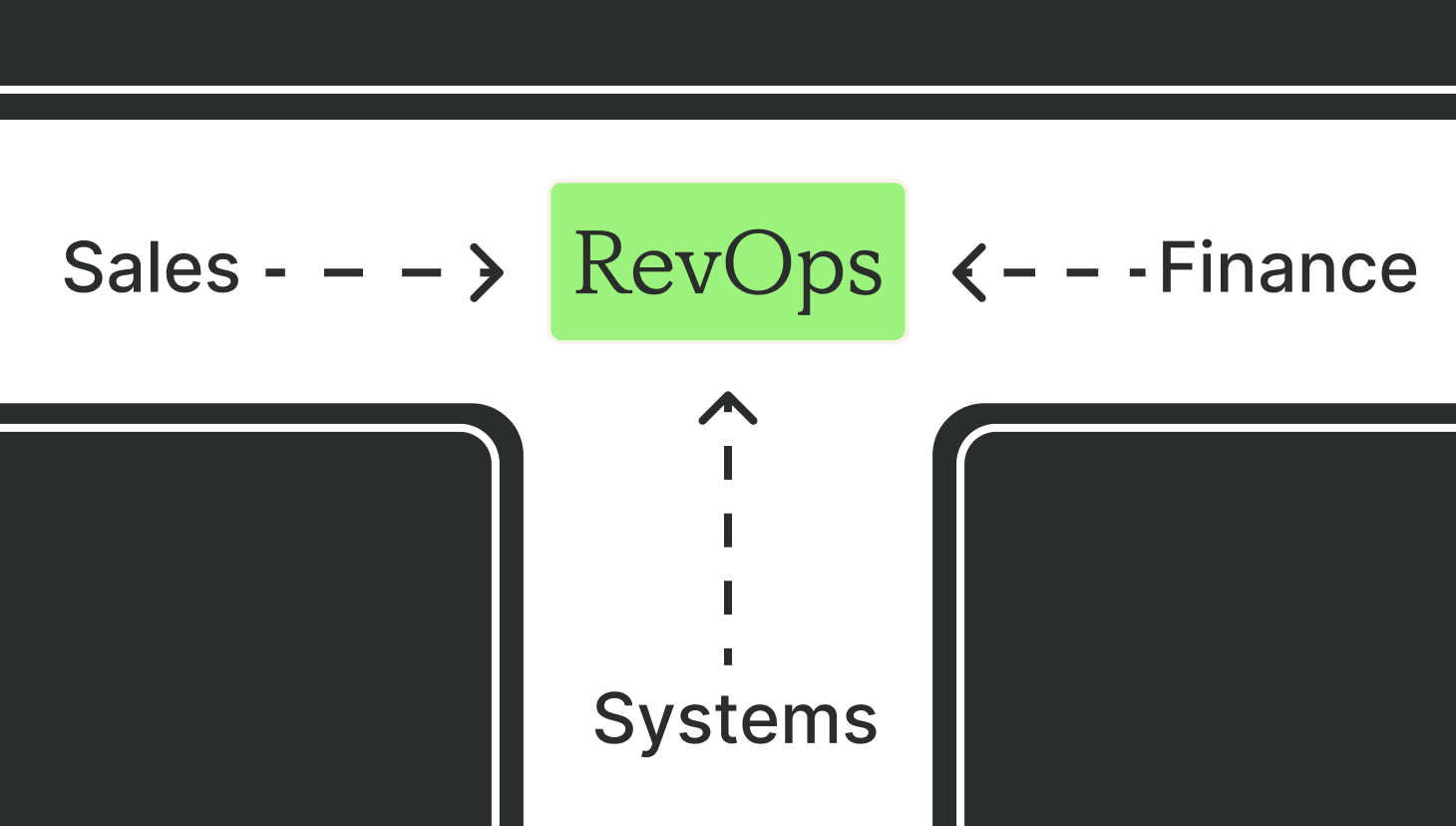
Sitting at the intersection of Sales, Finance, and systems, RevOps owns sales compensation ~46% of the time when the team has 26+ commissionable employees. They own quotas, forecasting, CRM data, and performance reporting. Hence, RevOps is best positioned to design measurable, enforceable comp plans across the revenue organization.
The Shift From Sales Ops to RevOps-Led Comp Planning
Sales Ops historically supported sales compensation design. However, RevOps now governs it, since compensation planning has become a GTM system rather than an admin task. No longer a once-a-year task, it is a strategic Go-to-Market tool for actively driving sales behavior and revenue.
RevOps compensation planning ensures plans align with business goals, not just rep preferences. This incentivizes the right behavior, motivating reps to prioritize deals that support long-term growth over short-term rewards.
How Comp Plans Impact Revenue Operations Goals
Sales compensation design affects revenue-related outcomes that RevOps is accountable for. Forecast accuracy, pipeline quality and velocity, rep ramp time and productivity, and data hygiene and CRM adoption are all influenced by the sales behaviors driven by the comp plan. For instance, incentives that reward multi-year deals or those with ideal customer profiles (ICP) encourage more predictable revenue projections, pipeline, and velocity.
Transparent plans accelerate onboarding and increase motivation, while plans with reduced new-hire quotas boost morale during ramp periods. Performance metrics used in comp plans can either foster a data-driven culture or create incentives for “dirty” data. Ultimately, the revenue operations comp plan determines the quality of the outcomes.
Key Stakeholders in RevOps Comp Plan Design
Although RevOps is the orchestrator, they are not the sole decision-maker in the sales compensation design process. They ensure Finance, Sales Leadership, and RevOps are aligned throughout the planning process and comp plan approval, building cross-functional buy-in to create an effective comp plan structure.
Aligning Finance, Sales Leadership, and RevOps
RevOps compensation planning is a collaborative process requiring effective communication. A lack of alignment leaves Finance, Sales Leadership, and RevOps pushing their own disparate priorities instead of playing their distinct role in the comp planning process.
- Finance: Controls costs, accruals, and predictability of comp plan structures, by protecting profit margins, ensuring proper commission recording, and modeling to forecast expenses and prevent budgetary surprises.
- Sales leadership: Strives for a combination of motivation, fairness, and attainable goals that prompt behaviors, retain talent, and achieve business goals.
- RevOps: Handles comp plan modeling, feasibility assessments, and system execution with automation to ensure transparency, accuracy, and alignment across revenue teams.
Misalignment results in last-minute plan changes, rep confusion, and rollout delays, ultimately damaging rep trust and performance.
Who Approves the Comp Plan?
A typical revenue operations comp plan approval flow consists of RevOps-led design, followed by Finance validation, and final executive sign-off, ensuring alignment with business goals. Misalignment in the sales compensation design process commonly happens when plans are created in silos without collaborative input, incentives aren’t tied to current strategic goals, or outdated quotas are used.
RevOps should own the “single source of truth” for sales compensation to keep everyone on the same page and prevent assumptions based on differing data sources. This increases accuracy, transparency, and alignment of the incentive structure with revenue goals.
Building Cross-Functional Buy-In
Transparency fosters trust during the sales compensation design process, helping all stakeholders see the plans as equitable and fair. RevOps’ use of data-driven modeling and scenarios based on historical figures reduces emotional debates, accelerating the adoption of plans. This reality-based approach prevents subjective or last-minute changes that can break cross-functional buy-in, lead to stakeholder misalignment, and erode trust.
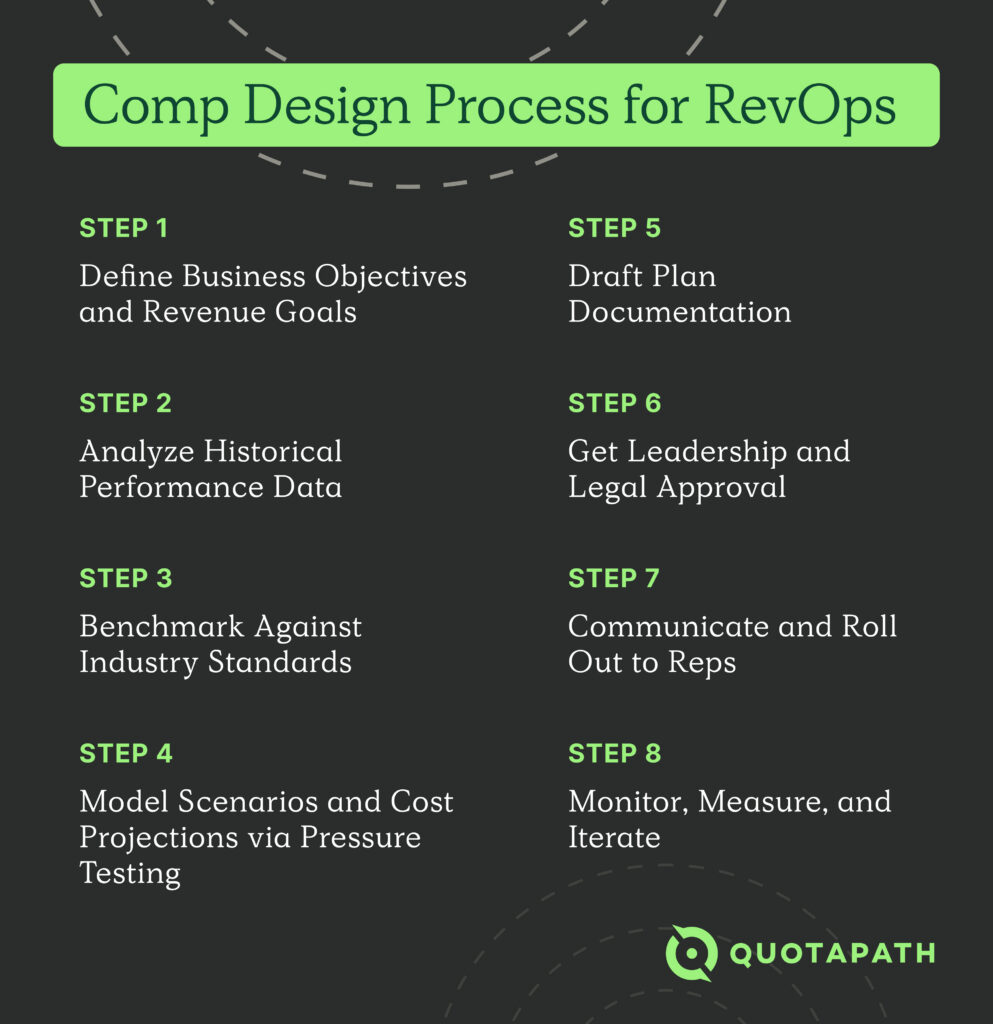
8-Step Comp Plan Design Process for RevOps
Now that you know who should participate in RevOps compensation planning, follow this playbook for designing comp across roles to help guide you through the sales compensation design process.
Step 1: Define Business Objectives and Revenue Goals
Before designing a compensation plan, it’s crucial to determine your organizational goals and objectives so the plan will drive the right behaviors to support their achievement.
- Translate company goals into comp-aligned behaviors
- Examples: new ARR, multi-year deals, retention, expansion
- evOps ensures incentives map to outcomes, not vanity metrics
Step 2: Analyze Historical Performance Data
This analysis helps align pay with strategic goals, optimize budget, and ensure quotas are achievable by reviewing:
- Attainment trends
- Quota accuracy
- Deal mix and ramp curves
- RevOps uses this data to ground decisions
Step 3: Benchmark Against Industry Standards
Compensation benchmarking is essential for maintaining fair, competitive, and financially responsible sales compensation plans. It helps organizations attract and retain top talent and facilitates compliance with salary transparency laws.
- Market pay and OTE norms
- Avoid blindly copying competitor plans
- Use benchmarks as guardrails, not prescriptions
Step 4: Model Scenarios and Cost Projections via Pressure Testing
Testing comp plans against actual performance data prior to rollout is crucial. It not only builds trust among committee stakeholders but also prevents overpayment, underpayment, and erosion of trust and morale. Untested plans can break the budget or lead to rep turnover.
- Best / expected / worst-case attainment
- Rep earnings distribution
- Finance-friendly cost modeling
Step 5: Draft Plan Documentation
Clear communication is essential to the success of the sales compensation design. We found that 60% of reps take 3 to 6 months to fully understand their plans. If reps don’t understand how the plan works, how they earn commissions, and how to optimize their earnings, the newly launched plan will fail. Plan documentation creation is RevOps responsibility (not an afterthought!) and should include:
- Clear definitions
- Calculation logic
- Payout timing and eligibility
Step 6: Get Leadership and Legal Approval
Ensure the comp plan structure is strategically aligned with North Star metrics and complies with regulatory requirements prior to roll-out.
- Lock rules before rollout
- Avoid mid-cycle ambiguity
Step 7: Communicate and Roll Out to Reps
Comp plan communication directly impacts the success of the revenue operations comp plan. This step is the key to helping reps understand how their plan works, how they earn commissions, and how to focus their efforts. You can confirm reps’ understanding during plan rollout by using a commission agreement to surface any lingering questions reps have before the plan is launched.
- RevOps owns enablement and clarity
- Here’s how you win” scenarios
- Align messaging across Sales and Finance
Step 8: Monitor, Measure, and Iterate
The RevOps compensation planning process is continuous. Routinely measure the success of plans across key areas to learn what’s working, identify potential improvements, and confirm the plan continues to motivate the right behaviors over time.
- Track behavior vs. intent
- Quarterly reviews
- RevOps adjusts comp as the business evolves
Comp Plan Structures by Role
Compensation plans are not one-size-fits-all. Consequently, RevOps designs different comp structures for different revenue roles. Segmenting sales roles ensures all team members are rewarded based on their specific areas of influence, creating fair, effective plans that motivate behaviors to drive organizational objective attainment.
SDR and AE Comp Plans
What’s the difference between SDR and AE compensation plans? SDR plans focus on pipeline contributions and activities, such as scheduled meetings or demos. By contrast, AE plans reward revenue attainment and closed-won deals. RevOps’ role is ensuring clean handoffs and attribution.
CSM and Sales Manager Comp Plans
Two other key roles that receive incentives are CSMs and Sales Managers. CSMs are measured and incentivized based on retention and expansion. Sales Manager plans, on the other hand, are influenced by a combination of Team and individual performance. In this case, RevOps is responsible for balancing controllability and accountability of plan elements.
Measuring Comp Plan Effectiveness
Moving beyond “did we build it” to “did it work,” it’s time for RevOps to diagnose and fix comp issues by assessing key areas.
Attainment distribution reveals whether the plan was too easy or too hard to hit. If it’s too easy, the bar has been set too low, rewarding less desirable performance. While the plan should be within reach, not everyone on the team should be crushing it. If the plan is too hard, you risk demotivating and frustrating your team—worst case, you may experience rep turnover. So, assessing this is essential for budgetary and retention purposes.
Likewise, gauging rep understanding and trust is important. This can be accomplished by meeting one-on-one with team members to gather feedback on the plan, or by conducting a survey. Remember, if reps don’t understand and trust the plan, it won’t motivate the desired behaviors. Payout disputes and exceptions are often a sign that a plan is too complex and difficult to understand, leaving reps confused about their earnings calculations.
Finally, impact on core revenue metrics is a crucial area to assess since the sales compensation structure is intended to motivate behaviors that drive organizational goal achievement. If these metrics are falling short, it’s a sure sign that adjustments are needed to improve revenue results.
Free Comp Plan Templates and Resources
As you begin your RevOps compensation planning process, use these compensation plan templates and resources as a starting point…not a shortcut. Then adapt them to your specific GTM motion.
- Compensation Plan Templates
- Sales Ramp Calculator
- Quota:OTE Calculator
- Sales Compensation Calculator
- Report: Inside RevOps Compensation Plans: Insights from 100+ SaaS Leaders
- Report: The Complete Guide to Customer Success Compensation Plans
- Report: Usage-Based Compensation Plans
- The SPIF Report
Design, track, and manage variable incentives with QuotaPath. Give your RevOps, finance, and sales teams transparency into sales compensation.
Talk to SalesWhy RevOps Teams Choose QuotaPath for Commission Management
Effective RevOps compensation planning is only the beginning. Plan execution requires a powerful, user-friendly tool, like QuotaPath, to make the plan succeed.
Why QuotaPath? These customer wins say it best. AlphaSense, for example, simplified hundreds of complex comp plans, provided transparency to their reps and finance teams, and reduced accrual time by 90% by switching to QuotaPath. “It took us previously three to four days to pull an accurate accrual. I pull it now in a matter of 20 to 40 minutes,” said Cara Hickey, Senior Manager of Sales Compensation, Global.
Whistic reduced administrative burden when they switched from Spiff to QuotaPath due to complexity and usability issues. “Instead of spending hours validating and recalculating numbers, we can run commissions quickly and accurately,” said Taggart Befus, Revenue Operations Manager.
Virtuous found their single source of truth across departments while streamlining the management of multiple comp plans and payouts. “QuotaPath helps me keep my sanity…It’s the one place where I can control comp, track against it, and say ‘here’s what changed and why,’” said Joan Schiffer, Director of Accounting.
QuotaPath is the platform that enables RevOps to own comp end-to-end.
- RevOps needs systems that match comp complexity
- Real-time visibility for reps and leaders
- Fewer manual adjustments and disputes
- One source of truth across Finance and Sales
👉Book a demo to see how RevOps teams design and manage compensation with QuotaPath.