A compensation accelerator is a tiered commission structure where a sales rep’s commission rate increases once they meet or exceed a designated goal, such as a sales quota or a performance milestone. It is designed to incentivize salespeople to overachieve.
We’re huge fans of sales accelerators because rewarding overperformance is always a good thing. And if you leave them out, you risk losing great talent to an org that enables reps to maximize their earnings.
But not all compensation accelerators lead to motivated sellers.
For instance, sales accelerators fall short when they are too complex, seem unattainable, or lead to delayed payouts. This reduces trust and behavior reinforcement. However, sales compensation plans, including properly designed elements such as commission accelerators, increase performance by an average of 22 percent, according to the Incentives Research Foundation.
Key Takeaways
In this blog, learn how to design compensation accelerators that deliver outcomes. Here’s an overview of what’s below:
- Commission accelerators act like a financial carrot to reward sales overperformance.
- Start with the business outcome, not the payout mechanism, when defining the behavior an accelerator will reward.
- Model scenarios that look at total payout, payout as % of revenue, and payout vs target variable to ensure the upside will feel real, but the cost of sales won’t spike unpredictably.
- Keep the final design easy to explain in under two minutes. If sales reps don’t understand how they earn, the accelerator will not motivate them.
What are commission accelerators?
Sales accelerators are incentives that increase the payout rate once reps exceed a predetermined sales goal, boosting sales performance. They act like a financial carrot to reward sales overperformance. Like the cheese in the maze for the goal gradient effect study. The research revealed that the closer the goal, the stronger the anticipation of the associated reward, which acts as a powerful motivator and encourages greater effort.
Types of commission accelerators
| Tiered accelerators | A sales compensation structure where the commission rate increases at preset milestones of quota attainment. |
| Multiplier accelerators | The use of a value to increase the amount of commission awarded to a sales rep based on a specific performance level or achievement. For instance, an accelerator multiplier of 1.5x might be applied to a multi-year contract, increasing the commission for the deal by 50%. |
| Product-specific or strategic accelerators | A tiered commission structure that is designed to motivate salespeople to close high-priority offerings, multi-year deals, or deals with specific customer types and market segments. |
| Time-bound accelerators | A temporary, deadline-driven increase to a commission rate intended to motivate reps to close deals by a specific date, driving urgent pipeline movement and preventing salespeople from delaying deals to the next month or quarter. |
Design, track, and manage variable incentives with QuotaPath. Give your RevOps, finance, and sales teams transparency into sales compensation.
Talk to SalesHow to Design a Commission Accelerator in 6 Steps
Follow these 6 steps to create an effective sales accelerator to include in your sales compensation plan. All examples below reference this scenario:
Assume a mid-market AE with $180K OTE, 50/50 mix, $900K annual quota, so the target variable is $90K, and the base commission rate (BCR) is 10%.
Step 1: Define the behavior you’re rewarding
Start with the business outcome, not the payout mechanism. Pick one primary behavior and maybe one secondary quality lever. Common choices: exceed quota, sell multi-year terms, improve ACV, shift to outbound, or prioritize strategic segments.
Example: Prioritize overperformance as the core objective. Introduce an additional incentive for multi-year upfront contracts. This ensures the structure emphasizes both high-volume output and superior contract value.
Step 2: Set the attainment threshold
Position the kicker at the precise point you want to ignite urgency. Leverage historical performance data to identify where reps typically cluster; for instance, if the majority land between 85–95%, setting a 90% gateway can drive that final push.
When baseline performance is already robust, sticking to 100% remains the most defensible choice. In the SaaS world, we typically see the first tier kick in at 90–100%, with a secondary high-performer tier at 125–150%.
Example: If your team usually lands between 92–98%, you could set the 1st accelerator at 90% and a bigger one at 100%. If you want a simpler plan, just start acceleration at 100% attainment.
Step 3: Choose a flat bump or multiplier
Opt for a flat bump to prioritize simplicity, or use a multiplier to ensure streamlined consistency across roles and quotas. A flat bump translates a 10% base rate into 13%, whereas an accelerator multiplier applies a “1.3x BCR” to reach that same 13%. Generally, multipliers offer superior scalability for organizations managing multiple plan families.
Example: For this AE, BCR is 10%. Above 100%, you could pay either 13% flat or 1.3x BCR. Same result here, but the multiplier is easier to standardize across teams.
Step 4: Model the cost at every attainment level
This is where finance discipline matters most. Test payouts at 70%, 80%, 90%, 100%, 110%, 125%, and 150%. Look at total payout, payout as a % of revenue, and payout vs target variable. You want the upside to feel real, but the cost of sales should not spike unpredictably.
Example: With a 1.5x accelerator above 100%, this rep earns: $90K at 100%, $117K at 120% (($900K × 10%) + ($180K × 15%)), and $157.5K at 150%. That tells you exactly what upside costs before rollout.
Step 5: Benchmark against proven plans
Evaluate your structure against industry standards based on specific roles and sales motions. In the mid-market SaaS space for new business, we see quota-to-OTE ratios ranging from 3.5–4.5x, with post-threshold incentives typically scaling at 1.25x–1.5x of the base rate.
For enterprise plans, higher multipliers may be necessary to maintain momentum when transaction volumes are lower.
Example: Your AE example is 5.0x quota-to-variable if measured against variable only, and 5.0x quota-to-OTE? No. Here it’s $900K quota / $180K OTE = 5.0x, which is reasonable for a more mature motion but a bit firm for earlier-stage mid-market SaaS. A 1.5x post-100% accelerator is still within normal range.
Step 6: Finalize and roll out
Our last recommendation? Keep the final design easy to explain in under two minutes.
Reps should know:
- What counts
- Where acceleration starts
- What the rate becomes
- And how special kickers work
Publish examples at 80%, 100%, and 120% attainment. Avoid mid-year structural changes unless absolutely necessary.
Example: Final language could be: “AEs earn 10% on ARR through quota attainment, 15% on ARR above 100%, and an additional 2 points on 2-year prepaid deals.” Then show three payout examples in the comp doc.
Commission Accelerator Example With Dollar Math
Now, let’s walk through an example, including calculations, to show you what all these steps look like in action.
Example plan
- Role: AE
- OTE: $180,000
- Base salary: $90,000
- Target variable: $90,000
- Annual quota: $900,000
- Base commission rate (BCR): $90,000 ÷ $900,000 = 10%
Accelerator structure
- 0%–100% attainment: 10%
- 100%–125% attainment: 15%
- 125%+ attainment: 20%
This means the rep earns:
● 10% on bookings up to quota
● 15% on the next 25% above quota
● 20% on anything above 125%
| Dollar math | ||||
| Attainment | Bookings | Commission math | Variable earned | Total cash comp |
| 80% | $720,000 | $720,000 × 10% | $72,000 | $162,000 |
| 100% | $900,000 | $900,000 × 10% | $90,000 | $180,000 |
| 110% | $990,000 | ($900,000 × 10%) + ($90,000 × 15%) | $103,500 | $193,500 |
| 125% | $1,125,000 | ($900,000 × 10%) + ($225,000 × 15%) | $123,750 | $213,750 |
| 130% | $1,170,000 | ($900,000 × 10%) + ($225,000 × 15%) + ($45,000 × 20%) | $132,750 | $222,750 |
| 150% | $1,350,000 | ($900,000 × 10%) + ($225,000 × 15%) + ($225,000 × 20%) | $168,750 | $258,750 |
How Atlas Helps You Design Smarter Accelerators
Our AI Revenue Strategist product, Atlas, is a comp expert and GTM consultant on demand, helping you design compensation accelerators with confidence. With it:
Grade your current accelerator plan
Compare your existing compensation accelerator to industry performance benchmarks and best practices.
Build an accelerator plan with AI
Align your tiered commission structure with specific outcomes that drive achievement of business goals.
Stress-test scenarios before rollout
Model various scenarios to ensure budget predictability, rep motivation, and risk avoidance.
Generate leadership-ready outputs
Transform insights into executive-grade briefs of sales compensation plans, models, assessments, and recommendations.
Commission accelerator FAQs
When should accelerators kick in?
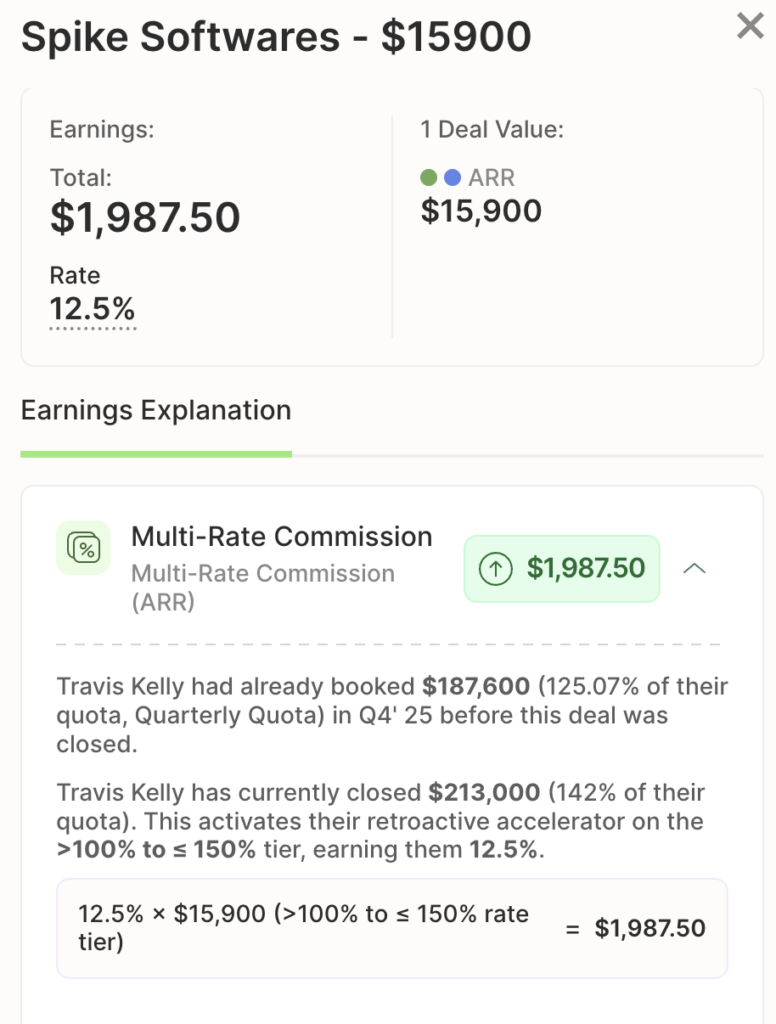
Commission accelerators typically kick in when a sales rep achieves 100% of their quota, to reward overachievement. How reps earn them varies depending on whether it is a marginal vs retroactive accelerator. With marginal accelerators, the higher rate applies only to revenue beyond the 100% threshold. By contrast, retroactive accelerators apply the higher rate to all revenue closed during the designated period once the milestone is reached.
Should accelerator payouts be capped?
Compensation accelerator payouts should typically not be capped. Doing so contradicts the main purpose of an accelerator to motivate overperformance and encourage top performers to continue selling after achieving quota. Capping these payouts has the opposite effect, demotivating reps, and may result in reps sandbagging deals until the next period.
How do accelerators work with decelerators?
Accelerators and decelerators act as carrot-and-stick mechanisms within a sales compensation plan. They influence the amount a rep earns per dollar they bring in, depending on how close they are to meeting their sales quota. Accelerators pay a higher commission rate to reward top-performing reps, while decelerators pay a reduced percentage of the base commission rate to underperforming reps.
Can accelerators change mid-year?
Sales accelerators typically don’t change mid-year. However, underperformance in the first half of the year may necessitate changes to the sales compensation plan. The intent is to prevent disengagement and attrition as reps falling short of quota feel like there’s no way to catch up, particularly if most of their upside kicks in once they hit quota. Mid-year adjustments are intended to address these issues and boost motivation and earnings during H2.
How do you budget for accelerators?
Budget for accelerators by running scenarios with historical attainment data to model cost impact and limit budgetary risk. Modeling commission costs across a range of quota attainment levels calculates the impact on commission expenses, rep earnings, and total revenue. The use of decelerators can also be used to offset aggressive accelerators
See how easy it is to design compensation accelerators with QuotaPath’s AI Revenue Strategist product, Atlas. Try it for free.