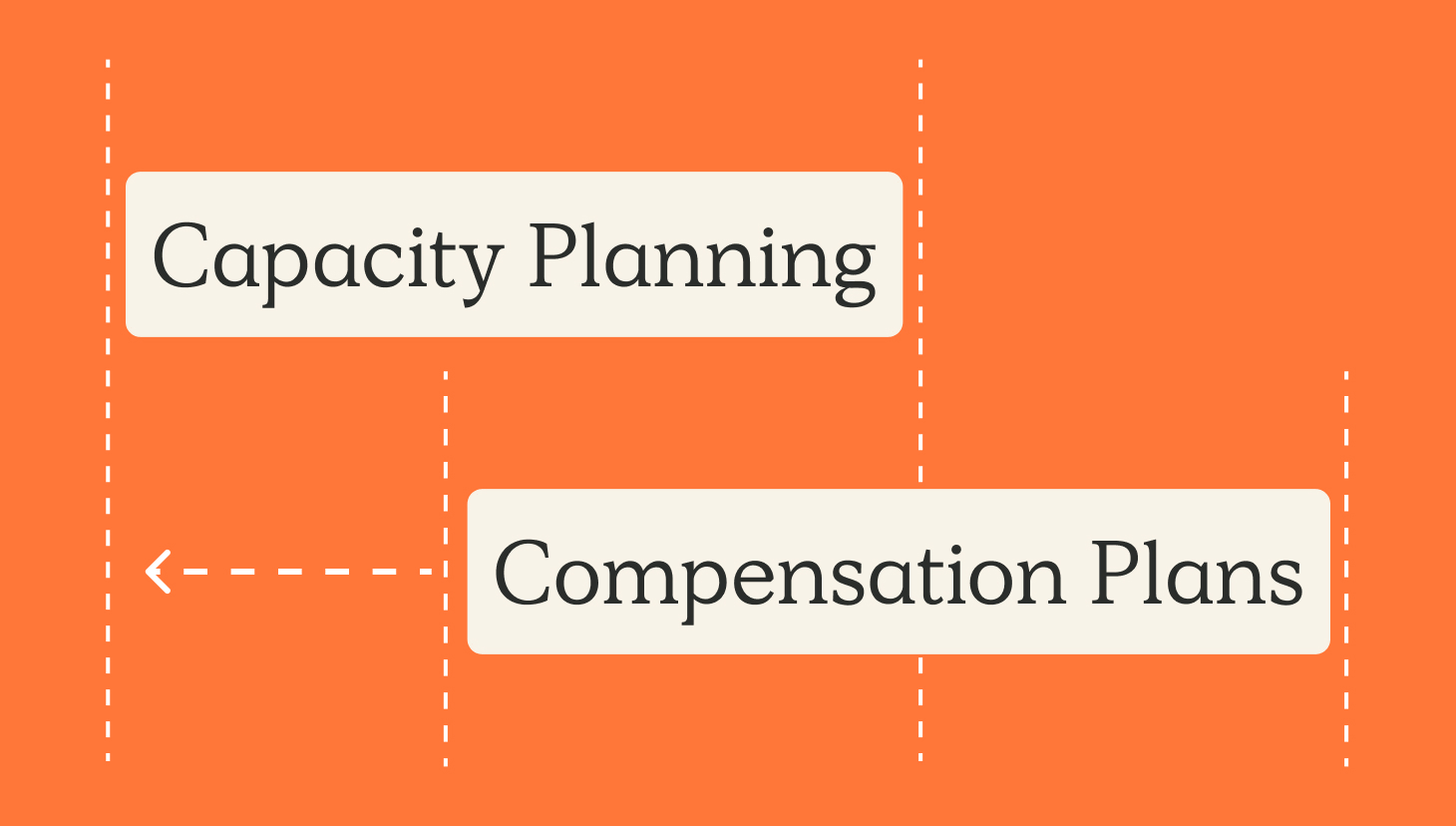
Two-thirds of respondents update their comp plans less often than once per year, according to Sales Xceleration’s Sales Agility Assessment. This is surprising, since nearly 40% of revenue leaders admit to struggling with incentive plans misaligned with goals.
Unchecked plans are costly. As most plans silently reward behaviors leaders never asked for, causing the business to fall short of objectives quarter after quarter, and rep turnover to rise.
A plan you don’t evaluate is a plan you’re paying for blindly. In this blog, we walk through a structured audit framework and a way to grade your plan at the end.
Key Takeaways
- Complete a comp plan review if your plan is motivating the right behaviors, and you’re falling short of your business objectives.
- A sales compensation plan evaluation answers the question: ‘Was the plan worth executing?’
- The fastest path to a benchmarked scorecard is Atlas’s Grade My Comp Plan track.
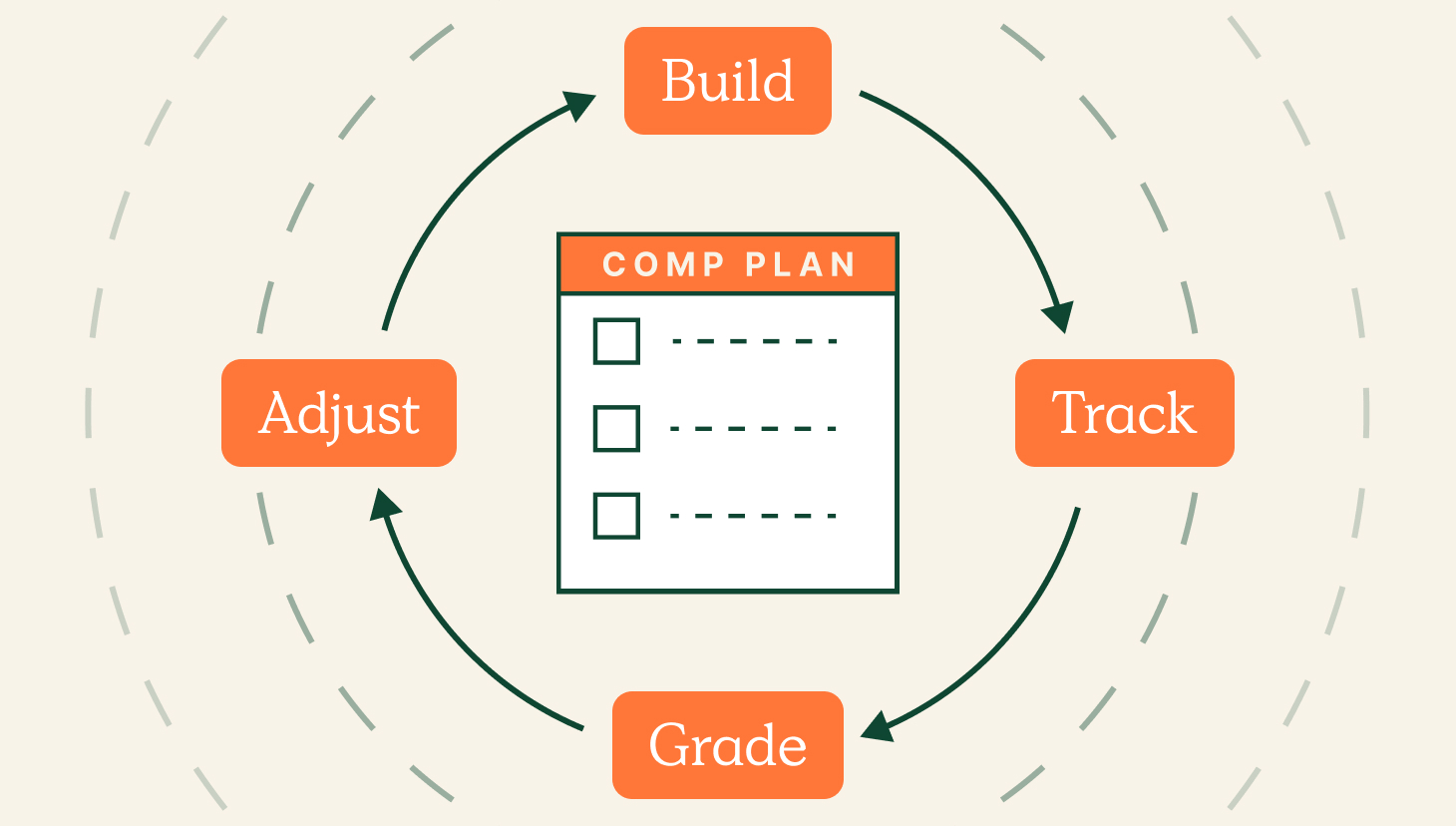
- A sales comp plan audit is a recurring loop of Build, Track, Grade, Adjust, Repeat.
Meet our AI Revenue Strategist
Use Atlas to quickly run an analysis and evaluation of your sales compensation plan performance.
Try Atlas for FreeWhy Evaluate Your Comp Plans?
Sales comp plan evaluation is necessary to ensure the plan remains effective as business and market conditions evolve. Business-context shifts such as pricing changes, ICP shifts, new motions including PLG, expansion, or multi-product all silently break plan logic. To minimize business impact, evaluate a sales compensation plan to ensure audit-readiness in terms of clean documentation, ASC 606 hygiene, and defensible payouts before year-end.
Allowing the cost of letting drift compound leads to overpaid low performers, underpaid top performers, mid-year quota chases, and a risk of rep churn. And the most important consideration here is behavioral. If your plan’s outputs don’t match the behaviors you wanted, it doesn’t matter if the math is correct, because you’re falling short of your business objectives.
What Does A Complete Sales Compensation Plan Audit Cover?
It’s often thought that a sales compensation plan review measures commission accuracy, answering the question: ‘Did we pay the right amount?’ However, a plan evaluation answers the question: ‘Was the plan worth executing?’
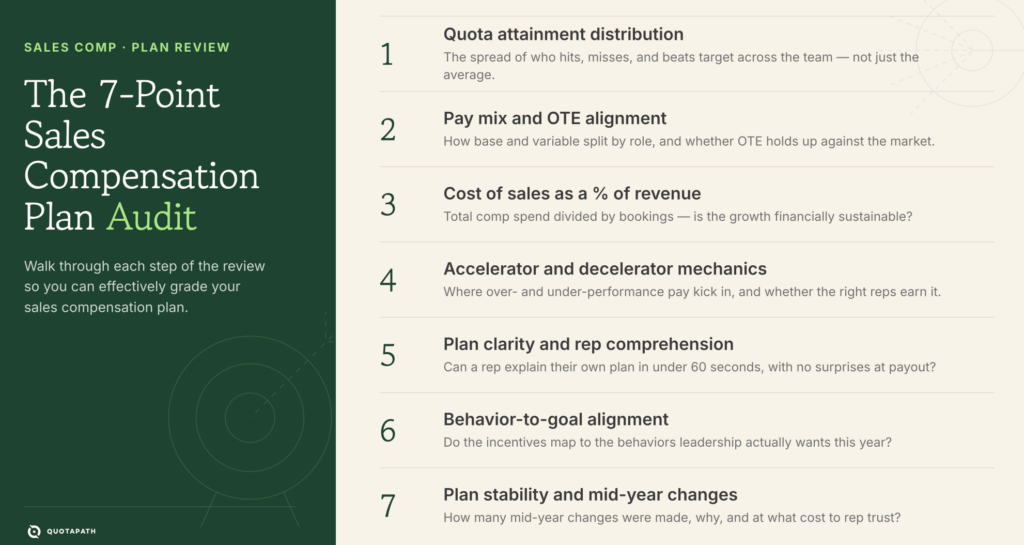
While commission accuracy has become table stakes, thanks to automated tools, sales comp plan evaluation is a continuous process. In this blog, we’ll walk you through a 7-point sales compensation plan audit to help you evaluate a sales compensation plan.
The 7 audit points are:
- Assess quota attainment distribution
- Evaluate pay mix and OTE alignment
- Measure the cost of sales as a percentage of revenue
- Review accelerator and decelerator mechanics
- Gauge plan clarity and rep comprehension
- Ensure behavior-to-goal alignment
- Monitor plan stability and mid-year changes
The 7-Point Sales Compensation Plan Audit
Let’s walk through each step of the sales compensation plan review process so you can effectively grade it.
1. Quota attainment distribution
Quota attainment distribution measures the spread of sales performance across the team, revealing the percentage of sales reps who hit, miss, or exceed their designated targets.
- What to measure: The spread of attainment across the team, not just the average.
- Healthy quota attainment benchmarks: Most SaaS teams target ~80–90% team attainment with a healthy bell curve and a clearly differentiated top decile.
- Red flag: Persistent team attainment below ~70% or above ~110–120% — usually a quota, coverage, or capacity problem, not a rep problem.
A too-high average is just as bad as a too-low one. It leads to a cost-of-sales blowout and demoralized top performers.
2. Pay mix and OTE alignment
The pay mix in a sales comp plan defines the percentage of a sales rep’s earnings that consists of base salary, commission, and other incentives. Aligning the pay mix with On-Target Earnings (OTE) ensures the plan strikes a balance between financial risk and rep motivation, while driving the right sales behaviors to achieve business objectives.
- What to measure: Base/variable split by role and OTE position vs. market.
- Healthy pay mix benchmarks: AEs typically 50/50; SDR/BDR 60/40 or 70/30; CSMs more base-heavy unless they own expansion. SaaS AE OTE often $120K–$200K (SMB/mid-market), $200K+ (enterprise).
- Red flag: Roles with strong revenue control but heavy base-weighting, or vice versa.
Each role’s compensation should reflect the degree of direct control it has over revenue.
3. Cost of sales as a % of revenue
Customer Acquisition Cost (CAC) as a percentage of revenue is an efficiency metric that reveals whether your growth is financially sustainable and how much of the budget is actual profit.
- What to measure: Total comp spend (base + variable + accelerators + SPIFFs) divided by bookings/revenue.
- Healthy benchmark: SaaS new-business commission rates often 8–15% of ARR; expansion is approximately half that; renewals are approximately 25–33% of new business.
- Red flag: Accelerator-heavy plans where the marginal dollar of revenue costs more than the company can sustain.
Cost of sales as a percentage of revenue varies by company stage and sales motion, typically decreasing as organizations scale and increasing with higher-touch selling motions.
4. Accelerator and decelerator mechanics
A sales accelerator is a tiered commission structure that rewards sales rep overperformance by increasing the payout once a specific sales goal is achieved, such as quota. By contrast, sales decelerators pay a lower commission percentage of the base rate for underperformance. Decelerators are often used to offset the costs of accelerators in a sales compensation plan.
- What to measure: Where accelerators kick in, how steep they are, and whether they’re earning out for the right people.
- Healthy signal: Accelerators reward truly exceptional performance and bend cost of sales only at attainment levels the business already wins from.
- Red flag: Accelerators paying out broadly across the team (suggests quotas are too low) or never paying out (suggests quotas are unrealistic).
5. Plan clarity and rep comprehension
When reps don’t understand how they earn commissions, they aren’t motivated by the plan. This often leads to confusion, demotivation, frustration, compensation disputes, and ultimately sales rep turnover.
- What to measure: Can a rep explain their own plan in under 60 seconds? How many components does the plan have? How many edge cases are documented?
- Healthy signal: One-page, rep-facing summary, no more than 4 earnings components, and no surprises at payout time.
- Red flag: “We keep getting the same questions on the comp Slack channel.”
Reps who don’t understand their plan don’t optimize against it and don’t behave as intended.
6. Behavior-to-goal alignment
Behavior-to-goal alignment gauges whether selling behaviors are actually tied to business goals.
- What to measure: Do the plan’s incentives map to the specific behaviors leadership says it wants this year (multi-year deals, ICP fit, expansion, etc.)?
- Healthy signal: Every accelerator, SPIFF, and bonus traces back to a specific business metric.
- Red flag: The plan still rewards last year’s strategy.
Misalignment leads to rewarding the wrong behaviors, preventing the achievement of business goals.
7. Plan stability and mid-year changes
When you build a sales compensation plan, your intent is to effectively motivate reps’ behaviors that drive the achievement of business objectives. However, there are instances when mid-year plan changes are necessary, such as market or economic changes, company acquisitions, new leadership, product changes, employee turnover, and performance shortfalls.
- What to measure: How many mid-year changes were made last year, why, and at what cost to sales rep trust?
- Healthy signal: Small, communicated, scoped adjustments — not full plan overhauls.
- Red flag: More than 2 unplanned mid-year changes typically signal the original plan wasn’t pressure-tested before rollout.
Design, track, and manage variable incentives with QuotaPath. Give your RevOps, finance, and sales teams transparency into sales compensation.
Talk to SalesHow Do You Score Your Sales Compensation Plan?
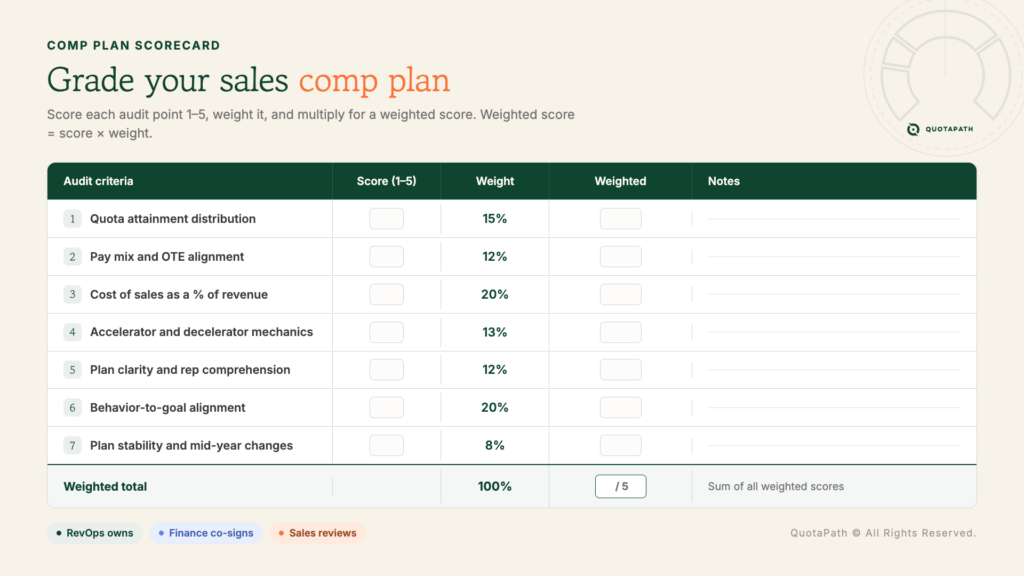
Easily grade your sales compensation plan with a comp plan scorecard. Score each of the 7 audit points on a 1–5 scale and assign weights to them. Behavior-to-goal alignment and cost of sales typically carry the most weight. When scoring the plan, RevOps owns the scorecard, Finance co-signs it, and Sales reviews it. Here’s a comp plan scorecard you can use:
Grade Your Comp Plan With Atlas
The fastest path to a benchmarked scorecard is Atlas’s Grade My Comp Plan track, built on QuotaPath’s proprietary data and sales compensation benchmarks. Try Atlas for Free to see it in action.
What Atlas evaluates
Atlas handles the complete sales compensation plan audit, including attainment distribution and payout concentration, pay mix, OTE, quota-to-OTE benchmarking, and cost of sales-to-revenue analysis. Our AI Revenue Strategist also performs accelerator and incentive design diagnostics, assesses pay-for-performance alignment, and performs plan effectiveness diagnostics, answering the question, “Is this plan actually working?”
How Atlas uses QuotaPath benchmarks
Atlas uses 8+ years of proprietary QuotaPath commission data plus insights from thousands of comp plan consults to evaluate your plan. It layers in market benchmarks and the customer’s own historical data to assess plans against actual attainment patterns, payout behavior, and revenue economics.
Atlas recommends; it doesn’t just describe. So, every output points to a specific tradeoff or fix. Unlike an LLM that can describe what a plan looks like, Atlas knows what plans actually pay out.
Leadership-ready outputs from Atlas
Atlas generates shareable briefs that span RevOps, Finance, CRO, and CEO without reformatting. Serving as a common source of truth for cross-functional debate, Atlas eliminates the “everyone has their own spreadsheet” problem, keeping everyone on the same page. This shortens the time it takes to evaluate a sales compensation plan, adjust, and test it.
What To Do After The Audit
Once you’ve completed your comp plan scorecard, what’s next?
Prioritizing fixes by financial impact
Before taking action, determine how to proceed. Stack-rank issues by dollar impact, not by how loud the complaints are. Cost-of-sales misalignment and attainment distribution typically dwarf everything else.
Sort into quick-wins that take short-term, surgical adjustments versus structural fixes requiring fundamental, long-term overhauls to the commission plan, weighing them based on urgency, scale, and root cause.
How do you roll out plan changes?
Following these best practices will ensure a successful rollout of the revised plan.
- Timing: Tie to natural plan cycles (year-end, half-year, fiscal kickoff) wherever possible.
- Communication: Rep-facing one-pager, manager talk track, FAQ.
- Documentation: Version-controlled plan doc, updated terms.
- Note: Hard plan changes mid-cycle erode trust faster than they save dollars.
Tracking plan efficacy post-change
Don’t wait until the next annual audit to find out whether the fix worked. Select three to four leading indicators to monitor the plan’s impact post-change. Include metrics like attainment trend, payout concentration, deal mix, and rep retention. Then review monthly to quickly detect developing issues.
The build, track, grade, adjust flywheel
A sales compensation plan audit is not a one-time event. It is one stage in a recurring loop: Build → Track → Grade → Adjust → repeat. Atlas lives at every stage of the flywheel. Start your next audit in Atlas.
Sales Compensation Plan Audit Checklist
Use this handy sales compensation plan audit checklist to routinely grade your plans.
FAQs
How often should RevOps audit comp plans?
RevOps should audit comp plans quarterly by completing a light-touch review of attainment and payout distribution. A full audit should be carried out at least once a year, ideally before annual planning. Trigger-based audits should be performed when business shifts such as pricing, ICP, motion, and headcount change.
Who owns the audit, RevOps or finance?
RevOps owns the audit execution, while Finance co-signs the audit output. Sales leadership reviews and weighs in on behavioral alignment identified during the sales compensation plan audit. A shared source of truth helps facilitate this process by ensuring everyone is looking at the same data and eliminating version control issues throughout the audit.
What’s the fastest way to grade a plan?
The fastest manual way to grade a sales compensation plan is with the 7-point scorecard provided above. However, the fastest path is to use Atlas’s Grade My Comp Plan track, which takes minutes rather than weeks. Try Atlas for Free
Can you change a plan mid-year?
Yes, you can change a plan mid-year, but only with clear communication, a documented rationale, and, ideally, adjustments (not overhauls). Best practice: If you’re considering a mid-year overhaul, you will almost certainly need a full redesign at the next cycle anyway.
Audit vs. redesign: what’s the difference?
The difference between an audit and a redesign is that one is an assessment, and the other involves plan changes. An audit involves evaluating your plan against benchmarks and outcomes. By contrast, a redesign is building a new plan from scratch when the audit reveals structural problems. Most teams should be auditing far more often than they’re redesigning.