Pipeline slowing compared to Q1? Fewer reps pacing toward quota? Commission costs rising? It must be Q2…the moment when compensation patterns surface, revealing what’s actually working in the comp plan.
Compensation problems compound quietly. They are rarely sudden; rather, they build over time.
Consider that 91% of organizations have less than 80% of their sales reps hitting quota, and 80% of companies pay sales reps incorrectly. Ignoring these issues has serious consequences, including margin erosion, rep disengagement, forecasting inaccuracies, and trust breakdowns due to payout errors.
Pinpoint risks by completing a comp plan audit. This process enables you to evaluate alignment, cost efficiency, attainment health, and motivation, then proactively address issues. This blog shows you how to run a comp plan audit to check efficacy and identify areas of improvement before heading into the second half of 2026.
Key Takeaways
- Q2 audit checklist
- Key metrics to review
- Red flags to watch for
- How to course-correct before H2
Head into H2 with clarity, not guesswork.
Build, Test, and Improve Your Compensation Plans
Use Atlas, our AI Compensation Plan Consultant that runs entirely from proprietary QuotaPath data and benchmarks. Learn best practices in compensation strategy, evaluate your existing comp structures, and build plans that drive performance.
Use AtlasThe Q2 Comp Plan Audit Checklist
So, what should you actually evaluate?
Use this checklist to systematically review your plan’s performance across alignment, cost, motivation, and operational health.
1. Business Goal Alignment
“Compensation plans should be the caboose, not the engine,” according to Pablo Dominguez of Insight Partners. So, start your commission plan review by confirming that your pay structure supports your business strategy, rather than creating it.
Audit questions:
- Are reps incentivized on your current North Star metric?
- Are you paying the most commission on the behaviors that matter most?
- Has your strategy shifted since January?
Metrics to review:
- Revenue growth rate: A measure of how much a company’s revenue has increased within a given period compared to a comparable timeframe, such as month over month.
- Product mix vs. profitability: Measure of how product choices affect overall profitability, in terms of gross margin, net profit margin, and return on investment (ROI).
- Earnings by comp component: A breakdown of revenue associated with each incentive plan element.
Tying the two together: If your goal is increasing ACV, what % of commission dollars are tied to multi-year or high-value deals?
2. Quota & Attainment Health
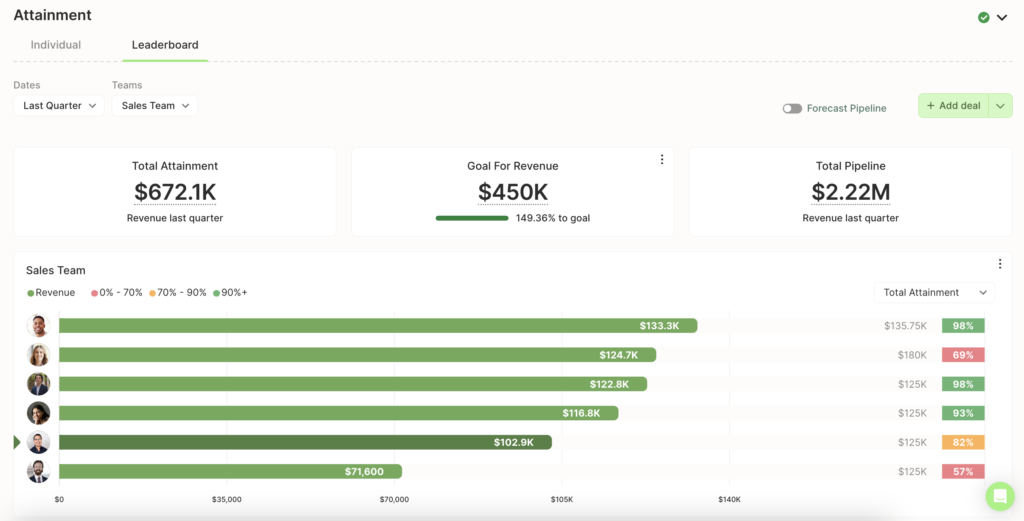
Our CEO AJ Bruno’s rule of thumb says that 80% of reps should realistically hit quota. However, 91% of organizations have less than 80% of their sales reps hitting quota. Use these questions and metrics to perform a quota attainment analysis.
Audit questions:
- What percentage of reps are on track to hit quota?
- Is attainment clustered or wildly inconsistent?
- Are top earners also top performers?
Metrics to analyze:
- Attainment over time: Tracks the attainment of sales goals over time to identify seasonality, reveal rep consistency, and gauge how well sales incentives align with overall business objectives.
- Time to quota attainment: Indicates how quickly sales reps hit their targets, revealing the efficiency and effectiveness of comp plans.
- OTE:Quota ratios: An OTE to Quota ratio compares a sales rep’s on-target earnings (OTE) to their quota, determining the amount of revenue a rep must generate for every dollar they earn.
- Ramp duration vs. expectations: A comparison of the actual time it takes for a rep to become productive compared to the forecasted timeframe.
If fewer than 50% of reps are on pace to meet quota, your issue likely isn’t effort. It’s design.
3. Commission Cost & Margin Impact
Include Finance in the comp plan audit process to measure sales compensation effectiveness, prevent overspending, and ensure financial stability.
Audit questions:
- What is your commission expense ratio?
- Is your effective commission rate under 25%?
- Are you overpaying on low-margin products?
Metrics to review:
- Commission payout ratio: The percentage of revenue reserved for commissions, helping improve the accuracy of financial planning and forecasting.
- Effective commission rate per deal: Cumulative commission percentage per deal, including every role that earns an incentive on a deal.
- Total commission dollars by product line: Monetary value of compensation paid to sales reps, segmented by product category.
4. Motivational Impact
Motivation is an essential metric when assessing sales compensation effectiveness. Comp plans that are viewed as fair and equitable inspire reps to overachieve. By contrast, confusing or seemingly random plans tend to demotivate and frustrate reps. In fact, according to our compensation trends report, 9% of reps quit due to compensation errors or disputes.
Audit questions:
- Are accelerators reachable or out of sight by mid-year?
- Are reps disengaging after a slow Q2?
- Are disputes increasing?
Metrics:
- Commission dispute count: The number of pay questions or inconsistencies per pay period, indicating how well reps understand how they earn commissions and gauging how accurate compensation calculations and data are.
- Turnover rate: The frequency that sales reps leave the company, revealing the effectiveness of the comp plan in motivating and retaining talent.
- SPIF effectiveness: Gauges the impact of special performance incentive funds (SPIF) in driving selling behaviors to determine if it might be worth implementing as an element in your compensation plan.
5. Operational & Administrative Efficiency
Commissions processing, accuracy, and visibility matter. Spreadsheets increase error risk and admin burden, negatively impacting sales compensation effectiveness and limiting transparency. However, automation reduces processing time by up to 90%.
Audit questions:
- How long does commission processing take?
- How many manual adjustments occur each cycle?
- Are disputes resolved quickly?
Metrics:
- Processing time per payout cycle: The amount of time spent reconciling comp plan data and verifying its accuracy, processing commissions, responding to rep payout questions, and creating audit logs.
- Discrepancy/resolution count: The number of pay inconsistencies or questions per pay period. This is an indicator of how well reps understand how they are paid and how accurate your commission calculations and data are.
- Rep visibility into earnings: Real-time access to commission data, quota attainment, and potential deal payouts through dashboards, enabling reps to calculate earnings, track performance against goals, and forecast how each deal impacts their pay. This level of transparency reduces rep payout disputes and increases trust.
Common Red Flags Your Comp Plan Audit Might Reveal
Now that you’ve completed your comp plan audit, here are some common issues you may have found and what they mean.
- Less than 60% of reps pacing to quota: Results in missed revenue goals, overpaid commissions, and increased rep turnover due to a lack of transparency and trust.
- High attainment but low profitability: Causes commission overpayment and elevates customer acquisition costs (CAC) relative to lifetime value, causing budgetary strain, often an indicator that quotas and/or margins are too low.
- Frequent commission disputes: Decreases rep trust in compensation plan and payout calculations.
- Heavy commission spend on non-strategic products: Results in misaligned sales incentives, reduces profitability, and wastes selling time on what are typically low-margin items.
- Reps unclear on earnings potential: Inability to forecast potential earnings reduces motivation and sales compensation effectiveness.
- Q2 pipeline drop paired with flat incentives: This pipeline dip creates a decrease in commissions, rep motivation, and quota attainment.
What to Do If Your Audit Surfaces Issues
An audit without action is just analysis. Leverage the following best practices to improve sales compensation effectiveness based on the insights your commission plan review revealed.
Make Targeted, Not Reactive Changes
Implementing intentional changes is more likely to resolve issues and drive desired behaviors for positive Q2 goal attainment.
- Temporary accelerators can revive waning motivation while boosting efficiency when aligned with metrics like gross margin or GRR.
- Quota rebalancing boosts attainment by aligning quotas with historical achievement data and buyer behavior instead of evenly distributing them across four quarters.
- SPIFs tied to specific behaviors improve performance that compensates for Q2 weakness. For example, a SPIF that rewards self-sourced opportunities to make up for demand gen lulls.
- Territory realignment helps improve rep performance when the issue is the quality of the territory. It redistributes accounts and offers underperforming accounts a fresh start. When doing this, it’s important to be conscious of perceived fairness and the impact on overlays such as SEs and BDRs.
Model Before You Roll Out
QuotaPath modeling tools enable pressure testing of compensation plan changes using real historical data to predict the impact on commission costs. Scenario modeling determines payout impact by running “what-if” tests, such as: What happens if 80% of reps achieve 80% of quota? Testing accelerators before launch measures their impact on cost and attainment distribution.
Use AI Comp Consultant to Model & Test
Atlas, QuotaPath’s AI Comp Consultant, will model every scenario your comp plan could face to help you understand how it will perform and stand up against edge cases.
Use AtlasIncrease Transparency Immediately
Giving reps real-time dashboards helps them understand how they earn commissions and track progress toward targets and milestones. It shows reps the earning potential for different deal types and the impact on payouts, motivating them to prioritize deals aligned with business objectives. This transparency reduces reliance on Finance to answer payout questions because they can already see payout calculations and proactively flag discrepancies.
“Reps have full access to their compensation details so that they can see their plans, what they’ve earned so far this month or quarter, and their year-to-date earnings—all in real-time,” said Liza of Rootly. “I rarely get questions about commissions anymore because they have everything they need in QuotaPath.”
Make Comp Plan Audits a Quarterly Habit
Spring cleaning shouldn’t be once a year. Ongoing quarterly mini-audits prevent H2 surprises and increase performance consistency. Comp plan audits are a strategic form of revenue hygiene. The resulting visibility improves trust, alignment improves quota and business objective attainment, and forecasting accuracy in Finance improves.
Schedule time with a team member to see how QuotaPath combines real-time visibility, scenario modeling, and expert guidance to help you make smarter mid-year comp plan decisions.