
The role of the CFO has evolved well beyond closing the books and managing budgets.
Modern finance leaders are expected to act as strategic partners, aligning financial discipline with revenue growth, operational efficiency, and employee performance.
But one area continues to create unnecessary friction: sales compensation.
For many finance teams, commissions remain buried in spreadsheets, riddled with errors, and totally disconnected from payroll or revenue strategy.
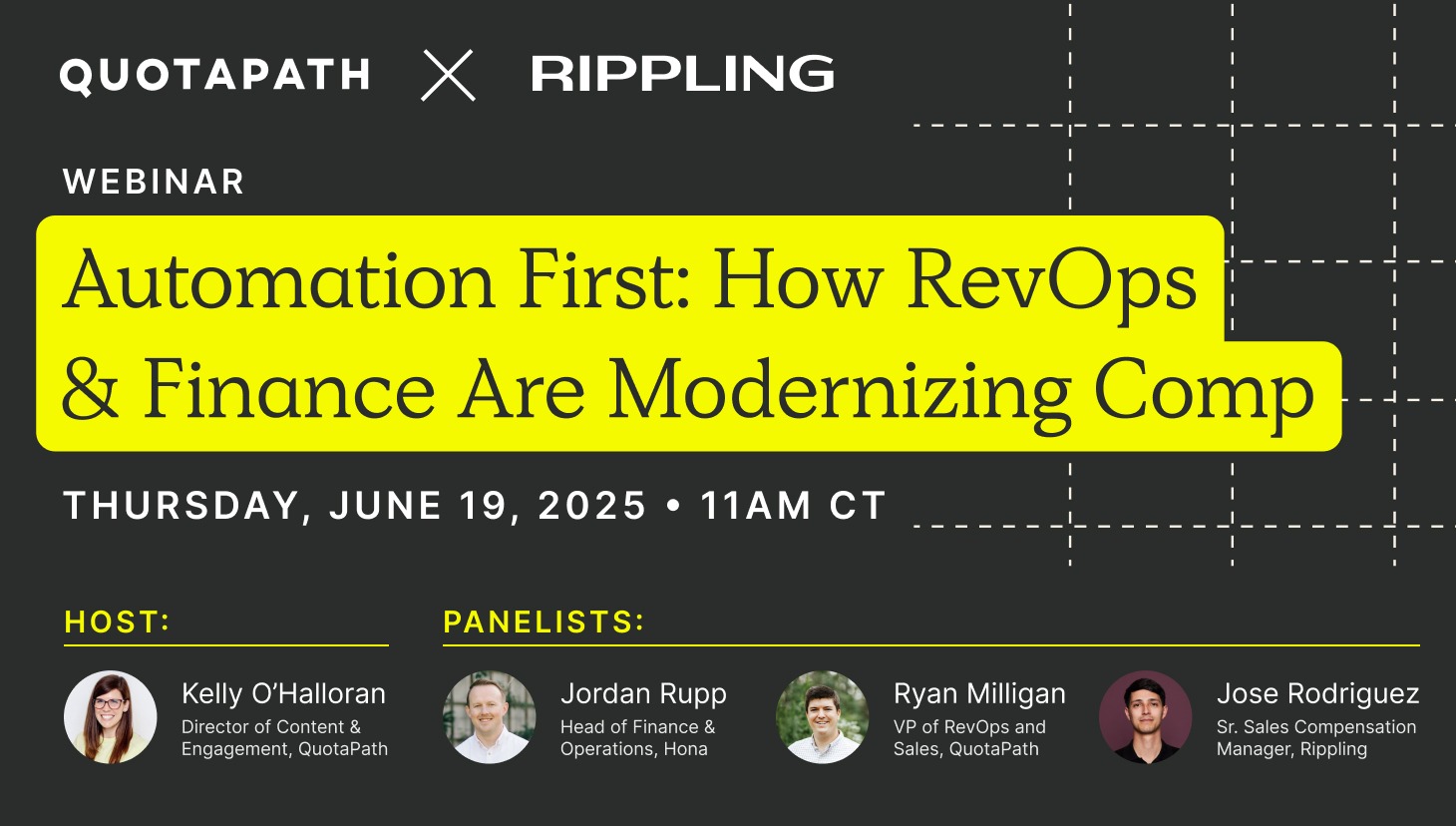
That’s a problem. And CFOs like Jordan Rupp (Hona), Jose Rodriguez (Rippling), and Ryan Milligan (QuotaPath) are helping solve it.
Here’s how.
Manual Commission Calculations: High Risk, Low Reward
Let’s face it, commissions are emotional. Get them wrong, and you risk losing rep trust, morale, and even headcount.
“Calculating commissions is such a high-risk, low-reward activity… reps never say thank you for doing the math right, but they’ll definitely notice if it’s wrong,” said Ryan Milligan, GTM Leader at QuotaPath, during our webinar.
Milligan spent years managing commissions across large GTM teams and saw firsthand how complexity and scale introduced operational chaos.
Jose agreed.
“G-sheets for 300 reps across five segments is very difficult. Handling disputes, sending out statements … it was all anxiety-inducing,” said Jose Rodriguez, Sales Compensation Strategy at Rippling.
And even when processes don’t break, they often still feel brittle and inefficient. At Hona, Jordan Rupp recognized that even small manual errors were a constant risk… one that software could eliminate.
“It was kind of like a breath of fresh air… peace of mind more than anything. Nobody’s fat-fingering anything anymore,” said Jordan, after Hona integrated Rippling with QuotaPath.
The Right Time to Automate? Yesterday.
Speaking on automation. When is the right time? For these three leaders, it’s “yesterday.”
Because waiting to automate commissions is not only inefficient, it’s risky.
The longer the delay, the higher the operational debt. That’s why modern CFOs are increasingly pushing for automation early in their company’s growth, well before pain points reach critical mass.
At Hona, Jordan knew the emotional and operational toll of manual processes wasn’t worth tolerating. “It should be day one,” said Jordan. “The emotional drain, the low confidence… it’s not worth waiting for.”
That’s a common thread across finance teams who’ve lived through the spreadsheet phase, and then scaled past it.
“You never know when your business is going to grow in a meteoric fashion,” said Ryan. “You’re not going to pause mid-hypergrowth to fix commissions.”
Even in high-performing orgs, the legacy systems often don’t hold up to scrutiny.
When Jose joined Rippling and assessed their process, he was stunned by how brittle and outdated it was. “When I got to Rippling and saw the process, I said, ‘How did the last person do this?’” said Jose. “We had to fix it immediately.”
The lesson?
Scaling effectively means treating automation as infrastructure (not a fix-it-later feature). And commissions, given their direct tie to morale, cash flow, and performance, deserve to be one of the first systems built for scale.
Trust Starts with Transparency
For the modern CFO, accuracy is table stakes.
But what builds trust, and ultimately boosts performance, is transparency.
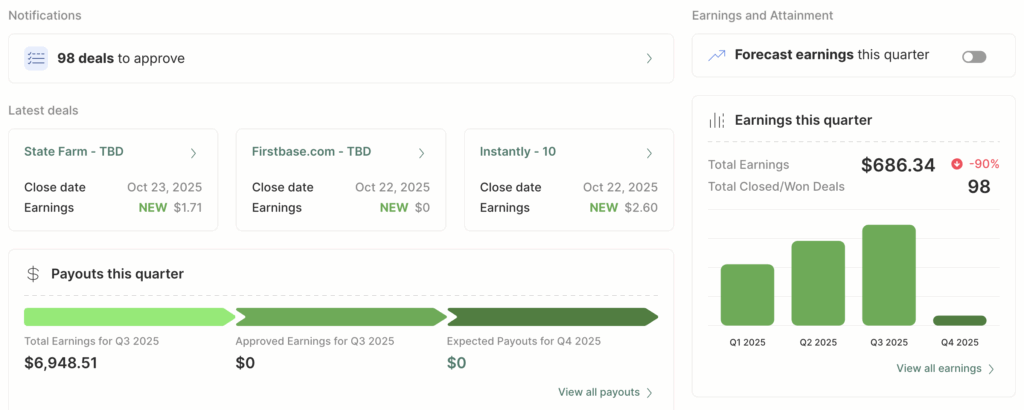
Whether it’s a first-year AE or a senior finance analyst, everyone benefits from knowing how compensation is calculated. When reps understand their earnings in real time, and finance can easily audit and validate payouts, it reduces tension and fosters alignment across teams.
As Ryan put it, the real productivity loss doesn’t always show up on the balance sheet. “The hidden time killer is reps with their own calculators,” said Ryan.
When sellers are doing shadow math to verify their earnings, it’s inefficient and signals a lack of confidence in the system.
That trust gap often appears at the most critical moment: immediately after the deal closes.
“If a rep is closing a $60,000 deal, they want to see their payout and know it’s accurate, right then and there,” said Jose. Waiting until payroll lands, or worse, until a discrepancy is flagged, undermines both motivation and credibility.
Even the most sophisticated spreadsheet models can’t solve this, said Jordan. “I can build a great Excel model. But that doesn’t build trust. I want reps focused on closing, not debating their comp.”
The takeaway is clear: transparency is a strategic lever. When finance and sales share a single source of truth, the entire revenue engine runs smoother.
Align Comp Strategy with Business Goals
When compensation plans are built in isolation from broader company strategy, friction between Finance and Sales is inevitable.
However, when incentive structures align with what the business actually values (efficient growth, ideal customer profiles, and long-term retention), those tensions begin to dissolve.
“Use the comp plan to show sellers how they’ll earn more for bringing in long-term, ICP-fit customers,” said Ryan. “Now Finance and Sales are aligned.”
This alignment will deliver better deals while fostering partnership across departments, something finance leaders increasingly recognize as a win in itself. “If I can cut down the time spent arguing over comp,” said Jordan, “that’s how Finance helps Sales win. That’s partnership.”
When incentives reflect company priorities, and compensation disputes give way to shared goals, you don’t just fix commissions, you unlock cohesion.
Build Systems Before You Hire People
As teams grow, so do the challenges.
But while it’s tempting to solve problems by hiring more people, the modern CFO knows that long-term efficiency comes from more than headcount. It’s strong systems, too.
“Instead of asking ‘who do I hire?’ ask ‘what’s the right process?’” said Jordan. “Then find someone to own that and grow it.”
That mindset is critical when you’re trying to scale fast without drowning in administrative overhead. Jose reflected on the cost of waiting too long: “I wish we had the luxury to build it early. Once you’re scaling, compounding inefficiencies snowball fast.”
The takeaway? Every hire adds complexity. Every process adds stability. And when it comes to commissions, process should come first.
The Future of Finance-Driven Comp Strategy
With automation and transparency in place, finance leaders are looking ahead and actively using compensation to drive performance.
“Now we’re using comp to incentivize champions, like testimonials, referrals, and case studies,” said Ryan. “We want reps closing the right deals, not just more deals.”
The shift is tactical. Jordan shared how his team is rethinking BDR incentives: “Less about volume, more about quality and alignment to closed-won revenue.”
And in complex sales motions, Jose is helping drive a more collaborative approach. “We’re launching team-based incentives for complex deals,” he said. “Rewarding AEs, SCs, and AMs together for collective success.”
From reward structures to role alignment, finance is leading the charge toward smarter, more intentional comp plans that reflect how selling actually happens today.
Design, track, and manage variable incentives with QuotaPath. Give your RevOps, finance, and sales teams transparency into sales compensation.
Talk to SalesFinal Thoughts: The CFO’s Opportunity
Finance leaders have a powerful lever in their hands: the comp plan.
But using it effectively requires transparency, trust, and a system that scales.
The modern CFO doesn’t just sign off on the numbers. They utilize compensation to drive sales behavior, enhance revenue quality, and establish connections between Finance, RevOps, and Sales.
With tools like QuotaPath + Rippling, those goals aren’t just possible…they’re expected.
Want to see how automated commissions can transform your finance operations? Book a time with QuotaPath