Key Takeaways
- The strongest incentive compensation plans are role-specific, matching each function’s core behavior to the right pay mix.
- Pay mix moves on a sliding scale, from a near-even base-to-variable split for account executives to a base-heavy structure for customer success and management roles.
- Applying one flat plan across every role tends to flatten motivation, because the metric that drives a closer rarely moves a pipeline builder.
- AE pay packages keep climbing, with on-target earnings up more than 5% a year against roughly 2% quota growth, so the plan behind that spend has to be designed to earn its cost.
- Connecting plans to live CRM and finance data cuts payout disputes and gives RevOps and Finance their time back.
Most teams already know their compensation plan matters, but struggle to identify what each role should actually be paid to do. This guide bridges that gap with concrete, role-by-role incentive compensation plan examples you can adapt, the benchmarks behind them, and a simple way to keep every plan accurate as you scale.
What makes an incentive compensation plan work by role?
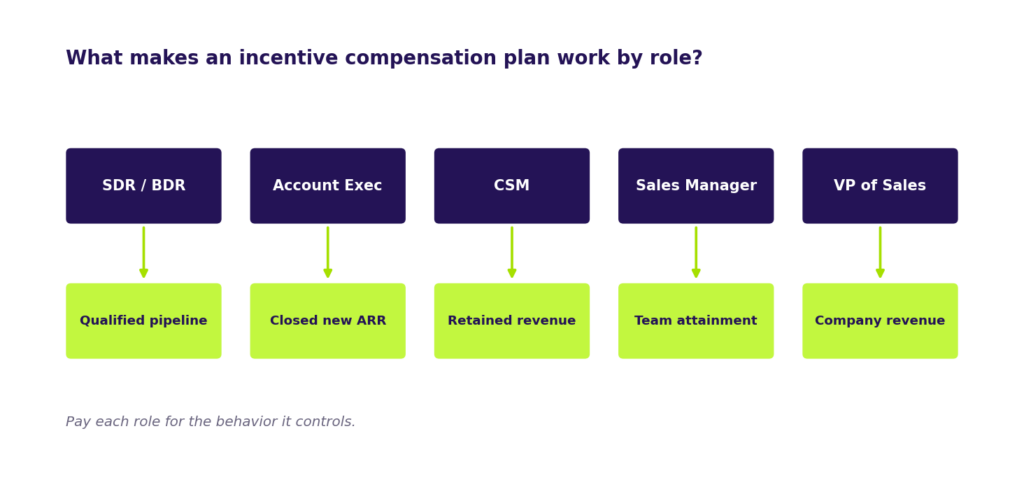
A plan works when the metric it rewards is the one the person can actually influence, which is the single point where most plans quietly break. An account executive controls closed revenue. A sales development rep controls a qualified pipeline. A customer success manager controls renewals and expansion. Pay each of them based on the behavior they and their plans are steering the business towards, rather than just settling up at the end of the month.
This is where good design shines. The Bridge Group’s SaaS benchmark research shows AE on-target earnings have climbed more than 5% annually. In comparison, quotas rose only about 2% annually, meaning pay packages keep getting richer and the plans behind them have to work harder to justify their cost. On the other hand, Salesforce’s own guidance makes the same case from the design side, recommending that incentives be tailored to each role and kept transparent so reps understand exactly how and why they are paid.
If you’re new to the building blocks, our primer can help you get up to speed on what sales compensation includes, covering base, variable, OTE, and quota.
A quick principle to carry through every example below: start simple, then add complexity only where it changes behavior. A plan a rep can calculate on the back of an envelope is a plan they will chase.
Design, track, and manage variable incentives with QuotaPath. Give your RevOps, finance, and sales teams transparency into sales compensation.
Talk to SalesHow pay mix and OTE shift across roles
It helps to see how the numbers move across a team. Pay mix is the split between guaranteed base salary and performance-based variable pay. On-target earnings (OTE) are what someone earns at 100% of quota.
The shift by role and the logic are consistent: the closer a role sits to closing revenue, the heavier the variable shares tend to be.
Pay mix and OTE benchmarks by role
| Role | Typical pay mix (base/variable) | Benchmark reference point | Primary metric |
|---|---|---|---|
| SDR / BDR | 60/40 to 70/30 | Base often $50K to $60K | Qualified meetings or pipeline |
| Account Executive | ~53/47 | Median OTE near $190K | Closed new ARR |
| Customer Success Mgr | 70/30 to 80/20 | Varies by book of business | Net revenue retention |
| Sales Manager | ~70/30 | Tracks team performance | Team quota attainment |
| VP of Sales | 60/40 | Tied to org revenue | Company-wide revenue |
The account executive figures come straight from the aforementioned Bridge Group SaaS AE benchmark research, which puts median AE OTE at $190,000 with a 53:47 base-to-variable split, up from $167,000 two years earlier. Those numbers make a useful anchor, since AE pay tends to sit in the middle of the range and most other roles flex up or down from there.
For a closer look at how percentages change by seat, see our breakdown of commission rates by role.
SDR and BDR incentive plan example
Sales development and business development reps sit at the top of the funnel, booking meetings, qualifying leads, and handing pipelines to closers. Rarely owning the close means an activity-linked plan fits better than a pure revenue commission.
A clean starting structure has three parts:
- Base salary: A 60/40 or 70/30 mix, weighting toward stability since the rep does not own the close.
- Per-meeting or per-qualified-opportunity bonus: Paid only on opportunities the AE team accepts, plus a monthly accelerator for clearing a stretch target like 120% of quota.
- Small closed-won component: Often in the 2% to 5% range, so the rep stays connected to deal quality rather than chasing volume alone.
The quality gate design choice matters most. Pay only for opportunities the AE team accepts, not raw meetings booked. That one rule protects pipeline integrity and keeps the SDR and AE relationship healthy.
Account Executive incentive compensation plan example
Teams often build the account executive plan first, as it is the easiest to over-engineer.
A proven structure: a flat commission rate on all new ARR up to quota, then an accelerated rate on everything above it. A common shape is a base rate to 100% of quota and a higher rate beyond, which rewards overperformance without inflating fixed costs.
ICONIQ’s research on AE incentive programs puts the median commission rate for new-logo and expansion revenue at 10%, with lower rates of around 4-5% for renewals and services. This makes a helpful reference when you set your own.
The accelerator solves a specific problem. A flat rate treats the deal that gets a rep from 90% to 100% the same as the one that takes them from 130% to 140%, even though the second is far harder and far more valuable to you. Tiering the rate above quota puts the reward where the effort is. Keep the tiers limited, generally no more than four, so the plan stays legible.
CSM incentive compensation plan example
Customer success has moved from a cost center to a revenue role, and comp has followed suit. Retention now rivals new business in importance, which is why customer success and account management rates have climbed in recent years.
A retention-linked structure works well: a base-heavy mix, usually 70/30 or 80/20, with commission tied to renewed ARR and expansion. As an example, a CSM might carry a monthly retention target and earn a commission on the contracts they renew, with an added expansion rate on upsell or cross-sell revenue. Some teams add a net revenue retention bonus, paying it out when the book of business exceeds a defined threshold.
The reason for the base-heavy mix is the nature of the work. Renewals and expansion build over quarters, not weeks, so a stable base keeps CSMs focused on long-term account health rather than short-term wins. The trick is making the CSM plan fit cleanly alongside the AE and SDR plans, so that the same renewal is never paid for twice.
Sales Manager incentive compensation plan example
A sales manager plan rewards leadership rather than individual selling, so it tracks team performance. The structure differs from a rep plan in two important ways: the metric is collective, and the plan needs a buffer.
Most teams choose between two structures, and both keep the manager invested in the whole team rather than a few stars:
- Commission with a team accelerator: The manager earns on team-sourced deals, and the rate steps up once the team clears 100% of its collective quota.
- Attainment-point bonus: The manager earns a fixed amount for each percentage point the team moves toward the target.
The detail that protects fairness is the buffer, so rather than holding a manager to 100% of the combined team quota, most plans set their target at 80% to 90% of it. That cushion accounts for ramping reps, open territories, and the occasional underperformer, none of which a manager fully controls in a given period.
VP of Sales incentive compensation package example
A VP of Sales package balances two needs that pull in opposite directions: attracting an experienced leader who wants predictable income and keeping that leader motivated to grow the number. The package usually leans on a stronger base than a rep plan and is paired with variable pay tied to organization-wide revenue.
In practice, that often means three layers: a competitive base, an annual bonus or commission tied to company revenue targets, and equity that vests over several years. How you weight the variable side depends on the company stage:
- Early-stage companies: Often tilt the variable side toward aggressive growth targets, rewarding the VP for putting points on the board quickly.
- More established teams: Blends in retention and profitability goals, since durable revenue matters as much as new logos.
At either stage, the key is to set targets that are ambitious yet achievable. Pitch them too low, and you leave revenue on the table. Pitch them too high, and a strong VP will read the plan and disengage before they start. Because the role evolves as the company grows, revisit the package annually.
These levers, accelerators, bonuses, and recognition apply across every role above. The table below is a quick reference for choosing among them.
When to use each incentive lever
| Lever | Best for | Watch-out |
|---|---|---|
| Accelerator | Rewarding overperformance past quota | Define the goal it serves, or it raises cost |
| Milestone bonus | Encouraging consistent monthly attainment | Keep tiers to four or fewer for clarity |
| SPIFF | Short-term pushes on a product or behavior | Time-box it so it does not become expected pay |
| Non-cash recognition | Culture and retention | Pair it with cash and do not substitute it |
Two data points sharpen these choices. Non-cash rewards and recognition matter more than plans often assume, since people are motivated by progress and acknowledgement alongside the paycheck. Pairing a cash plan with recognition tends to outperform cash alone. And with average quota attainment sitting around 43% per RepVue’s Q4 2024 Cloud Sales Index, leaning too hard on a single all-or-nothing target can leave most of the team unmotivated.
Try the most collaborative solution to manage, track and payout variable compensation. Calculate commissions and pay your team accurately, and on time.
Start TrialHow to keep role-based plans accurate at scale
Running the right plans accurately across a growing team is as important as designing them, and it is also where trust is won or lost. The risk shifts from design to execution once you have five role-specific plans, each with its own rates, accelerators, and buffers.
That risk often concentrates in spreadsheets. The steps below keep plans clean as headcount increases.
Centralize plan data in one source of truth
Pull quota, attainment, and payout data directly from your CRM, finance, and payroll systems into one connected place so each role’s numbers reconcile automatically. Otherwise, you’ll face a costly alternative in which spreadsheets impede accurate plan assessment, and manual reconciliation invites errors that erode rep trust.
Consider a simple commission tracking template as a first step, even though most teams outgrow it as plans multiply.
Set role-based payout rules and approvals
Configure eligibility, accelerators, and buffers per role once, then route approvals to the right reviewer before anything pays out. Reps, managers, and finance each see what they need to and previous periods stay locked for a clean audit trail.
Give every role real-time earnings visibility
Visibility does more than reduce disputes, although it does that too. Let people view their earnings against the live pipeline so they can calculate them at any time.
Review and recalibrate plans on a set cadence
Treat each plan as a living system. Conduct quarterly checks on attainment distribution and payout efficiency, and adjust quotas or accelerators before they drift out of the market range.
It’s been considered standard practice, as WorldatWork reports 91% of companies expected to update their plan design in 2024 to drive pay-for-performance and strategic goal alignment.
Build role-based plans without the spreadsheet risk
The best incentive compensation plans match each role to the behavior that drives revenue, and run cleanly enough that reps trust the payout. The examples we provided give you a starting point for every seat on the team.
QuotaPath makes the running part effortless. Design role-based plans, connect them to your CRM and finance data, and give every rep real-time visibility into what they have earned, all in one place.
Build your role-based plans in minutes with QuotaPath today.