I’ve spent the better part of the last decade working in RevOps, and if there’s one truth I’ve come to believe, it’s this: a company without a clear North Star Metric is a company navigating without a compass.
At QuotaPath, we’ve worked with hundreds of finance, sales, and RevOps leaders, from high-growth SaaS teams to commission-heavy industries like real estate and logistics. And the pattern is always the same.
When the business isn’t aligned around a single, actionable, and predictive metric of success, it shows up everywhere: in disconnected priorities, conflicting comp plans, missed targets, and overburdened finance teams trying to make sense of it all.
So let’s break this down.
What is a North Star Metric? Why does it matter so much? And, critically, how do you actually operationalize it across departments?
Design, track, and manage variable incentives with QuotaPath. Give your RevOps, finance, and sales teams transparency into sales compensation.
Talk to SalesWhat is a North Star Metric?
Your NSM is not just another KPI. It’s the measurable, shared, and strategic metric that best reflects how your business creates long-term value. Done right, it’s the answer to the question: “If we moved just one number up and to the right, would we be confident the business is growing in the right direction?”
For us at QuotaPath, our NSM is: % of revenue with payouts running through QuotaPath this quarter. It’s simple. It’s tied directly to product usage.
And most importantly, it gives us a pulse on our overall business health.

Why It Matters (Especially to Finance)
If you’re in Finance, you’re used to tracking dozens of metrics.
But the NSM plays a different role; it acts as the strategic glue that connects finance to revenue teams and the boardroom.
Here’s why it matters:
- It creates clarity in decision-making. When your GTM teams request additional budget or resources, you can tie those decisions back to their impact on the NSM.
- It strengthens compensation plan design. If your sellers don’t understand how their behavior impacts company-wide metrics, they can’t be expected to optimize for them. The NSM gives them that visibility.
- It aligns incentive structures. Whether it’s Sales, CS, Marketing, or Product, everyone should see how their work ladders up to one core measure.
When the NSM is missing or vague, Finance ends up being the referee between teams instead of the strategic partner they want to be.
With that said, here’s how to get started.
Step 1: Identify Your NSM
First, you have to agree on the metric.
You can’t drive alignment until you’re aligned yourself. Here’s how I recommend teams identify the right North Star Metric.
Ask yourself:
✅ Can every team understand and repeat it in one sentence?
✅ Is it measurable and consistently trackable?
✅ Does it require cross-functional ownership?
✅ Will moving it predict real business growth?
Additionally, avoid lagging indicators like raw revenue or closed/won deals. They’re important, but they don’t help you steer in real-time.
Focus instead on leading indicators tied to product value or customer behavior:
- Time to value
- % of customers realizing value
- Renewal rate
- Monthly active users

Step 2: Drive Buy-In Across the Org
Next up is getting org-wide buy-in. This is where most teams stumble. You find a good metric, get excited, and then… it falls flat.
Why? Because you didn’t operationalize it.
Here’s two factors that we’ve found works:
Socialize It Internally
Start with leadership. Bring in Finance, RevOps, Sales, and Product. Ask: “How do you influence this metric?” If they can’t answer, either the metric’s wrong, or you haven’t clarified its value.
Then test it across the org.
Ask individual contributors to repeat it back. If it’s not sticky, it won’t scale.
Make It Part of the Company Story
Don’t just slap the NSM on a slide and move on. Bake it into:
- Team meetings
- OKRs
- Onboarding sessions
- Quarterly planning
- Compensation plans
Push teams to ask: “Will this initiative move the NSM?” If not, why are we doing it?
Step 3: Track It, Report It, Celebrate It
Once your NSM is live, track it obsessively.
- Slice the data by team, segment, or region. Who’s moving the needle? Who’s stuck?
- Celebrate playbooks that work. Highlight what teams did to impact the metric.
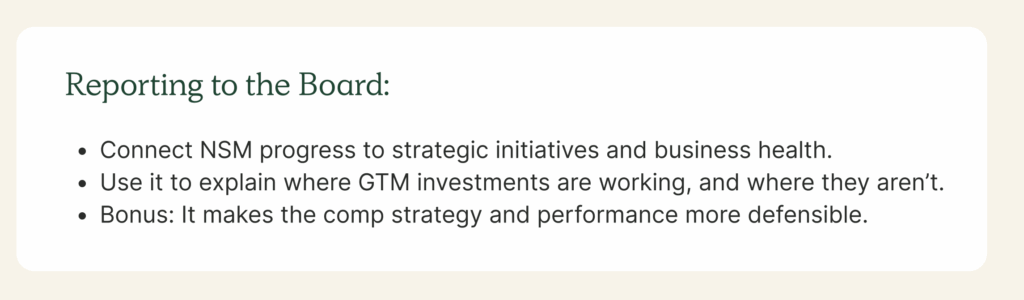
- Report progress to leadership and the board. Connect it to strategic investments, rep performance, and market trends.
Don’t forget: Context matters. If your NSM moves, explain why. Create a learning loop.
Step 4: Revisit and Refine
Your NSM shouldn’t be permanent. Reevaluate it at least annually.
Ask:
- Is it still the most predictive signal of success?
- Are teams still engaged with it?
- Has our product, model, or GTM strategy evolved?
If the answer to any of these is “no,” iterate. Layer in supporting metrics if needed, but don’t dilute the focus.
Bonus: Tie It to Compensation (Yes, Really)
This is where Finance leaders can lead from the front.
When comp plans reflect NSM movement, reps care. Period. At QuotaPath, we’ve helped teams align comp in powerful ways:
- SDRs: Bonus for meetings with NSM-fit accounts
- AEs: Accelerators for closing high-NSM-value deals
- CS/AMs: Bonuses for moving customers from “non-NSM” to NSM usage tiers
Try the most collaborative solution to manage, track and payout variable compensation. Calculate commissions and pay your team accurately, and on time.
Start TrialFinal Thoughts
If you’re serious about efficient growth, you need more than dashboards. You need direction.
A clear, company-wide North Star Metric doesn’t just align teams. It drives the right behaviors, connects day-to-day execution to long-term value, and gives Finance leaders a powerful tool to tie performance to strategy.
If you’re not sure where to start…start by asking the hard question:
What’s the one metric that matters most to your future growth?
If you can’t answer that confidently, you’ve just found your first step.
Let’s get clear.
Let’s get aligned.
And if you need help operationalizing your NSM, from comp plan design to payout automation, we’re here.