If Q1 is about building momentum, Q2 is about sharpening execution.
By the second quarter, most companies have enough data to understand where the sales motion is working…and where it isn’t. Pipeline quality may be uneven. Deals may be stalling late in the cycle.
Cash collection may be slower than expected.
That’s where SPIFs (Sales Performance Incentive Funds) come in.
When designed well, SPIFs allow companies to quickly influence seller behavior without redesigning the entire compensation plan.
In fact, it’s common for mid-stage SaaS companies to allocate $10,000–$50,000 per quarter toward SPIF programs, depending on team size and revenue targets. For organizations with 20–100 quota-carrying reps, this often works out to $200–$500 per rep per quarter in incremental incentives designed to drive specific outcomes.
But there’s a catch.
Too many organizations run SPIFs that simply reward more activity (more meetings, more demos, more pipeline) without tying incentives to the actual outcomes the business needs.
A better way to think about Q2 SPIFs is this:
Your SPIFs should buy specific outcomes you need by midyear—better pipeline quality, cleaner closes, and stronger cash efficiency.
Below are practical Q2 SPIF examples and the best practices that make them work.
Create SPIFs with AI Comp Plan Consultant
Use Atlas, QuotaPath’s AI Comp Plan Consultant, to create, test, and predict performance of potential SPIFs.
Use AtlasWhy Q2 SPIFs Matter
Q2 is a pivotal quarter for most revenue organizations.
By midyear, leadership teams are trying to influence several outcomes:
- Strengthen pipeline coverage before the summer slowdown
- Improve close rates for the quarter
- Shape deal quality and contract structure
- Accelerate cash collection
- Stabilize renewal pipelines for the second half
SPIFs are one of the fastest ways to adjust behavior if these metrics are lagging.
And when compensation plans are aligned with business goals, they can meaningfully influence performance and motivation across the revenue team.
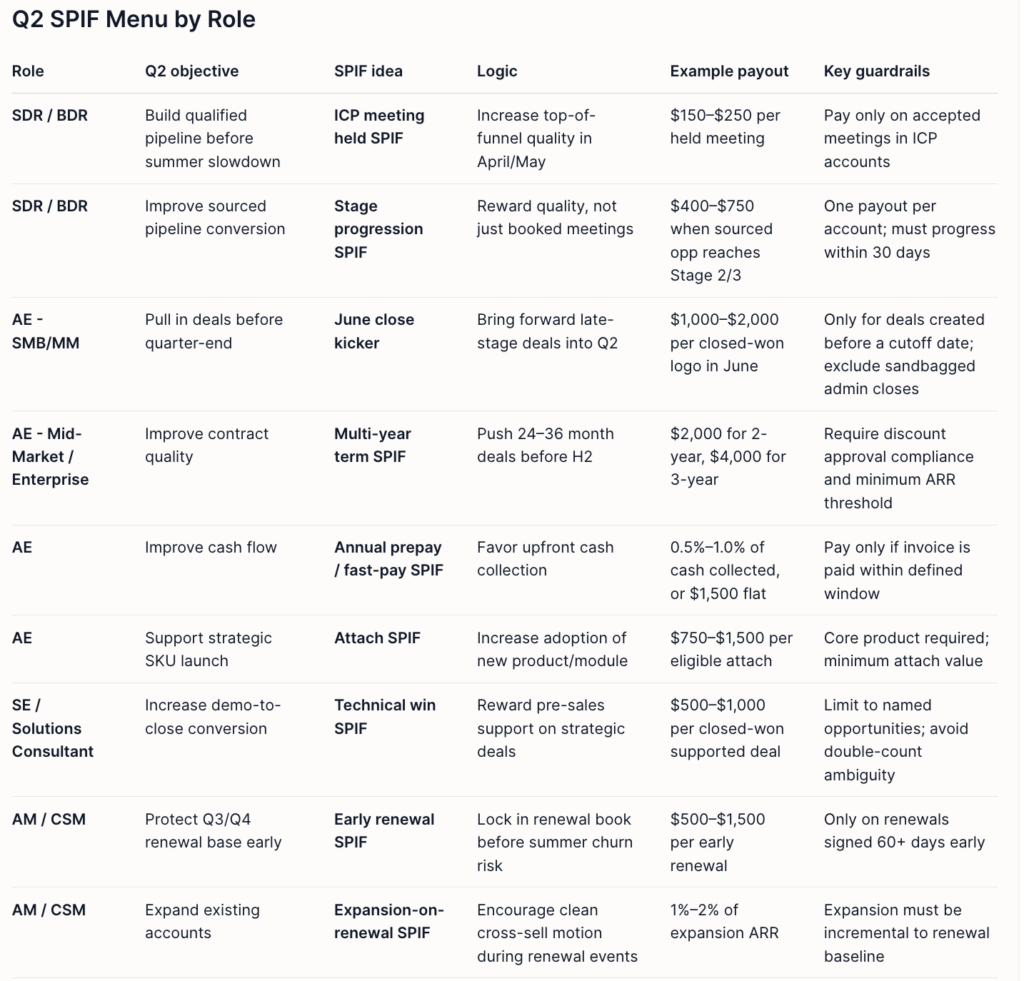
Q2 SPIF Examples by Role
The most effective SPIFs target specific behaviors by role.
How to Structure Q2 SPIF Programs
Just remember: not every SPIF works.
The best programs share a few key design principles.
1. Tie Every SPIF to One Behavior
SPIFs fail when they become too complicated.
Each SPIF should reward one clear outcome, such as:
- Held ICP meetings
- Deals closed before a specific date
- Multi-year contract terms
- Early renewals
Simple incentives are easier for reps to understand and act on.
2. Align SPIF Timing with Your Objective
The timing of your SPIF matters just as much as the incentive.
Front-load SPIFs (April–May) when your goal is:
- Pipeline creation
- Product adoption
- New feature attach
Back-load SPIFs (June) when your goal is:
- Close acceleration
- Forecast accuracy
- Deal progression
3. Set Clear Guardrails
Without guardrails, SPIFs can create unintended consequences.
Common guardrails include:
- Minimum deal sizes
- Discount approval requirements
- ICP account qualification
- Time-bound stage progression
These controls ensure incentives drive the right behavior without distorting deal quality.
4. Cap SPIF Payouts
SPIF budgets can quickly spiral.
Most companies set limits such as:
- Per-rep payout caps
- Total program budget caps
- Team pool limits
Caps allow leadership to encourage performance without creating runaway incentive costs.
Design, track, and manage variable incentives with QuotaPath. Give your RevOps, finance, and sales teams transparency into sales compensation.
Talk to SalesQ2 SPIF Mistakes to Avoid
Even well-intentioned SPIFs can create problems.
Here are a few common mistakes.
- Running a “more meetings” SPIF without quality filters: Without qualification rules, pipeline quality often drops.
- Paying for contract length without discount controls: Reps may trade margin for term length.
- Launching too many SPIFs at once: If reps have to track five different incentives, they usually ignore all of them.
Using SPIFs to fix structural compensation problems
SPIFs should adjust behavior temporarily…not compensate for broken quota models or pricing strategy.
The Bottom Line
SPIFs are most powerful when they are strategic, targeted, and temporary.
For Q2, the most effective SPIF programs focus on:
- Building high-quality pipeline
- Improving close timing
- Increasing contract durability
- Accelerating cash collection
- Stabilizing the renewal base
When done right, SPIFs become a powerful lever for both sales motivation and for driving the business outcomes leadership cares about most.
To implement and track SPIFs to drive performance, talk to our team today.