Revenue recognition is one of the most scrutinized areas of financial reporting. And for SaaS companies in particular, ASC 606 didn’t just change how revenue is recognized — it fundamentally changed how commissions must be accounted for.
Yet years after its effective date, many finance teams are still:
- Expensing commissions upfront when they shouldn’t be
- Managing amortization schedules in spreadsheets
- Reconciling manual journal entries across CRM and ERP systems
- Increasing audit exposure without realizing it
If you’re responsible for financial reporting, audit readiness, or board reporting, ASC 606 isn’t a “set it and forget it” standard. It directly impacts margin, CAC, forecasting, and investor confidence.
Let’s break down what ASC 606 requires, and how commission accounting fits into it.
Design, track, and manage variable incentives with QuotaPath. Give your RevOps, finance, and sales teams transparency into sales compensation.
Talk to SalesWhat Is ASC 606?
First, what is ASC 606?
ASC 606 is the revenue recognition standard issued by the Financial Accounting Standards Board (FASB). It created a single, principles-based framework for recognizing revenue from contracts with customers across industries.
Before ASC 606, revenue guidance was fragmented across multiple industry-specific rules. ASC 606 replaced that structure with one unified model designed to improve consistency and comparability.
The Core Principle
Revenue should be recognized in an amount that reflects the transfer of promised goods or services to customers, and that consideration the company expects to receive.
ASC 606 Summary: The 5-Step Model
Under ASC 606, companies must follow a five-step model:
- Identify the contract with the customer
- Identify the performance obligations
- Determine the transaction price
- Allocate the transaction price to the performance obligations
- Recognize revenue when (or as) the performance obligations are satisfied
For SaaS companies, that typically means subscription revenue is recognized ratably over the contract term (if service is delivered over time), while usage-based revenue is recognized as incurred.
When Did ASC 606 Go Into Effect?
- Public companies: Annual reporting periods beginning after December 15, 2017
- Private companies: Annual reporting periods beginning after December 15, 2018
While implementation deadlines have passed, compliance scrutiny has not. Revenue recognition ( and related contract cost accounting) continues to be a key area of audit focus.
How Do You Recognize Revenue Under ASC 606?
For most SaaS businesses:
- Subscription revenue → Recognized ratably over time
- Multi-year contracts → Recognized over the service period
- Multi-element arrangements → Allocated using standalone selling price (SSP)
- Contract modifications → May require reallocation or prospective treatment
But revenue timing is only half of the equation.
The other half, and often the more operationally complex half, is commission accounting.
Finance Leaders’ Commission Accounting Checklist
A structured commission accounting checklist helps eliminate these challenges, keeping your reporting accurate, compliant, and efficient from the start.
Read BlogThe Overlooked Requirement: ASC 340-40 and Commission Accounting
ASC 606 includes guidance on costs to obtain a contract under ASC 340-40.
This is where sales commissions come in.
The Rule
If a cost is:
- Incremental (meaning it would not have been incurred without the contract), and
- Recoverable
Then it must be capitalized… not expensed immediately.
For SaaS companies, that often includes:
- New logo commissions
- Expansion commissions
- Certain deal-specific bonuses
This fundamentally changed how commission expense flows through the P&L.
How Should Commissions Be Accounted for Under ASC 606?
1. Capitalize Incremental Commission Costs
If the commission is directly tied to obtaining the contract, it must be recorded as an asset on the balance sheet.
This means instead of expensing the full commission in month one, you defer the expense.
2. Amortize Over the Period of Benefit
The amortization period is not necessarily the contract term; it is the expected period of benefit.
Example:
- 1-year SaaS contract
- Average customer lifetime = 4 years
The commission may need to be amortized over four years, not one.
This requires:
- Reliable churn assumptions
- Defined amortization policies
- Consistency across reporting periods
3. Expense Non-Incremental Costs Immediately
Costs that are not directly tied to winning a specific contract, such as base salaries or general bonuses, are expensed as incurred.
The nuance lies in determining what qualifies as incremental.

What Finance Needs to Know Before Rolling Out 2026 Variable Pay
This guide breaks down four things Finance must lock in before the ball drops: Business goals, ASC 340/606 implications, budgeting and headcount, and automation readiness,
Read BlogWhy Commission Accounting Under ASC 606 Creates Complexity
On paper, the guidance sounds straightforward.
Operationally, it is anything but.
Finance teams must now:
- Track commissions at the deal level
- Determine which portions are capitalizable
- Create amortization schedules
- Adjust for churn and renewals
- Post recurring journal entries
- Reconcile against revenue schedules
- Maintain documentation for auditors
When managed manually in spreadsheets, this becomes:
- Time-consuming
- Error-prone
- Difficult to audit
- Nearly impossible to scale
And the financial impact is material.
What Happens When Commission Accounting Isn’t Done Properly?
1. Margin Distortion
If commissions are expensed upfront when they should be amortized:
- EBITDA becomes artificially volatile
- Gross margin appears lower
- CAC calculations become inaccurate
For CFOs presenting to boards or investors, that distortion matters.
2. Forecasting Instability
Incorrect commission accounting affects:
- Burn multiple
- LTV:CAC ratio
- Rule of 40 performance
- Cash runway projections
The further you scale, the more these distortions compound.
3. Increased Audit Risk
Auditors routinely request:
- Support for amortization period assumptions
- Evidence of recoverability
- Reconciliation between CRM data and commission expense
- Documentation of journal entries
Manual processes increase the likelihood of:
- Inconsistent amortization
- Incomplete documentation
- Control weaknesses
The Case for Automation: Aligning Commissions with Revenue
ASC 606 is ultimately about alignment, matching revenue and related costs to the same periods.
That alignment becomes significantly easier when commission tracking and accounting are automated.
An effective system should:
Automatically Track Deal-Level Commissions
Direct CRM integration ensures commissions are calculated from actual deal data (not spreadsheets!).
Identify Capitalizable Costs
Incremental commissions should be flagged and separated from non-capitalizable compensation.
Generate Amortization Schedules
Amortization should follow defined policies and automatically adjust for renewals or churn assumptions.
Sync with Your ERP
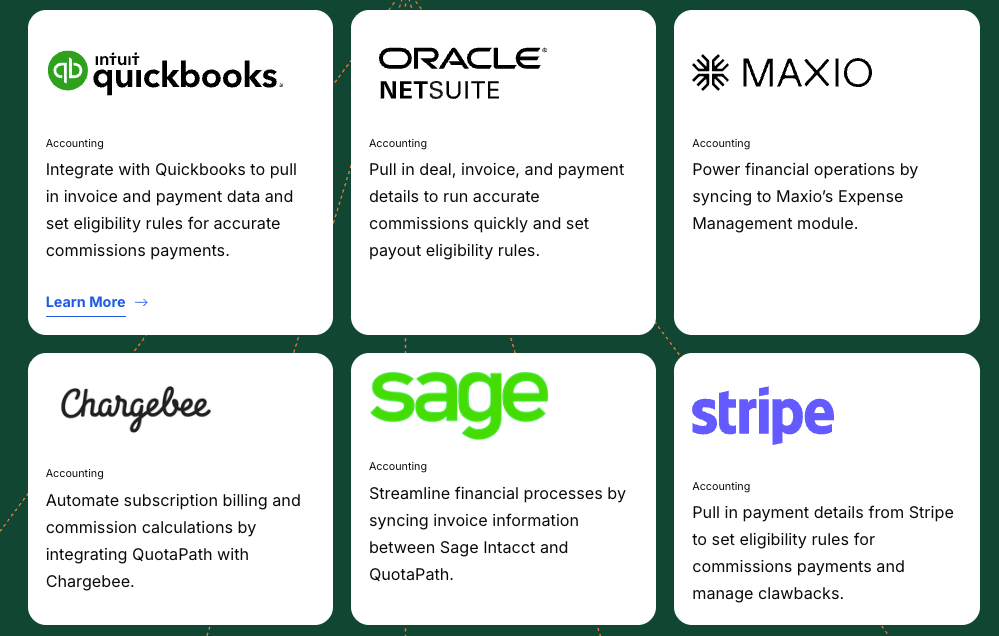
Commission expense and amortization entries should flow directly into your general ledger — whether you use NetSuite, QuickBooks, Sage Intacct, or another ERP.
This reduces:
- Manual journal entries
- Reconciliation work
- Close cycle time
- Audit preparation stress
What Finance Leaders Should Be Asking
If you oversee commission accounting, ask:
- Are we capitalizing commissions consistently under ASC 340-40?
- Are we amortizing over the correct benefit period?
- Can we produce a clean audit trail quickly?
- How much time does our team spend manually managing amortization schedules?
- Are we aligning commission expense timing with revenue timing?
If the answers rely heavily on spreadsheets, manual tracking, or institutional knowledge, there is risk, and inefficiency.
Final Thoughts: Compliance Shouldn’t Create Chaos
ASC 606 was designed to improve consistency and transparency.
But for growing SaaS companies, it introduced real operational complexity, particularly around commission accounting.
Finance teams shouldn’t have to choose between:
- Staying compliant
- Closing the books on time
- Supporting revenue growth
With the right automation in place, you can do all three.
Try the most collaborative solution to manage, track and payout variable compensation. Calculate commissions and pay your team accurately, and on time.
Start TrialSimplify ASC 606 Commission Accounting with QuotaPath Ledger
Managing commission capitalization and amortization manually does not scale.
QuotaPath’s Ledger helps Finance teams:
- Capitalize incremental commission costs automatically
- Generate ASC 606-compliant amortization schedules
- Align commission expense with revenue recognition
- Sync directly to your ERP for audit-ready reporting
- Eliminate manual spreadsheets and journal entries
If you’re still tracking commission amortization in Excel, it’s time to modernize the process.
See how QuotaPath Ledger automates ASC 606 commission accounting and reduces audit risk at scale. Book time with our team today.