
The summer slide isn’t just about students losing a bit of the skills they learned the previous year. It’s applicable to sales too.
As a result, every summer the same conversation happens in RevOps and Finance when the pipeline starts to slow, attainment drops, and the whispered questions about comp changes grow louder.
Comp questions during a slowdown are fair. And how you answer it is even more important. Overreact in one direction and you could permanently risk your plan’s economics and rep trust. But doing nothing could hurt even more.
We ran this question through Atlas, QuotaPath’s AI Revenue Strategist, trained on tens of thousands of comp plans and current market benchmarks.
Here’s what we learned.
The short answer: Adjust quota pacing (not the comp plan)
Yes, seasonal adjustments are sometimes warranted. But the first lever to reach for is quota re-phasing, not a rewrite of your compensation structure.
That’s because if summer changes the timing of deals but not the annual demand, your plan economics are still sound. You don’t need to reprice commissions. You need to redistribute when you’re asking reps to hit their numbers.
Rewriting the actual pay curve or commission structure only makes sense if seasonality is also changing the economics of selling. Think: deal quality, cycle length, win rate, or cash timing…and in a durable, recurring way.
So what do you do?
First: Make sure you’re actually looking at seasonality
Keep in mind that not every summer slowdown is structural. Before changing anything, confirm the pattern is real.
According to Atlas, you’re dealing with genuine seasonality (not noise or execution issues) when you see patterns that repeat for at least two years, ideally segmented by role and motion:
- Attainment consistently dips in summer, even when pipeline entering the period was healthy
- Sales cycle length expands, pushing deals into later periods
- Win rates fall seasonally rather than randomly
- Pipeline creation or meeting volume drops in a predictable window
- Average deal size, discounting, or product mix shifts materially
- Collections or invoice timing slips if payouts depend on cash rather than bookings
INFO BOX – A useful rule of thumb: if the slowdown moves expected attainment or payout cost by 10–15% or more on a recurring basis, it’s worth redesigning something. If it’s smaller or inconsistent, it’s probably noise, and the right answer is no change.
What to Measure Before Making Any Changes
Our recommendation is to use at least 24 months if you have it, and segment by role and motion.
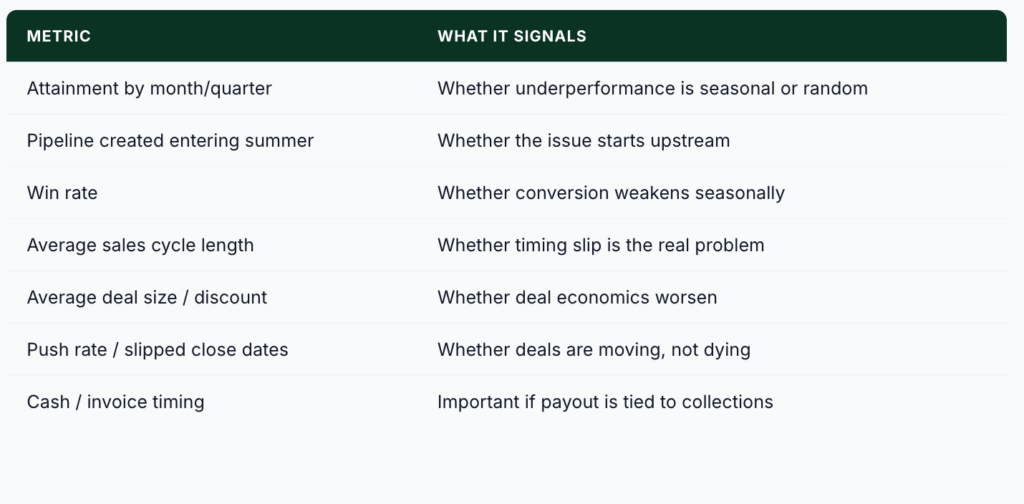
The seasonal comp decision framework
You should also start with one question: Is summer changing the timing of demand, or the economics of selling?
If it’s mostly timing → adjust quota pacing.
If it’s changing conversion, deal quality, or cash realization → you may need a broader comp review.
Below, we unpack when to avoid a change, and when to look into adjusting quota periods and structures.
When to make no change
First up is when to avoid making changes:
- Summer softness is small, inconsistent, or less than ~10% of expected attainment
- Reps can still recover within the quarter or year
- The dip is concentrated in one-off events, not a repeatable pattern.
When to re-phase quotas
What about re-phasing quotas?
We recommend re-phasing when:
- Summer attainment dips are predictable and consistent
- Pipeline creation and close timing shift, but annual bookings potential is intact
- Win rates and average deal quality remain somewhat stable
- Deals are slipping out of summer, not disappearing
In practice, this means setting lighter Q3 or monthly summer targets and heavier Q4 targets, keeping annual quota intact while acknowledging that volume is unevenly distributed across the year.
When to change the measurement period
For adjustments to quota length, move from monthly to quarterly pacing if:
- Monthly attainment becomes highly volatile in summer
- Reps are being penalized for timing swings they can’t control
- You have enough deal volume to manage performance at a quarterly level
- Sales cycles are stretching past the monthly cadence
This smooths noise without touching core plan economics. It’s a low-lift change that often significantly reduces rep frustration.
When to review the compensation structure itself
Then, look to the compensation structure’s rate structures, accelerators, and payout timing when the following materially change over summer:
- Win rate
- Average discounting or deal size
- Product or segment mix
- Cash collection timing
- Sales cycle length in a way that affects payout fairness or cost
This is a bigger move. Remember to do it only if the economics shift by 10–15% on a recurring basis. Using higher commission rates to “make reps feel whole” during a slow period (without a corresponding business case) erodes your cost model and sets a precedent that’s hard to walk back.
Guardrails before you make any change
Regardless of which lever you pull, keep the following guardrails in mind:
- Protect annual pay philosophy. OTE, pay mix, and expected cost of sales should stay coherent. Seasonal adjustments shouldn’t quietly inflate your cost model or shrink rep earnings on an annualized basis.
- Avoid mid-year whiplash. Reps lose trust when the goalposts move too often. If you’re making changes, communicate the logic clearly and frame it as a fairness correction rather than a response to business pressure.
- Keep it simple. Quota phasing is infinitely easier to explain than seasonal commission formulas. Complexity is the enemy of adoption.
- Test by segment. Don’t apply a blanket fix company-wide unless seasonality is clearly broad. A change that makes sense for enterprise outbound may not make sense for SMB inbound.
- Model manager impact too. Team rollup targets can get distorted if IC quotas are re-phased but manager targets aren’t adjusted to match.
- Separate demand timing from execution issues. This bears repeating: not every summer slowdown is seasonality. If pipeline entering summer was thin, that’s a Q2 execution problem and adjusting Q3 quotas doesn’t fix it.
Use Atlas to model it yourself
The framework above came directly from Atlas, QuotaPath‘s AI Revenue Strategist. Atlas is trained on tens of thousands of real comp plans and the revenue outcomes that followed, so when you ask it whether to adjust quotas or comp structures seasonally, it’s drawing on what’s actually worked across thousands of teams in similar situations.
You can run your own scenarios, stress-test your current plan, and get guidance grounded in real data. Then you can push those changes directly into QuotaPath to initiate the change and track and payout commissions.