Everyone is automating everything to streamline operations and increase productivity. Companies invest in systems such as CRM, payroll, finance systems, and reporting tools, yet commissions often remain manual.
We’ve found that 70% of organizations still use spreadsheets for commissions. Commission management often gets delayed because it’s “good enough for now.” Companies also put off automating commissions due to fear of implementation work, a lack of clean documentation, or a CRM structure.
Teams don’t usually wake up and decide they love spreadsheets. They inherit them, patch them, and keep pushing modernization until later. Meanwhile, risk compounds quietly.
In a recent webinar, we discussed the value of compensation automation with the Head of Finance and Operations at Hona, Jordan Rupp; the Sr. Sales Compensation Manager at Rippling, Jose Rodriguez; and the CRO at QuotaPath, Ryan Milligan.
This post will include their thoughts and quantify what Finance and RevOps lose by waiting to switch from spreadsheets to sales compensation automation.
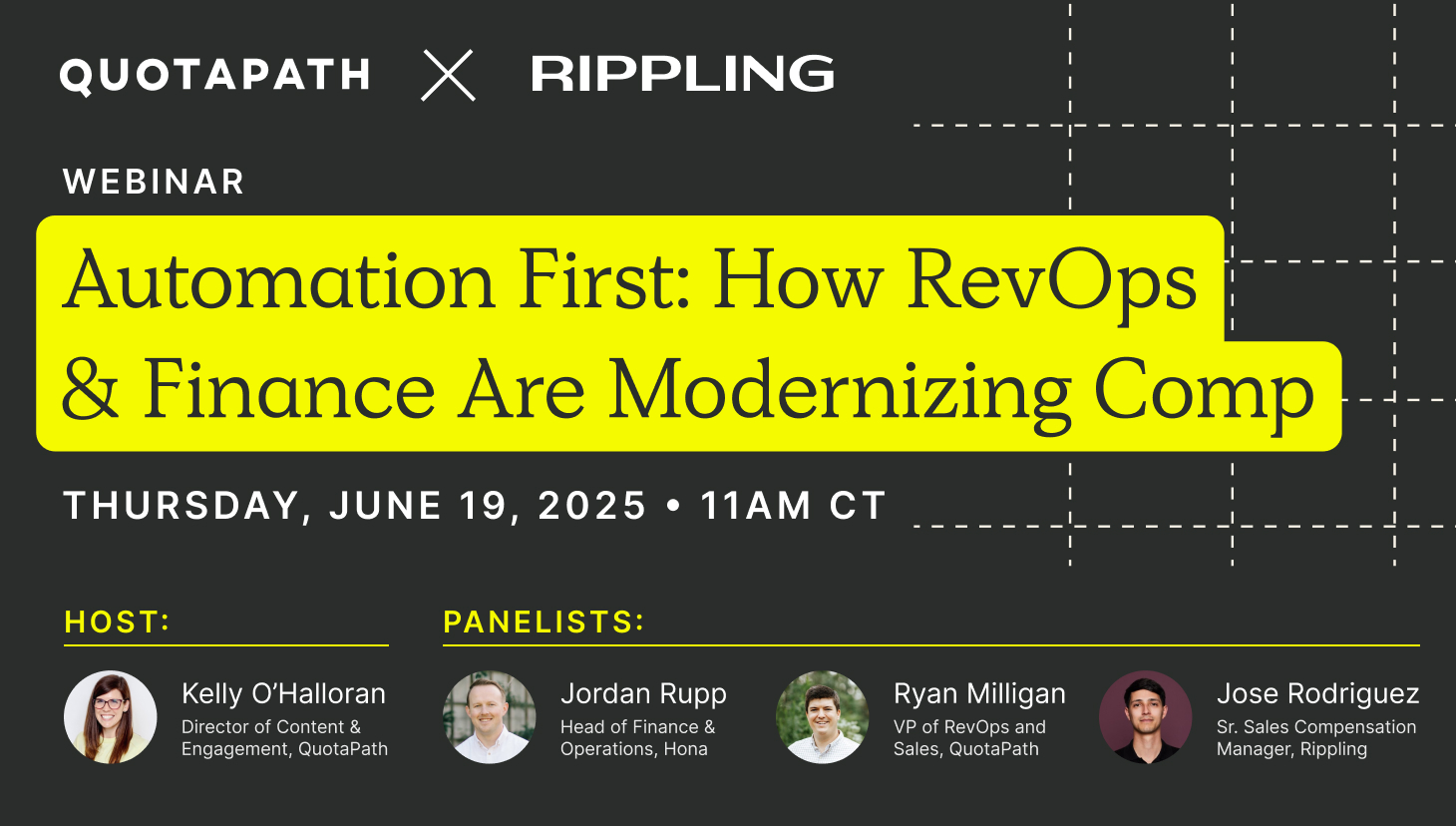
Webinar: How RevOps & Finance Are Modernizing Comp
Join QuotaPath, Rippling, and Hona to learn how top companies automate compensation workflows from calculation to payroll.
Watch RecordingThe Cost of Waiting Starts with Accuracy
Manual systems can “work” until a single bad cycle causes real damage. Reps lose confidence in the accuracy of their commission payments, potentially leading to rep turnover.
Spreadsheet errors are not edge cases
Manual compensation processes result in errors ranging from 3% to 8% of total incentive payouts. Formula errors, version control issues, manual overrides, disconnected data sources, and handoffs between systems are common causes of inaccurate payout calculations. So, it’s not surprising that these errors occur.
“Calculating commission is such a high-risk, low-reward activity,” Ryan said. “A rep never says thank you for doing the math right, but they definitely get annoyed when you do the math wrong.”
Payroll mistakes carry outsized consequences
“There are no accounting emergencies unless it has to do with payroll,” said Amy Walker.
- Commission payouts are emotionally charged because they are tied to personal income.
- Errors create immediate escalation as reps initiate dispute resolution.
- Payroll-related mistakes damage credibility faster than many other accounting mistakes, causing reps to lose confidence and trust in the accuracy of their payouts.
“I’ve seen orgs lose top reps by messing up their commissions over and over again,” said Ryan. This is why commission should be treated with the same seriousness as payroll operations, not like a side spreadsheet Finance fixes at month-end.
What Finance Loses by Staying in Spreadsheets
Beyond the administrative burden of spreadsheets, Finance loses visibility, confidence, and speed by postponing sales compensation automation.
Less visibility into commission expense
Reliable financials depend on reliable operational inputs. When compensation data lives in spreadsheets, visibility into accruals, real-time payout liability, and plan performance and payout patterns is limited. If compensation data is messy, downstream planning is weaker.
Even routine activities, like preparing for board and planning conversations, are slower because data must be cleaned and reconciled first, delaying insights and reducing confidence in the numbers being presented.
More audit and compliance risk
Commissions do not live in isolation. They connect to close processes, expense recognition, and financial controls. However, sticking with manual commission processes results in a weak audit trail and inconsistent documentation. Signoff and reconciliation, often completed via email, is harder. Consequently, spreadsheet-based approvals are difficult to defend and review later.
“If your bookkeeping isn’t right, the rest of it’s not right,” said Amy Walker. Messy data and documentation increase audit and compliance risk.
Slower close and more last-minute anxiety
Emotionally draining manual reconciliations mean more time spent checking formulas and correcting disputes in hopes of catching errors before submitting commission calculations for payroll. It’s scary to rely more on specific people who “know the spreadsheet.” And if they aren’t available, payroll could be delayed, further raising the payroll timing pressure.
“The mistakes in these processes typically happen when there’s some kind of handoff,” said Jordan. Regardless of how hard you try, the handoff between commission calculation and payroll is where risk often peaks.
What RevOps Loses by Staying Manual
Finance isn’t the only one affected by manual commission processes. RevOps teams are rarely hired to babysit spreadsheets, yet too much of their time goes to that.
Time gets consumed by maintenance, not strategy
Manual commission management is “very difficult,” said Jose. Pulling data, checking logic, handling disputes, answering “how did you calculate this?” questions, and updating formulas for plan changes become more complex as teams grow. “Large team size and operational complexity made automation an immediate need,” said Jose.
Less time for modeling and forecasting
For leaders trying to support a growing sales team, it can be easy to automatically think of hiring another staff member based on invoice volume and closed-won deals. However, manual commission systems keep teams reactive instead of strategic.
Focus on systems to address processes first, before adding staff to handle that process. This frees up time for more strategic measures such as scenario modeling, quota planning, territory strategy, GTM experimentation, and incentive alignment. The result is improved productivity and profitability, while reducing stress and anxiety.
Slower comp plan iteration
The goal is getting to the point where you “have the comp plan drive the behavior you want, to close better revenue for the business,” said Ryan. This process requires consistent review and adjustments based on performance data and feedback.
However, staying with manual commission processes makes it hard to test new incentives and align comp with changing revenue priorities to drive desired behaviors and organizational objectives. Instead, plan changes often feel risky because every spreadsheet edit introduces a new risk: either blowing the budget or not incentivizing reps sufficiently.
The Trust Cost Is Often Bigger Than the Time Cost
Compensation is emotional, and manual processes create uncertainty that spreads quickly. Reps want visibility into how they are paid. When Rippling’s reps were finally able to see their earnings daily, it was evident that visibility was something reps had wanted “for a very long time,” said Jose.
If reps cannot see the math, they build shadow calculations, disputes become common, and confidence in Finance and RevOps drops. “The last thing you want is your sales team to not have confidence in you as their business partner,” said Jordan. If you screw that up, it is difficult to overcome.
Trust is not built only by being accurate. Trust is built through transparency, timeliness, and consistency. “I don’t want reps wasting time coming and arguing with accounting and finance about how they’re being paid. I want them closing deals,” said Jordan.
Automation not only provides transparency and accuracy by modernizing compensation from a platform perspective, but it also modernizes compensation from a relationship perspective. It gets Finance, Sales, and RevOps on the same page and enables collaborative win-win communication that drives organizational results.
Automation Gives Teams More Than Time Back. It Gives Them Peace of Mind.
Teams often buy automation, thinking they are buying speed, but what they actually gain is confidence, control, and consistency.
“It was kind of like a breath of fresh air,” said Jordan. “I thought, ‘Oh, this will save us time.’ But I’ve realized, as we’ve used it, it’s really just getting more peace of mind.”
- Fewer handoff errors: When Finance teams run their jobs-to-be-done through shared, connected processes, they eliminate the chances of errors that arise amid handoffs.
- Cleaner payroll process: Integrations throughout the payroll process simplify it to a click.
- Stronger confidence that what reps see is what they get paid: When reps can see what they earn as deals close, they stop shadow accounting and trust Finance and the accuracy of their paycheck.
- Reduced anxiety for Finance and RevOps each cycle: Eliminating manual processes prevents the errors that made payroll so scary and stressful each time it was run.
Why the Best Time to Automate Is Earlier Than Most Teams Think
Companies often wait until there are too many reps, plans, exceptions, or disputes to automate sales compensation. However, rapid hiring compounds spreadsheet risk, making cleanup work harder. Undocumented comp plans are harder to automate later, too.
Although team size and complexity are forcing functions, they should not be the first trigger. “I think it should be day one,” said Jordan. Besides, automation is easier to adopt before complexity explodes.
The right time is not when spreadsheets fail publicly. By then, it’s too late because the damage has already been done, and reps have lost confidence in Finance and payroll accuracy. The right time is before spreadsheets become a hidden tax on growth. “The earlier you can set up a system to scale, the easier it is to actually scale in the way that you want,” said Ryan.
QuotaPath ROI Calculator
Calculate the potential return on investment for implementing QuotaPath in your organization.
Use CalculatorCommission Automation Is a Finance ROI Story
Companies automate CRM, payroll, financial systems, and reporting tools, yet commissions are often left in manual spreadsheets. Waiting until the costs and operational risk become visible only makes the transition harder.
Commission automation is ultimately a finance ROI decision. It reduces payout errors, improves audit readiness, speeds up close, and provides real-time visibility into commission expenses. At the same time, it frees RevOps to focus on modeling and forecasting, improves rep trust, and reduces friction across teams.
Finance and Sales do not need to operate as opposing sides. A well-structured compensation process aligns both teams around shared goals, creating better visibility, stronger collaboration, and more predictable business outcomes.
Design, track, and manage variable incentives with QuotaPath. Give your RevOps, finance, and sales teams transparency into sales compensation.
Talk to SalesConclusion: The Cost of Waiting Is Higher Than the Cost of Change
Spreadsheets feel cheap until you measure what they are costing across the business. Commissions should not be the last mission-critical process left in spreadsheets. Every delayed automation decision has a hidden cost in trust, accuracy, and strategic focus. Modern teams should treat commission automation like core infrastructure, not a back-office afterthought. Schedule a demo to see how QuotaPath connects your pipeline to payroll in a single, automated workflow, giving you greater peace of mind.