Commission system migrations rarely happen without a strong trigger. Switching commission software is a decision typically inspired by common breaking points.
Spreadsheet errors and rep disputes due to broken formulas, or slow payout cycles due to time-consuming manual calculations, often motivate change. For instance, “It was a dumpster fire every single month when we went to pay them.” Cara Hickey, Senior Manager of Global Sales Compensation at AlphaSense, describes their experience with a previous comp tool before switching to QuotaPath.
Lack of visibility for reps and leadership, and the scaling complexity introduced by new roles, plans, or geographies, often reveal process weaknesses. “We were told we couldn’t make core changes to our comp plan eligibility. That was the final push to reevaluate QuotaPath.” Emma Wilkinson, RevOps Manager at Moxo, recognized they had outgrown their solution.
Sometimes, the need to change is driven by a platform that doesn’t meet your needs, as Randy Lafursky, President at Core Imaging, explained, “Palette was a great stepping stone, but it was tough to use, for both us and the reps.”
Although switching commission systems can feel risky and disruptive, migration is a controlled, step-by-step process when done right. In this blog, we show you what to expect from vendor selection to go-live, plus tips to avoid common pitfalls and delays.
Key Takeaways
- Commission system migrations are triggered by operational risk. Spreadsheet errors, payout delays, and scaling complexity usually signal it’s time to move on.
- A successful commission system migration follows a structured process. Internal alignment, data cleanup, implementation, testing, and onboarding reduce disruption and risk. Switching commission software doesn’t have to be slow or chaotic. With the right preparation and partner, most teams can go live in 30–90 days and see immediate operational improvements.
Phase 1: Vendor Selection & Internal Readiness
Before any data is moved, the real work starts with preparation. To select a commission system that fits your organization, your team must first align on needs and priorities. Clarifying internal requirements makes vendor comparisons more objective and ensures evaluation criteria reflect operational reality—not just feature lists.
Defining What You Actually Need
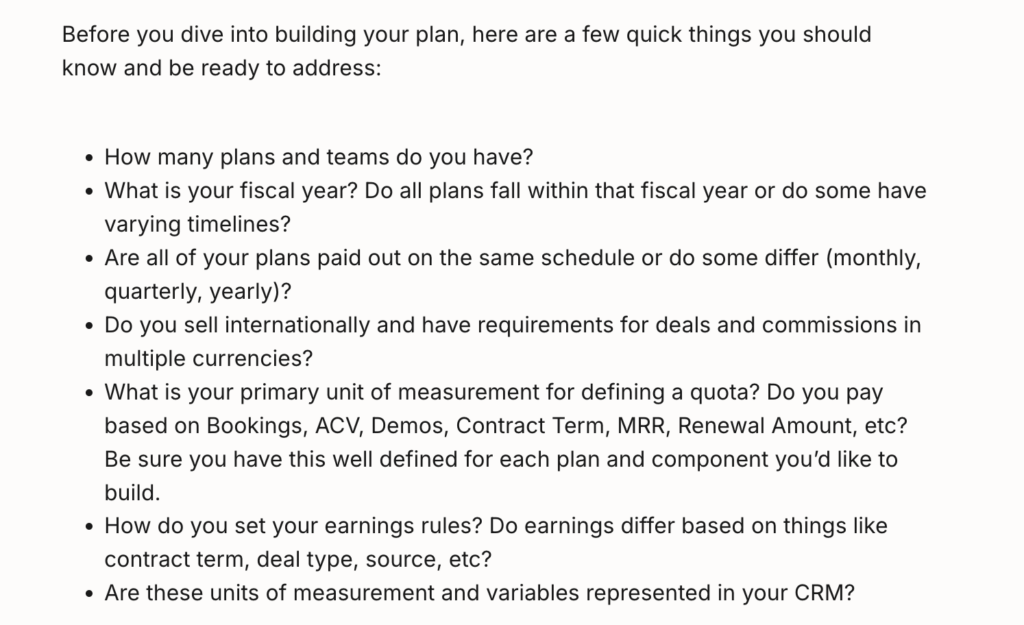
Before selecting a vendor, teams should answer some key questions internally:
- How complex are your current comp plans?
- How often do plans change?
- Who owns commissions today (Finance, RevOps, Ops)?
Aligning Finance, RevOps, and Sales early simplifies vendor selection by clarifying priorities. It ensures the system drives strategic revenue goals rather than simply tracking individual commissions. Otherwise, organizations risk choosing tools that do not support complex compensation structures, leading to inefficient processes, inaccurate payments, and reduced sales reps’ trust.
Evaluating Commission Software Vendors
Once the team has defined its needs and priorities, it’s time to consider which solution best meets those requirements. The following evaluation criteria will help you choose the best commission system for your organization.
Time-to-value and onboarding speed
Consider how long it will take to set up the new commission system, including training your team and getting commissions running. A fast, quality onboarding process shortens time to value and reduces frustration.
Self-serve vs vendor-dependent plan changes
Look for a platform that makes it easy to adjust plans without contacting support to build and manage compensation plans.
CRM integrations and data reliability
Confirm that the commission system offers native integrations for your CRM and payroll system. Data pulled automatically from your CRM, assuming it’s accurate, streamlines commission tracking and error-free payroll runs.
Compliance readiness (ASC 606)
Ensure that the commission tracking software you select supports the ASC 606 revenue recognition standards documentation requirements. Leaving your accounting teams to recognize commission expenses manually increases your risk of non-compliance.
Support model and post-sale partnership
Whether you’re new to a tool or experienced with it, when you have questions, you need answers. Carefully assess the support mechanisms and availability for each prospective commission system vendor you evaluate. Do they have a comprehensive self-serve knowledge base and live support options with a rapid response? Check out the reviews to see what others are saying about their support options and responsiveness, too.
Phase 2: Pre-Migration Planning & Data Prep
Once a vendor is selected, migration success depends on data readiness. Cleaning up existing compensation plans and CRM data increases the success of commission software implementation.
Auditing Your Existing Comp Plans
Migration is the best time to simplify. Start by cleaning up legacy plans to configure the new system with accurate data for a seamless commission software implementation, accurate costs, and increased sales team adoption.
Documenting key information, such as roles and plan owners, quotas, rates, accelerators, bonuses, and spiffs, as well as payout frequency and fiscal calendars, also streamlines sales commission system onboarding.
Getting CRM Data Migration-Ready
Clean CRM fields ensure accurate commission calculations, prevent payout errors, and increase confidence in sales performance data. Clean data also improves forecasting and shortens pay cycles.
Common issues uncovered during prep include missing fields tied to compensation logic and inconsistent deal stages or amounts. This type of dirty data causes automation failures and inaccurate reporting. Involving CRM admins early in the migration process simplifies the process and increases implementation success.
Phase 3: Implementation & System Setup
This is where spreadsheets officially start to disappear. You create compensation plans, and sync and validate deal data in the new commission system.
Building Compensation Plans in the New System
The first step in eliminating spreadsheets from the sales commission process is to create a compensation plan in your new platform. Modern tools, like QuotaPath, think about compensation plans in terms of roles and components. For instance, is the plan for an account manager (AM), sales development rep (SDR), or sales manager?
Examples of components include:
Quotas: The amount of sales that a salesperson or sales team is expected to achieve in a designated timeframe.
Accelerators: A commission structure that rewards sales reps for exceeding their sales targets.
Bonuses: An incentive for meeting or exceeding a pre-defined goal, either calculated as a percentage or a set reward amount.
Spif: a short-term incentive designed to motivate salespeople to achieve specific goals.
Best practice: Start with a base plan, duplicate it, and build on it.
The SPIF Report
Curious how top revenue teams use SPIFs and accelerators to align with key business goals and drive measureable results? Our latest report below dives into our data from $7.3M in sales incentives
View ReportSyncing and Validating Deal Data
Now that you’ve created comp plans in your new commission system, it’s time to initiate communication between your deal data source and your new platform with a pre-built integration or API designed for your CRM. Sync your data to authenticate your CRM. Don’t worry, this process doesn’t add or override any CRM values; it is a one-way sync of data into your new commission system.
After authenticating your CRM, you need to map data to each plan and component. Each plan component may trigger different values or rules. So, aligning data at the plan and component level ensures accuracy in the sales compensation automation process. Involving the CRM administrator in this process may help to map the correct fields in your CRM system.
To confirm everything is properly mapped and syncing, take a couple of validation steps. Start by running payroll in your new commission system with historical deal data. Then spot-check earnings against prior payouts previously paid for those deals. Are they accurate?
Parallel Runs & Testing
Parallel payroll testing is a crucial step in the final phase of commission software implementation, running the old commission system and the new system side-by-side for a designated number of commission cycles. This helps to ensure that the new systems calculate commissions, taxes, accelerators, and bonuses accurately before fully switching to commission software. It also allows you to adjust settings if any discrepancies arise.
Using test periods builds sales rep and leadership trust in the new commission system, providing peace of mind and confidence in future commission payout runs. Then once you’re certain the new commission system is running smoothly, you’ll know when it’s safe to sunset spreadsheets and rely solely on your new solution.
Phase 4: Team Onboarding & Change Management
A technically correct system still fails without rep adoption. Sales reps, Finance, RevOps, and Admins are more likely to actively use the new commission system if they know how to use it and the benefits.
Onboarding Sales Reps
After your data is validated, it’s time for the sales commission system onboarding. Set up your reps and invite them to start exploring the new system. Show them how to navigate the platform and address what they care most about, namely, ‘How much am I earning?’ and ‘Can I trust this number?’
Make them aware of the test period to help build trust in payout accuracy as the process advances. Then orient them to the system’s dashboards and show them how to forecast future earnings based on potential deals. Real-time visibility will motivate reps to push harder by revealing how close they are to hitting milestones, prioritizing deals that will help them reach key goals, and encouraging them to keep selling even after exceeding targets.
Training Finance, RevOps, and Admins
Providing training to Finance, RevOps, and Admins when switching commission software builds their confidence in using the new tool, reducing their dependency on vendors. [Ongoing ownership vs one-time setup]
Support responsiveness is essential, especially during the first payout cycles. Teams need their questions addressed promptly to ensure payroll is accurate and isn’t delayed while awaiting support team responses. Prompt responses also boost confidence and help prevent frustration as you adjust to the new commission system.
Phase 5: Go-Live & First Payout Cycles
Go-live isn’t the finish line; it’s the real beginning. It is the start of the operational phase where processes are optimized, progress is monitored, and training continues to ensure success.
Commission system “go-live” marks the exact moment when you transition from testing your new system, making it the active system of record for calculating and paying sales commissions. This is also the moment when you stop planning and start enjoying the benefits of your new sales commission system.
During the first 1-2 payout cycles, it’s normal to receive more questions. You’ll also make final tweaks to plans or mappings based on feedback to improve payout accuracy. Success indicators during the initial “go-live” period are faster payout processing, fewer disputes, and higher rep confidence in the accuracy of earnings calculations.
Design, track, and manage variable incentives with QuotaPath. Give your RevOps, finance, and sales teams transparency into sales compensation.
Talk to SalesWhat a Smooth Commission Migration Looks Like with QuotaPath
Let’s bring it all together with a concrete example.
AlphaSense smoothly transitioned from a competitor to QuotaPath within 90 days. Here’s their high-level implementation timeline:
- Rapid proof of value without needing support. “I spun up seventy-five percent of our plans, and I got them working by myself,” explained Cara Hickey, Senior Manager of Global Sales Compensation at AlphaSense.
- Hands-on implementation support (not ticket-based). No long delays, limited responsiveness, and inability to operationalize complexity. QuotaPath’s implementation model included a comprehensive array of communication options and materials that removed friction and offered real-time collaboration.
Technical flexibility and support with their “messy” CRM constraints. QuotaPath’s team even built calculated fields on the backend! - QuotaPath empowered the Admin team and provided backup as needed. Admins operated autonomously while leveraging a true partnership with QuotaPath.
AlphaSense saw immediate operational ROI, with measurable improvements in accrual time, reduced end-of-quarter chaos, real-time visibility for reps, and increased capacity for compensation strategy.
They experienced fast onboarding and leveraged native CRM integrations, self-serve plan management, and ongoing support and consulting for a smooth sales commission migration.
This is not an isolated example. “QuotaPath has this amazing commission tool migration checklist, and the CS team sets up the plans for you. Onboarding was perfect to a T,” according to Kim Stithem, Controller at CFI.
Schedule a demo to see how quickly you can be live in QuotaPath with fast time-to-value and low implementation lift.