At the Operators’ Guild Summit in Chicago, I opened my session with a show of hands: who already runs a consumption- or usage-based revenue model, and who expects to soon.
About a third of the room raised their hands.
Sure, that was a smaller sample size, but it lines up to what’s happening on a much larger scale. For instance, in ICONIQ’s 2026 State of AI report, the share of AI builders using consumption-based pricing jumped from 35% to 42% in just six months.
AI-embedded products are moving revenue from pre-booked contracts to consumption. Most comp plans haven’t caught up.
I’ve worked across data science, marketing, RevOps, and sales leadership, and I’ve reviewed more than 500 comp plans in the past five years.
My session answered one question for finance and revenue leaders: how do you use incentive comp to win high-quality customers and protect margin at the same time?
Key takeaways
- Shift your model. When profit varies widely, comp on profit instead of revenue. Separate quota retirement from the payment schedule. Pay a percentage up front and the rest over time.
- Invest in scoring. Propensity to expand is central to this model. Predicting 12-month profitability is what makes upfront payment possible.
- Treat the comp plan as the lever. Reward sellers for closing great-fit customers, and use the plan to drive the right behavior across your entire go-to-market org.
Here’s the framework I shared.
Design, track, and manage variable incentives with QuotaPath. Give your RevOps, finance, and sales teams transparency into sales compensation.
Talk to SalesTraditional SaaS comp was built on predictability
For most of the SaaS era, incentive comp rested on three assumptions.
You comped on revenue. Each role earned a percentage of booked revenue. The moment a deal was signed, everyone knew what variable comp it would generate.
You paid on bookings. Cash collection was reliable, so paying at signature made sense. Reps got rewarded right away, and finance could plan around it.
You knew your margin. Most revenue was created equal. Commission spend was a predictable line in the margin stack.
That predictability produced benchmarks most operators still use. A seller’s quota landed at 3.5 to 5 times their OTE, putting AE commissions at roughly 10% to 14% of revenue. Quota was a function of deal volume and ACV. Total commission cost stayed under 20% of ARR.
Here’s the practical benchmark I use to break that spend down by role:
| Role | Commission spend (% of new ARR) |
|---|---|
| Account executives | 10% |
| SDRs and BDRs | 2% |
| Sales managers | 2% |
| SEs, partners, and overlay roles | 2% |
| VP of Sales or CRO | 1% |
| Marketing | 1% |
| Total | 18% |
Want to see where your own plan lands? Plug your roles into our Total Commission Rate Calculator to find your blended rate.
The model worked because the inputs held still. Consumption pricing moves all of them.
Consumption pricing breaks the old model
In a usage-based model, two customers who sign the same contract can end the year in very different places.
That variability touches every assumption comp was built on.
| Traditional SaaS | Consumption and usage-based | |
|---|---|---|
| Revenue | ARR is a stable, predictable unit | Usage varies customer by customer |
| Gross margin | Consistent, typically 75% to 80% | Can swing 20 to 40 points based on how customers use the product |
| Commission trigger | Close the deal, book revenue, pay commission | Land and expand drives success and the commission schedule |
The upside is real.
Deloitte found that usage-based companies grew revenue 38% faster year over year than the broader SaaS index, and PwC notes that shifting from seat-based to hybrid, usage, or outcome models “can reset your revenue engine.”
But for a CFO or COO, the shift also raises three hard questions:
- How should I design my org in a land-and-expand model?
- How and when should I pay my team?
- What behavior am I trying to motivate?
The answers point to a different kind of comp plan.
Five principles for comp in a usage-based world
My framework rests on five shifts.
Each one answers a piece of the margin and motivation problem. (For real-world plan examples, see our report on usage-based compensation plans.)
1. Extend seller responsibility (and comp) past the signature
In a classic handoff model, the AE closes the deal and walks away. Implementation takes the first couple of months, account management carries the customer to renewal, and the AE has no stake in what happens after signature.
That works when revenue is locked at signing. In a consumption model, the real revenue shows up after the deal closes, as the customer adopts and expands. So the AE needs to own the relationship through the first renewal, with CS and account management executing underneath.
Their comp should measure adoption and expansion along the way. That’s why rewarding post-sale involvement is a core rule of engagement for usage-based plans.
2. Pay on profit when margin varies
ARR stops being a reliable commission unit when:
- AI token costs spike mid-contract
- Customer usage patterns are unpredictable
- Two deals with the same ARR carry very different margins
I recommend using 12-month projected gross profit.
It rewards your team for bringing in healthy-margin customers. The catch: you need a way to assign and track profitability for each customer.
3. Predict usage and profit at the point of close
Here’s the core challenge. Four customers can start at the same $500 a month and land in completely different places a year later.
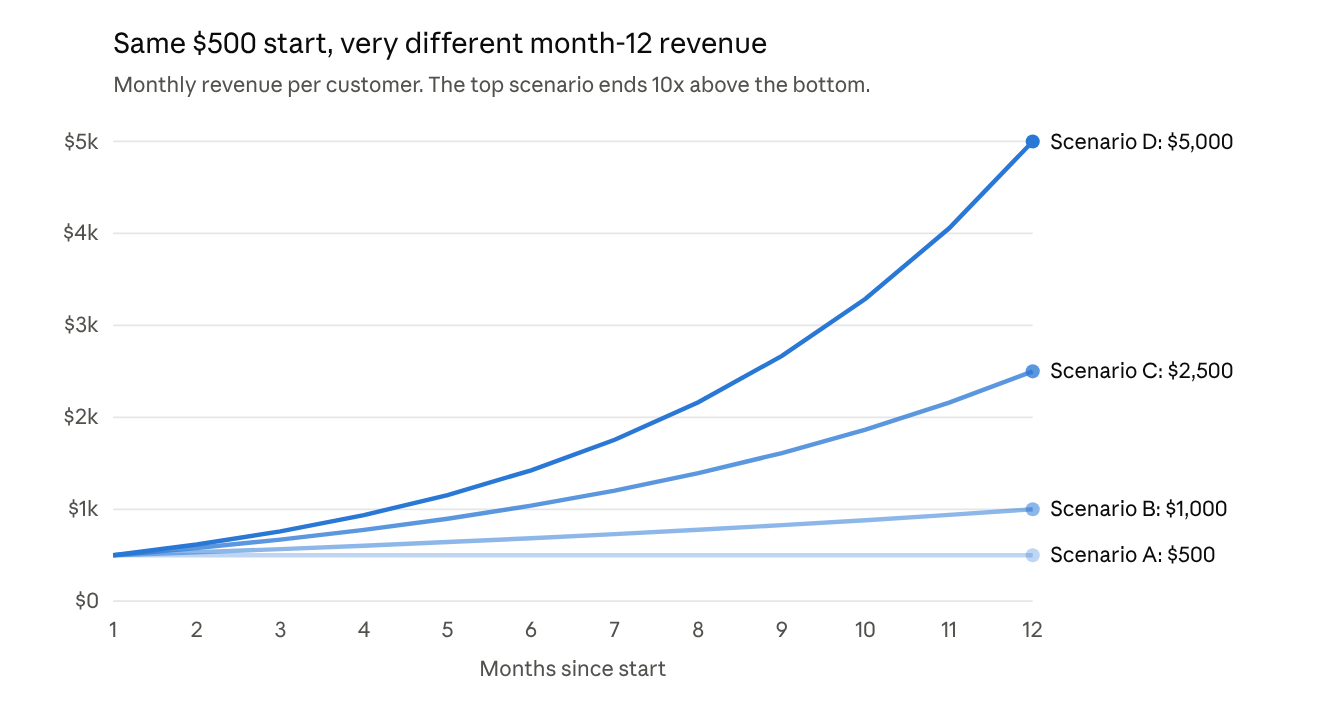
If you can predict where a customer will land, you can comp on it. That takes work from two teams.
Marketing and data build an ICP tied to propensity to adopt, then a scoring model applied at signature. The score combines propensity to use with the projected margin profile, and it drives both quota retirement and the release of commissions.
Sales sees predicted annual profit during the sales cycle, so AEs can prioritize high-margin deals. Projected 12-month profit retires quota on its own track, separate from the payment schedule.
Here’s an example scoring model I shared:
| Input | Example value | Weight |
|---|---|---|
| Platform fee (direct revenue anchor) | $10,000 | 40% |
| Project utilization | 75 projects per year | 25% |
| Pilot adoption rate | 20 of 250 total headcount (8%) | 20% |
| Expansion potential | 230 seats addressable | 15% |
The output: $12,000 in projected 12-month profit, with a medium confidence rating. That number is what the AE retires quota against.
4. Separate quota retirement from the payment schedule
In traditional SaaS, quota retirement and commission payment happen at the same moment. In a consumption model, they need their own timelines. Quota retires at close, based on projected profit, so reps see credit for the deals they win. Payment follows a schedule that reflects how revenue actually arrives.
5. Pay part of the commission at close and the rest as invoices come in
When it comes to commission payment terms, both extremes create problems. Paying 100% on bookings leaves finance exposed to cash flow surprises. Paying 100% on cash received drips commissions out over months and kills motivation.
My recommended zone sits in between: 50% at closed-won and 50% as year-one invoices come through. Reps get a meaningful reward at signature, and the business pays the rest as revenue actually arrives.
When profit is hard to predict
Not every business can score profitability at signature yet. For those teams, I recommend one of two fallback options.
- Anchor on the committed portion of the deal. Retire quota and release commissions on minimums or platform fees, then pay the rest on cash received.
- Release less up front. Pay out a smaller share of projected 12-month gross profit at signature to account for the range of possible outcomes.
The second option also explains why the right upfront split varies. The less confident you are in your profit prediction, the smaller the share you should release at close.
Use your comp plan to show sellers what great looks like
Usage-based pricing can feel like a black box to sellers at the point of sale. Reps disengage when they can’t predict their comp. And plan complexity kills performance.
A well-built plan solves for that. In my view, great looks like this:
- Quota retires on projected 12-month gross profit, with a split payout schedule
- Rate accelerators reward ICP customers with high propensity to expand, which matters most when profitability is hard to predict
- Roles, responsibilities, and payment schedules are clearly defined for every seller
Design your plan with Atlas
I closed the session with a live demo of Atlas, QuotaPath’s comp intelligence layer for consumption pricing, variable margins, and AI-era go-to-market teams. Atlas is trained on tens of thousands of comp plans and revenue outcomes in QuotaPath.
You can design any plan against your own revenue plan and business model, then push it into QuotaPath to pay commissions.
In the demo, I gave Atlas this prompt:
I’m the CFO of a $10 million ARR business launching a new AI-powered consumption-based product with varying margins on a customer-by-customer basis. I’m trying to design a compensation plan for my account executives that protects the margin of the business while properly rewarding the AEs for closing great deals. Help me design this.
Atlas came back with a complete plan:
| Plan element | Recommendation | Cost impact |
|---|---|---|
| Primary pay basis | Year-one expected gross profit dollars for the AI product | Aligns payout directly with margin |
| Deal structure | Split the deal into fixed commit or platform fee and variable usage | Rewards predictable revenue while controlling volatility |
| Payout timing | 25% to 30% at booking, 70% to 75% as usage revenue is invoiced or collected and margin is realized | Limits overpayment on under-consumed or low-margin deals |
| Margin eligibility | Set a minimum margin floor for full credit and accelerators, with approval required below it | Protects the business from uneconomic deals |
| Accelerators | Keep them modest, such as 1.0x to target, 1.25x above 100%, and 1.5x above 125% | Avoids margin leakage at the high end |
| Quality modifiers | Small uplifts for prepay, annual commit, multi-year, and ICP fit | Rewards great deals without overcomplicating the plan |
The 25% to 30% upfront split sits below my 50% benchmark. That lines up with my fallback advice: the less certain the profit prediction, the less you release at close.
Ready to rethink your own plan? Try Atlas free or book a demo.