
Organizations are starting to review their current commission plan as they plan for the next sales year. Although many think of it as a sales effort, this commission plan review should be a controllership exercise, not a sales planning exercise.
While Sales asks, “Is the plan motivating?” Finance should ask, “Is the plan accurate, accrual-clean, and auditable?”
October is the ideal time for this review because Finance has nearly a full year of actual performance data. Accounting teams can identify where commission costs diverged from budget, uncover accrual or payout issues, and determine whether the plan’s cost behavior holds up under an accounting lens. If it doesn’t, there’s still time to make changes before 2027 locks in.
Below, we’ll outline your commission accounting checklist for October.
Key Takeaways
- October is the best time for accounting teams to stress-test the current commission plan for cost accuracy, accrual, and audit readiness.
- Clearly document commission expense rules for accrual, payment, and reversal timing to avoid most year-end accrual cleanups.
- A high override rate usually means plan rules are unclear, hard to administer, or misaligned with real deal structures.
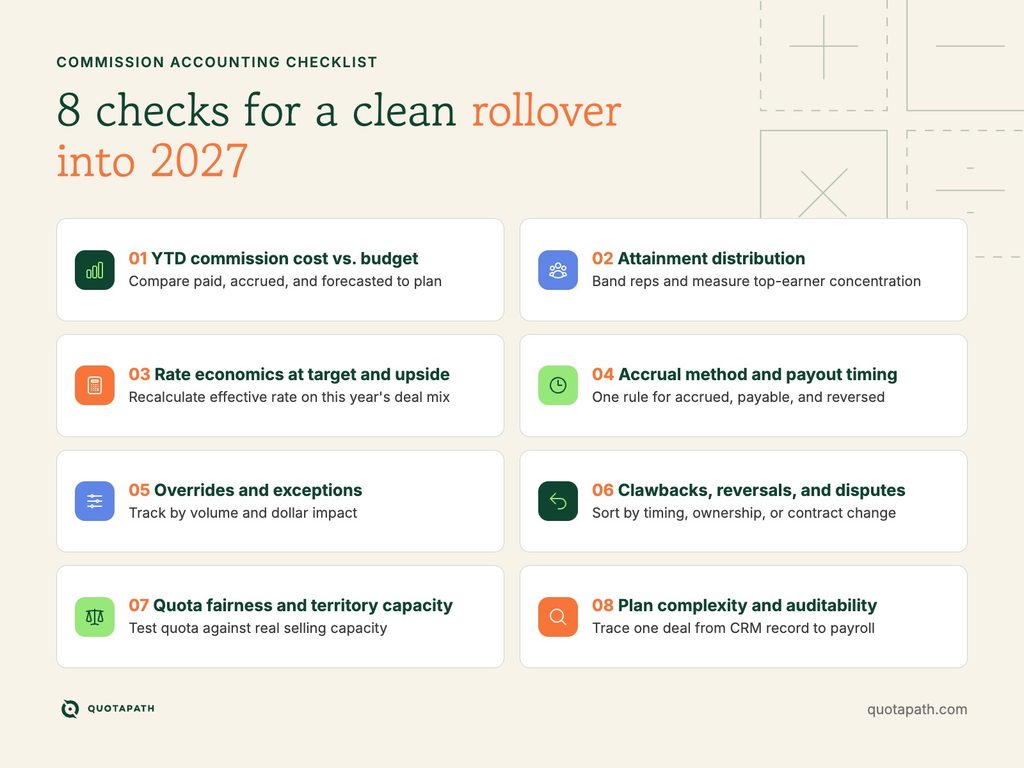
Commission Accounting Planning Checklist
Catch sales compensation cost problems before they compound into next year’s budget. Use this checklist to review the current commission plan for GAAP accrual, cost of sales, budget variance, and auditability issues, so you can start 2027 accurately.
- Year-to-date commission cost vs. budget
Compare actual payouts, accruals, and forecasted Q4 payouts against plan. This establishes whether cost of sales is tracking to what finance expected before the same economics roll into next year.
Tip: Don’t just compare paid commissions to budget. Build a three-part view of paid, accrued, and forecasted through year-end so you can tell whether a variance is just timing-related or a real cost-of-sales issue.
- Attainment distribution and payout concentration
Look at how payouts spread across the team: too many reps far below plan, clustering at threshold, or concentration among a few outliers. This signals quota-setting or rate-shape problems that will distort next year’s budget.
According to Alexander Group, ⅔ of sales reps should achieve or exceed quotas to ensure a balanced payout. Companies that don’t follow the ⅔ attainment guideline end up with high incentive costs and missed company goals.
Tip: Group reps into simple attainment bands — under 50%, 50–80%, 80–100%, 100–120%, and 120%+ — then separately measure how much of total commission expense sits with the top 10–20% of earners. That shows whether next year’s budget depends too heavily on a small group of outcomes.
- Commission rate economics at target and upside
Recheck whether rates still make sense relative to quota, gross margin, and pay mix. If pricing, ACV, renewal mix, or sales motion shifted this year, next year’s rates may not produce the intended cost at 100% attainment.
Tip: Recalculate the effective commission rate at 100% attainment and at upside performance using this year’s actual average deal size and revenue mix, not last year’s planning assumptions. Plans often drift when the selling motion changes but the payout curve does not.
- Accrual methodology and payout timing
Review whether accrual happens on booking, invoice, cash collection, or milestone completion, and whether that still matches how commissions are actually earned and paid. This matters for clean close processes and fewer year-end true-up surprises.
Tip: Document one clear rule for when commission expense is accrued, when it becomes payable, and when it reverses if a deal changes. Most year-end cleanups come from applying those dates inconsistently.
- Manual adjustments, overrides, and exceptions
Count how often finance or RevOps had to intervene. A high override rate usually means plan rules are unclear, hard to administer, or misaligned with real deal structures. As SPM Tribe explains, “As compensation exceptions become normalized across the sales organization, forecasting commission expense becomes difficult, if not impossible.”
Tip: Track overrides by both volume and dollar impact. A few large exceptions usually point to a plan design issue, while many small ones usually point to unclear rules or operational friction.
- Clawbacks, reversals, and crediting disputes
Review where commission expense was reversed or contested. This usually points to plan language, payout timing, or ownership rules that need tightening before the new year starts.
Tip: Sort each one into three buckets: timing, ownership, or contract change. That makes it much easier to see whether the right fix is updated plan language, better process control, or cleaner territory definitions.
- Quota fairness and territory capacity
Test whether quotas were realistically supported by territory potential, lead flow, and headcount ramp. If the denominator is wrong, next year’s commission budget will be wrong even with correct rates.
Tip: Test quota against actual selling capacity, not just the company growth target. A useful finance check is whether the median rep had a realistic path to goal based on territory potential, lead flow, and ramp time.
- Plan complexity and auditability
Review whether the current structure can be explained, reconciled, and audited cleanly. If finance cannot trace payout logic from deal to payroll, the administrative burden and error risk usually outweigh any motivational benefit.
According to Deloitte, “if compensation plans are complex, determining which costs are truly incremental and estimating the period of amortization related to them increases in difficulty.”
Tip: Ask someone outside the plan design process to trace one deal from CRM record to payroll payout. If it takes too long or depends on unwritten explanations, the plan is probably too complex to scale cleanly into next year.
Design, track, and manage variable incentives with QuotaPath. Give your RevOps, finance, and sales teams transparency into sales compensation.
Talk to SalesFinal Thoughts
Determine in October if 2027’s comp structure needs a rate change, quota reset, payout timing change, cleaner definitions, or just better governance.
This decision belongs to finance in partnership with revenue leadership.
Try QuotaPath and Atlas to help determine what to fix in the existing sales comp plan.