
If there’s one thing every revenue leader agrees on, it’s that Customer Success compensation is hard to get right. Designing a plan that motivates retention, rewards expansion, and doesn’t accidentally pit CS against Sales can feel impossible.
That’s exactly why we built The Complete Guide to Customer Success Compensation Plans: What Actually Works.
It’s our most comprehensive look yet at how high-growth SaaS, healthtech, and fintech companies are structuring compensation for 2026, based on hundreds of compensation consultations, QuotaPath data, and the real frameworks teams are using today.
As per usual, it’s ungated. Read the full guide online and download a copy for your planning sessions.
Report: Customer Success Compensation Plans
Build a CS comp model that motivates your team, aligns with your company goals, and scales as you grow
Read Full ReportWhy CS Comp Plans Still Lag Behind Sales Plans
Sales compensation gets all the attention—accelerators, tiering, SPIFFs, and endless debate over base-to-variable ratios.
Meanwhile, Customer Success often gets a flat bonus or a vague “NRR goal.”
As Ryan Milligan, QuotaPath’s VP of RevOps and Sales, put it: “Most organizations over-engineer sales comp and under-think CS comp, even though CS manages the majority of their revenue.”
Your CS team is the backbone of revenue retention. They directly influence 80–90% of your company’s recurring revenue. Yet many teams still struggle to connect pay to what actually drives outcomes, like renewals, expansion, and advocacy.
Four Proven Models That Actually Work
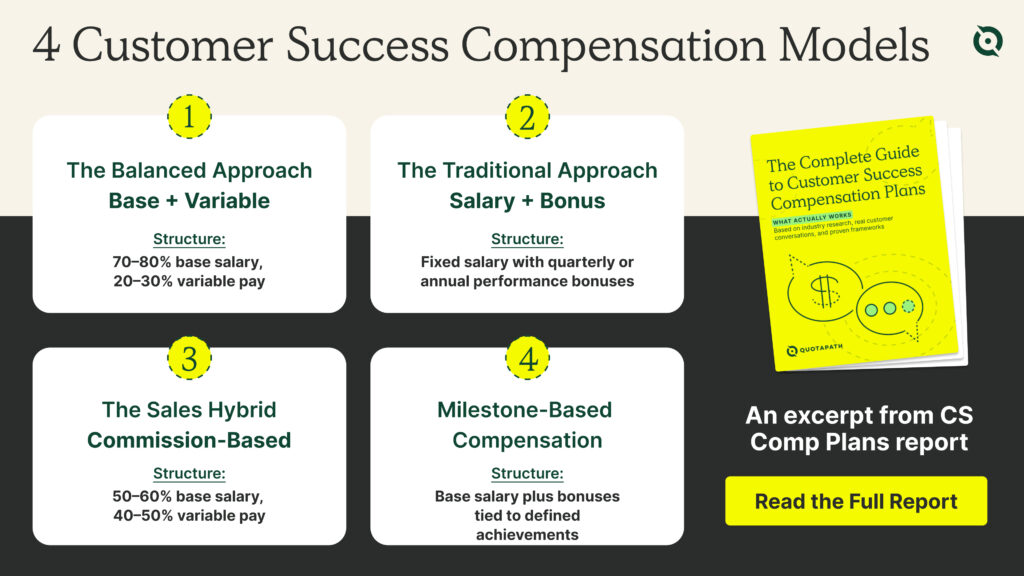
After hundreds of plan reviews, four structures consistently stand out:
- Base + Variable (Balanced Approach)
- 70–80% base / 20–30% variable.
- Rewards retention and upsell metrics equally.
- Works best for established CS orgs with reliable data.
- Salary + Bonus (Traditional)
- Fixed pay with quarterly or annual bonuses.
- Perfect for early-stage teams still maturing metrics or roles.
- Commission-Based (Sales Hybrid)
- 50–60% base / 40–50% variable.
- Ideal for CS teams directly influencing upsells and renewals.
- Milestone-Based (Project Focused)
- Base pay plus bonuses tied to implementation or adoption milestones.
- Great for onboarding or enablement-focused teams.
Each model balances motivation with predictability—a theme that came up in nearly every consultation.
GRR, NRR, and the Metric That Matters Most
When it comes to measurement, most confusion starts with the alphabet soup.
Here’s the quick breakdown we share in the report:
- GRR (Gross Revenue Retention) = How well you keep what you already have.
- NRR (Net Revenue Retention) = GRR + expansion − contraction.
- Expansion Revenue = Growth inside existing accounts.
Ryan Milligan’s take: “Ask yourself whether you’re smoothing earnings or smoothing commission rates. CSMs don’t control when their book renews, so the plan should smooth earnings.”
The guide walks through examples of each model, how to align variable pay with renewal cycles without creating volatility for reps.
What the Best-in-Class Teams Do Differently
Across industries, the top-performing CS organizations share three habits:
- They start simple. Early plans focus on GRR and customer health, not 10 KPIs.
- They evolve with data. As forecasting improves, they add expansion components.
- They separate GRR from NRR. That way, one big upsell can’t mask churn.
These companies treat their CS comp plan as a living system, not a one-time spreadsheet.
Design, track, and manage variable incentives with QuotaPath. Give your RevOps, finance, and sales teams transparency into sales compensation.
Talk to SalesReal-World Examples
Inside the report, you’ll find anonymized snapshots from companies that made the shift:
- Enterprise SaaS Team: 75 / 25 split; retention 60% + expansion 40%; +15 points NRR in 12 months.
- Mid-Market SaaS Provider: Hybrid model with GRR floor of 90%; +25% expansion revenue.
- Healthcare Tech Company: Moved to quarterly GRR-based variable pay; cut churn 8% in two quarters.
Each example includes plan structure, payout logic, and measurable outcomes.
Our Best Advice for 2026 Planning
- Start with clarity. Everyone on your CS team should know exactly how they earn.
- Keep metrics measurable. If you can’t track it cleanly, don’t pay on it.
- Align timing. Pay frequency should match performance cycles.
- Revisit quarterly. Compensation is a strategy, not a set-and-forget line item.
Read the full ungated guide and download your copy here. You’ll get frameworks, formulas, and quotes from dozens of RevOps and CS leaders.
Want additional help designing your 2026 CS plan? Book a free Comp Plan Consult with our team. We’ll help you turn the guide’s models into a plan tailored to your org.