What happens when your commission tool becomes harder to manage than the commissions themselves?
For many RevOps teams, what starts as a system meant to bring structure quickly turns into a source of friction. Instead of saving time, teams find themselves troubleshooting errors, fielding rep questions, and relying on technical support just to make basic updates.
That’s exactly where AirDNA found itself.
As a global data company in the short-term rental space, AirDNA operates with a distributed go-to-market team and increasingly complex compensation structures. But their previous tool couldn’t keep up.
So they made a switch.
This is the story of how AirDNA replaced Spiff with QuotaPath—and turned commissions into a system their RevOps, Finance, and Sales teams actually trust.
Key Takeaways
- Complexity in commission tools often creates more work, not less
- Ease of use and support can outweigh feature depth
- Visibility into earnings builds trust across Sales and Finance
- Flexibility is critical when comp plans evolve mid-year
The Breaking Point: When the Tool Becomes the Problem
When Alejandra Gutierrez, Revenue Operations Associate at AirDNA, stepped into her role, one issue became obvious almost immediately: commissions were taking too much time.
It wasn’t just the calculations; it was everything around them.
“We were spending a lot of time fixing errors, answering questions from the team, and trying to understand the tool,” she explained.
Even simple updates became time-intensive. Every change required a full review of commission structures, and the team couldn’t make adjustments on their own.
Instead, they were dependent on external support.
“You had to request a technical person to make the changes for you,” Alejandra said.
That combination (complexity, lack of autonomy, and constant back-and-forth) created a system that simply couldn’t scale.
Evaluating Alternatives: Simplicity Without Tradeoffs
Once the team decided to move on, the goal wasn’t just to replace their existing tool; it was to fix what had been broken.
They needed something intuitive, flexible, and easy to manage internally.
QuotaPath stood out right away.
“It was really intuitive, really easy to understand… from the first moment,” Alejandra said.
But usability wasn’t the only differentiator.
During the trial period, the level of support helped reinforce their decision.
“We were receiving quick videos with the solution and the steps… it was really easy for us to understand the tool,” she added.
That experience reframed the evaluation process to focus on whether the team could actually own and operate the system themselves.
Implementation: Faster Than Expected, Even With Complexity
After making the decision, AirDNA moved quickly.
Despite managing multiple business units, evolving comp plans, and historical data, implementation took just about a month and a half.
That speed wasn’t expected.
“We expected maybe three months… and in the end, we did it super quick,” Alejandra said.
Even more importantly, the platform proved flexible during implementation.
At the time, their 2026 commission plans weren’t even fully finalized.
That didn’t slow things down.
“All the use cases that we have… it was always doable,” she said.
Instead of delaying progress, the team built, adjusted, and refined plans in real time.
Managing Complexity Without the Fear
As implementation progressed, one of the biggest concerns started to fade: whether the system could actually handle their complexity.
AirDNA’s comp structure includes multiple teams, business units, and layered incentives.
Initially, there was hesitation.
“At the beginning, we were a little bit scared… if this is going to work or not,” Alejandra shared.
But that concern didn’t last long.
“It was super easy… now we are super confident. We don’t have any errors,” she said.
Three months in, the team was operating confidently.
HubSpot Integration: From Data Sync to Full Visibility
With HubSpot as their CRM, an integration was critical.
QuotaPath allowed AirDNA to map fields across different plan components, supporting their varied commission logic without limitations.
“I really like that part of the HubSpot integration… we have all the possibilities,” Alejandra said.
But the real impact showed up in visibility.
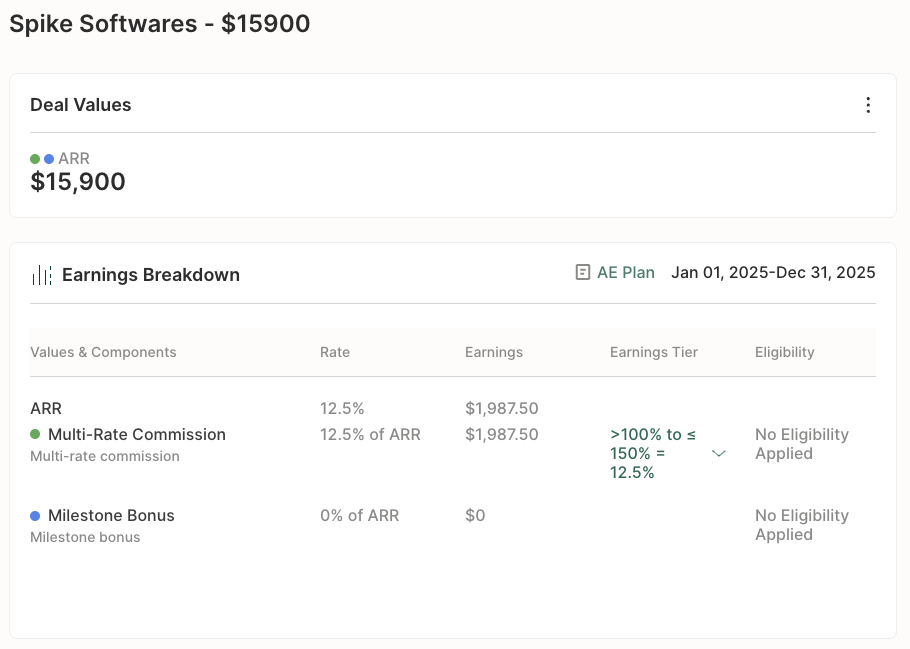
Instead of just seeing final commission totals, both RevOps and reps could now access detailed, real-time data.
“It helps us have more visibility… not only the final earning number,” she explained.
That shift, from outputs to full transparency, changed how commissions were understood across the organization.
Rep Experience: Fewer Questions, More Clarity
In addition to supporting RevOps, QuotaPath transformed the rep experience.
Sales reps can now:
- See how each component contributes to their earnings
- Forecast commissions before closing deals
- Access compensation plans directly within the platform
“This is something that is really visual… we didn’t have it before,” Alejandra said.
The result is fewer questions, less confusion, and more trust in the numbers.
Instead of relying on RevOps for answers, reps can find what they need themselves.
Adapting Compensation Plans Without Risk
As with most growing companies, AirDNA’s comp plans don’t stay static.
Quotas change. Goals shift. Incentives evolve.
Previously, those updates were painful and risky.
Now, they’re simple.
“It’s pretty simple… just go to the plan, adjust it, and update it,” Alejandra said.
Even more importantly, historical data remains protected.
“We can block past data… and make changes moving forward. That gave us confidence,” she explained.
That ability, to evolve plans without breaking what’s already been calculated, removed a major source of hesitation.
The Bigger Impact: From Maintenance to Momentum
Before QuotaPath, commissions at AirDNA were reactive.
Time was spent fixing issues, answering questions, and managing a tool that required constant attention.
Now, that time is redirected.
“It helped us focus our time more efficiently… not spending time creating plans or fixing issues,” Alejandra said.
Across RevOps, Finance, and Sales, the system has shifted from a bottleneck to a foundation.
One that’s accurate, visible, and scalable.
Design, track, and manage variable incentives with QuotaPath. Give your RevOps, finance, and sales teams transparency into sales compensation.
Talk to SalesThe Takeaway: Simplicity Enables Scale
AirDNA’s story highlights something many teams overlook:
Complex commission structures don’t require complex tools.
They require clarity, flexibility, and control.
By replacing a system that slowed them down with one they could actually operate, AirDNA didn’t just improve commissions—they unlocked time, confidence, and alignment across teams.
And just a few months in, the result is already clear.
“It’s really self-explanatory… we don’t receive a lot of questions… everything is working pretty well,” Alejandra said.
For growing teams, that’s what scalable commission software should look like.
To learn more about QuotaPath, book time with our team here.