The complexity of a commission plan is more than a headache. It’s expensive.
Comp complexities create distrust, administrative bottlenecks, and misaligned incentives, reducing productivity and increasing turnover.
When plans are hard to understand, reps spend time calculating payouts instead of selling, eroding profitability, driving top talent away, and encouraging short-term behaviors that undermine long-term customer trust.
Below, we share five strategies to reduce complex commission structures.
Key Takeaways
- Most commission plans are too complex, long before leadership realizes it
- Complexity increases disputes, slows payouts, and distracts reps from selling
- Simplifying means clarity
- The best commission plans can be explained in minutes, not meetings
Design, track, and manage variable incentives with QuotaPath. Give your RevOps, finance, and sales teams transparency into sales compensation.
Talk to SalesCommission Plan Complexity: Quick Diagnostic
Before you do anything, eliminate commission plan complexity by identifying its sources.
Use the following practical self-assessment as a quick gut check before reviewing strategies to simplify commission plan structures. If any of the following feel familiar, commission plan complexity is already costing you.
| Signs your commission structure is too complex | Why commission plans become complicated | The real cost of commission complexity |
| – 3–4+ variables in a single commission formula – 10+ exception rules or one-off SPIF logic – Manual adjustments every payout cycle – Too many tiers, accelerators, or edge-case rules – Reps regularly asking “Can you explain my commission? | – Too many behaviors being incentivized at once – Temporary fixes that were never removed – Product expansion creating rate sprawl – Mergers or pricing changes layered onto old plans – No clear owner or governance cadence | – Reps can’t estimate earnings → more disputes and lost selling time – Finance and RevOps spend hours reconciling instead of analyzing – Higher risk of payout errors and retroactive corrections – Slower commission close process |
Other symptoms to consider include the frequency of commission errors and the hours spent on manual reconciliation. For instance, according to research by HiBob, 44% of employees notice payroll errors at some point; 24% being miscalculations, and 42% reportedly occur monthly or on every pay cycle. And Aberdeen Group reported that the average time spent on manual reconciliation is 8 days.
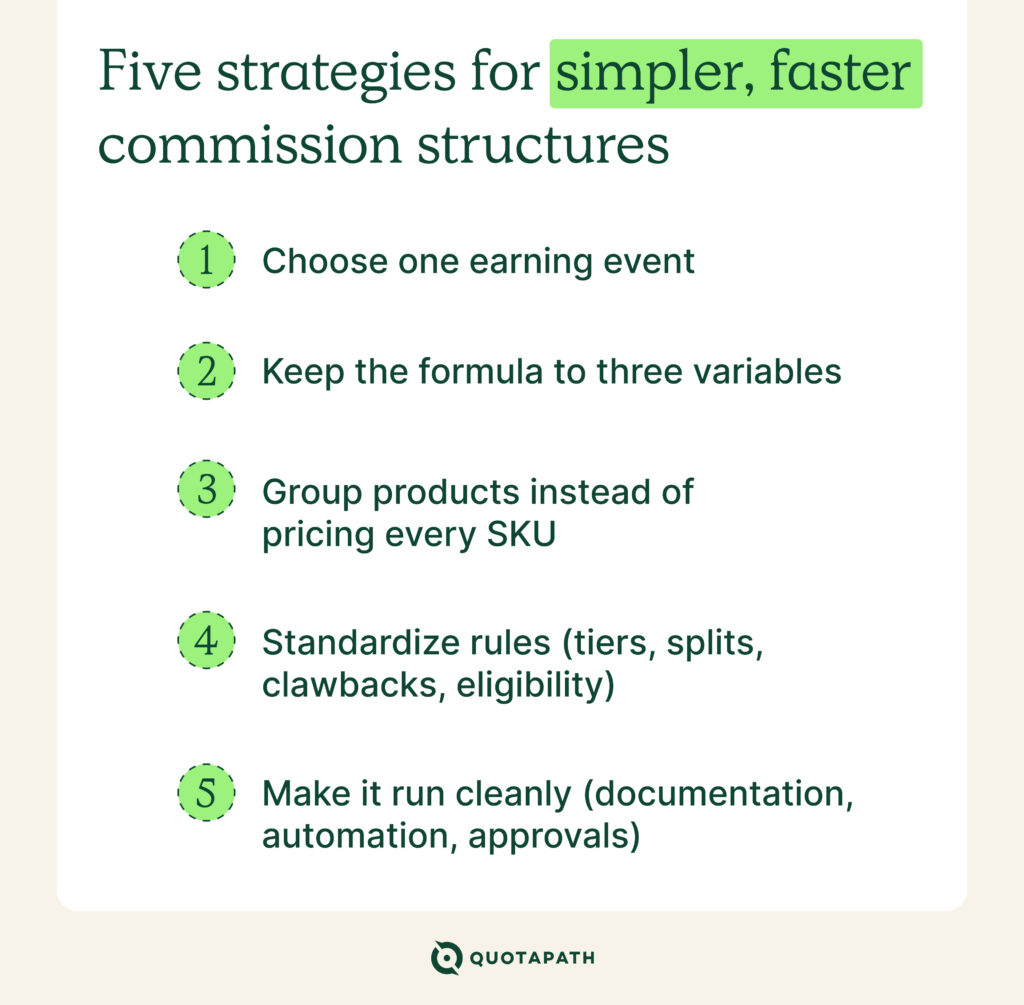
Strategy 1: Choose one earning event
Multiple earning events create confusion, leaving reps struggling to understand how their actions translate into earnings and decreasing rep motivation and engagement. Select either Booked, Paid, or Delivered earnings events, and commit to it. This aligns payment timing with when sales reps close deals while balancing company cash-flow risks. Then define one clear policy for Refunds, Cancellations, and Contract Changes.
Strategy 2: Keep the formula to three variables
A commission formula should usually include:
- Base measure (revenue or margin)
- Performance modifier (quota attainment)
- One multiplier (product group or deal type)
Once you go beyond that, it becomes hard for reps to estimate earnings and makes a mess for admins paying commissions.
- Messy formula example:
- Commission = Deal ARR × SKU-based rate × quota tier × contract multiplier
- SPIFs − clawbacks ± manual adjustments
Simplifying it reduces disputes, helps reps understand and own their commissions, and makes administrative work more feasible.
- Simplified formula examples:
- Commission = Deal Revenue × Base Rate × Quota Modifier
Strategy 3: Group products instead of pricing every SKU
SKU-level pricing explodes complexity by dramatically increasing administrative, operational, and calculation burdens. Common grouping methods include core vs. add-on products and new vs. expansion items.
Grouping reduces exceptions by standardizing incentives, simplifying plan structure and variable rates, reducing confusion, and disincentivizing reps from cherry-picking what they’ll sell. Fewer rates improve reps’ understanding of how they earn and reduce commission disputes.

Strategy 4: Standardize rules (tiers, splits, clawbacks, eligibility)
Standardization builds trust. Simplify complex commission structures by using a short checklist of standard rules to create easy-to-understand compensation plans.
Checklist can include:
- Tier structure: A performance level or sales threshold that, when reached, unlocks a higher commission rate.
- Split logic: A structured method for dividing a single deal’s commission between two or more sales reps or teams who contributed to the sale.
- Clawback window: A defined timeframe during which a company can reclaim previously paid commissions if a customer cancels, defaults, or fails to pay.
- Eligibility requirements: Specific, documented criteria that sales representatives must meet to qualify for variable pay.
- Payment timing: Defines when a salesperson receives their earned commission.
So, an example of this for clawbacks might be defined at your organization as: Clawbacks only apply within 90 days of the deal.
Strategy 5: Make it run cleanly (documentation, automation, approvals)
Undocumented commission plans always fail at scale, creating confusion, disputes, and manual work that slows the commission close process and increases risk. Clear commission plan documentation, defined approval workflows, and commission calculation automation create consistency and transparency, forming the foundation of effective commission plan governance as teams scale.
These elements result in a faster commission close, fewer manual adjustments, and clear audit trails that Finance and RevOps can rely on. Solutions like QuotaPath help teams operationalize these practices, making commissions easier to manage, explain, and scale.
A 30-60 day rollout plan for simpler commissions
Apply the five strategies as you follow this execution process to create a clearer comp plan.
Weeks 1–2: Audit and lock your rules
Start by reviewing all incentive elements to simplify and finalize the plan.
- Inventory all variables and exceptions
- Identify what can be removed vs. standardized
- Lock earning events and core rules
Weeks 3–4: Build, document, and train
With the rules locked, the focus shifts to rebuilding the plan using simplified logic, documenting it clearly, and ensuring reps understand how it works in practice.
Cover:
- Rebuilding the plan using simplified logic
- Writing clear commission plan documentation
- Training reps with real examples
Weeks 5–6: Parallel run, go live, and monitor
In the final phase, teams should run the old and new plans in parallel to validate calculations, surface edge cases, and build confidence before fully going live. This parallel run helps identify gaps or unexpected scenarios early, reducing risk at launch. Once live, gather rep feedback to confirm clarity, address friction points, and make small adjustments before complexity creeps back in.
Try the most collaborative solution to manage, track and payout variable compensation. Calculate commissions and pay your team accurately, and on time.
Start TrialCommission plan examples and templates you can copy
You don’t have to start from scratch. Use templates and examples to reduce risk and speed adoption. You can use these commission plan templates and commission structure examples to get started.
Example 1: SaaS plan simplified with three variables
This simplified sales commission structure example is best suited for Series A–C B2B SaaS companies with revenue teams of 10–100 reps. The ideal industry fit for this plan offers subscription or ARR-based pricing, has a clear ICP definition, and moderate deal complexity (SMB: Mid-Market or light Enterprise).
Roles
- Account Executives (new business)
- Can be adapted for Mid-Market or Commercial teams
- Not ideal for highly bespoke Enterprise motion without refinement
Base Salary: $80,000
On-Target Earnings (OTE): $160,000 (50/50 base + variable)
Quota: $1,000,000 in new ARR per year
Compensation Variables
Base Commission (Quota Attainment)
Commission: 10% on all closed-won new ARR
Applies from 0–100% of quota
Paid monthly based on booked revenue
Deal Quality Multiplier
- Standard deals: 1.0× commission
- Strategic / multi-year / target ICP deals: 1.2× commission
- Non-strategic or low-margin deals: 0.8× commission
- One multiplier per deal; no stacking
Accelerators:
- 110–124% of quota: 12.5% commission
- 125%+ of quota: 15% commission
Why This Plan Works
- Simple to understand: Reps can easily calculate earnings without spreadsheets or guesswork.
- Aligned with profitability: Deal quality ensures reps optimize for good revenue, not just more revenue.
- Scales cleanly: You can adjust rates, multipliers, or thresholds without redesigning the entire plan.
- Low admin overhead: Three variables reduce disputes, exceptions, and manual calculations.
- Behaviorally sound: Reps focus on hitting quota, selling the right deals, and pushing past targets—not gaming edge cases.
Example 2: Multi-product plan simplified with four groups
In the original plan, each product carried its own commission rate, accelerators, exceptions, and temporary SPIFFs. As the product catalog expanded, reps had to remember dozens of rules, Finance spent hours managing exceptions, and sellers began prioritizing deals based on payout mechanics rather than customer fit or long-term value.
The plan was simplified by grouping like products into four logical groups:
- Core Platform
- Add-Ons
- Premium Solutions
- Services
Each group has a single commission rate and clear eligibility rules.
The outcome: With fewer variables, reps can easily understand how deals impacted earnings, reducing confusion and disputes. Sales behavior shifts away from cherry-picking high-rate products toward selling the right solution mix, while lowering administrative overhead, reducing payout errors, and creating a plan that scales with the product portfolio.
Template A: fixed rate plus accelerator
A fixed rate plus accelerator commission structure pays sales reps a set, consistent percentage on all deals until a specific quota milestone is reached (e.g., 100% attainment). Once this milestone is surpassed, the commission rate increases for all deals in that period. Companies confident in the math behind their quotas and targets use this structure to reward high performance.
Template B: Product groups plus quota modifier
A commission plan template that uses product groups plus a quota modifier includes a base salary and pays different commission rates based on the value or strategic product focus. This plan encourages reps to sell high-priority services or products. Then the quota modifier rewards reps who achieve a designated product mix goal.
For example, a rep earns a base salary, plus 4% commission on basic products and 8% commission on premium products. Then, a multiplier of 1.2 is applied for hitting a product mix goal.
This plan works best for growth-stage SaaS companies (Series B–D) that have moved beyond a single core product and are actively managing product mix, margin, or attach rates.
Design, track, and manage variable incentives with QuotaPath. Give your RevOps, finance, and sales teams transparency into sales compensation.
Talk to SalesFinal Thoughts
Simplifying complex commission structures isn’t about paying less or removing incentives; it’s about creating clarity, consistency, and trust at scale. With the right design, documentation, and governance, teams can reduce disputes, improve rep confidence, and turn commissions into a predictable, manageable process.
Explore commission plan templates or request a demo to see how automation simplifies complex commission structures.