Variable pay is one of the most widely used incentive structures across sales organizations and performance-driven teams. It is one of the most powerful tools companies use to motivate performance, drive revenue outcomes, and align compensation with business objectives. However, poorly structured variable compensation plans can create confusion, disputes, and misaligned performance incentives.
A well-structured variable pay plan directly links employee performance to measurable business outcomes. This blog will explain how to structure variable pay programs that are transparent, motivating, and scalable.
Key Takeaways
Structuring variable pay plans requires a clear compensation philosophy, well-defined performance metrics, and transparent payout structures that employees can easily understand.
- Define your base salary vs variable pay mix
- Align compensation metrics with company goals
- Set realistic and measurable performance targets
- Implement commission accelerators to reward overperformance
- Ensure transparency through automation and real-time visibility
AI Revenue Strategist
Build, Test, and Improve Your Variable Pay Programs using our AI Revenue Strategist.
Try for FreeWhat Is Variable Pay?
Before structuring a plan, leaders must first understand variable compensation. Variable pay is compensation tied directly to performance outcomes rather than a fixed salary, and includes components such as:
- Sales commissions: a fee or incentive paid to a sales rep for closing sales.
- Performance bonuses: an amount of money earned based on hitting or exceeding specific goals, such as scheduling a designated number of meetings or demos.
- Incentive compensation tied to KPIs: bonuses or commissions that reward employees for achieving specific, measurable goals such as quotas.
- Revenue-based compensation plans: earnings based on a percentage of the revenue a sales rep generates, and directly aligns pay with top-line growth.
A variable pay structure differs from a fixed salary. A variable pay structure differs from a fixed salary. A fixed salary is consistent and unchanging. However, variable pay fluctuates based on performance, results, or company metrics. It is commonly used in sales compensation plans to incentivize achieving specific goals while aligning employee behavior with business objectives.
On-target earnings (OTE) is the total amount a sales rep can expect to earn annually if they meet or exceed their performance targets. This figure includes the rep’s base salary, commission, and other potential incentive payouts.
Example:
A SaaS account executive earning $120K OTE might have:
- $60K base salary
- $60K variable compensation tied to quota attainment
Why Variable Pay Matters for Your Business
Now that you understand what variable pay is, why is it important to businesses? Incentive compensation drives performance alignment and revenue growth by attracting and retaining high-performing talent and motivating sales behaviors that support company goals.
Attracting and Retaining Top Talent
Strong incentive plans help companies compete for top-tier candidates. “Bonuses and equity incentives can provide that extra layer of appeal for high-performing individuals,” said Daniel Raimondi, vice president of compensation and human resources at ADP.
- Top sales talent often prefers high upside through variable compensation
- Clear commission accelerators reward top performers
- Transparent compensation builds trust and reduces turnover
Aligning Employee Performance with Company Goals
Variable pay aligns behavior with business outcomes by linking incentives to performance metrics, motivating employees to drive results like profitability, customer retention, and revenue growth.
Examples:
- Sales reps incentivized on new revenue growth
- Customer success teams rewarded for NRR or renewals
- SDRs compensated on qualified meetings booked
Sales compensation design shapes employee priorities by showing which activities, such as upselling, retention, or new logo acquisition, align with company objectives and are associated with higher incentive compensation.
Key Components of a Variable Pay Structure
Now, let’s look at the building blocks of a strong incentive compensation program.
Base Salary to Variable Pay Ratio
Pay mix ratio is a combination of base salary vs variable pay, such as commissions and bonuses. While the fixed portion provides stability, the variable portion motivates sales reps to deliver their best performance.
Which % of pay should be variable? Although common sales splits consist of 50% fixed salary, the pay mix varies by role:
- 50/50 pay mix for Account Executives
- 60/40 or 70/30 for Customer Success roles
- 80/20 for SDRs or entry-level roles
What is the right variable pay ratio for sales reps? Pay mix depends on and varies according to:
- Sales cycle length: shorter cycles typically have a lower base salary, based on the influence sales reps have on the rate of outcomes and results.
- Deal complexity: more complex deals usually translate to a higher base and lower variable pay, such as 80/20.
- Risk tolerance: companies with greater risk tolerance are typically more willing to offer a higher percentage of variable pay.
- Role responsibility: roles that have greater control over their outcomes often have a higher percentage of variable pay.
Performance Metrics and KPIs
Variable pay should be tied to clear and measurable KPIs. They should be simple metrics that employees can directly influence, creating a clear line of sight between effort and reward.
Examples:
- Revenue closed is the dollar value of deals that are won and is one of the clearest measures of sales output.
- Quota attainment is the percentage of a rep’s sales target achieved in a specific timeframe. This is significant because other incentives, such as accelerators and bonuses, are based on quota attainment.
- Expansion revenue is revenue from existing customers generated through upsells, upgrades, cross-sells, or added features or seats. This is essential for tracking growth within existing accounts and encouraging retention.
- Product usage milestones are predefined activation or adoption events, such as achieving a usage threshold, activating a specific feature, or completing onboarding. These reward the behaviors that lead to future revenue in product-led or customer-success-driven sales motions.
- Meetings booked are the number of qualified customer meetings scheduled, commonly used for SDRs, and are key to measuring pipeline creation activity and help reward work that supports future revenue.
Payout Frequency and Timing
Incentive compensation payout schedules are typically aligned with the length of the sales cycle and the percentage of variable pay in the plan. For instance, monthly for short sales cycles or high variable pay mix ratios, quarterly for medium-length cycles, and annual for long cycles and/or a low variable pay mix.
The best schedule typically pays close to the deal close, so the reward feels connected to performance.
Typical fit by organization
| Payout schedule | Typical organization types | Main reason |
| Monthly | High-velocity SaaS, inside sales, retail, transactional selling, high-variable-pay roles | Short sales cycles and frequent closes |
| Quarterly | B2B sales, field sales, many account executive roles, moderate-complexity products | Balanced timing for medium sales cycles and meaningful check sizes |
| Annual | Enterprise software, complex industrials, capital equipment, long-cycle consultative sales | Long sales cycles and low-frequency, high-value deals |
There are tradeoffs to consider when establishing payout frequency and timing. Monthly payouts increase motivation and provide faster performance feedback. However, quarterly payouts reduce administrative time and complexity.
Whatever you decide, it’s essential to set a predictable commission payout schedule. This builds trust, boosts motivation, and improves retention. Otherwise, your sales team won’t know what to expect and may struggle to pay their bills. The mortgage or rent comes due on the same date each month; your reps need to be able to count on a predictable payout schedule, too.
Caps and Accelerators
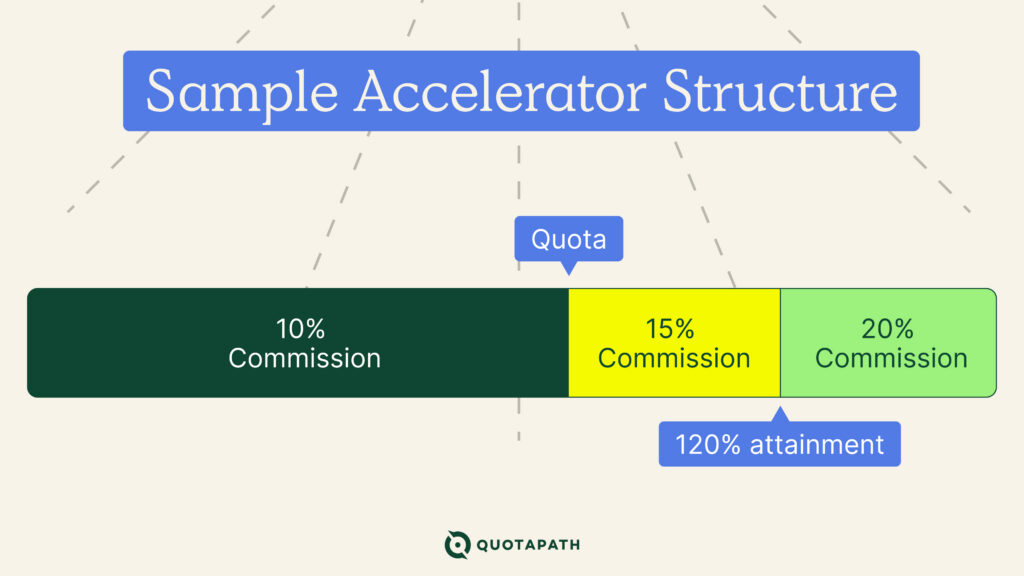
Commission accelerators are a variable pay structure that rewards salespeople for overperformance by increasing the commission rate as attainment milestones are met.
Example structure:
- 10% commission up to quota
- 15% commission after 100% attainment
- 20% commission after 120% attainment
Commission caps set a dollar limit on how much sales reps can earn regardless of their sales performance. There’s been a longstanding debate around capped commissions. The debate ties to cost control and motivation.
Organizations that are concerned about overpaying their sales reps may favor limiting commissions. However, commission caps tend to backfire, causing reps to stop selling once they hit the limit or encouraging sandbagging by delaying a deal until the next quota period.
SaaS growth depends on reps continually pushing for every deal. Therefore, to encourage overperformance, many SaaS companies avoid caps.
Design, track, and manage variable incentives with QuotaPath. Give your RevOps, finance, and sales teams transparency into sales compensation.
Talk to SalesHow to Design a Variable Pay Plan
Follow this practical step-by-step framework to successfully design a variable compensation plan.
Define Your Compensation Philosophy
Companies must first decide, “Do we prioritize revenue growth, profitability, or customer retention?” Answering this question allows you to identify the sales behaviors that will help the company achieve this goal. This philosophy shapes decisions about variable compensation, such as which KPIs are used, which incentive compensation elements are used, and whether payouts are based on individual or team results.
Identify Eligible Roles and Teams
Roles that directly impact revenue, such as sales reps like Account Executives (AEs), Sales Development Reps (SDRs), Customer Success Managers (CSMs), and channel partners, benefit most from variable compensation. Variable pay structures that include elements, such as commission, bonuses, and accelerators, align performance with high earning potential, higher engagement, and revenue growth.
Variable pay examples for SaaS teams:
- Sales reps: 50/50 OTE with commission on closed-won ARR or ACV
- SDRs: 60/40 or 70/30 OTE, with variable pay tied to qualified meetings, SQLs, or pipeline generated
- Customer success: 80/20 OTE with variable pay tied to renewals, retention, and expansion revenue
- Channel partners: Commission-only or tiered revenue commission, such as a percentage of revenue on partner-sourced deals
Set Realistic and Measurable Targets
Sales quotas and performance metrics set clear expectations and goals that help reps track progress and motivate behaviors that drive attainment of business objectives. Quotas must be achievable to inspire reps to strive for targets.
Unrealistic quotas typically demotivate reps, reduce engagement, and can increase rep turnover. However, challenging but realistic quotas help reps adopt desired behavior and improve performance.
Quota attainment benchmarks vary by industry. For instance, 70 – 80% is a good rule of thumb for SaaS sales reps, whereas 60 – 70% attainment is typical in many other types of sales organizations. Setting realistic and measurable targets will help you achieve this level of quota attainment.
Choose the Right Variable Pay Model
Selecting the right variable compensation plan is crucial to align sales rep behaviors with company goals, drive high performance, and manage compensation costs effectively. A well-chosen plan boosts motivation, helps attract top talent, and ensures financial flexibility. Consider these common models when making your selection.
- Commission-based plans pay either a flat or tiered percentage of revenue or margin generated in deals closed.
- Bonus-based plans pay a base plus a separate incentive payment for individual, team, or company goal or milestone attainment.
- Hybrid incentive compensation combines base pay with one or more variable pay elements, such as salary plus commission or plus bonus.
Example SaaS structure:
- Base salary + quota-based commission
- Expansion revenue bonuses
- Multi-year contract incentives
Communicate the Plan Clearly to Employees
Confusion around compensation leads to mistrust, making your compensation plan rollout essential because transparency improves motivation, trust, and performance. Follow these 5 best practices to increase the success of your new comp plan launch.
- Use various formats to share the new plan, such as group presentations, individual conversations, explainer videos, and written documents, communicating the same message each time. This provides reps with multiple opportunities to get their questions answered while increasing understanding.
- Written plan documents should be clear, concise, and detailed. So, avoid confusing jargon, include a Frequently Asked Questions (FAQs) attachment, and share examples of how to calculate earnings under the new plan.
- Messaging should progress from broad to specific, explaining the reasons for plan changes and the advantages of the new plan.
- Use real-time dashboards, such as those in QuotaPath, that show reps how to track performance, calculate commissions, and prioritize deals to optimize earnings.
- Gather continuous feedback to confirm understanding, reinforce transparency, and refine the plan. This can start with the plan verification process, where reps confirm they understand the new plan, followed by routine surveys, one-on-ones, and analysis of sales compensation plan performance.
Automate Calculations and Give Reps Real-Time Visibility
Managing variable pay manually introduces complexity. Tiered commissions, accelerators, splits, and one-off incentives often require intricate spreadsheet logic that’s difficult to maintain and even harder to audit. As a result, small formula errors or broken links can cascade into widespread miscalculations, increasing financial risk and eroding trust with sales teams.
Finance teams spend hours reconciling data across systems, delaying commission calculations and payouts, frustrating reps who rely on timely, accurate earnings. Lack of earnings visibility leaves reps guessing how deals impact their commissions, often leading to shadow tracking, disputes, and reduced confidence in the compensation process.
Modern compensation tools replace manual processes with software platforms that help organizations plan, manage, and administer employee compensation more accurately and efficiently.
Platforms like QuotaPath automate commission calculations by applying plan rules consistently across deals, reducing errors and eliminating manual work. Deal data is automatically synced via CRM integrations such as Salesforce or HubSpot, ensuring accurate payouts.
Real-time earnings dashboards give reps immediate visibility into their commissions, improving transparency and reducing disputes. When building compensation plans, plan modeling allows Finance and RevOps teams to test scenarios before rollout, helping them understand financial impact and avoid costly mistakes.
What Are the Top Mistakes When Structuring Variable Pay Plans?
As you create your variable compensation plan, watch out for these common pitfalls companies often face.
- Overly complex compensation formulas: Compensation plans including too many variables, tiers, and exceptions make it difficult for reps to understand how they’re paid, while Finance struggles to accurately calculate and audit payouts.
- Unclear performance metrics: Vague or inconsistently defined metrics, such as “qualified pipeline” or “revenue contribution,” leave room for interpretation and lead to disputes over what counts toward commission.
- Unrealistic quotas: Failure to align quotas with market conditions, territory potential, or historical performance results in a greater percentage of reps missing targets and becoming demotivated, disengaged, or churning.
- Commission caps that discourage top performers: Limiting earnings for high performers reduces motivation to continue selling once hitting the cap.
- Lack of visibility into earnings: The inability to track real-time commissions and performance reduces plan understanding and motivation while increasing shadow tracking.
- Manual calculations causing payout errors: Relying on spreadsheets and manual processes is time-consuming and error-prone, delaying payouts while increasing pay disputes and rep turnover.
All of these variable pay structure mistakes can easily be resolved by plan simplicity and transparency.
Design, track, and manage variable incentives with QuotaPath. Give your RevOps, finance, and sales teams transparency into sales compensation.
Talk to SalesHow to Simplify Variable Pay Structures with QuotaPath
Modern compensation platforms solve these common challenges. QuotaPath simplifies variable pay structure management with automated commission calculations, compensation plan modeling, real-time rep dashboards, and CRM integrations, ensuring accurate, real-time deal data. Transparent earnings tracking creates a single source of truth, improving alignment and confidence in commission data across the organization.
The result is a more efficient and trustworthy compensation process, with reduced administrative workload for Finance and RevOps teams, improved rep trust through greater transparency, and faster payout cycles that keep teams motivated and aligned.
Designing and managing variable pay plans doesn’t have to be complicated. With QuotaPath, RevOps and Finance teams can automate commission calculations, model new compensation plans, and give reps real-time visibility into their earnings. Book a demo to see how QuotaPath simplifies variable compensation management.