
Key takeaways
This table, sourced from The Bridge Group, 2026 AE Models, Motions & Metrics (158 companies, June 2026):
| Metric | 2026 | 2024 |
| Quota-to-OTE ratio | 4.6x | 4.2x |
| Reps at quota | 48% | 51% |
| Median AE OTE | $200K | n/a |
| Median AE quota | $960K | n/a |
| Median AE ramp time | 6.2 months | n/a |
Historically, the old 5x rule of multiplying on-target earnings (OTE) by 5 was used to calculate quota. The ratio has moved to 4.6x and is trending up, while attainment is trending down, according to the data in the table from The Bridge Group, 2026 AE Models, Motions & Metrics (158 companies, June 2026).
Design, track, and manage variable incentives with QuotaPath. Give your RevOps, finance, and sales teams transparency into sales compensation.
Talk to Sales8 Sales Compensation Best Practices
Using current benchmarks is essential to design or fix sales compensation plans, set realistic expectations, and make informed design decisions. But benchmarks are only part of the equation. Applying the following eight sales compensation best practices will help you improve the quality and effectiveness of your plans and better position them to deliver the intended results.
1. Start from the business goal, not last year’s plan
Define the business outcomes the organization needs to achieve before designing the compensation plan. Revenue growth, new logo acquisition, expansion, retention, and profitability require different seller behaviors and incentives. Starting with the desired outcomes ensures compensation reinforces current priorities rather than carrying forward incentives that may no longer support the business strategy.
Align comp to business goals as you build a sales compensation plan. Work backward from those goals to determine which roles influence each outcome, which performance measures belong in each plan, and how much incentive to tie to each measure. This creates a direct connection between company objectives, seller behavior, and compensation.
Design the plan cross-functionally to ensure incentives align with financial goals and operational realities, while motivating behaviors that drive goal attainment. When Sales leadership, Finance, and RevOps share perspectives and performance data, they reduce the risk of conflicting priorities or last-minute changes.
2. Set pay mix and quota from current benchmarks, not rules of thumb
Use current market data to establish realistic OTE and quota targets rather than relying on longstanding rules of thumb. According to The Bridge Group’s 2026 AE Models, Motions & Metrics, the median AE on-target earnings (OTE) is $200,000, the median quota is $960,000, and the median ramp time is 6.2 months.
The same research puts the median quota-to-OTE ratio at 4.6x, up from 4.2x in 2024. That makes the traditional “5x rule” of setting quota at five times OTE a rule of thumb rather than a reliable benchmark. Use a quota:OTE ratio calculator and current performance data when setting sales quotas to ensure expectations reflect both market conditions and what sellers can realistically achieve, factoring in new rep ramp time.
Apply the same scrutiny to pay mix. A 50/50 split between base and variable compensation is a common convention for AEs, but no credible 2025–2026 benchmark establishes it as the ideal mix. Instead, balance fixed and variable pay based on factors such as the seller’s influence over the outcome, sales-cycle complexity, and the level of risk the role should carry.
3. Design for the attainment curve, not the average
Design the sales compensation plan for the full range of expected rep performance, not an average seller or a single attainment point. Use historical attainment data to understand how reps are likely to be distributed across performance levels, then model how the proposed plan will pay at each level.
The attainment curve should account for below-target, at-target, and above-target performance. Thresholds and decelerators can limit payouts at low attainment levels, while accelerators offer earning opportunities after reps hit quota and encourage top performers to continue selling. Model these mechanics against historical attainment percentiles to validate quotas and incentives and forecast payout distribution.
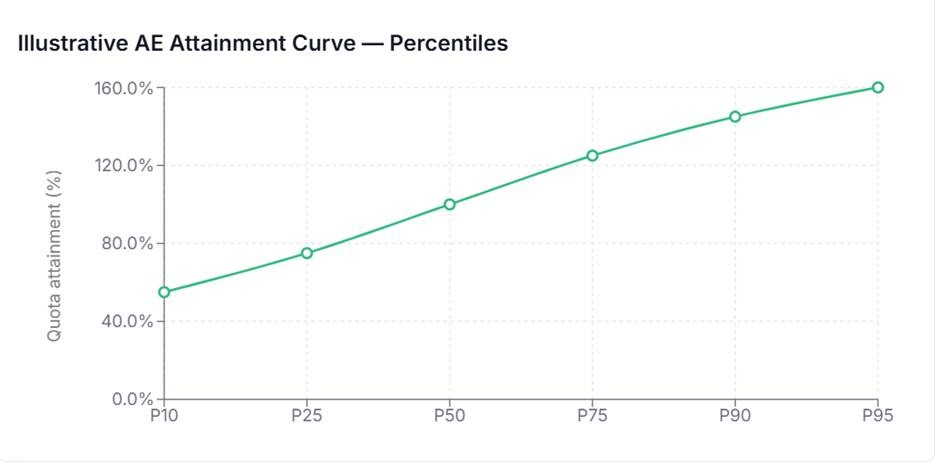
Pressure-test the plan against the curve before finalizing it. If the curve reveals too few reps near target, excessive payouts at the top, or other unintended outcomes, adjust quotas or payout mechanics before launch. As the Alexander Group cautions, a perfect sales compensation plan can fail because of poor quota setting and attainment distribution.
4. Hold the plan to three components and one page
Choose no more than three comp plan components that clearly connect performance to earnings, and document the terms on a single page. Sellers should be able to quickly understand what they are being paid for, how performance is measured, and how their payout is calculated. Simpler plans keep sellers focused on the intended behaviors while reducing questions, disputes, and administrative work.
Simplicity does not mean using the same plan for every sales role. SDRs, AEs, and sales managers influence revenue differently, so their plans should reward the outcomes they can directly affect. For example, an SDR plan might emphasize qualified opportunities, while an AE plan may reward closed revenue, and a sales manager plan reflects team performance.
Use comp plan templates to maintain a consistent structure across roles while tailoring metrics and incentives to each position. If you can’t explain the essential mechanics on one page, the plan is likely too complex.
5. Go uncapped, but write the windfall clause first
Despite the potential financial risks of uncapped commission, avoid placing an artificial ceiling on rep earnings. Caps can weaken the incentive to continue selling once a rep reaches the maximum payout. Instead, use accelerators to reward performance above quota while safeguarding against exceptional deals that could create an outsized, unanticipated commission expense.
Stay uncapped in principle, but pair it with a windfall clause, which is a large-deal review clause that is agreed upon before the deal closes, not negotiated after a rep hits a windfall. This preserves the motivational value of uncapped earnings while giving the business a predetermined process for managing unusual payout, cash flow, or margin exposure.
Document other exceptions and special incentives, such as clawbacks and SPIFs, in advance. Clearly define when clawbacks apply and how SPIFs are earned and paid so sellers understand the rules before compensation is affected.
6. Credit consumption, renewal, and expansion revenue when it arrives
Align sales compensation with when revenue is actually realized, particularly for usage- and consumption-based pricing models. According to ICONIQ’s The State of Go-to-Market in 2026, hybrid pricing models now account for 48% of those studied, compared with 15% for outcome-based, 9% for pure consumption, and 6% for seat-based models.
As pricing evolves beyond fixed subscriptions, compensation plans must account for the difference between committed contract value and what customers ultimately consume.
For a usage-based compensation model, Atlas, QuotaPath’s AI revenue strategist, recommends paying 60–80% of the expected commission at close, withholding 20–40%, and conducting a true-up at 12 months based on actual consumption. This gives sellers meaningful credit for closing the deal without compensating entirely on revenue that may never materialize.
In a consumption-based comp plan, consider triggering accelerators closer to 100% attainment rather than waiting until 150% attainment, so sellers have an earlier incentive to drive customer usage.
Apply the same principle to renewals and expansions by defining whether commission credit is based on ACV or TCV and when that credit is earned. Establishing these rules upfront ensures compensation follows the revenue events sellers are expected to influence rather than treating every dollar of contracted and realized revenue the same.
7. Ship plans before the period starts, and check what job posts must disclose
Finalize and distribute sales compensation plans before the performance period begins so sellers know how to focus their efforts and how they earn incentives. Review the plan with each team, provide written documentation, and communicate the terms repeatedly throughout the period. Clear, consistent communication helps reps make informed decisions about deal prioritization and supports fair application of the plan across the sales organization.
Beyond giving current reps visibility into their earnings, pay transparency laws determine what employers must disclose to candidates in job postings, and vary by state. For instance, the California Equal Pay Act requires that job postings include the commission range, while Colorado, Illinois, and Washington require a description of bonuses and commissions.
New York and Maine permit a general commission-based statement, while Vermont exempts commission-based roles. As pay transparency laws continually evolve, check the current requirements in every jurisdiction where you hire.
Building transparency and fairness into compensation practices, from plan design through recruiting, reduces compliance risk while giving candidates and employees clearer pay expectations.
8. Review quarterly, change annually, and check ASC 606 first
Review sales compensation performance quarterly, but reserve significant plan changes for the annual planning cycle. Use quarterly reviews to analyze comp plan performance, including quota attainment, payout distribution, compensation cost, and whether incentives are producing the intended behaviors. Automating commission admin frees RevOps and Finance to monitor these signals consistently.
Before making annual changes, consider how plan design and contract terms affect commission accounting. According to Armanino’s SaaS Cost Capitalization Survey, published in March 2025, 89% of the top 100 public SaaS companies capitalize sales commissions, up from 22% in 2017.
Under ASC 340-40, companies may elect the practical expedient to immediately expense qualifying incremental contract acquisition costs when the amortization period would otherwise be one year or less.
However, when a performance obligation exceeds 12 months, the practical expedient disappears, creating a significant accounting cliff where a 13-month deal costs meaningfully more to account for than a 12-month one because the commission must be capitalized and amortized rather than immediately expensed.
Sales Compensation Mistakes to Avoid
| Mistake | What it costs | The fix |
| Capping Commission without a windfall clause | Reduced motivation and lost Revenue potential when top performers no longer benefit from selling beyond the cap. | Keep commissions uncapped, use Accelerators to reward overperformance, and establish a windfall clause in advance to manage unusually large payouts. |
| Setting quota from a rule of thumb instead of current benchmarks | Unrealistic quotas can undermine attainment and motivation while making compensation costs and revenue expectations less predictable. | Use current quota-to-OTE benchmarks, historical attainment data, and realistic ramp assumptions when setting quotas. |
| Crediting consumption revenue only at close | The business may overpay commissions when actual usage falls short of committed value or misalign incentives with consumption, renewal, and expansion. | Pay a portion at close, withhold the remainder, and true up against actual consumption; define renewal and expansion crediting upfront. |
| Missing a state’s pay transparency requirement | Noncompliant job postings can create legal and financial exposure and undermine fair, consistent compensation practices. | Check current pay transparency requirements in every jurisdiction where you hire and make the required compensation disclosures. |
| Treating a 13-month deal like a 12-month one for ASC 340-40 purposes | Losing the practical expedient can add capitalization, amortization, tracking, and audit requirements, making the deal meaningfully more expensive to account for. | Determine whether the commission qualifies for the practical expedient and flag arrangements with amortization periods exceeding one year for the appropriate accounting treatment. |
Design, track, and manage variable incentives with QuotaPath. Give your RevOps, finance, and sales teams transparency into sales compensation.
Talk to SalesWhy These Best Practices Break Down in Spreadsheets
Even a well-designed sales compensation plan can break down when managed in spreadsheets. Manual formulas, data imports, and plan updates create opportunities for calculation errors, especially when plans include accelerators, attainment thresholds, split credit, consumption-based revenue, and other variables. As complexity increases, so does the time RevOps spends checking calculations, reconciling data, and correcting mistakes.
Limited visibility compounds the problem. When reps cannot easily verify how their commissions were calculated, they may maintain their own spreadsheets to track expected earnings. This shadow accounting creates competing versions of compensation data and can lead to disputed payouts, forcing RevOps to spend more time investigating discrepancies and explaining calculations instead of analyzing plan performance.
Automation reduces this administrative burden by connecting compensation calculations to source data, applying plan rules consistently, and giving reps visibility into their earnings. AI can extend those capabilities by helping teams analyze plan performance, model scenarios, identify potential problems, and evaluate proposed changes more efficiently.
However, AI should support, not replace, human judgment in sales compensation planning. It cannot decide which tradeoffs an organization should make between motivation, affordability, and fairness or determine the compensation philosophy that best supports the company’s strategy. While RevOps, Finance, and Sales leaders remain responsible for those decisions, technology gives them better information and more time to make them.
Put These Best Practices on Autopilot with QuotaPath
Putting sales compensation best practices into action requires more than a well-designed plan. QuotaPath helps RevOps, Finance, and Sales turn compensation strategy into an operational system that is easier to manage, monitor, and adjust.
Atlas, our AI revenue strategist, helps teams automate comp plan design by analyzing existing plans, benchmarking key inputs, identifying potential risks, and modeling different scenarios. Teams can use those insights to pressure-test decisions around quotas, OTE, pay mix, and other plan mechanics while retaining control over the strategic and fairness decisions that require human judgment.
Once plans go live, QuotaPath connects compensation data and plan rules to automate commission calculation, reducing the spreadsheet work and manual reconciliation that can lead to errors and disputed payouts. Reps gain real-time visibility into quota attainment and expected earnings, while Finance and RevOps get greater visibility into compensation performance and payouts.
Together, these capabilities make it easier to carry compensation best practices from plan design through calculation and payment without adding administrative work at every stage. If you’re ready to spend less time managing compensation manually and more time optimizing it, try QuotaPath free.
Sales Compensation Best Practices FAQs
What is a good quota-to-OTE ratio?
A good quota-to-OTE ratio is 4.6x, the 2026 benchmark, according to The Bridge Group’s 2026 AE Models, Motions & Metrics study. That’s up from 4.2x in 2024 and provides a more current reference point than the traditional 5x rule. Use the benchmark as a starting point, then adjust the ratio based on factors such as historical attainment, sales cycle, rep ramp time, and your organization’s revenue model.
What is the ideal sales compensation pay mix?
The common convention is a 50/50 split between base and variable pay. No data-backed benchmark exists for pay mix, so determine the appropriate mix based on factors such as the seller’s role, influence over the outcome, deal complexity, and ramp time. Roles with greater control over revenue outcomes can generally support more variable compensation, while roles with less direct influence may warrant a higher proportion of base pay.
Should sales commissions be capped?
Sales commissions generally should not be capped. Instead, keep them uncapped and pair the compensation plan with a windfall clause that is agreed upon before the deal closes, rather than imposing a hard cap on earnings. This preserves the incentive for reps to continue selling above quota while giving the business a predetermined way to manage unusually large or unexpected payouts.
How do you pay commission on usage-based pricing?
For usage-based pricing, Atlas, QuotaPath’s AI revenue strategist, recommends paying 60–80% of the expected commission at close, withholding 20–40%, and conducting a true-up at 12 months based on actual consumption. Atlas also recommends setting accelerators closer to 100% attainment rather than 150% to encourage sellers to drive customer usage sooner. This approach rewards reps for closing the initial deal while aligning total compensation more closely with the revenue the customer actually generates.