Key takeaways
- Choosing compensation management software comes down to three things: how complex your comp plans are, how fast you can get set up and make changes, and whether reps can see and trust their own numbers.
- Teams move off spreadsheets and basic tools because of slow updates, calculations reps can’t follow, plan changes that need vendor help, long implementations, and payouts that arrive late with no clear math.
- QuotaPath stands out for minimal setup time, transparent published pricing, and real-time rep visibility. It is designed for growing GTM teams that need to run their own comp without specialist headcount.
- Enterprise tools like CaptivateIQ, Spiff, Xactly, and Everstage handle deep complexity at scale, but most carry custom quote-based pricing, longer implementations, and reporting or interface tradeoffs.
Compensation management software automates how sales teams calculate, track, and pay commissions. It pulls deal data from your CRM and billing systems, applies your plan rules, and shows reps what they earn as deals close, replacing the manual tracking that produces errors as headcount grows.
The best compensation tool is the one your team will actually use and trust. Enterprise suites earn their complexity for large orgs with dedicated comp admins and intricate plans. For growing teams that want transparency, fast setup, and pricing they can see upfront, that depth often turns into cost and overhead they never use.
Why compensation software matters more in 2026
Comp plans have become more complex, and the cost of running them poorly has increased. A few shifts are pushing teams to adopt or upgrade their tools:
- Plans change more often. Quotas reset, territories shift, and new roles get added mid-year. Tools that need vendor help for every change can’t keep pace.
- Reps expect to see their own math. As plans add accelerators and adjustments, sellers want to understand payouts without waiting on RevOps or finance. When they can’t, they build shadow spreadsheets and trust drops.
- Finance carries more risk. ASC 606 accounting, audit trails, and clean payroll handoff have become non-negotiable, especially as teams scale.
- Spreadsheets break at scale. Manual tracking that worked for ten reps quietly produces errors at fifty, underpaying people and creating disputes nobody catches until later.
The tools below are evaluated against that reality on how they handle ongoing plan management, rep transparency, and accuracy, not just whether they can calculate a commission.
What to look for in compensation management software
Before comparing tools individually, consider these factors that distinguish platforms that simply calculate commissions from those that manage the full process at scale.
| Tool | Best for | Setup time | Plan complexity | Rep self-service visibility | Published pricing |
|---|---|---|---|---|---|
| QuotaPath | Growing GTM teams | Days | Standard to moderate | Real-time, deal-level | Starting at $35/user/mo |
| CaptivateIQ | Complex enterprise plans | 8 to 12 weeks | High, no-code builder | Real-time | ~$55/user/mo [quote-based] |
| Salesforce Spiff | Salesforce-native teams | Weeks | Moderate to high | Real-time | Starting at $75/user/mo |
| Everstage | Rep engagement at scale | ~2 months | High | Real-time | ~$55/user/mo [quote-based] |
| Xactly | Established enterprise SPM | Months | Very high | Real-time | ~$40-60/user/mo [quote-based] |
| Performio | Complex plans at scale | Weeks to months | High | Periodic, lags | ~$50/user/mo [quote-based] |
Setup speed and self-serve control
Implementation that runs in days lets you adjust plans mid-quarter without waiting on the vendor. Tools that take months or require a support ticket for every plan change turn each adjustment into a dependency.
Rep-facing transparency
If reps can’t see exactly how a commission was calculated, they revert to their own tracking and stop relying on the tool. Look for clear, deal-level breakdowns reps actually understand.
Integration depth
“Integrates with Salesforce” is not the same as syncing the specific objects your plan relies on. Confirm how the sync handles edits, disputes, and your CRM, ERP, and payroll stack.
Compliance and audit readiness
In finance, under ASC 606 accounting, a clear audit trail for every payout separates a real platform from a calculator.
Per-user rates rarely tell the full story. Platform fees, implementation, and add-ons can multiply the real cost. Get the all-in number before comparing.
Top Compensation Management Software Tools
1. QuotaPath
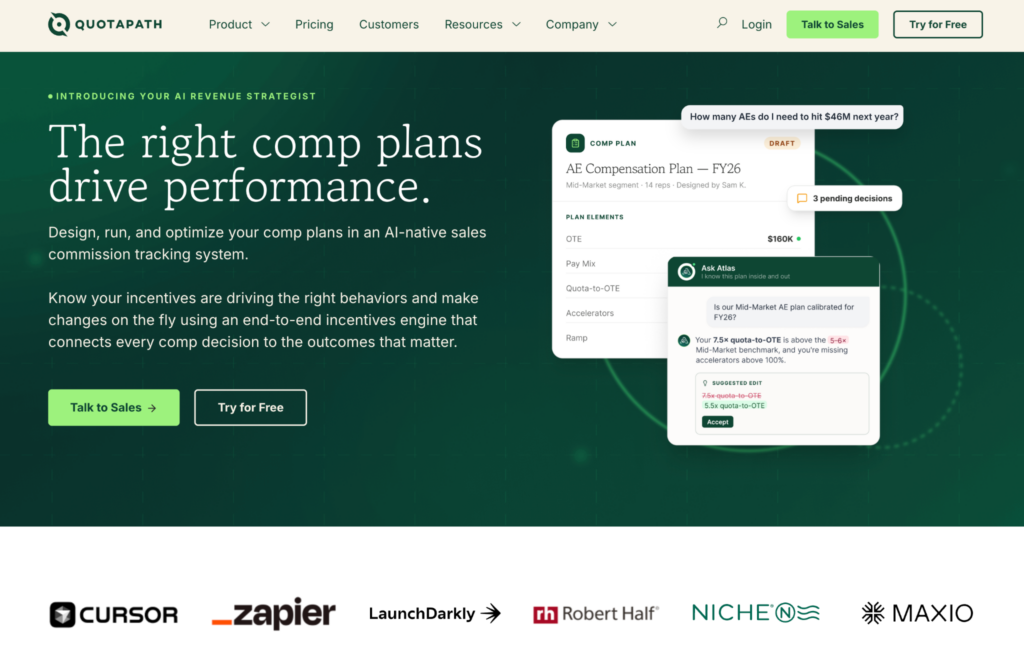
QuotaPath is built for go-to-market teams that want to own their comp without a dedicated admin or a long implementation. Reps get real-time visibility into earnings and attainment, and RevOps can build and change plans without engineering.
A G2 reviewer described moving their team off manual spreadsheets and automating commissions through the HubSpot integration, with everyone viewing commissions in real time. A 5/5 review also noted the transparency QuotaPath brings, seeing earnings, quota attainment, and projected commissions in real time instead of waiting until quarter-end. For growing teams pivoting from spreadsheets, it delivers that without the cost or setup time of an enterprise suite.
QuotaPath Key Features
- Real-time rep dashboards tying each deal to projected payout
- Self-serve, AI-assisted plan builder that changes plans without engineering or support tickets
- Native CRM, ERP, and payroll integrations, including HubSpot, Salesforce, and Rippling
Who’s it for
Growing GTM teams of roughly 10 to 1,000 employees with 15 to 150 reps, running standard commission structures like tiered rates, accelerators, draws, splits, and SPIFs. Best when you want transparent published pricing and setup in days rather than months.
Why teams choose QuotaPath:
- Fast, self-serve setup. One reviewer stated that they signed in through SSO and Gmail with no drawn-out onboarding, and plan changes launch in hours.
- Rep transparency that builds trust. Sellers can see how each deal maps to their payout, which cuts shadow spreadsheets and back-and-forth with finance.
- Transparent, published pricing. Rates are on the site with a free trial, no sales call is required to see a number.
To get started with QuotaPath, book a free demo today.
Design, track, and manage variable incentives with QuotaPath. Give your RevOps, finance, and sales teams transparency into sales compensation.
Talk to Sales2. CaptivateIQ
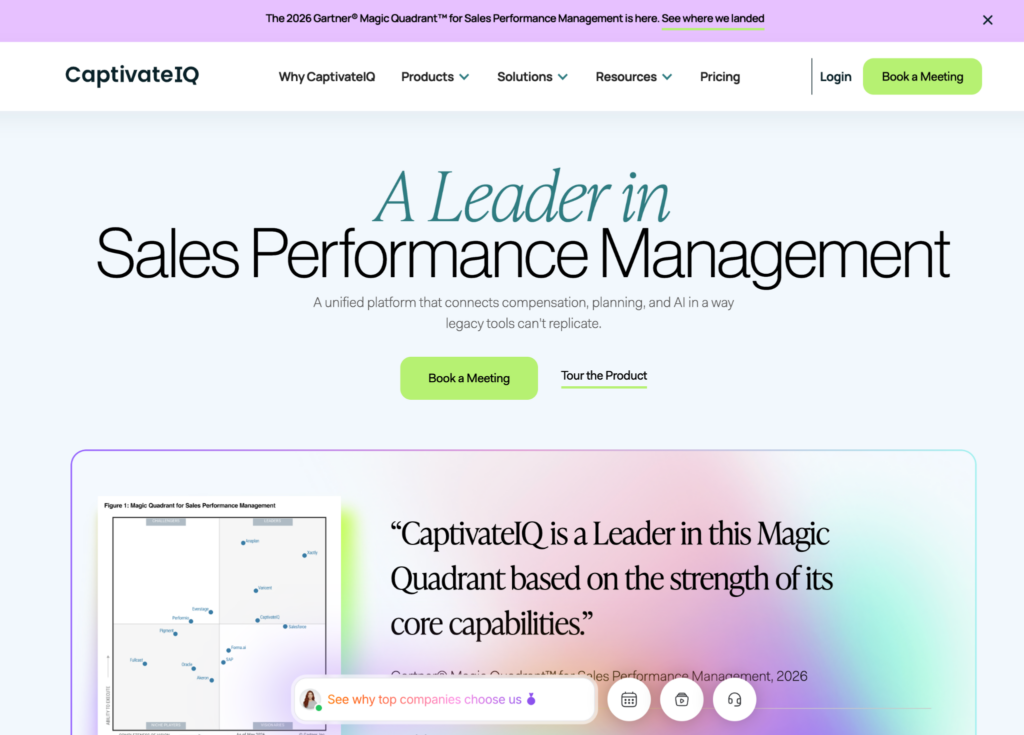
CaptivateIQ runs complex, multi-tier commission plans through a no-code, spreadsheet-like engine. The platform handles complex setups. A team running five to seven separate plan structures moved all of them into the platform with nothing left to manual work, and clearer statements meant fewer questions from reps.
CaptivateIQ Key Features
- No-code SmartGrid engine for complex, multi-tier plans
- Audit trails and versioning for every calculation
- Enterprise integrations with Salesforce, NetSuite, and Workday
Who’s it for
Mid-market and enterprise teams with 50 or more payees, complex multi-tier plans, and a dedicated comp admin or RevOps function to run them. It’s overkill for smaller teams on straightforward flat-rate plans.
Where CaptivateIQ falls short
- Reporting is the recurring complaint. G2 reviewers flag dashboard building as cumbersome, with reporting issues cited 46 times and missing features 55 times. One reviewer relies on exports because in-platform reporting is difficult to extract from.
- Multi-plan statements are hard to read. Each annual plan generates its own statement, making it difficult for reps to see what they were paid and what to expect next.
- Implementation takes more lift than expected, typically 8 to 12 weeks.
3. Salesforce Spiff
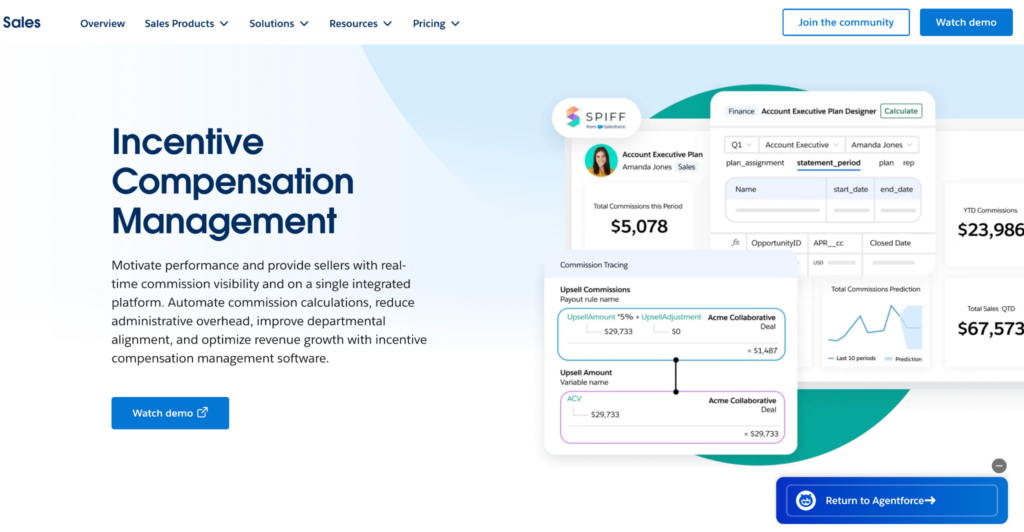
Spiff runs commission calculations natively inside Salesforce, with real-time statements and a no-code plan builder. For reps on complex plans, the draw is transparency: users found Spiff made their pay clearer to follow even as the comp structure grew more complicated.
Spiff Key Features
- Native Salesforce integration with no connectors
- Spiff Designer no-code plan builder
- Real-time commission statements via web and mobile
Who’s it for
Mid-market and enterprise teams already standardized on Salesforce Sales Cloud that want commission data native to their CRM, and can absorb enterprise-tier pricing with no SMB plan.
Where Spiff falls short
- Calculations can feel opaque. User reviews called the data “a black box.” They found it hard to tell how commissions were calculated with extra SPIFs or multipliers and noted thin AI capability.
- Mobile and speed issues. Multiple reviews reported the mobile app failing so often that they stopped opening it, and others flagged delays when switching between months.
- Cost and lock-in. Each extra data connector runs $250 a month, and native advantages fade for teams on HubSpot, Pipedrive, or a custom CRM.
4. Everstage
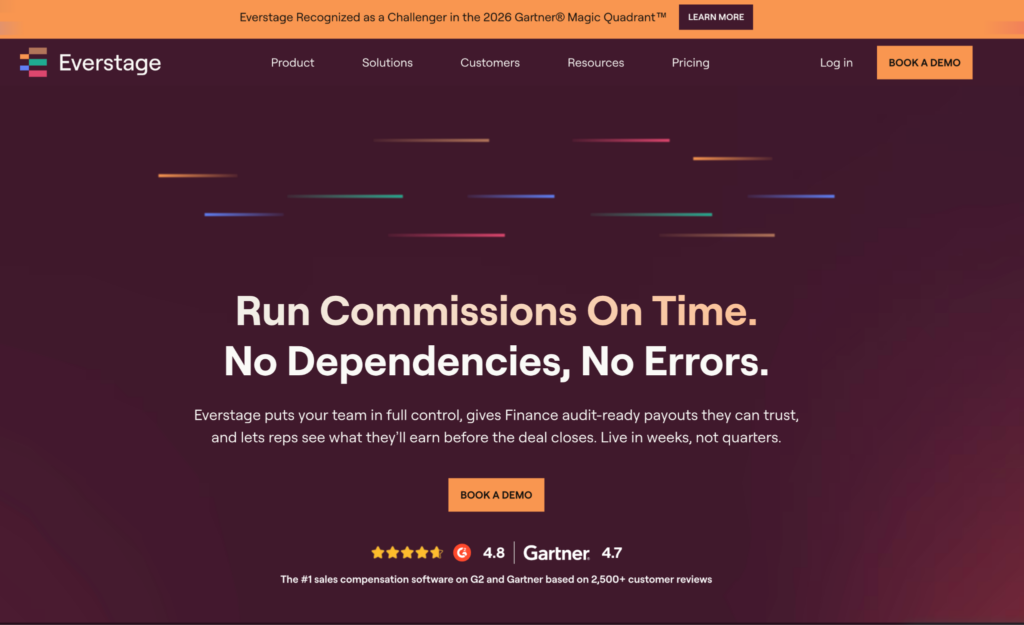
Everstage’s angle is rep engagement. Alongside automation, it adds gamification and clear dashboards meant to keep sellers checking their numbers, backed by analyst recognition for scale. A reviewer on G2 called it intuitive with flexible reporting and a smoother implementation than expected, and another rep liked seeing how booked meetings and pipeline translate into payouts.
Everstage Key Features
- Clear rep dashboards tying pipeline to payouts
- Flexible reporting and gamification for engagement
- Analyst-recognized scale (Forrester Wave Strong Performer, SPM Q1 2025)
Who’s it for
Larger sales organizations of roughly 200 to 1,000 employees with 50 or more commissioned reps that prioritize rep engagement and gamification at scale.
Where Everstage falls short
- Commission logic is hard to follow from the rep side. Customers wanted tooltips to break down each number once multiple accelerators were stacked up. The dashboards show the payout but not the reasoning, which is the part reps escalate to ops.
- Customization and templates take effort. Advanced configurations take time, and reviewers wanted more out-of-the-box report templates instead of building each one from scratch.
- Migration and AI gaps. One reviewer couldn’t pull historical data in during the switch, leaving gaps in year-over-year reporting, and flagged limited AI capability.
5. Xactly
Xactly’s strength is depth earned over time. As one of the longest-running enterprise sales performance platforms, it carries two decades of capability and is now positioned around AI and agentic automation. Users value its transparency and real-time reporting, which cut the manual reporting workload for executives. Admins also point to mid-cycle recalculation, changing something, and having a full month reload correctly before close.
Xactly Key Features
- Mid-cycle recalculation that reloads a full month
- Salesforce and HCM integrations with daily statement updates
- Predictive and agentic AI features for forecasting
Who’s it for
Established enterprises with large, complex sales organizations, often compliance-heavy, multi-region, or publicly traded, that need mature full-suite SPM and can commit to a months-long implementation.
Where Xactly falls short
- Rigid, hierarchy-based reporting. Reports are channeled by title, so a manager who wants their view formatted differently can’t change it without affecting everyone else’s.
- Reporting and data onboarding slow the start. Another reviewer said that reporting struggled to produce the reports they needed, and getting data in stretched the learning curve during implementation.
- Interface slows down adoption. Across G2, the interface draws the most complaints, non-intuitive navigation, slow loading, and a steep learning curve, all of which raise training cost and slow adoption.
6. Performio
Performio’s strength is daily reliability. It’s the tool reps actually open between deals, easy to access across browsers, and backed by a support team reviewers call responsive. For teams that want dependable tracking over a long feature list, that consistency is the selling point.
Performio Key Features
- Simple, accessible rep tracking across browsers
- Historical commission records for period comparison
- Standard plan automation for common structures
Who’s it for
Enterprise and upper-mid-market teams, often 500 or more reps across regions, run complex plans at scale that justify a longer rollout.
Where Performio falls short
- Slow to update. The most common complaint is lag, and it bites at month-end when reps check where they landed, and the latest sales aren’t reflected yet, the moment the numbers matter most.
- Thin dispute process. Users flagged that there is no way to leave feedback when rejecting a dispute, so a rep whose claim is denied gets no reason why, which pushes the conversation into email and erodes trust.
Try the most collaborative solution to manage, track and payout variable compensation. Calculate commissions and pay your team accurately, and on time.
Start TrialHow to move off your current setup
Switching comp tools sounds disruptive, but most of the risk is in the preparation phase. If QuotaPath is the right fit, here’s what the move looks like.
Step 1: Export your current data
Pull your existing comp plans, attainment history, and payout records from spreadsheets or your current platform. This is also the moment to drop what you’ve outgrown: retired plans, duplicate rules, and one-off exceptions. Migrating a clean version beats carrying old mess into a new system.
Step 2: Build and map plans
QuotaPath’s AI-assisted builder turns your plan rules into a live plan and maps CRM fields so deals flow in automatically. Most teams rebuild their core plans in days rather than waiting on a vendor implementation team.
Step 3: Run in parallel
Run QuotaPath alongside your current process for a recent pay period and confirm the numbers match. That’s also what earns rep trust: when sellers see the new tool land on the payout they expected, adoption stops being a fight.
Step 4: Go live
Once the math reconciles, reps move to real-time dashboards, and finance runs payouts through integrations like Rippling. From there, plan changes are self-serve, so the next quota reset or new hire doesn’t restart the cycle.