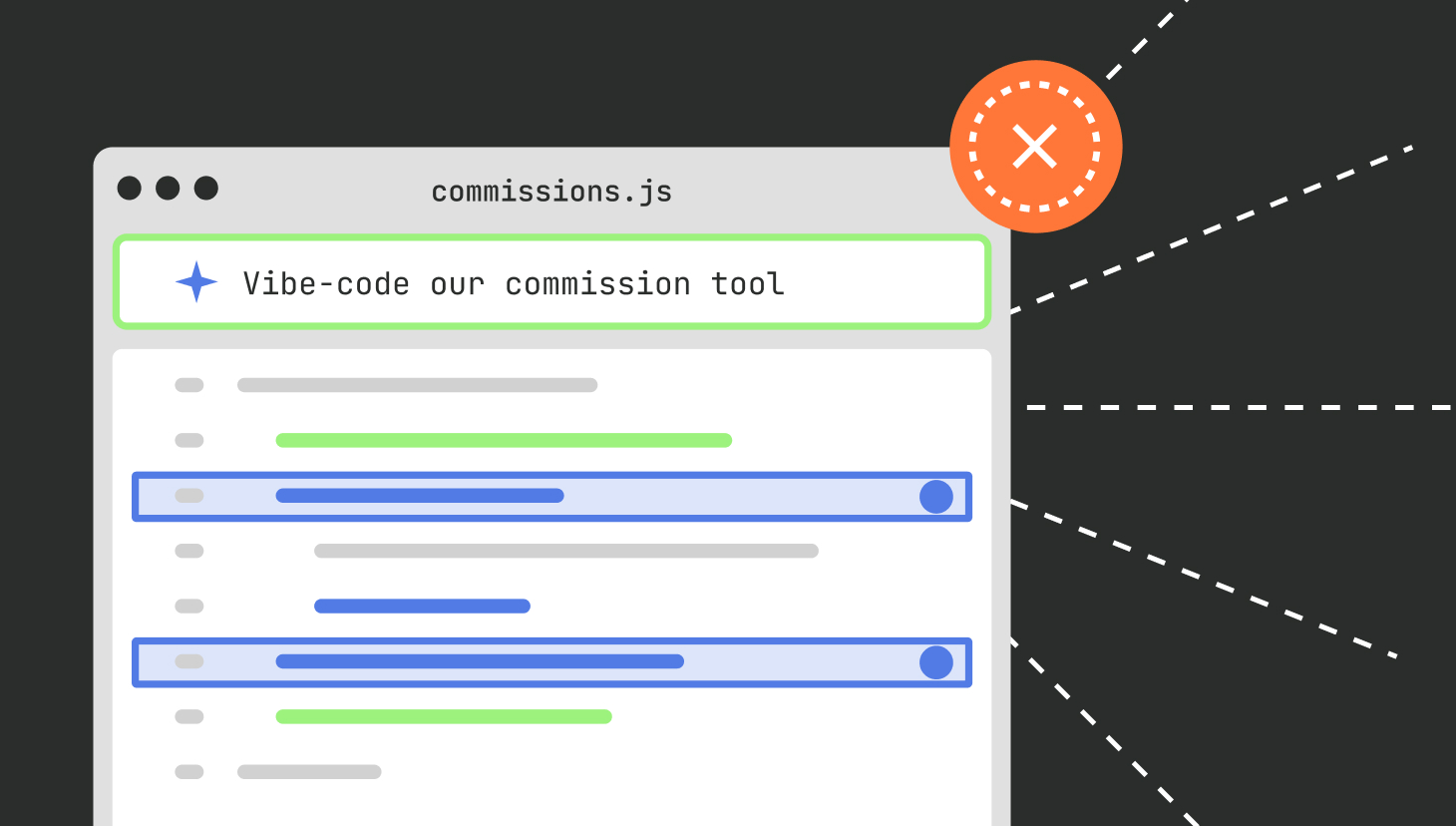
RevOps teams increasingly ship their own internal tools using AI coding assistants, also known as vibe coding. According to GoNimbly, about 75% of new enterprise applications now involve low-code/AI-assisted development, evidence of vibe coding’s rise within RevOps teams.
The availability of low-code and AI-assisted development have made DIY tooling feel accessible to non-engineers. For instance, Luke Cullimore, Senior RevOps Manager at Birdie, says outright, “I’m building out a lot of vibe-coded applications that we’re using across the go-to-market team.”
If Luke is comfortable building his own tools everywhere else, why would he refuse to build commissions and pay for QuotaPath instead? Because commission logic is the one GTM system where “good enough” DIY code creates compounding, expensive risk because it touches pay.
So, when Luke’s manager asked if they could’ve built QuotaPath themselves using the same AI tools, Luke replied, “I would not consider doing that for commission… you’d grossly underestimate the database structures you’d need to manage version control.”
“It would actually be way, way, way more complex than people think… you’d spend more time figuring that stuff out than actually building it as a first version,” Luke said.
Why commission breaks DIY tools
Birdie’s actual complexity consisted of 40+ reps, 6+ comp plan types, and payout eligibility tied to invoice-paid status (via Snowflake) rather than deal-closed date, while attainment is still measured against close rate. For example, a deal could be “6 months old, that was part of someone’s quota 6 months ago, that actually is still not due to be paid,” said Luke, creating a version-control problem that’s simple to describe and brutal to build correctly.
Before QuotaPath, Luke built SQL queries feeding “a bunch of very difficult-to-maintain spreadsheets,” which made the RevOps team “so reluctant to make any changes to comp plans” that sales sentiment toward incentive structures got worse over time.
This isn’t an isolated problem: widely cited research on spreadsheet error rates shows that the vast majority of spreadsheets contain at least one error. It’s a structural issue common to spreadsheet-based and hand-rolled systems. So, there’s no doubt why spreadsheets break down as commission logic gets complex.
The real cost of building it yourself
Building, operating, and maintaining your own tool is costly and time-consuming. For instance, Birdie took 2–3 weeks to originally build the spreadsheet/SQL system, then a full day every month to run it, plus up to 2–3 days per quarter for the more complex plans. That’s a recurring cost, not a one-time build.
It’s a common build-vs-buy blind spot for teams to price the build, not the maintenance. Yet the hidden costs of building your own commission tool come after creation, not during initial development, because internal tools can cost 3-10x more to maintain than expected. In fact, GoNimbly says roughly 90% of software costs are incurred after launch.
What you lose when you skip the partnership
A vendor relationship gives you compensation-design expertise you won’t get from a codebase. Luke said, “If you try to build something yourself, you completely lose that thought leadership and partnership that comes from working with a dedicated vendor.”
For example, before Birdie even signed, QuotaPath reviewed their draft comp plans, including an overly complex MME annual/quarterly hybrid quota, and helped them redesign it into something workable. Whereas a competitor, Everstage, reportedly said a similar plan simply “won’t work” and left it at that.
Luke’s comparison was “you could jump in and start making changes live on the call” vs a competitor’s “we’ll take it away and come back to you.” This exemplified the level of service and support that makes the difference when you choose to buy the right commission tool.
The payoff: what buying right actually looks like
Buying the right tool, rather than building your own, shows up in payout cadence, rep trust and engagement, and implementation speed. For example, Birdie saw a shift in payout cadence. Previously, Birdie’s reps on quarterly plans with unpaid invoices might wait “until the end of Q2 or Q3” to get paid on Q1 deals. With QuotaPath, Birdie moved everyone to monthly payouts tied to real invoice activity.
The new payout cadence improved rep trust and engagement. According to Luke, “The sales team really appreciates the visibility into their payroll,” and he now fields more questions from reps, which he describes as a sign of engagement, not confusion.
Implementation speed is clearer-cut and more predictable when you buy a purpose-built tool than building your own, accelerating time to value. For instance, Birdie fully met their aggressive onboarding timelines. “The clear onboarding steps that you guys outlined were seamless,” Luke said.
Try the most collaborative solution to manage, track and payout variable compensation. Calculate commissions and pay your team accurately, and on time.
Start TrialTakeaways for RevOps leaders weighing build vs. buy
A buyer’s checklist for evaluating commission tracking software, plus key points to consider, will help you decide whether to build or buy.
- Does the logic touch pay directly?
- Does it require version control across historical plan changes?
- Does eligibility depend on multiple systems such as CRM, billing, and data warehouse?
- Will finance eventually need to own this?
- Can you afford to staff ongoing maintenance, not just the initial tool build?
Build your own Slack bot — not your own commission engine.
“I couldn’t recommend you guys more highly,” said Luke.
Schedule a demo to see how QuotaPath handles complex invoice-based commissions.