Reps start checking a new comp plan the day their first commission statement arrives. By then, quotas and rates are locked, and a rule that looked fine in a spreadsheet pays out as written. Almost every team resets those rules each year: the Alexander Group’s 2026 survey found 97% of companies changed their plans. In the same survey, 57% named quota setting their most persistent challenge, and 46% struggled to allocate quotas on time. RevOps, Finance, and sales leaders who own the annual comp plan can close that timing gap by planning in six two-week steps. Each step produces the input the next one needs.
Key takeaways
- Sales compensation planning is the yearly process of turning a revenue target into pay rules for every sales role.
- Start planning 12 weeks before the plan year begins.
- Cost out every role at five attainment levels. Keep any accelerator under the point where an over-quota dollar costs more than the plan’s average dollar at target.
- Put every plan in writing and collect each rep’s signature before launch.
Design, track, and manage variable incentives with QuotaPath. Give your RevOps, finance, and sales teams transparency into sales compensation.
Talk to SalesWhat do you need before you start sales compensation planning?
Collect five inputs before the first planning meeting:
- Closed-won deals from the last four to eight quarters
- Attainment by rep, including reps who have left
- The sales expense budget and next year’s revenue target
- The hiring plan, with start dates and territories
- Current plan documents and approved exceptions
RevOps owns the process and needs read access to CRM and payroll data. Sales picks the behaviors to reward, Finance approves the cost, and HR or legal reviews the documents.
Book all six milestones on the calendar when planning starts.
![Timeline of the six-step sales compensation planning runway, from defining outcomes in weeks 12 to 11 through signing and launch in weeks 2 to 1, followed by a first review on day 90 of the plan year.]](https://5cd97948.delivery.rocketcdn.me/wp-content/uploads/image-97-1024x252.png)
Figure 1. The planning runway and a first review 90 days into the plan year.
SME quote 1: replace with a real quote or delete before publishing
Ask: How far ahead of the plan year do QuotaPath customers who launch on time start planning, and which step slips most often?
Suggested source: Ryan Milligan, VP of RevOps at QuotaPath (confirm current title), or a comp strategist from QuotaPath’s Strategic services team
How to plan sales compensation in six steps
The six steps run in order, and the output of one becomes the input for the next: outcomes set the measures, the cost model sizes the budget, and pay mix, quotas, and rates fill it in. Run the sequence once per role, then check the totals across roles.
Combined cost should stay within budget, and combined quota should exceed the revenue target.
1. Define the outcomes the plan pays for
Begin with the company’s operating plan and list the outcomes each role controls, such as new annual recurring revenue (ARR), multi-year terms, or expansion revenue, and weight each one. An illustrative account executive (AE) plan puts 80% of the weight on new ARR and 20% on multi-year terms. Keep each plan to three measures or fewer, the limit QuotaPath’s new comp plan report recommends. Tie every accelerator and short-term bonus, or SPIF, to one of those outcomes.
Expected result: A one-page brief of outcomes, measures, and weights by role
2. Model the cost before you set any rates
Using the step 1 brief, build the cost model on benchmark on-target earnings (OTE) and quota. Final numbers arrive in steps 3 and 4. Pay per booked dollar at target equals OTE divided by quota. The Bridge Group’s 2026 research puts median AE OTE at $200,000 (from $167,000 in 2022) and the median quota-to-OTE ratio at 4.6x (from 4.2x in 2024). At those medians, pay comes to 21.7% of bookings.
Test the plan at 50%, 75%, 100%, 125%, and 150% attainment. RepVue’s Q3 2025 index recorded quota attainment for 43.24% of reps. Price the plan for a year when more than half the team misses quota.
Expected result: A cost model per role
3. Set pay mix and OTE for each role
Working inside the step 2 cost model, give roles with more control over the buying decision a larger variable share.
Table 1. Typical pay mix and trade-offs by role
| Role | Base/variable | Pays for | Watch for |
|---|---|---|---|
| Account executive | 53/47 | Closed new ARR | Windfalls from one oversized deal |
| SDR or BDR | 60/40 to 70/30 | Meetings the AE team accepts | Meeting volume over quality |
| Customer success manager | 70/30 to 80/20 | Renewals and expansion | Double pay on one renewal |
| Sales manager | About 70/30 | Team quota attainment | Targets over 90% of team quota |
Sources: QuotaPath’s role-by-role plan guide for the SDR, customer success, and manager rows, and the Bridge Group 2024 benchmark for the account executive median.
Peg OTE for each role and region to market data and budget it apart from company-wide raises. US employers project 3.6% salary increase budgets for 2027 in WorldatWork’s 2026-2027 survey, short of the pace of sales OTE growth.
Expected result: A pay sheet that sets base pay and target incentive
4. Set quotas and commission rates
After step 3 sets OTE, build quotas two ways and reconcile them: top-down from fully ramped headcount and the revenue target, and bottom-up from each territory’s pipeline, win rate, and account potential.
Size new-hire ramps to your segment. AE ramp lasts 2 to 4 months in SMB, 4 to 6 months in mid-market, and 6 to 9 months or more in enterprise, according to QuotaPath’s capacity planning page. Capacity modeling runs in Atlas, QuotaPath’s AI revenue strategist, which estimates ramp, attainment, and quota coverage. Native territory planning sits outside the core commission platform.
Compare each final quota-to-OTE ratio with your own history. A ratio above your historical range flags a quota for a second look.
The base commission rate for each role equals its target incentive divided by its quota. Choose an accelerator that stays under the break-even multiple.
Expected result: A quota plan covering ramp schedules and commission rates
5. Stress-test the plan before anyone signs it
Re-run the cost model on the final quotas and rates from step 4. Replay every closed-won deal from the past year through the new rules and line up each rep’s pay under both plans. Explain any swing over 10% and test edge cases such as:
- One deal worth more than half a rep’s annual quota
- A deal split between two reps and a manager
- A customer who churns inside the clawback window
- A rep who joins or leaves mid-quarter
Bring the results to the approval meeting with answers to the questions Finance will ask about cost at target, downside, and upside.
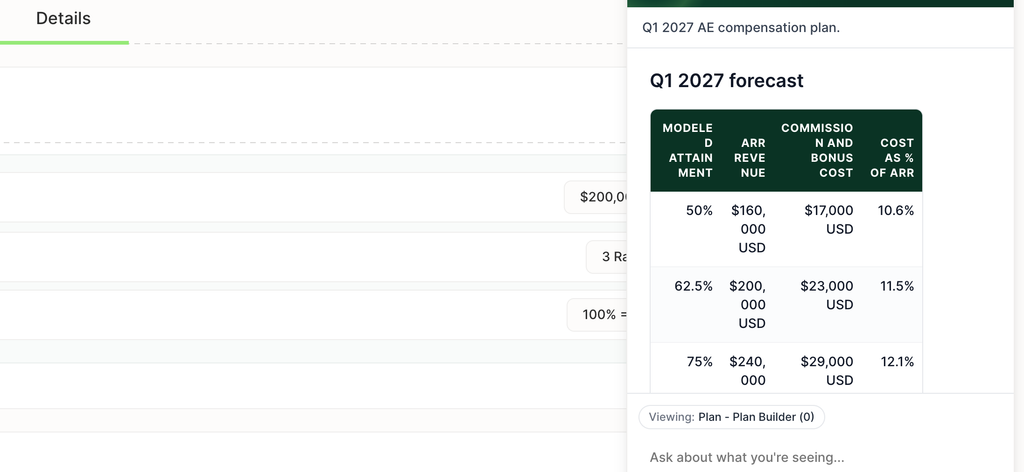
In QuotaPath, the AI-powered Plan Builder turns a plain-language description or an Excel formula into plan logic, and draft mode forecasts cost and revenue from your historical deals. Atlas then pressure-tests scenarios against benchmarks from tens of thousands of comp plans.
Expected result: A replay summary and an edge-case log
6. Sign and launch the plan
Once Finance approves the plan, brief managers before reps see it and prepare a personal earnings example for every rep. Book a one-on-one with each rep in launch week to run a live deal through the plan.
Check the legal and accounting rules before plans go out:
- California Labor Code 2751 requires a written plan explaining how commissions are calculated and paid, plus a signed receipt from each rep. An expired plan stays in force until a new one replaces it.
- New York requires a signed agreement kept three years after employment ends, and New York’s Labor Department presumes the rep’s version of the terms when none exists.
- For non-exempt reps, commissions count toward the regular rate used to calculate overtime under Department of Labor guidance.
- IRS Publication 15 treats commissions as supplemental wages, with an optional flat 22% federal withholding rate and a required 37% rate over $1 million a year.
- Commissions paid to win customer contracts are capitalized and amortized under ASC 340-40 unless the amortization period is a year or less, and Deloitte’s ASC 340-40 roadmap explains how renewal commission rates affect that period.
Plan Verification in QuotaPath sends plan documents to reps and tracks signatures, and QuotaPath Ledger builds the ASC 340-40 capitalization and amortization schedules.

After launch, audit payouts monthly and check the plan metrics each quarter.
Expected result: Rep acknowledgments on file and the day-90 review on the calendar
Worked example: one AE plan under two accelerators
It carries the 53/47 AE pay mix from step 3 and a 1.5x accelerator over quota. Commission starts at the first dollar, and the plan has no threshold or cap.
Table 2. Pay as a percentage of bookings for one AE plan
| Attainment | Bookings | Variable pay | Total cash pay | Pay as % of bookings |
|---|---|---|---|---|
| 50% | $460,000 | $47,000 | $153,000 | 33.3% |
| 75% | $690,000 | $70,500 | $176,500 | 25.6% |
| 100% | $920,000 | $94,000 | $200,000 | 21.7% |
| 125% | $1,150,000 | $129,250 | $235,250 | 20.5% |
| 150% | $1,380,000 | $164,500 | $270,500 | 19.6% |
Source: QuotaPath calculation. Commission rate: 10.2% of bookings up to quota. Figures exclude benefits, payroll taxes, and support roles.
Pay as a percentage of bookings falls as attainment climbs, since base salary stays fixed. At 50% attainment, base salary alone takes 23.0% of bookings, more than the full plan’s 21.7% at quota. Over-quota bookings cost 15.3 cents per dollar, below that average.
For a 47% variable share, the break-even multiple is about 2.1x (1 ÷ 0.47). A 2.5x accelerator costs 25.5 cents per over-quota dollar and lifts pay to 22.5% of bookings at 125% attainment. At 150% attainment, total pay reaches $317,500, against $270,500 under the 1.5x plan. Common multipliers in a QuotaPath accelerator guide run from 1.25x to 2x, below this plan’s break-even multiple.
![Line chart of pay as a share of bookings for one AE plan from 50% to 150% attainment. Both lines fall from 33.3% at 50% attainment to 21.7% at quota. Above quota, the 1.5x accelerator line keeps falling to 19.6% at 150%, while the 2.5x line rises to 23.0%. A dashed line marks the 21.7% cost at target.]](https://5cd97948.delivery.rocketcdn.me/wp-content/uploads/image-98-1024x576.png "Pay as a share of bookings at five attainment levels")
Figure 2. Pay as a percentage of bookings under a 1.5x and a 2.5x accelerator.
SME quote 2: replace with a real quote or delete before publishing
Ask: Which accelerator multiples and caps do QuotaPath customers use most often in AE plans, and how do they check the cost before launch?
Suggested source: A comp strategist from QuotaPath’s Strategic services team, or Graham Collins (confirm current role)
Which metrics show the plan is working?
Set targets for five numbers at launch and measure actuals against the cost model at each review:
- Reps at or over quota and the attainment spread from top to bottom
- Pay as a percentage of bookings, by role
- Pay gap between the top and median performer
- Disputes per payout cycle and days to resolve
- Rep understanding, from a short survey after the first commission statement
A wide attainment spread with a low median points to quota or territory design.
Common sales compensation planning mistakes and how to fix them
Four errors surface again and again in review, in how accelerators are timed, how draws are written, where exceptions are recorded, and how the quota period fits the sales cycle. Catch each one during planning, before it turns into a payout correction:
- Paying accelerators during ramp: Hold accelerators until a rep carries full quota. Only 30% of companies in a QuotaPath ramp survey of 114 revenue leaders allow them earlier.
- Leaving draw terms vague: State whether each draw is recoverable and when it reconciles against earned commission.
- Handling exceptions in email: Write crediting, split, and exception rules into the plan document to give Finance an audit trail.
- Ignoring the sales cycle when picking a quota period: Use monthly or quarterly quotas for short cycles and annual quotas for long ones.
Plan next year’s sales compensation with QuotaPath
All year, QuotaPath’s commission platform calculates payouts from CRM data under the rules you set during design.
Its comp plan templates give you a starting structure, and the 14-day trial opens with an optional setup call where a product specialist builds your plans and syncs your deal data.
Disclaimer: Sources and figures checked October 23, 2026. For legal, tax, or accounting decisions, confirm state wage rules and ASC 340-40 treatment with counsel and auditors.
Frequently asked questions
What types of sales compensation plans can you choose from?
Most sales compensation plans combine a base salary with variable pay. Common structures include a single commission rate, tiered rates with accelerators over quota, bonuses for set targets, and commission-only pay. Short-term SPIFs can sit on top of any structure for a product launch or a quarter-end push.
How do you change a sales compensation plan midyear?
Send written notice, explain the reason, and apply the change to future deals only. A change that lowers potential earnings needs a revised written plan, acknowledged by each affected rep before it applies. Store each notice with the plan version it changes.
Can you run sales compensation planning in a spreadsheet?
Yes, for a small team on one plan. A spreadsheet handles the cost model, the quota math, and a deal replay for a few reps. Spreadsheets get harder to trust as plans add roles, split deals, clawbacks, or monthly payouts, because each formula change needs a manual check.
Sources
- WorldatWork, Sales Comp Trends: Navigating Plan Change and Execution Priorities, May 21, 2026, https://worldatwork.org/publications/workspan-daily/sales-comp-trends-navigating-plan-change-and-execution-priorities
- QuotaPath, New Report: Building Performance-Driving Comp Plans, October 7, 2026, https://www.quotapath.com/blog/performance-driving-comp-plans-report/
- QuotaPath, What Is OTE? On-Target Earnings Definition + Examples, updated December 8, 2025, https://www.quotapath.com/blog/what-is-ote/
- The Bridge Group, AE Models, Motions & Metrics: 2026 Research Report, June 22, 2026, https://www.bridgegroupinc.com/research/2026-ae-models-motions-metrics
- RepVue, Cloud Sales Index: Q3 2025, 2025, https://repvue.com/cloud-index/2025/Q3
- QuotaPath, Incentive Compensation Plan Examples for Every Role, July 14, 2026, https://www.quotapath.com/blog/incentive-compensation-plan-examples-for-every-role/
- The Bridge Group, 2024 SaaS AE Metrics & Compensation: Benchmark Report, March 5, 2024, https://blog.bridgegroupinc.com/2024-ae-metrics-compensation-benchmark
- WorldatWork, WorldatWork: Employers’ 2027 Pay Budget Projections Point to Stability, July 16, 2026, https://worldatwork.org/publications/workspan-daily/worldatwork-employers-2027-pay-budget-projections-point-to-stability
- QuotaPath, Sales Capacity Planning, updated June 4, 2026, https://www.quotapath.com/sales-capacity-planning-software/
- QuotaPath, How to Design Compensation Accelerators that Motivate, July 9, 2026, https://www.quotapath.com/blog/design-compensation-accelerators/
- QuotaPath, 7 CFO Questions for RevOps Before Approving the 2027 Comp Plan, October 22, 2026, https://www.quotapath.com/blog/cfo-questions-for-revops-comp-planning/
- QuotaPath, Build Sales Compensation Plans, updated April 3, 2026, https://www.quotapath.com/build-sales-compensation-plans/
- QuotaPath, Introducing Atlas: Your AI Revenue Strategist, June 1, 2026, https://www.quotapath.com/blog/introducing-atlas-ai-comp-consultant/
- California Legislature, California Labor Code Section 2751 (via California.Public.Law), effective January 1, 2013, https://california.public.law/codes/labor_code_section_2751
- New York State Department of Labor, Payment of Commissions Frequently Asked Questions (FAQ), March 2021, https://dol.ny.gov/payment-commissions-faq
- U.S. Department of Labor, Fact Sheet #56A: Overview of the Regular Rate of Pay Under the Fair Labor Standards Act (FLSA), December 2019, https://www.dol.gov/agencies/whd/fact-sheets/56a-regular-rate
- Internal Revenue Service, Publication 15 (2026), (Circular E), Employer’s Tax Guide, December 15, 2025, https://www.irs.gov/pub/irs-prior/p15–2026.pdf
- Deloitte, Roadmap: Revenue Recognition, 13.4 Amortization and Impairment of Contract Costs, 2026, https://dart.deloitte.com/USDART/home/codification/revenue/asc606-10/roadmap-revenue-recognition/chapter-13-contract-costs/13-4-amortization-impairment-contract-costs
- QuotaPath, How to Make Rep Sign-Off on Comp Plans Less Painful, updated December 24, 2025, https://www.quotapath.com/blog/comp-plans-sign-off/
- QuotaPath, ASC 606 Revenue Recognition: How Commissions Should Be Accounted For, March 19, 2026, https://www.quotapath.com/blog/asc-606-revenue-recognition-automation/
- QuotaPath, Motivational Accelerator Plans: How to Design, May 19, 2026, https://www.quotapath.com/blog/motivational-accelerator-plans/
- QuotaPath, How Today’s Best Teams Build Sales Ramping Comp Plans, April 24, 2025, https://www.quotapath.com/blog/sales-ramping-comp-plans/
- QuotaPath, QuotaPath: Sales Commission Tracking Software, updated October 15, 2026, https://www.quotapath.com/
- QuotaPath, Trial Start, updated May 12, 2026, https://www.quotapath.com/trial-start/
- QuotaPath, Compensation Plan Template Library, updated October 11, 2024, https://www.quotapath.com/compensation-plan-templates/