Key Takeaways
Sales compensation consulting is the practice of designing, benchmarking, and managing sales incentive programs.
- Sales compensation consulting can help solve expensive plan design mistakes.
- Not every company needs a consultant.
- Consulting costs vary significantly by scope and company size.
- Traditional consulting often delivers point-in-time recommendations.
- AI can dramatically reduce analysis time and cost.
- Human expertise still matters in certain scenarios.
- Atlas offers an alternative approach for many SaaS teams.
AI Comp Consultant
Use Atlas at anytime to model, benchmark, or build compensation plans from proprietary QuotaPath data.
Try AtlasDo You Actually Need a Sales Compensation Consultant?
Compensation design impacts sales rep motivation and retention, business profitability, and forecasting. Many teams wonder whether they truly need outside help or simply better internal processes.
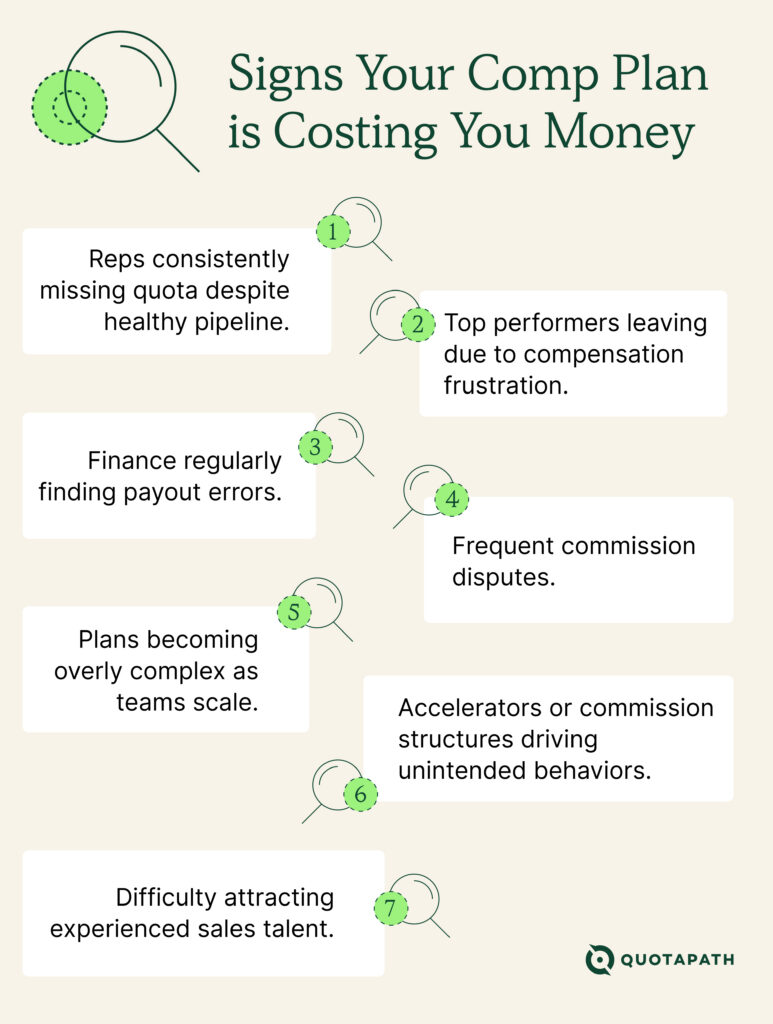
Signs Your Comp Plan Is Costing You Money
Compensation is often the largest controllable sales expense. Even small flaws in a plan can lead to six-figure consequences at scale, such as overpaying on low-margin deals. Misaligned incentives frequently create hidden revenue leakage. For instance, accelerators or commission structures that drive unintended behaviors such as reps prioritizing contract size over retention, or incentives that encourage discounting.
Plans becoming overly complex, as teams scale, present additional challenges. For example, reps consistently missing quota despite a healthy pipeline, Finance regularly finding payout errors, frequent commission disputes, and top performers leaving due to compensation frustration. Your comp plan can not only influence rep retention rates but also increase the difficulty of attracting experienced sales talent.
According to a McKinsey study, companies with transparent, well-designed variable compensation structures report up to 30% lower turnover rates than those with confusing or opaque plans. And more than 75% of sales professionals base their decision to accept a new role on the perceived fairness and opportunity offered by the compensation plan.
When In-House RevOps Is Enough
Internal teams at early-stage companies and teams with experienced RevOps leaders can successfully manage compensation without assistance. Likewise for businesses with small sales organizations, stable compensation structures, and access to benchmark data and modeling.
Hiring a consultant shouldn’t be the default answer. Strong revenue operations (RevOps) teams can often solve many compensation challenges internally. However, sometimes it’s best to enlist external expertise to address complex sales compensation questions.
When It’s Worth Bringing in Outside Help
As organizations grow, compensation plans evolve from simple quotas to multi-dimensional programs, triggering complexity in plan administration, data tracking, and compliance. This shift transforms compensation from a straightforward reward mechanism into a complex strategic lever that requires careful design to avoid unintended consequences.
External expertise can be especially valuable during periods of significant change, such as major compensation redesigns, rapid scaling, IPO preparation, mergers and acquisitions, and geographic expansion. Multi-product sales organizations, companies transitioning to usage-based pricing, or those requiring assistance resolving compensation disputes between Sales and Finance, may also benefit from external support.
A sales compensation consultant can bring industry benchmarks, objective analysis, and experience across multiple compensation models to these decisions. This outside perspective can also help align stakeholders around a compensation strategy that balances sales incentives with the company’s broader financial and business objectives.
How Much Does Comp Consulting Cost, and Is It Worth It?
Once leaders determine they need help, the next question is typically cost versus business impact.
Typical Pricing (Project, Hourly, Retainer)
Compensation consulting services typically use three common pricing structures: hourly consulting rates, project-based engagements, and ongoing advisory retainers. Hourly rates are often for ad hoc guidance or smaller, less well-defined needs, while project-based fees cover a defined scope and deliverables. Retainers provide ongoing access to consulting expertise and are typically best suited for organizations requiring continuous strategic support.
Market pricing varies widely by provider and scope of engagement. Independent consultants may charge approximately $250 to $500 per hour, while focused projects with boutique firms may range from $25,000 to $60,000. Enterprise-wide engagements with large consulting firms can cost $100,000 to $250,000 or more.
The difference often comes down to specialization and scale. Boutique compensation consulting firms typically offer specialized expertise and more tailored support for focused compensation challenges, while larger firms bring broader resources and capabilities to complex, enterprise-wide engagements. As a result, the right pricing model and provider depend largely on the scope and complexity of the compensation challenge.
What Moves the Price
Sales compensation consulting costs increase with the size and complexity of the engagement. Key factors include company size, the number and complexity of compensation plans, geographic coverage, technology integrations, and the number of stakeholder interviews required.
Data cleanup requirements can also significantly affect the scope and cost of an engagement. Organizations often underestimate the time required to gather and validate compensation data from disparate systems before consulting work even begins.
How To Calculate ROI
The ROI of sales compensation consulting can be measured through outcomes such as fewer commission errors and improved rep retention. For instance, 22% of sales reps experience at least one commission dispute each year, and 9% quit as a result. Improving compensation accuracy and rep retention translates into significant savings: a rep earning a $50K base salary costs $150K or more to recruit, hire, and ramp.
Additionally, improved quota attainment and sales productivity help eliminate costly redesign cycles when compensation fails to drive the intended performance. Better forecast accuracy can help prevent overpayment, while faster compensation plan rollout and reduced administrative workloads create additional time and cost savings.
Where Traditional Comp Consulting Falls Short
Traditional consulting remains valuable, but it also comes with tradeoffs that many mid-market SaaS teams struggle with.
Cost and Speed for Mid-Market Teams
Traditional consulting engagements can take weeks or months to move from discovery and analysis to final recommendations. For growing SaaS organizations with budget constraints and rapidly changing priorities, that investment of time and money may be difficult to justify. There’s also an opportunity cost while waiting for recommendations when compensation challenges require faster decisions or adjustments.
Static, Point-in-Time Advice
Recommendations are often based on a snapshot in time. However, markets, territories, and compensation benchmarks change rapidly. Consequently, plans require ongoing iteration to keep current, which is why a compensation plan is rarely “finished.” In fact, according to WorldatWork, 97% of survey respondents reported making changes to their sales comp plans for 2026, compared to 86% last year.
Handing Sensitive Comp Data to Outsiders
Modern revenue teams increasingly want secure, internal-first solutions. Working with external consultants may require sharing sensitive compensation data, including employee earnings and performance information, creating additional security and confidentiality considerations.
Organizations must also consider how compensation data is accessed, shared, and protected to maintain employee trust and meet internal governance requirements. Keeping sensitive information within controlled systems can provide teams with greater oversight of their compensation data while limiting unnecessary external exposure.
How AI Changes Sales Compensation Consulting
Advances in AI are creating a new category between DIY compensation planning and expensive consulting engagements.
On-Demand Benchmarks Instead of Weeks of Analysis
AI-powered compensation analysis can deliver immediate, always-on access to insights that traditionally require weeks of discovery and analysis. By continuously learning from evolving benchmark datasets, AI can provide benchmark-driven recommendations as compensation trends and market conditions change. This gives teams faster access to relevant insights while reducing their dependency on lengthy discovery processes.
Continuous Modeling vs. One-Time Reports
AI supports the ongoing need to adjust sales compensation plan design in response to evolving business and market conditions. It enables recurring compensation plan modeling, scenario planning, on-target earnings (OTE) analysis, pay mix adjustments, and testing of quota attainment outcomes to keep plans current. With AI-assisted scenario planning, teams can explore questions such as:
- What happens if quota increases by 20%?
- What happens if accelerators change?
- What happens if expansion revenue becomes a priority?
Rather than relying on a one-time report that reflects a single set of assumptions, continuous modeling allows teams to test different scenarios and adjust the sales incentive plan as business priorities and conditions change.
When AI Replaces a Consultant, and When It Doesn’t
The best sales compensation consulting solution depends on organizational size, budget, and desired outcome. AI is well-suited for benchmarking, plan grading, scenario modeling, compensation analysis, and first drafts of plan recommendations. However, there are scenarios where a human consultant is the better solution.
Human consultants remain valuable when compensation decisions involve executive alignment, organizational politics, M&A situations, large-scale transformations, and change management. AI can accelerate the analysis behind compensation decisions, while human expertise remains essential when those decisions require nuanced judgment, stakeholder alignment, and the ability to navigate organizational complexity.
Meet Atlas, Your AI Compensation Plan Consultant
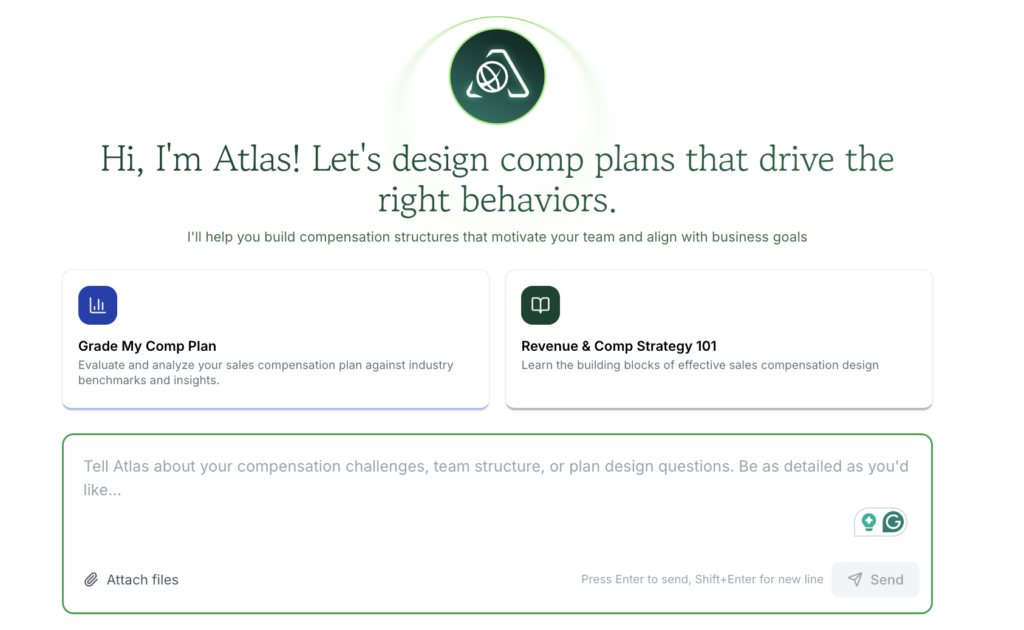
Traditional consulting and AI-driven alternatives each have their place. Atlas offers modern revenue teams a practical solution to compensation planning that combines AI-powered guidance with proprietary compensation data and benchmarks.
Grade Your Existing Plan in Minutes
Atlas helps finance and RevOps teams assess existing sales compensation plans against proprietary QuotaPath data and benchmarks to identify potential risks and evaluate plan simplicity and fairness. These insights help leaders understand whether their plan is competitive and aligned with business goals.
Build and Test Plans Against Proprietary Benchmarks
Leaders can move from intuition to evidence-based compensation planning with Atlas. Powered by proprietary QuotaPath data and benchmarks, Atlas facilitates compensation plan modeling, OTE validation, and pay mix recommendations to enable benchmark-informed design. Teams can build compensation plans with greater confidence while preventing costly financial surprises.
Leadership-Ready Briefs You Can Share Upward
RevOps teams often spend significant time packaging recommendations for leadership. Atlas streamlines this process by turning compensation insights and recommendations into clear, executive-ready summaries that communicate key findings and recommended actions. These structured outputs facilitate Finance alignment and give leaders the information they need to bring compensation decisions into board discussions with greater clarity and confidence.
Secure By Design for Sensitive Comp Data
Atlas prioritizes data security by keeping sensitive compensation information private and never using it to train external AI models. This approach supports internal ownership for reduced exposure of compensation data and information. Maintaining greater control over how sensitive data is accessed and used strengthens employee trust and supports internal governance requirements.
Try Atlas Free
Atlas offers a fast evaluation of your compensation plan and immediate insights without committing to a consulting engagement. Teams can test Atlas for free before deciding whether it’s the right approach for their compensation planning needs.
FAQ Section
● What does a sales compensation consultant do?
A sales compensation consultant helps organizations design, benchmark, evaluate, and optimize sales incentive programs. They may analyze compensation structures, quotas, OTE, pay mix, and performance data to identify potential issues and recommend changes that align incentives with business objectives.
● How much does sales compensation consulting cost?
Sales compensation consulting can cost anywhere from approximately $250 per hour to $250,000 or more per consulting engagement. While independent consultants may charge $250 to $500 per hour, boutique firms may charge $25,000 to $60,000 for focused projects, and enterprise-wide engagements with larger firms typically cost $100,000 to $250,000 or more. Final costs depend on factors such as company size, plan complexity, project scope, and data requirements.
● Is sales compensation consulting worth it?
Sales compensation consulting can be worth the investment when compensation challenges are complex or costly enough to require outside expertise. Consultants can help organizations prevent expensive plan design mistakes, improve quota attainment and sales productivity, reduce commission errors, and align stakeholders around compensation decisions. However, organizations with simpler compensation structures and experienced internal RevOps teams may be able to manage these needs without external support.
● Can AI replace a sales compensation consultant?
AI can replace a sales compensation consultant for many analytical and planning tasks, but not in every scenario. AI is well-suited for benchmarking, plan grading, scenario modeling, compensation analysis, and developing initial recommendations quickly and cost-effectively. Human consultants remain valuable when complex organizational challenges require nuanced judgment, executive alignment, change management, or navigating stakeholder dynamics.
● How often should compensation plans be reviewed?
Sales compensation plans should be formally reviewed at least annually and monitored throughout the year to ensure they continue driving the intended outcomes. Additional reviews may be necessary when business priorities, market conditions, territories, products, pricing models, or sales roles change significantly. Ongoing monitoring can help teams identify performance or cost issues early rather than waiting until the next annual planning cycle.
● What is the difference between compensation consulting and compensation software?
Compensation consulting provides external expertise and strategic guidance, while compensation software provides technology for designing, managing, and analyzing compensation programs. Consultants typically help with complex decisions, plan design, benchmarking, and stakeholder alignment, while software can automate sales compensation processes, model scenarios, track performance, and provide ongoing insights. AI-powered solutions increasingly bridge the gap by combining software capabilities with on-demand analysis and strategic guidance.
Book a demo with QuotaPath to benchmark, model, and optimize your compensation plans with AI-powered guidance.