Key takeaways
- The best compensation design software in 2026 includes QuotaPath, CaptivateIQ, Xactly, Varicent, Forma.ai, Everstage, and Pave. QuotaPath leads on scenario modeling and is one of the few that publishes its rates.
- Design and administration are different jobs. Payout accuracy proves your calculation engine works, instead of whether the quota was reachable or the accelerator was priced against your margin.
- Design decisions run on ratios. The Bridge Group puts the median quota-to-OTE multiple for a SaaS account executive at 4.6x.
- Commissions get capitalized and amortized under ASC 340-40. Workday amortizes over five years and Gartner over the initial contract term, depending on how each pays on renewals.
QuotaPath ranks first in this guide for handling the design decision and the payouts that follow. A plan commits your company to a cost per closed deal for the full fiscal year, and the seven platforms here differ in how much of that pricing work they do for you.
7 compensation design platforms at a glance
The seven platforms compared on design-stage capability, benchmark data, the handoff into live payouts, G2 rating, and published pricing:
| Platform | Design-stage capability | Benchmark data | Design-to-payout handoff | G2 rating | Published pricing |
| QuotaPath | Atlas tests scenarios, payout outcomes, attainment sensitivity, and cost exposure | Tens of thousands of comp plans, 8 years | Atlas recommendations feed back into QuotaPath | 4.8 | $35 and $50 per user, plus platform fee |
| CaptivateIQ | SmartGrid runs what-if scenarios in real time, plans versioned and tested on historical data | None native | Logic updated without rebuilding plans | 4.7 | Quote only |
| Xactly | Xactly Design simulation engine forecasts spend, pay equity, and turnover | 1,500+ companies, 20+ years | Design is a separate module from Incent | 4.2 | Quote only |
| Varicent | Territory changes modeled through to comp cost, GenAI quota and headcount optimization | None native | Model, test and deploy in one platform | 4.5 | Quote only |
| Forma.ai | Plain-English rules configured by AI, then modeled and merged live | None native | Modeled change merges into the live plan | 4.7 | Quote only |
| Everstage | Time Machine models plans against payee history before publishing | None native | Models and publishes in the same platform | 4.8 | Quote only |
| Pave | Pave Agent prices ranges and equity against live market data | 9,000+ companies, salary and equity | No commission engine | 4.7 | Free tier, paid quoted |
Why payout automation does not fix a bad comp plan
A design error runs longer than a calculation error before anyone catches it.
Underpay a rep by $400, and you hear about it inside the pay period. An accelerator that fires 15 points early produces no complaint and no exception in the reconciliation.
Two patterns tend to surface around Q3:
- Attainment clusters tightly at quota with little above it, which points to a target set below what the territory carries.
- Payout as a percentage of revenue clears the budget by month seven, which points to an accelerator curve priced without a cost model behind it.
Both signals sit in payout data you already hold. Reading them takes reporting on attainment distribution and payout cost, which tools built for calculation accuracy rarely surface. By the time the pattern is clear, correcting it means reopening plans your reps have been selling against for two quarters.
What separates a design tool from a payout tool?
Three capabilities determine what a platform contributes before rollout:
- Cost modeling before a plan goes live
Payout cost does not scale linearly with revenue. Above quota, accelerators pay a higher rate on every incremental dollar, so a handful of reps finishing at 150% moves total cost further than a straight-line forecast predicts. Pricing a plan across several attainment levels exposes that before you commit to it.
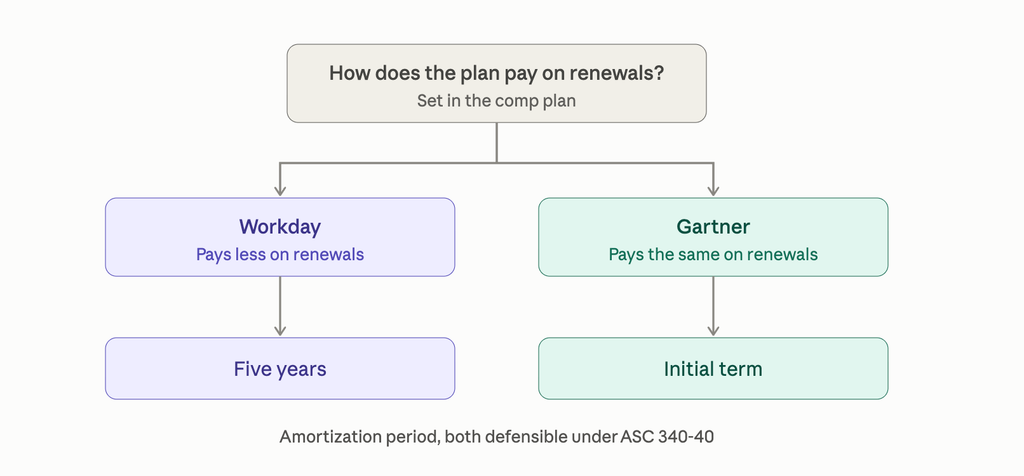
Commissions that qualify as incremental costs of obtaining a contract get capitalized and amortized under ASC 340-40, and that treatment is not a policy election. Accelerator and quota-threshold uplifts capitalize alongside the base commission.
The amortization period follows from how the plan pays. Workday told the SEC staff its renewal commissions run at a rate significantly lower than new business, which combined with its technology life to set a five-year period of benefit. Gartner reached the opposite conclusion under the same standard, telling the staff it does not distinguish between a new customer and a follow-on contract when compensating salespeople, so its initial-contract commissions amortize over the initial term only.
2. Benchmark data specific enough to set a number
The Bridge Group‘s 2026 study of 158 B2B companies puts the median quota-to-OTE multiple for a SaaS account executive at 4.6x, up from 4.2x in its 2024 edition.
ICONIQ Growth‘s 2025 survey of software companies puts typical quota-to-OTE ratios at 5x to 8x, running higher at fast-growing companies and widening as reps move up-market. An OTE set precisely at market can still miss when the quota attached to it carries a multiple from the wrong segment. That ratio is set during sales compensation planning.
Usable design data does two things:
- It reports ratios such as quota-to-OTE multiple and pay mix split.
- It refreshes continuously from live plans.
3. The handoff from approved design to live payouts
Design in one system and execute in another, and the approved plan drifts from the running plan within a quarter. Every amendment gets entered twice, and the version finance signed stops matching the version paying reps.
A platform carrying a modeled plan into production without a rebuild removes that reconciliation permanently. If they are separate tools, price the recurring effort into your build-versus-buy decision.
Try the most collaborative solution to manage, track and payout variable compensation. Calculate commissions and pay your team accurately, and on time.
Start TrialThe 7 best compensation design software platforms
Each platform entry covers what it designs, where it falls short, and what it costs:
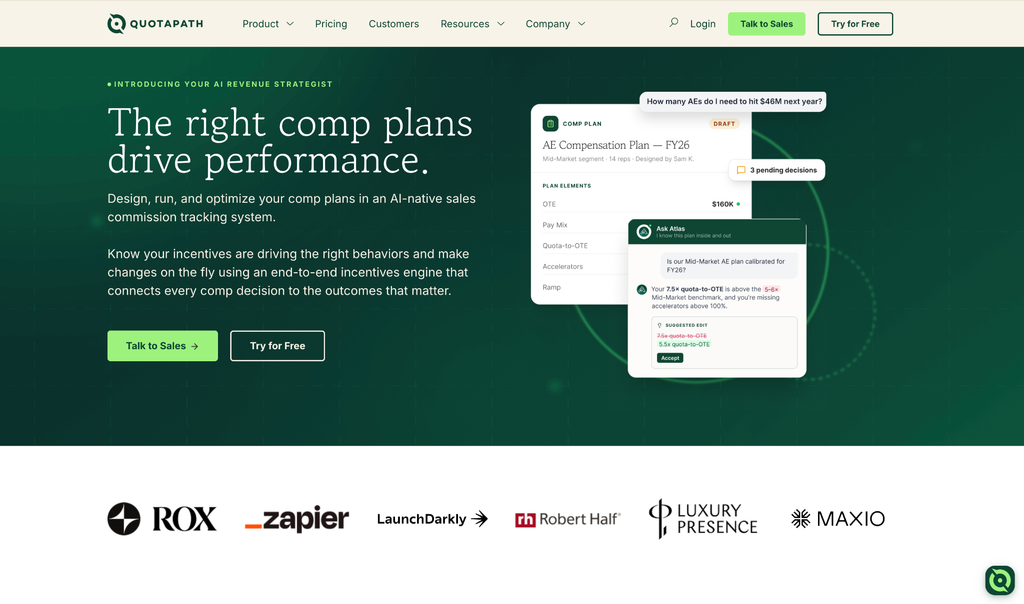
1. QuotaPath
QuotaPath fits RevOps and finance teams running variable pay for sales at companies of roughly 20 to 250 employees.
What it does at the design stage
Atlas works through the structure behind a revenue goal, setting quota, pay mix, rates, and accelerators. Those recommendations draw on your own historical attainment alongside benchmarks built from eight years of data and tens of thousands of comp plans running inside QuotaPath, covering OTE, pay mix, and quota-to-OTE ratios.
Sales, RevOps, and finance build the brief together in one workspace, with comments anchored to the section under discussion and sign-off tracked in one place.
Keen Decision Systems duplicated its 2025 plans, adjusted rates for expansion versus renewal, and applied them to new deals for 2026 without rebuilding. Ease of use and customer support are the attributes its reviewers tag most frequently.
Where it falls short
- Scope and sales compensation are variable. Merit cycles, salary bands, and pay equity analysis belong in an HRIS running alongside it.
- Territory planning and capacity modeling sit in Atlas, which is a separate purchase.
Rating and pricing
QuotaPath holds 4.8 out of 5 across 367 G2 reviews.
Growth runs $35 per user per month and Premium $50, each with a monthly platform fee covering the first five users, setup, the account team, and ongoing support. Atlas attaches from $5,000. A third tier, Strategic, bundles Atlas with a dedicated comp analyst and is listed as coming soon.
Billing is annual with a free trial, and QuotaPath is the only platform here that publishes per-user rates.
2. CaptivateIQ
With more G2 reviews than any other platform here, CaptivateIQ suits mid-market compensation teams with strong spreadsheet skills.
What it does at the design stage
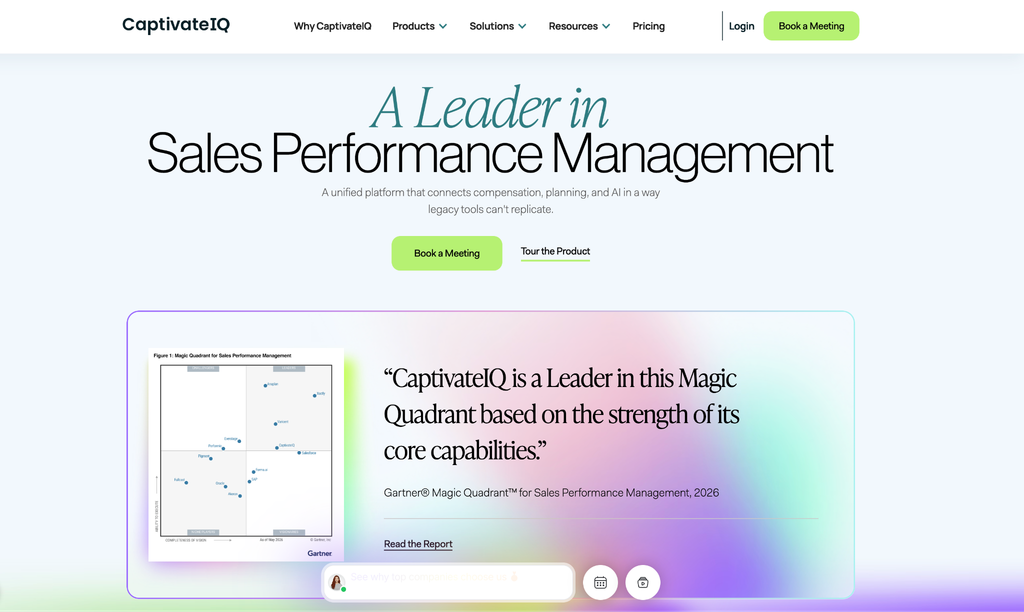
SmartGrid, its no-code modeling and calculation engine, combines spreadsheet-level flexibility with automated calculation and full auditability. Plans can be versioned, tested against historical data and validated before deployment, and what-if scenarios run in real time inside the platform.
Its Planning module extends that to territory carving, quota modeling and capacity planning, covering ramp, seasonality and coverage gaps.
Where it falls short
- The learning curve is the most-cited drawback in its G2 reviews, ahead of missing features.
- Seats are counted as admin users plus every payee, so cost scales with headcount on plan.
- Pricing requires a custom quote, with a one-time setup fee on top.
Rating and pricing
4.7 out of 5 from more than 3,400 G2 reviews. CaptivateIQ says most customers go live in under eight weeks.
3. Xactly
Around 56% of Xactly’s reviewers are at enterprise scale, with native integration into Salesforce, Microsoft Dynamics and NetSuite.
What it does at the design stage
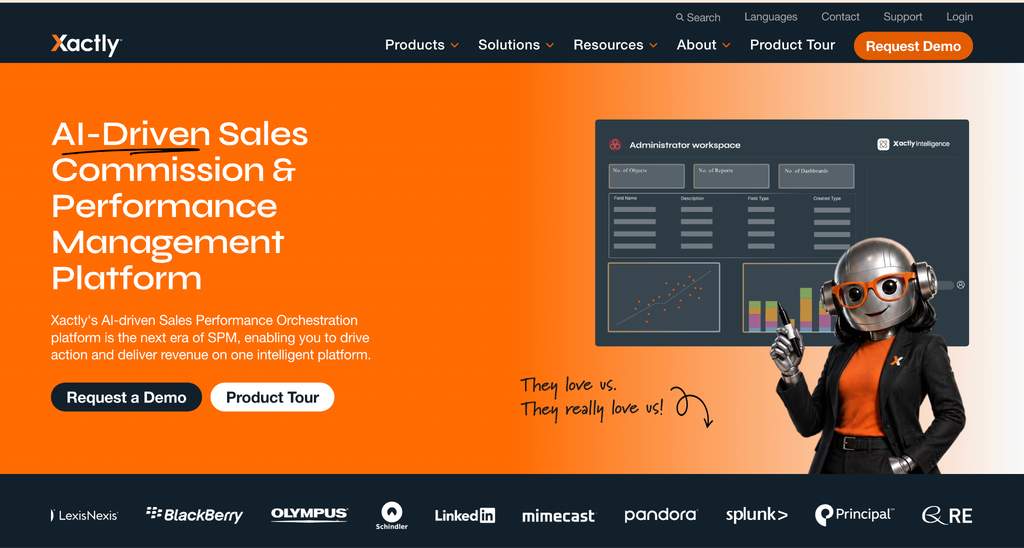
Xactly Design is a dedicated product for this stage. It compares your base and variable split and OTE against industry norms, then runs what-if scenarios to forecast the impact on total spend, pay equity, and turnover. A simulation engine estimates the effect of a change while it is still a draft.
Xactly Intelligence draws on more than 20 years of pay and performance data from over 1,500 companies, benchmarks your base/variable split and OTE against industry norms, and flags plan structures that have historically driven attrition before you roll them out. The base skews enterprise, which matters if your comparators are smaller.
Where it falls short
- Xactly Design is a separate module from Incent, the commission engine, and modules are layered on as you grow.
- Every tier and module sits behind a quote request.
- The benchmark data sits in Incent Ultimate, the top tier.
Rating and pricing
Its 4.2 out of 5 across roughly 1,100 G2 reviews is the lowest rating in this comparison. Every plan on its pricing page is quote-only, and Xactly publishes no implementation timeline.
4. Varicent
Varicent describes itself as built for mid-sized to large enterprises, and more than two-thirds of its reviewers work at companies above 1,000 employees, concentrated in financial services and banking.
What it does at the design stage
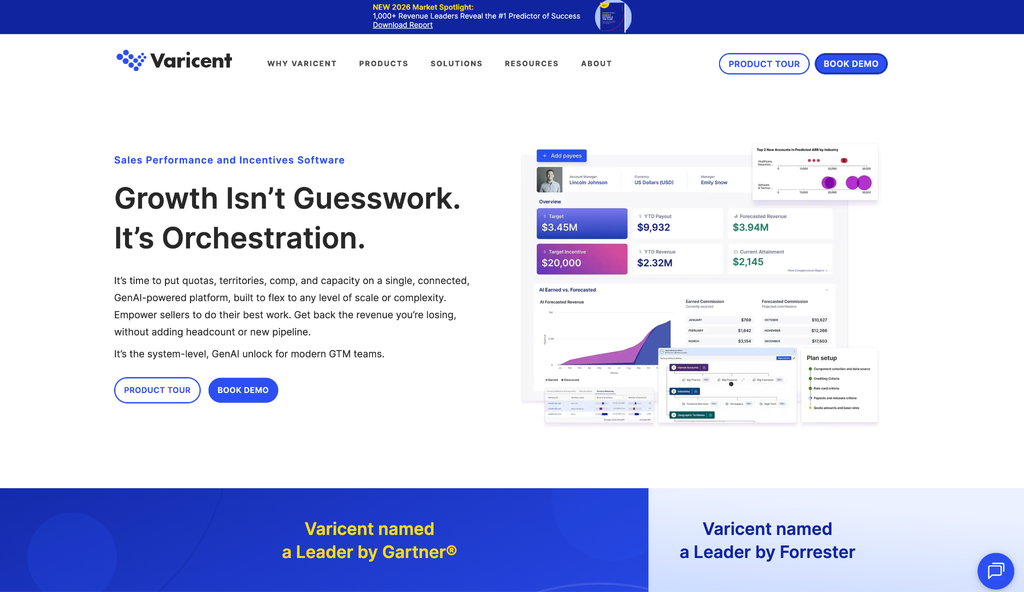
Varicent treats territory, quota, and incentive design as one connected problem. Its planning layer uses GenAI to optimize quotas and headcount at the outset, then models how a change to territory flows through to compensation cost. Plans are identified, modeled, tested, and deployed in the same platform, and the same models feed forecasting and commission accruals.
Intricate incentive structures are configured without engineering involvement. Varicent has been building for this category since 2005, when it launched tools covering incentive compensation alongside territory and quota management.
Where it falls short
- G2 reviewers note that its advanced features can overwhelm teams without dedicated resources to manage them.
- Neither pricing nor an implementation timeline is published.
Rating and pricing
4.5 out of 5 across roughly 600 G2 reviews.
5. Forma.ai
The one platform here where the vendor’s team is part of the delivery model, Forma.ai is built for complex, global sales organizations.
What it does at the design stage
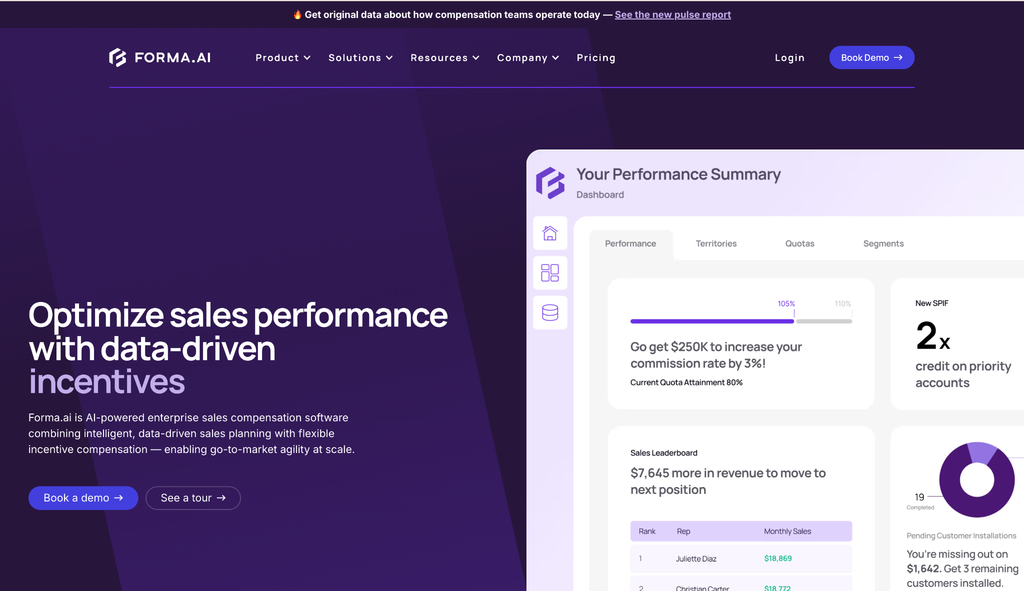
You describe a compensation rule in plain English, and Forma.ai converts it into configured logic, which removes the technical step that usually sits between deciding something and having a working plan. New designs are financially modeled against different data and parameters. Once the financial impact is understood, the change merges into the live plan.
Its analytical models assess how existing territory, quota, and comp plans are performing. A separate advisory arm covers quota-setting frameworks and cost scenario modeling for teams that want help deciding what the plan should be.
Where it falls short
- Pricing is not published, and G2 users report seven months to implement on average, with eleven months to a return.
- Its reviewer base is among the smallest here, so there is less independent evidence to weigh than for platforms with thousands of reviews.
Rating and pricing
4.7 out of 5 across 63 G2 reviews. Pricing is scoped across three components: a one-time onboarding fee, the platform itself, and the AI configuration layer, with every figure quoted per customer.
6. Everstage
Everstage weights mid-market, with around 61% of its reviewers in that segment.
What it does at the design stage
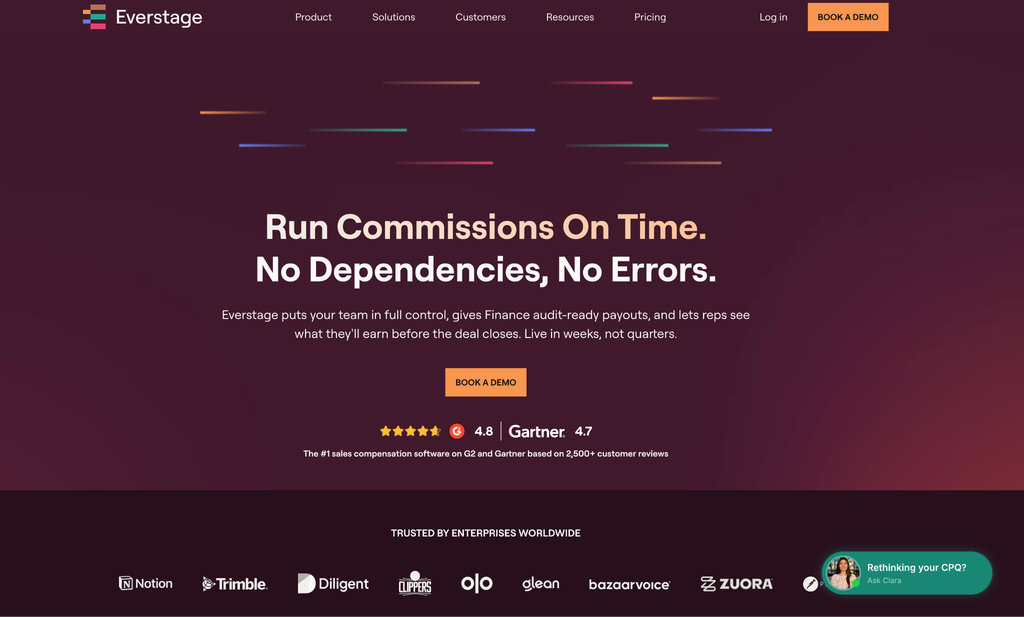
Time Machine models a plan against the historical performance of one or more payees before you publish it, estimating spend across a selected period so you can see what a structure costs before anyone is paid under it. The drag-and-drop plan designer covers multi-tier accelerators, split credits, and draw-against-commission without writing formulas.
Its planning product tests territory and quota structures as parallel scenarios, visualizes the gap between current capacity and assigned targets, and allocates quota against rep seniority and ramp profile.
Everstage will also build a free proof of concept on your actual plan before you commit to anything. Modeling and publishing happen on the same platform.
Where it falls short
- Its pricing page lists ASC 606 compliance as a scoped add-on, alongside the Salesforce app and the Slack and Teams connectors.
- Cost tracks every payee on plan, so it climbs with the size of the commissionable population.
Rating and pricing
4.8 out of 5 across roughly 2,000 G2 reviews. Everstage prices per payee, with every component scoped at quote. It states most teams go live in four to six weeks.
7. Pave
Pave is the only platform here designed for HR, covering salary bands and merit cycles. It earns a place because the pay mix starts with base salary, and a variable plan built on a band set two years ago inherits that error. Its reviewers are concentrated in mid-market companies.
What it does at the design stage
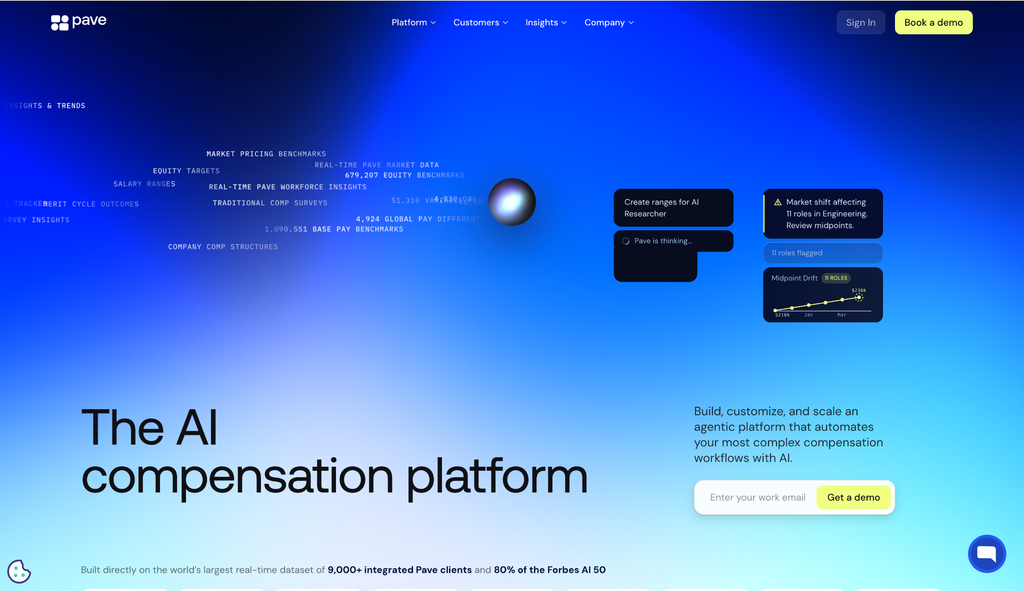
Pave’s benchmarks come from persistent connections to HRIS, ATS, and equity management systems across more than 9,000 companies, so pay data refreshes as the market moves. The Pave Agent prices salary ranges and equity targets against that data, with geo differentials and level progressions applied.
Merit cycle parameters and recommendation logic are set before the cycle opens, which keeps manager-level decisions inside a budget. Pave reports that Workato cut its annual benchmarking and salary range process from ten weeks to three.
Where it falls short
- Commission structures sit outside its scope, so accelerators, clawbacks and splits need a separate tool.
- Its review base is the smallest here at 46, and insufficient detail and limited data are the two drawbacks reviewers cite on G2.
Rating and pricing
4.7 out of 5 across 46 G2 reviews. Paid plans are quoted, and a free Market Data Lite tier covers 200 job families for the US market plus one other of your choice.
Design comp plans that hold through the year with QuotaPath
Ask any shortlisted platform to model your own accelerator at 130% attainment during the demo. Most will show you a template. QuotaPath publishes its rates, so you’ll know the cost before the call.
Talk to sales or start a free trial
Frequently asked questions
- How is compensation design software different from compensation management software?
The term covers two different jobs. On the HR side, compensation management means salary bands, merit cycles, and pay equity across every employee. On the revenue side, it means quota, pay mix, and accelerators for people paid on performance. The platforms in this guide do one or the other. Check which job a vendor is built for before you compare feature lists.
- Do we need it if we already have an HRIS?
An HRIS stores employee records and runs payroll. It will not price a quota against your margin or show what an accelerator costs when reps overperform. Teams running variable pay usually need both, with the design tool feeding approved plans into payroll.
- How much does compensation design software cost?
QuotaPath publishes per-user rates, at $35 and $50 per month depending on tier. The other six quote on request. Ask for the first-year total, including platform fees, one-time implementation charges, and per-payee counting.