Commissions land on Finance more often than anyone plans for. Payouts tie to revenue, payroll, and signed comp agreements, so the CFO or VP of Finance ends up owning the math.
For a while, a spreadsheet holds. Then the plans multiply, the analyst who built the file leaves, or a rep asks a question nobody can answer with confidence.
Finance leaders are also being asked to do more without adding people. In Gartner’s 2026 CFO budget research, 75% of CFOs said they plan to increase technology budgets, while expected headcount growth fell from 6% in 2025 to 2% in 2026.
We talked with three finance leaders who hit that wall and moved their comp system out of spreadsheets.
Each started for a different reason. YPrime needed its time back. SeekOut needed to run commissions without a new hire. Suitable needed order across years of legacy plans, then used that foundation to rethink comp strategy.
Below, learn how three finance leaders are modernizing their tech stack for commission automation.
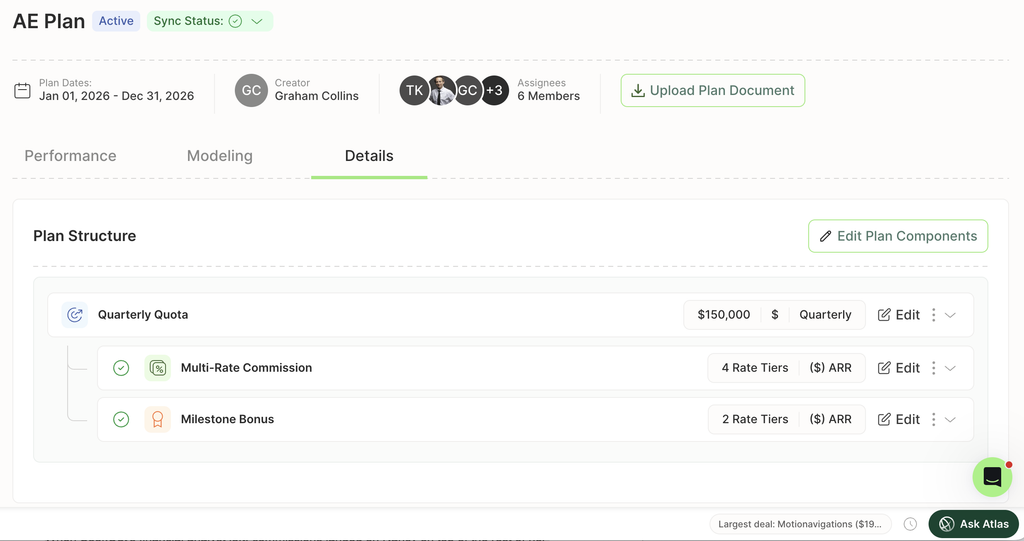
1. YPrime: From 80 hours a quarter to under four
Michael Bishop was the SVP of Finance and Controller at YPrime, which builds clinical trial software for the pharmaceutical industry. At YPrime, commissions have always been a Finance-owned process. Michael or someone on his team calculated payouts, communicated them, and answered every question that came back.
The breaking point
Commissions took about 80 hours a quarter. One member of Michael’s team spent roughly two weeks every quarter, just under 20% of her time, pulling it together by hand.
The hours were only part of the cost. Michael described the manual work as “frankly, riddled with errors.” He added: “We never really had a good trust in the fact that we were paying our people right. And I’m not sure if they actually had the full trust that they were getting paid right.”
A move from QuickBooks to NetSuite showed the team what integrations could do. Soon after, they came to Michael with a request: find a better way. They wanted a tool that could “bring all of our data together into one and, for lack of a better way of saying it, effectively do the math for us,” with the controls and traceability in one place.
Why QuotaPath
YPrime narrowed its shortlist to two vendors. The HubSpot integration decided it.
“Once we set it up, as the finance admin of QuotaPath, even I know how to use it,” Michael said. “It’s immensely easy for me to go find the field that I want and map it and make it work for us.”
It also gave Finance a clear agreement with Sales: “Go do your job in HubSpot, and we’ll do our job and make sure that it comes through appropriately.”
NetSuite data feeds the plans too. To validate it, Michael built his own report in NetSuite, pulled the matching report from QuotaPath, and compared the two. “I’m like, hey, this thing is working. So it was very, very quick, very easy.”
The results
Commissions now take two to four hours a quarter to fully review, including any back-and-forth on questions. Michael puts the time savings at about 95%.
“After the first quarter that we went through it and we did all the work, we had a return on investment almost immediately,” he said.
The reclaimed time went somewhere useful. “We’re now applying our mental capacity elsewhere, to something that is actually more value added to the business.”
The lesson: move your checks to the front end
Automation changed where YPrime’s controls live. With spreadsheets, errors surfaced at the end of the process, if they surfaced at all. With QuotaPath, the math follows the CRM data exactly, so the data has to be right when it enters HubSpot.
“You can’t put all your checks on the back end. You got to put your checks on the front end when you automate something,” Michael said. “You’re going to put the effort somewhere, so you might as well put it up front.”
He’s also candid that the rollout is a people project. “Your user base is inherently emotionally tied to the effectiveness of this platform. It is their pay.” His advice for teams leaving spreadsheets: communicate early and often, and tell reps exactly what will look different once the plan is automated.
Read the full story: YPrime Eliminates Errors and Reclaims 80+ Hours a Quarter with QuotaPath
2. SeekOut: One finance leader, ten comp plans, two hours
Nancy McBee is VP of Finance at SeekOut, a talent intelligence platform that helps companies recruit, hire, and retain top talent. She manages commissions, payroll, and finance operations.
The breaking point
When SeekOut’s financial analyst left, commissions landed on Nancy on top of the rest of her role.
“I wouldn’t have the bandwidth to hire, train and own commissions,” she said. “Getting a tool was the best way for me to get some scale for myself and the team.”
Spreadsheets were off the table. So was a heavyweight platform. Nancy had implemented Spiff at a previous company and knew that level of cost and complexity would overwhelm a lean team. She needed something intuitive that she could run herself, and she needed it fast.
Why QuotaPath
Nancy evaluated multiple vendors. Other tools came with more bells and whistles, but the buying experience told her more than the feature list.
“I kept running into walls with the other tool,” she said. “I’m hearing a lot of no’s, and I want to hear yes’s. Every single time I said something to Tom, it was, ‘Yes, yes, yes, yes. We can help figure that out. We can do this.'”
Her takeaway: “If you’re buying software, you’re really buying a partnership.”
The results
SeekOut went live in two weeks. “Our customer success rep, Josh, would drop everything to get on the phone with me, walk me through anything that I needed, and then I’d be up and running,” Nancy said.
Today, Nancy runs commissions in two hours across ten comp plans, with deal data flowing in from the Salesforce integration. One finance leader owns the whole process, and Sales and Finance see the same targets, plans, and payouts.
“It has really helped us at SeekOut in creating additional scale, transparency, and ensuring that everyone’s on the same page for targets, comp plans, to drive the right behavior and ultimately grow the business,” she said.
The lesson: pick a system your team can actually run
A lean finance team can run a complex comp program. The system has to be simple enough for one person to own, and the vendor has to show up when that person needs help. (For more on this, see how to scale your commission process without scaling headcount.)
Read the full story: Two Weeks to Implementation: SeekOut Scales Commissions with QuotaPath
Try the most collaborative solution to manage, track and payout variable compensation. Calculate commissions and pay your team accurately, and on time.
Start Trial3. Suitable: Treating the comp plan as a scoreboard
Jayson Tischler is CFO of Suitable, a Philadelphia-based student engagement platform. Colleges and universities use Suitable to improve student retention and outcomes, with tools for events, internships, work-study programs, and pathways outside the classroom.
Jayson’s path to CFO ran through classroom teaching, venture capital, and operator roles. Across all of it, he’s focused on helping early-stage organizations reach their next level through “systems and processes, forecasting, discipline management.”
The breaking point
Suitable grew organically over nearly ten years. Along the way, commission structures piled up by role and by person, each one written into a signed letter with an employee.
“I had really been given legacy commission plans and needed to make sense of them all in an organized fashion,” Jayson said.
With the sales and client success teams growing, he needed a system that connected Suitable’s revenue systems of record and “dramatically reduces time and dramatically increases accuracy.”
Jayson had seen QuotaPath before. At a previous company, the head of sales bought it, and Jayson received the commission output to run payroll. Suitable was his first time buying, implementing, and managing a comp system start to finish.
Handling the complexity
Suitable’s plans have a lot of layers. Account executives earn a base rate, higher rates on ARR past quota, kickers on multi-year contracts, and incentives tied to enterprise deals. SDRs are paid per meeting booked. Success Reps have their own plan, and a sales leader earns on the team’s total closed business. Deals get credited when they close in HubSpot, but payouts only trigger once the customer pays in Maxio.
Phase one focused on getting that right. Jayson and the QuotaPath team built rules for every commitment in those signed letters, connected and validated the HubSpot and Maxio integrations, and loaded historical payouts so QuotaPath matched what reps had already been paid.
The payoff showed up in rep questions. Before, reps asked whether they should close one deal before another to cross a quota threshold and trigger a higher rate. Now the rules split the rate on a single deal automatically when a rep crosses the line.
Those questions used to require “a direct interaction with me as a CFO or with a revenue ops manager, which is usually easy to resolve, but is like a point of friction you want to avoid,” Jayson said. “We’ve reduced a lot of that back and forth and ambiguity.”
The results
Reps see each closed deal in QuotaPath right away, with the exact commission rate applied. Jayson also found a benefit he didn’t expect.
“I can actually use a lot of data in QuotaPath that combines Maxio and HubSpot data in a way that was fairly difficult to do separately,” he said. “I actually do quite a bit of customer data analysis on expansion and upsell.” Because those calculations are built into the client success bonus rules, QuotaPath doubles as a data source for Suitable’s KPIs.
Would he go back to spreadsheets? “No, no, no. Having a system is critical.”
What’s next: comp as a strategy lever
With a year of clean data in place, Jayson is using the end of the calendar year to plan 2027 comp. On-target earnings for a role may stay the same. The structure behind them will change to match Suitable’s current priorities, including larger deal sizes and more university-wide enterprise deals.
“Something might have worked three, four, or five years ago that we’ve been pulling forward, but now this is a good opportunity with a data set that I can now manipulate,” he said.
Reps have more awareness of their pipeline and earnings today. Jayson expects plan changes to turn that awareness into action, and the groundwork makes those changes easier to introduce. He can use plan modeling and historical data to show reps how a new structure reaches the same financial goal a different way.
The end goal is reps who sell the best fit for the customer and the company. “It should be a scoreboard, and people want to win,” Jayson said. “We’re resetting the rules of the game a little.”
The lesson: stay in the implementation yourself
Jayson’s advice for finance leaders who just signed: don’t hand off the entire setup.
“There’s probably a bias towards delegating some of that implementation work, but I think even as a senior leader, understanding how the data sets are structured, how the rules are written, finding gaps in your other systems of record” pays off, he said.
Suitable found plenty of those gaps, from missing HubSpot IDs to Maxio revenue line items structured differently than HubSpot. Fixing them left Suitable with cleaner data across every connected system. “I would use it as a real tool to validate your data across all of the systems that funnel into it.”
What these three finance leaders have in common
Spreadsheets break at a predictable moment. For YPrime, it was 80 hours a quarter. For SeekOut, it was an analyst’s departure. For Suitable, it was a stack of legacy plans. (See what Finance and RevOps lose by waiting to ditch commission spreadsheets.)
Integrations make the numbers trustworthy. HubSpot and NetSuite at YPrime. Salesforce at SeekOut. HubSpot and Maxio at Suitable. When comp pulls from the same systems Finance already trusts, fewer payouts get questioned. Browse the integrations hub to see what connects.
Clean data belongs upstream. Michael moved his checks to the front end. Jayson used implementation to find gaps in his CRM and billing data. Both ended up with data they can trust. The commission accounting checklist covers the controls to put in place.
Partnership matters as much as features. Michael got custom walkthrough videos from support chat, a working session with a developer, and a call with a co-founder. Nancy had Josh. Jayson values “always having a resource at QuotaPath to resolve tricky issues, edge cases, and also support on best practices.”
The payoff grows over time. First, Finance gets its time back. Then payouts become accurate and trusted. Then comp data starts informing strategy. That last step matters. Gartner’s 2026 research on finance AI warns CFOs not to “mistake activity for impact.” Jayson’s 2027 planning shows what impact looks like: comp data shaping how Suitable pays for the deals it wants.
Design, track, and manage variable incentives with QuotaPath. Give your RevOps, finance, and sales teams transparency into sales compensation.
Talk to SalesTake the next step
Every one of these leaders reached the point where the spreadsheet cost more than a system. If you’re there, see how QuotaPath automates commission tracking and connects to the tools your finance team already uses. For more stories from finance leaders, visit our customer page.