Your commission process probably works.
Reps get paid, close eventually happens, and the spreadsheet only breaks a few times a year. That’s the problem … “works” and “good enough” are exactly what keep commission tracking off Finance’s risk register.
But the financial risk in commissions is equally high: paying your reps incorrectly when they already distrust Finance AND misstating variable compensation expense, slowing close, and losing confidence in the forecast (all at once).
In this blog, learn:
- Where “good enough” commission tracking actually costs you: forecasting, close, audit readiness, and rep trust
- Why spreadsheets fail hardest mid-year, right when plans change
- The exposure model Finance should require before approving any comp change
- How AI makes payout scenario modeling practical
- The metrics to track to know if your process is quietly taxing the business
Design, track, and manage variable incentives with QuotaPath. Give your RevOps, finance, and sales teams transparency into sales compensation.
Talk to SalesThe costs don’t show up as commission errors
It’s important to note that the costs don’t actually show up as commission errors. Instead, they show up everywhere else (!).
Like in your forecast. When accruals are built on a wrong earned-to-date base, every forecast layered on top inherits the error. Expense timing distorts monthly S&M and EBITDA, and true-ups bunch into later periods, so forecast variance starts looking like performance variance, and nobody can tell which is which.
Or in your close. Manual commission reconciliation means tying out bookings, payroll, and accrued liabilities by hand, chasing exceptions, and holding sign-off until disputes resolve. Teams running spreadsheet-heavy processes routinely lose two to five business days of close to commissions alone.
How about your audit file. Auditors flag the process: no effective-dated plan documentation, no clean tie-out from the approved plan to source deals to payout, weak evidence of accrual methodology, and no way to reproduce a historical payout exactly as of the pay period. If you capitalize commissions under ASC 340-40, errors flow into deferred contract costs and amortization, where they can hide for one to four quarters before a true-up or variance review surfaces them.
And of course, in your reps’ trust. A single dispute burns 2–10 hours across Finance, RevOps, payroll, and a manager. The compounding cost is worse: once reps believe the math is unreliable, every statement becomes contested.
Why spreadsheets fail exactly when you need them most
Spreadsheets fail mid-year when plans change, which is precisely when the stakes are highest.
A new SPIF introduces effective-date logic.
Accelerators require cumulative attainment math, not simple rate lookups.
Territory shifts break credit rules.
Quota adjustments raise retroactivity questions.
The failure modes are predictable: a lookup still pointing at the old rate table after an accelerator change, a split credit applied on one tab but not the payout tab, a SPIF that keeps paying after the promo ended, a clawback keyed to close date instead of churn date.
Operationally, teams respond by creating new tabs instead of controlled versions, hardcoding exceptions, and carrying “shadow adjustments” outside the model, until nobody is sure which file is authoritative.
Static tools handle tables well. They handle event history and rules that change over time poorly.
Comp plans are the latter.
The Finance move: model exposure before the plan changes
Here’s where Finance can shift from cleanup crew to gatekeeper. Before any comp change is approved, require a payout exposure model, mnot a single cost estimate at 100% attainment.
A plan can look cost-neutral at target and still get expensive above it.
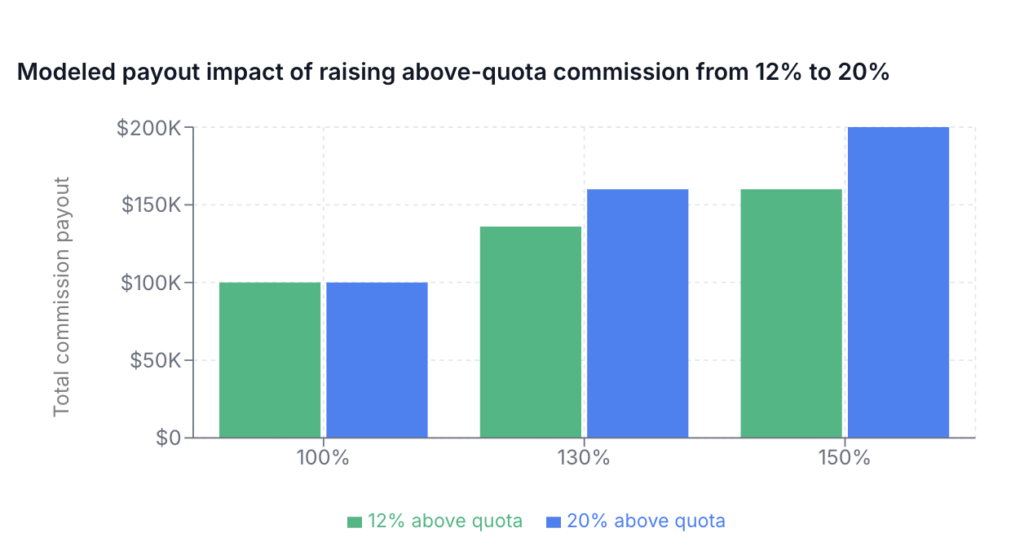
Consider a change from 12% to 20% commission above quota to “reward outsized performance.” At 100% attainment, cost looks unchanged. But if top reps finish at 130–150% (especially after territories also improved) payout on the overage cohort can rise 30–50% or more.
That’s the kind of change that looks small in a spreadsheet and expensive once fully modeled.
Before signing off, a Controller should ask:
- What does this cost at 100%, 110%, 125%, and 150% attainment?
- What’s the downside if the top quartile overperforms?
- Is anything retroactive?
- Does this change our accrual methodology?
- Can payroll reproduce the result from system logic, not manual edits?
Where AI changes the equation
The reason most teams skip scenario modeling is the effort involved.
Building attainment scenarios across roles, segments, ramp status, and deal mix in a spreadsheet is a project.
This is where AI earns its place in the comp stack: feed it plan rules, quotas, headcount, and historical attainment distributions, and it can model both deterministic scenarios (“what if 30% of reps hit 120%?”) and probabilistic exposure ranges.
The payoff for Finance is seeing where the payout curve bends, because that’s where budget risk lives, and it’s exactly what a static model at target attainment will never show you.
Start measuring “good enough”
You don’t need industry benchmarks to know if you have a problem.
Track your own: commission true-up percentage versus accrual, dispute rate per pay cycle, manual adjustment count, off-cycle payroll runs, and days to close variable comp.
If those numbers are trending up, or you can’t produce them, your commission process is quietly taxing your forecast, your close, and your audit readiness.
That’s the hidden cost of good enough. The fix isn’t working the spreadsheet harder; it’s moving commissions into a system built for changing rules, effective dates, and auditability.
See how QuotaPath automates commission tracking and models payout exposure before plan changes roll out; schedule a demo.