Most commission problems are not pay problems. Rather, they are process, data, and governance problems that show up in pay.
As organizations approach the second half of the year, these issues become evident. Mid-year is typically the point when Finance, RevOps, and Sales leaders reassess compensation plans, payout processes, and operational workflows.
Fixing inefficiencies before H2 can reduce administrative burden, improve rep trust, and prevent larger compensation problems later in the year.
Key Takeaways:
- The hidden operational costs created by manual commission processes
- Why mid-year is the time for RevOps and Finance leaders to identify and correct commission management inefficiencies
- How modern commission management software help organizations eliminate inefficiencies and improve operational performance
Design, track, and manage variable incentives with QuotaPath. Give your RevOps, finance, and sales teams transparency into sales compensation.
Talk to SalesCommission Management Inefficiencies: Why It Matters
Leaving inefficiencies in your commission management system could negatively impact your team and your bottom line. Operational shortcomings, such as manual data entry, calculation errors, and poor visibility, destroy rep trust, create costly talent churn, consume administrative resources, and reduce profitability. Correcting them before H2 boosts efficiency, productivity, and profitability, as well as rep motivation, trust, and satisfaction.
7 Common Commission Management Inefficiencies to Fix
1. Manual spreadsheet administration:
Commission calculations that live in spreadsheets create version-control issues, hidden errors, and heavy month-end effort.
The fix: Commission software replaces disconnected spreadsheets with a centralized system that automates calculations and standardizes commission data. This improves accuracy, increases payout visibility, and reduces the administrative burden during close cycles.
2. Unclear crediting rules:
When ownership is fuzzy across AEs, SDRs, CS, partners, or overlays, disputes rise, and payout accuracy falls.
The fix: Create role-specific comp plans with clear, documented ownership rules and responsibilities defining how credit is assigned. This reduces payout disputes, improves transparency, and increases confidence in the accuracy of commissions across the organization.
3. Overly complex plan design:
Too many exceptions, modifiers, and one-off rules make plans hard to administer and harder for reps to trust.
The fix: Designing comp plans that are simple to understand but include plan components that drive motivation. Less complex plans are easier to administer, build rep confidence, and enable sellers to tie performance with earnings.
4. Delayed payout timing:
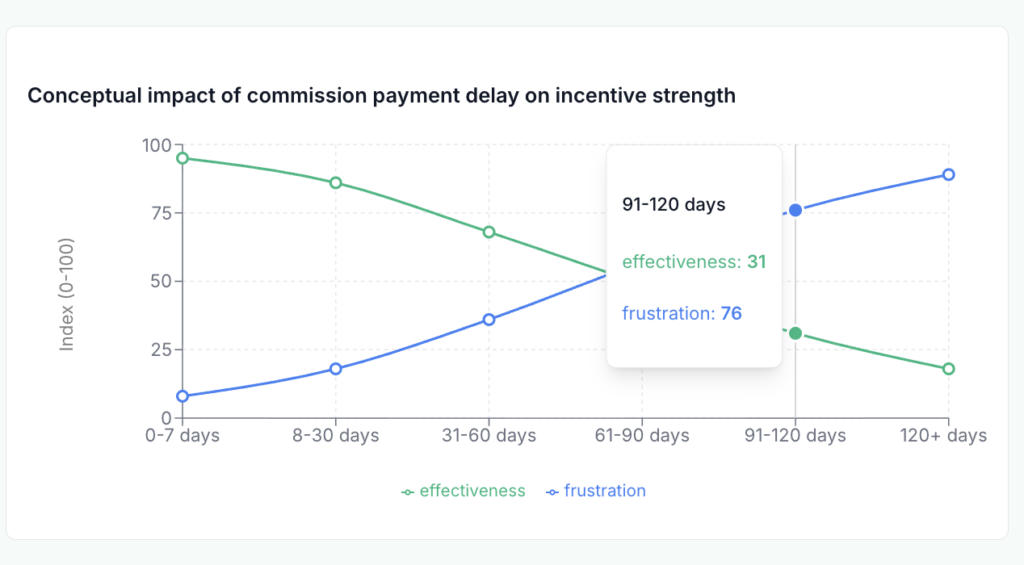
Long gaps between deal close and commission payment weaken the incentive effect and create frustration for reps.
The fix: Automated commission payouts with clear payout eligibility rules help reduce delays and create a consistent payout process. Faster, more transparent payments strengthen the connection between performance and reward while improving rep trust and satisfaction.
5. Disconnected source systems:
When CRM, billing, ERP, and payroll data do not align, finance teams spend time reconciling instead of analyzing.
The fix: Integrating your commission software with your payroll provider, such as QuotaPath and Rippling, creates a connected compensation workflow. This reduces manual reconciliation, improves data consistency, and gives Finance teams more time for analysis instead of administrative cleanup.
6. Poor visibility for reps and managers:
If sellers cannot see attainment and expected earnings in real time, it reduces motivation and increases commission questions.
The fix: Bringing earnings front and center with rep-friendly commission software gives reps and managers real-time visibility into attainment, payouts, and performance. Greater transparency improves motivation, reduces questions about commissions, and builds confidence in compensation data.
7. Weak auditability and governance:
Without clear approvals, documentation, and payout logic, finance carries more compliance risk and has less confidence in accruals.
The fix: Commission management tools streamline audits and approvals and increase visibility by centralizing payout logic, documentation, and compensation data in a single system. This improves governance, reduces compliance risk, and gives Finance teams greater confidence in reporting and accrual accuracy.
Try the most collaborative solution to manage, track and payout variable compensation. Calculate commissions and pay your team accurately, and on time.
Start TrialFinal Thoughts
Commission management inefficiencies extend beyond pay problems. They impact rep trust, financial visibility, operational efficiency, and overall revenue performance. Addressing these gaps before Q3 helps Finance, RevOps, and Sales leaders create a more scalable, transparent, and efficient compensation process.
Schedule a demo to see how QuotaPath helps fix commission management inefficiencies.