
Clawbacks are one of the most debated topics in sales compensation. Reps hate them. Finance needs them. RevOps is stuck in the middle.
Here’s the thing: clawbacks aren’t the problem. Poorly designed clawback policies are.
We analyzed 20,747 customer and prospect conversations and found that 12.1% touched on clawbacks, almost always tied to early churn, non-payment, or deals that failed to go live. These are predictable outcomes in most revenue models.
Your clawback policy should be built around them, not retrofitted afterward.
So what does an effective clawback policy actually look like? Here’s what the data shows.
Clawback Policies Playbook: Report
In our analysis of 20,747 customer and prospect conversations, 12.1% included clawbacks. This report uncovers what policies are working and how to build your own successful one.
View Report1. Design clawbacks as a standard mechanism, not an exception.
High-performing teams don’t treat clawbacks as rare or uncomfortable. They build them into the comp structure from day one. When reps know the rules upfront, clawbacks feel like a system… not a surprise penalty. That’s the goal.
2. Align payout timing with revenue risk.
The earlier a commission is paid, the more protection your business needs if a deal falls apart. Your policy should reflect this. Low-risk annual SaaS might pay ~70% at signature. Implementation-heavy deals should tie payouts to milestones. When payout timing matches revenue risk, you often reduce the need for clawbacks altogether.
3. Keep clawback windows short and clearly defined.
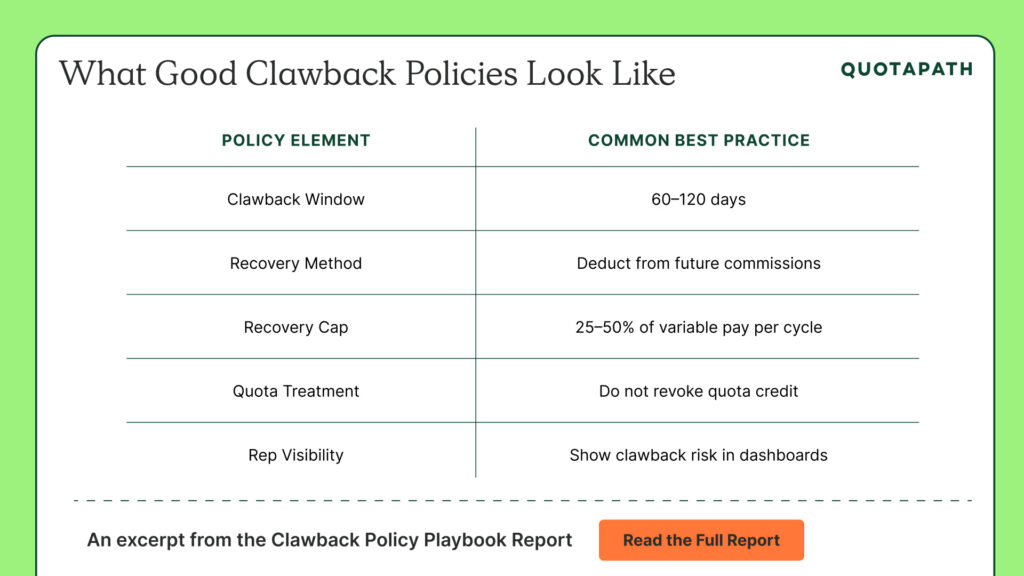
The data is consistent: 60-120 days is the sweet spot. Short windows protect the business from early churn while giving reps confidence that their deals become “safe” after a defined period. As one CRO put it: “Policies tied to a specific, reasonable window — 90 days or less — work well. Reps can stomach it when they know the rules going in.”
Long windows have the opposite effect. When commissions can be clawed back for a year, reps start treating their earnings like monopoly money. Keep it short.
4. Define your triggers explicitly (and in writing).
Disputes almost always come from ambiguity. Your policy should name exactly what triggers a clawback: customer cancellation, refund, non-payment, failure to complete onboarding. A simple clause — “Any commissions paid on deals that are refunded or canceled within four months will be deducted from future payouts” — eliminates most of the gray area and most of the arguments.
5. Automate the process.
Manually tracking original commission payouts, deal status changes, billing outcomes, clawback windows, and adjusted earnings is a recipe for errors. The teams with the cleanest clawback processes have taken the manual work out of the loop entirely.
Automation should flag deals inside clawback windows, adjust payouts when deals change, maintain an audit trail, and, critically, make clawback risk visible to reps in real time. When reps can see what’s at risk, nothing comes as a surprise.
Design, track, and manage variable incentives with QuotaPath. Give your RevOps, finance, and sales teams transparency into sales compensation.
Talk to SalesFinal Thoughts
These five practices are what separate clawback policies that work from ones that create ongoing headaches. They’re also the foundation of our new Clawback Policy Playbook for RevOps and Finance — which includes benchmark data, policy frameworks by company stage and cash position, and sample language you can adapt today.