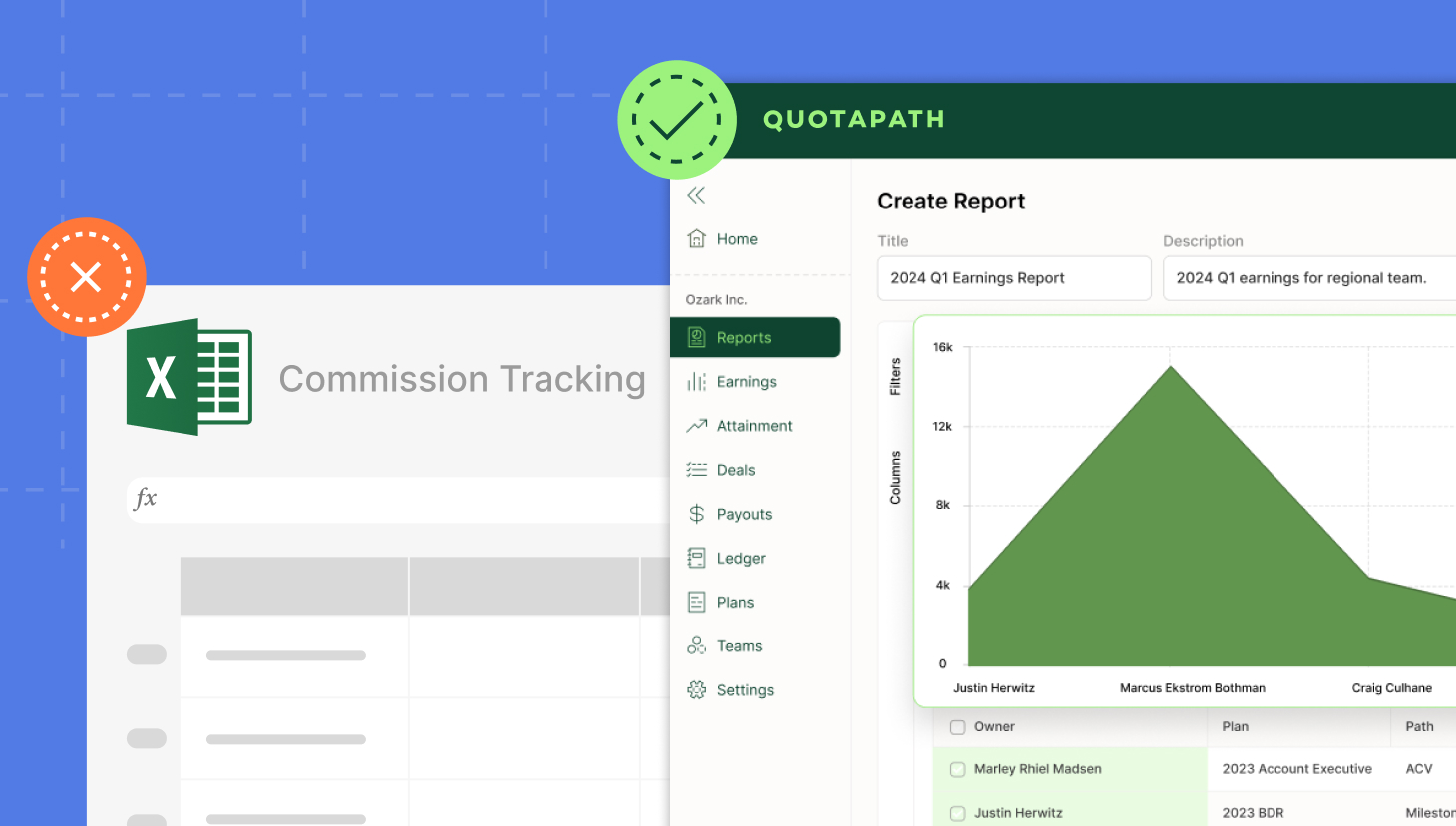
Sales bonuses are essential for motivating teams and hitting revenue goals, yet calculating them correctly isn’t always straightforward. Manual data pulls, unclear KPIs, and inconsistent formulas can lead to errors that frustrate reps and slow down Finance. If you’re looking for a clear, practical guide on how to calculate a sales bonus, you’re in the right place.
In this article, you’ll learn how to:
- Prepare the right inputs, KPI, period, bonus target, data source, and attainment, before running a sales bonus calculation
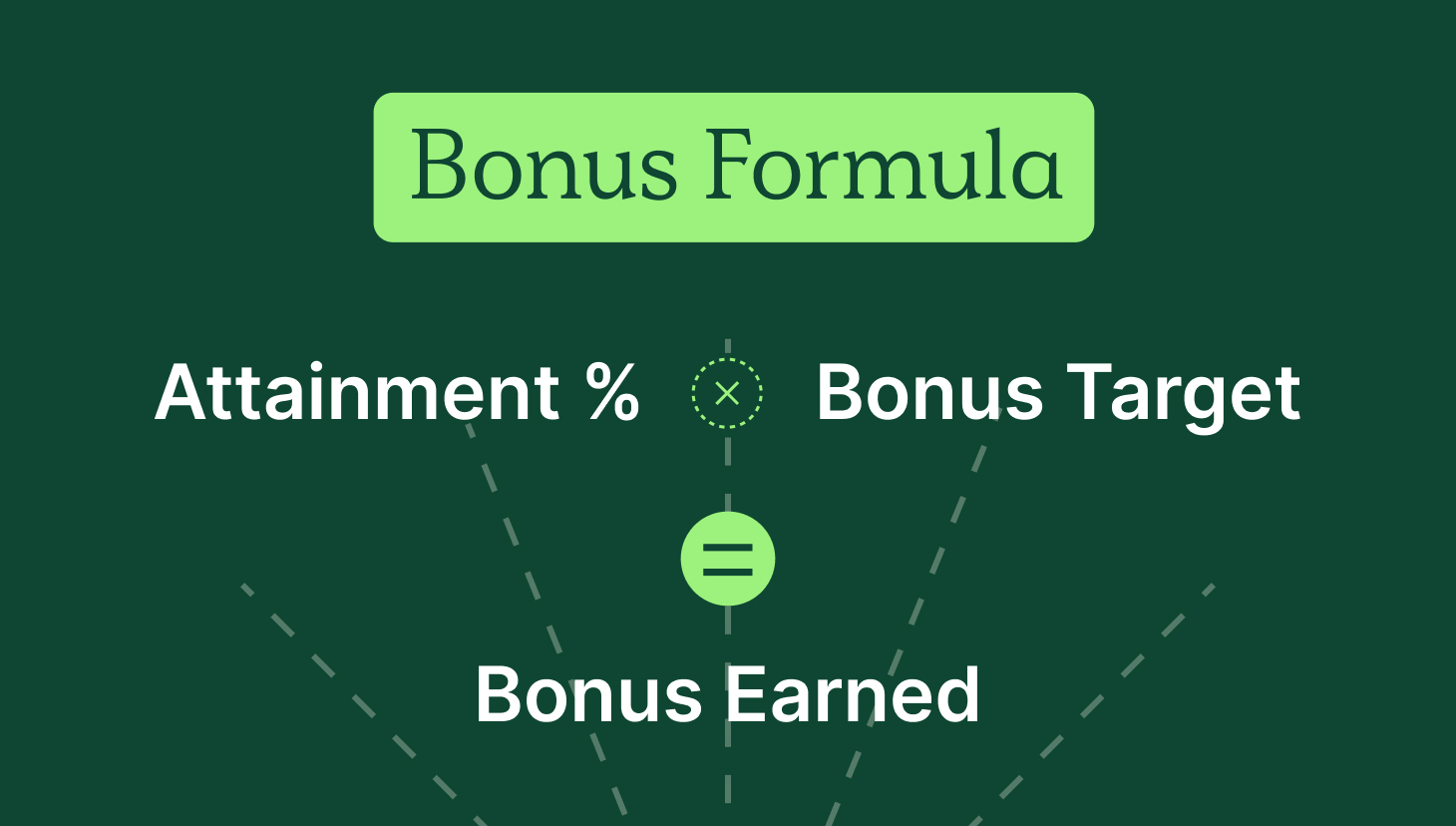
- Calculate bonuses using the formula [Attainment %] × [Bonus Target] = [Bonus Earned]
- Apply sales bonus formulas across roles like AEs, BDRs, CSMs, and Sales Engineers
- Use different bonus types *linear, tiered, milestone, and gated) and understand how each one works
Read on.
Start with the Inputs
Before diving into calculations, you must understand what data you need to collect.
Gathering the following elements will enable you to create effective bonuses to motivate desired sales behaviors and drive goal achievement.
KPI and Period
A clear key performance indicator (KPI) is the first input you need when calculating a sales bonus. This could be revenue closed, the number of deals won, meetings booked, or qualified opportunities created. The KPI you select depends on the desired behaviors you wish to motivate to drive organizational goal achievement. It also determines how success will be evaluated and provides the baseline for calculating attainment.
Once the KPI is set, determine whether the bonus should be measured monthly, quarterly, or annually. The period defines which results get pulled into the calculation and when the rep becomes eligible for payout. Monthly periods work well for roles with high activity volumes, while quarterly and annual sales bonus periods align better with longer sales cycles or retention-focused roles.
It’s also important to pair the KPI and period with the role’s responsibilities.
For example, Account Executives are typically measured on revenue closed, while BDRs are evaluated on qualified opportunities. This alignment ensures your bonus inputs reflect actual performance and reinforce the behaviors your organization wants to encourage.
Bonus Target
The bonus target is the amount a rep earns for achieving 100% attainment during the measurement period. It serves as the baseline for the bonus calculation, because the rep’s final payout is simply a percentage of this target based on their performance.
A bonus target is related to a rep’s OTE (On-Target Earnings), representing the variable portion they are expected to earn when they meet performance expectations. Most roles split OTE between base salary and variable compensation, and the bonus target defines how much of that variable pay is tied to the KPI being measured.
When determining an appropriate bonus target, consider the role’s complexity, the sales cycle length, and the rep’s level of influence over the KPI. Bonus targets typically represent a significant portion of a rep’s variable compensation, but the exact amount varies by role, seniority, and industry expectations. Using targets grounded in realistic performance expectations helps ensure the bonus is motivating and achievable.
Attainment and Data Source
Attainment shows the percentage of the KPI a rep achieved during the measurement period. The formula for attainment percentage calculations is (Actual Performance/Quota) × 100. This percentage serves as the multiplier applied to the bonus target, making accurate attainment essential to calculate the correct bonus payout.
Because attainment depends entirely on performance data, the quality and timeliness of that data directly affect bonus accuracy. Real-time, reliable results help ensure bonuses reflect true performance and prevent downstream discrepancies. Delays or inconsistencies, whether due to pipeline changes, late deal updates, or manual adjustments, can cause the attainment percentage to shift unexpectedly.
Common data challenges typically come from CRM inaccuracies, unclear deal attribution, and timing issues around when deals are logged or recognized. When teams track performance manually through spreadsheets, these issues become even more pronounced, increasing the risk of errors and rep disputes. Compensation automation systems alleviate this friction by pulling clean data directly from the source and continuously updating attainment, increasing bonus calculation accuracy and transparency.
Design, track, and manage variable incentives with QuotaPath. Give your RevOps, finance, and sales teams transparency into sales compensation.
Talk to SalesTypes of Sales Bonuses and Their Formulas
With your inputs set, here’s an overview of different bonus structures and the specific sales bonus formula used to calculate each one.
1. Linear/Straight-Line Bonuses
- Linear or straight-line bonuses are directly proportional to performance against quota.
- Formula: (Attainment %) × (Bonus Target) = Bonus Earned
- Characteristics: Same rate regardless of attainment level
- When to use: Simple, transparent plans
- Pros & cons: Straightforward and performance-driven with no cap, yet difficult to budget, discouraging to low performers, and lacking a ramp-up period.
2. Tiered Bonuses
Tiered bonuses award increasing bonuses based on the achieved goal percentage level.
Formula varies by tier (provide multiple tier examples)
- Example structure:
- 0-80% attainment: $0
- 80-100% attainment: $X per percentage point
- 100-120% attainment: $Y per percentage point (higher rate)
- 120%+ attainment: $Z per percentage point (highest rate)
- Characteristics: Accelerating payout for over-performance
- When to use: Motivate overachievement
- Pros & cons: Incentivizes top performance and aligns goals with company objectives, but may demotivate average performers and can become expensive to pay
3. Milestone Bonuses
A milestone bonus awards a pre-set payment when a rep hits quota
- Formula: Fixed amount earned upon reaching a specific milestone
- Example: $5,000 bonus when quota is hit (nothing below, same amount above)
- Characteristics: Binary (you hit it or you don’t)
- When to use: Simple motivational triggers
- Pros & cons: Encourages quota consistency and low organizational financial risk. However, unless paired with a commission plan, milestone bonuses may lead to sandbagging once a rep hits quota.
4. Gated/Cliff Bonuses
Gated or cliff bonuses pay out only when a rep meets a required minimum performance threshold.
- Formula: Minimum threshold must be met before any payout
- Example: Must hit 80% attainment before earning any bonus
- Characteristics: Encourages minimum performance levels
- When to use: Quality control, avoiding sandbagging
- Pros & cons: Ensures reps meet baseline expectations but can create frustration or disengagement if the threshold feels out of reach.

The Commission Cliff Problem: Why Leaders Should Reconsider Thresholds
Sales compensation cliffs, aka thresholds where reps earn nothing until they hit a certain level of quota, are a relic of a bygone era. And they’re still showing up in comp plans today. But should they?
Read Blog5. Capped Bonuses
Capped bonuses limit the maximum payout a rep can earn regardless of overperformance.
- Formula: (Attainment %) × (Bonus Target), capped at maximum amount
- Characteristics: Limits payout at a certain performance level
- When to use: Budget control, discouraging unrealistic deals
- Pros & cons: Helps control compensation budgets but can frustrate top performers who exceed expectations without additional earnings potential.
6. Bonus with Accelerators
Bonuses with accelerators increase the payout rate once a rep exceeds their quota.
- Formula: Changes based on attainment tiers, similar to a tiered bonus structure but specifically for exceeding quota
- Characteristics: Higher payout rates apply once a rep exceeds quota, often using tiered acceleration levels.
- When to use: To drive overachievement and reward reps for delivering incremental revenue beyond quota.
- Pros & cons: Provides strong motivation for exceeding targets but can become costly without careful modeling and clear performance tiers.
Step-by-Step Guide to Calculating Sales Bonuses
Once you’ve gathered your inputs and selected a bonus structure, follow this simple, step-by-step process to calculate a sales bonus accurately and consistently.
1. Identify the bonus structure type: Select a bonus structure from the section above, such as linear, tiered, milestone, or gated, that matches your compensation goals.
2. Gather your inputs: Collect the necessary data for the sales bonus calculation, including KPI results, measurement period, bonus target, and attainment data.
3. Calculate attainment percentage: Use the formula (Actual Performance/Quota) × 100 to determine attainment. For example, $90,000 on a $100,000 quota equals 90% attainment.
4. Apply the appropriate formula: Use the correct sales bonus formula for the structure you selected. For instance, a linear bonus uses Attainment% × Bonus Target.
5. Account for special conditions:
Incorporate any additional rules such as pro rata bonus adjustments, gates, bonus caps, and accelerators that affect the final payout.
6. Verify the calculation: Double-check the math and compare results against expected ranges to ensure the bonus aligns with performance.
7. Document for transparency: Record the calculation details so reps and leaders can see how the bonus was earned, creating a clear audit trail.
8. Process payout: Submit the final bonus amount for payroll processing, ensuring timing aligns with your monthly, quarterly, or annual payout schedule.
Try the most collaborative solution to manage, track and payout variable compensation. Calculate commissions and pay your team accurately, and on time.
Start TrialWorked Examples
To make these concepts practical, each bonus calculation example below shows realistic calculations across different sales roles using varying bonus structures.
AE Bonus (Linear with Cap)
Inputs:
- Role: Account Executive
- Period: Quarterly
- Quota: $250,000
- Bonus Target: $10,000
- Bonus Structure: Linear with cap at 150% attainment ($15,000 max)
Calculation:
- At 80% attainment: ($200,000 / $250,000) × $10,000 = $8,000
- At 100% attainment: ($250,000 / $250,000) × $10,000 = $10,000
- At 130% attainment: ($325,000 / $250,000) × $10,000 = $13,000
Payout: The AE receives their calculated bonus amount, with understanding that any performance beyond 150% ($375,000 in sales) would still max at $15,000.
BDR Bonus (Tiered)
Inputs:
- Role: Business Development Representative
- Period: Monthly
- Quota: 25 qualified opportunities
- Bonus Target: $2,000 at 100%
- Bonus Structure: Tiered
- 0-15 opportunities: $0
- 16-25 opportunities: $100 per opportunity
- 26+ opportunities: $150 per opportunity
Calculation:
- At 80% attainment (20 opportunities):
- First 15: $0
- Next 5 (16-20): 5 × $100 = $500
- Total: $500
- At 100% attainment (25 opportunities):
- First 15: $0
- Next 10 (16-25): 10 × $100 = $1,000
- Total: $1,000
- At 130% attainment (32 opportunities):
- First 15: $0
- Next 10 (16-25): 10 × $100 = $1,000
- Next 7 (26-32): 7 × $150 = $1,050
- otal: $2,050
Payout: The BDR’s bonus accelerates as they exceed quota, rewarding overperformance with higher per-opportunity payouts.
CSM Bonus (Gate with NPS)
Inputs:
- Role: Customer Success Manager
- Period: Quarterly
- Primary Metric: Net Revenue Retention (NRR)
- Quota: 105% NRR ($1,050,000 retained/expanded from $1,000,000 base)
- Bonus Target: $6,000
- Bonus Structure: Gated by minimum 75 NPS score
- Gate: Must achieve NPS ≥ 75 to earn any bonus
Calculation:
- At 80% attainment (NRR of 84%): $0 (below gate, no payout regardless of NPS)
- At 100% attainment (NRR of 105% = $1,050,000) with NPS of 78:
- Gate met (NPS ≥ 75): ✓
- Bonus: ($1,050,000 / $1,050,000) × $6,000 = $6,000
- At 130% attainment (NRR of 136.5% = $1,365,000) with NPS of 82:
- Gate met (NPS ≥ 75): ✓
- Bonus: ($1,365,000 / $1,050,000) × $6,000 = $7,800
Payout: The CSM must maintain customer satisfaction (NPS ≥ 75) to qualify for any bonus, ensuring quality of retention alongside quantity.
Sales Engineer Bonus (Milestone)
Inputs:
- Role: Sales Engineer
- Period: Quarterly
- Bonus Targets:
- Milestone 1: Support 20 technical evaluations = $2,000
- Milestone 2: Achieve 85% win rate on evaluations = $3,000
- Milestone 3: Complete 3+ enterprise deal certifications = $1,500
- Bonus structure: Milestone bonus
Calculation:
- Scenario at 80% of expected performance:
- 18 evaluations (below milestone 1): $0
- 87% win rate (exceeds milestone 2): $3,000
- 2 certifications (below milestone 3): $0
- Total: $3,000
- Scenario at 100% of expected performance:
- 22 evaluations (meets milestone 1): $2,000
- 88% win rate (meets milestone 2): $3,000
- 3 certifications (meets milestone 3): $1,500
- Total: $6,500
- Scenario at 130% of expected performance:
- 28 evaluations (exceeds milestone 1): $2,000
- 90% win rate (exceeds milestone 2): $3,000
- 5 certifications (exceeds milestone 3): $1,500
- otal: $6,500 (same—milestones are binary)
Payout: Sales Engineer earns fixed amounts for hitting specific milestones, regardless of how much they exceed them. This encourages balanced performance across multiple activities.
Automate Sales Bonuses in QuotaPath
As manual bonus calculations become more difficult to manage, automation offers a faster, more accurate, transparent, and scalable way to improve payout consistency.
The Manual Calculation Problem:
Manual sales bonus calculation is time-consuming, error-prone, lacks transparency, and is difficult to scale. Finance teams spend weeks per quarter reconciling spreadsheets, and 80% of companies admit to paying reps incorrectly, resulting in payout discrepancies and rep frustration. Without real-time visibility, reps can’t track their progress toward bonus targets and aren’t motivated to push for higher attainment. As teams grow and bonus structures diversify, complexity multiplies, making manual processes unmanageable.
QuotaPath’s Solution
AI-Powered Plan Building
QuotaPath makes it easy to upload existing compensation documents to generate plans automatically. Teams can then build and customize bonus components, including quotas, accelerators, gates, and caps, to match their needs. This provides a faster, more accurate way to create and manage plan structures without manual setup.
Automated Calculation
With real-time CRM integration, QuotaPath automatically pulls deal data to keep all calculations up to date. The platform supports all bonus types covered in this article, such as linear, tiered, milestone, and gated—ensuring plans reflect the correct structure. Automated calculations eliminate manual errors and save hours per cycle.
Rep Visibility & Motivation
With QuotaPath, reps can track progress, forecast earnings, and understand payouts in real time. This level of visibility reduces disputes and builds trust through transparency across the team. As Andre King, Director of Sales at Rootly, shared: “Visibility into their earnings has changed what the reps are pushing for.”
Strategic Alignment
QuotaPath enables teams to design bonuses that drive specific business behaviors such as multi-year deals, upsells, or new business. Leaders can align bonus structures with broader company objectives to reinforce the outcomes that matter most.
Integration & Scalability
QuotaPath integrates with sales operation software like Salesforce, HubSpot, and other CRMs, so performance data is always accurate and up to date. The platform easily scales with your team without adding administrative burden, even as plan variations increase.
See how QuotaPath saves time, reduces errors, provides transparency, and scales effortlessly: Schedule a demo.