Every revenue team is using AI somewhere.
In Salesloft’s 2026 Revenue Benchmark report, all 500 U.S. revenue leaders surveyed said they use AI in the revenue process. Only 20.6% called their AI strategy production-ready with measurable outcomes.
Finance is moving more carefully. In a 2025 Gartner survey, 59% of finance leaders said they use AI in their finance function.
Comp planning sits right between those two groups.
- Sales wants speed.
- Finance wants accuracy.
And pay is personal, so there’s no margin for error.
So where does AI belong in comp planning?
Design, track, and manage variable incentives with QuotaPath. Give your RevOps, finance, and sales teams transparency into sales compensation.
Talk to SalesWhere AI belongs in comp planning
The big calls stay with people: how the plan is designed, where quotas land, and which trade-offs leadership is willing to make. We made that case in AI Won’t Run Your Comp Planning. Here’s What It Should Do Instead.
AI earns its place in the work around those calls. Pulling the numbers. Answering questions about how a rep or team is performing. Writing up the results so leaders can act on them.
Reporting is where that work piles up.
Every month, someone on your team rebuilds the same commission report from the same questions, with the same sections and similar charts. The only things that change are the rep and the period.
That copy-and-tweak work is where recurring comp reporting goes sideways.
A section gets skipped. Last month’s number survives the edit. A manager’s version doesn’t match the rep’s. And the person rebuilding it could be spending that hour on the plan itself.
It costs trust, too.
Trust in comp is usually pretty low among reps, and for good reason: more than 70% of reps said they don’t think they’re paid fairly when it comes to comp, according to our 2024 report on comp challenges.
So a report that pulls current numbers the same way for every rep, every month, takes some of the guesswork out of that conversation.
What an Atlas brief is
This is where our Atlas briefs come into play.
Atlas is QuotaPath’s native AI layer, combining QuotaPath’s benchmark intelligence with your own commission data. This allows you to know what good comp plans look like and how yours measure up.
And, briefs, my friends, are how Atlas turns those answers into reports.
In Atlas, a brief is a shareable document built from your conversations with Atlas.
When Atlas answers a question about your comp data, like how a seller is pacing against quota, you click Add to Brief to save that answer as a section. The brief pulls those answers into one place, with sections, charts, and formatting, and you can edit, reorder, or remove any part of it.
When it’s ready, publish it as Public, Workspace, or Private and share the link. Teammates can then comment on any section for easy collaboration, and you can ask Atlas follow-up questions from inside the brief.
Briefs put AI where it belongs in comp planning. Atlas does the pulling and the writing. You decide what the brief asks, review what it says, and choose who sees it.
Until now, every brief was a one-off. To make next month’s version, or the same brief for another rep, you started over in a new chat.
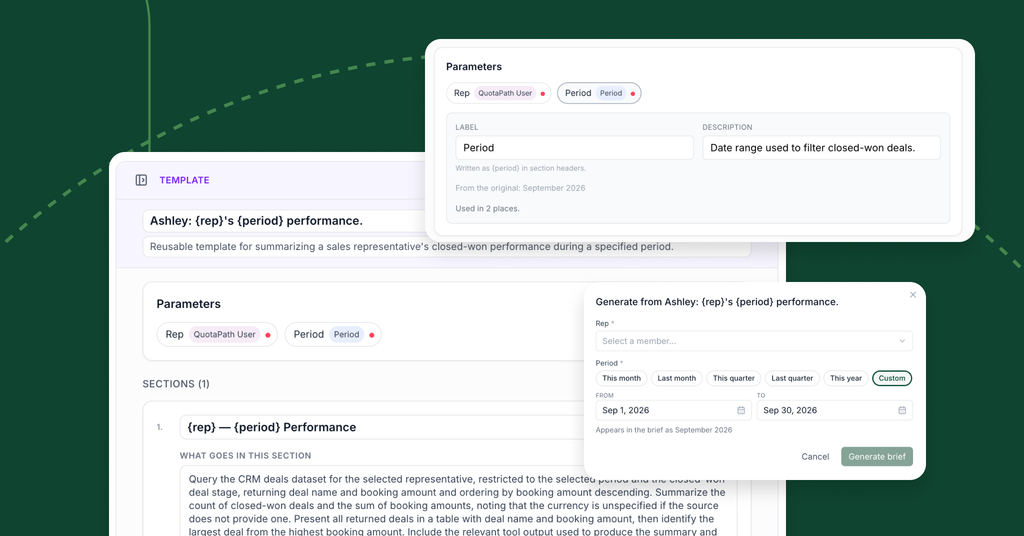
Introducing Brief Templates
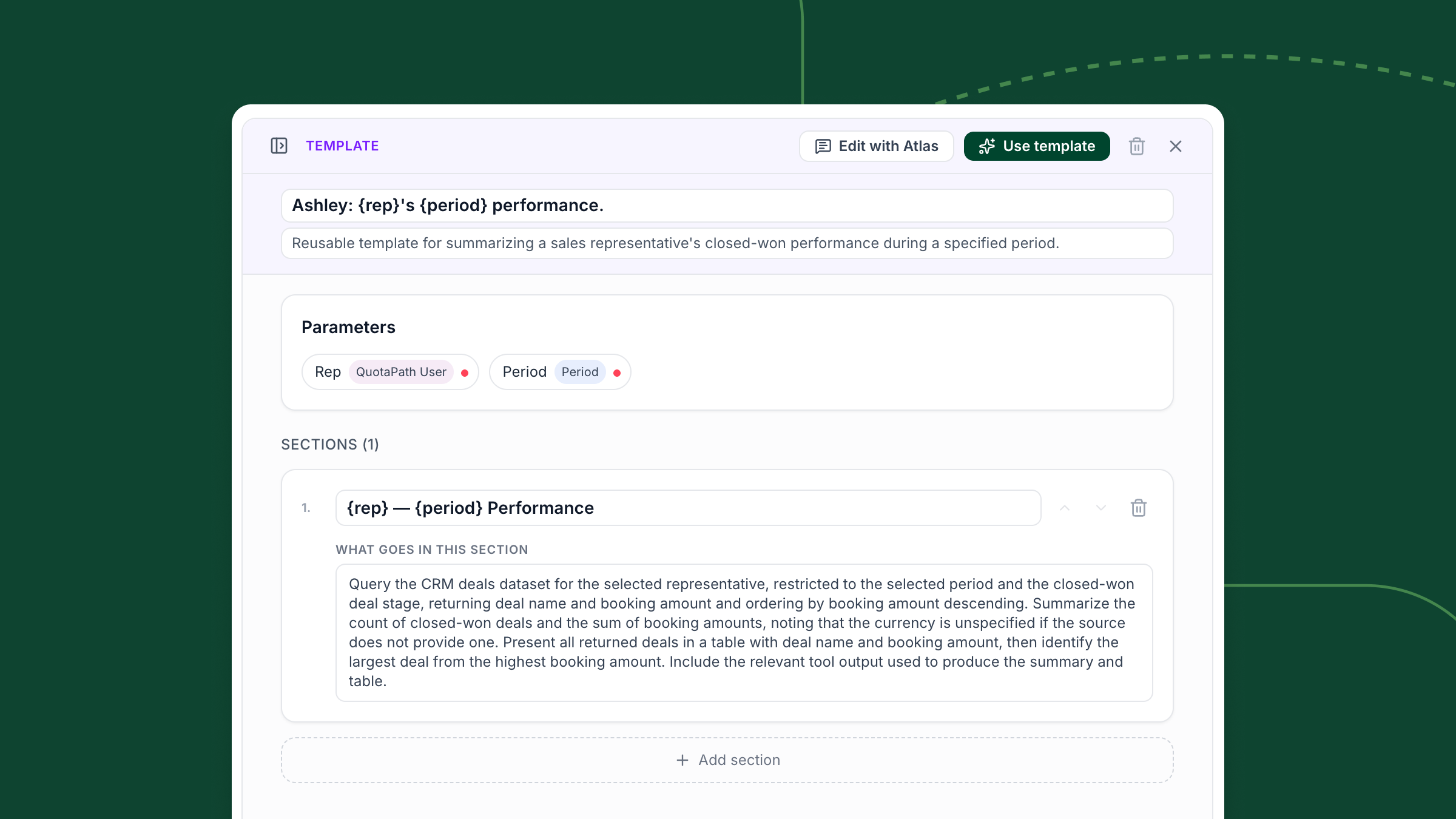
Brief Templates makes that work reusable.
Any chat becomes a brief, any brief becomes a template, and any template generates a fresh brief for another person, team, or period.
Build the report once. Atlas rebuilds it with this period’s numbers whenever you need it.
What you get with Brief Templates
Time back for the work that matters
The hour someone spent rebuilding last month’s report goes back to the plan itself: spotting what’s working, what isn’t, and what to change next.
Numbers you can trust
Every brief pulls from your current QuotaPath data at the moment it’s generated. Quarterly briefs are measured against the quarterly quota. Nobody has to wonder whether a number survived from last month’s copy.
The same report for every rep
Every brief from a template asks the same questions and follows the same sections. Reps and managers look at the same version, and leaders can compare one rep or team with the next on equal footing.
Reports that keep up with the business
Leadership wants a new section. A manager wants a team view. Ask Atlas for the change in plain language, and the template updates. Briefs you already generated stay as they were, so you keep a clean record of each period.
Easier conversations about comp
Publish a brief to your workspace, share a public link, or keep it private. Teammates can comment on any section, so questions about the numbers get answered in one place.
AI compensation reports worth building first
A few templates pay off right away:
- Monthly seller performance: every rep starts the month knowing where they stand.
- Quarterly team summary: leaders compare teams against the quarterly quota without rebuilding anything.
- Manager brief: one document covering a manager’s whole team, ready for the next pipeline review or one-on-one.
- Quarter-end attainment check: spot the reps close to a tier while there’s still time to act. (QuotaPath’s Building Performance-Driving Compensation Plans report puts healthy attainment around 80%.)
Frequently asked questions
What is an Atlas brief?
A brief is a shareable document you build in Atlas from its answers about your comp data, organized into sections with charts and formatting. You can publish it to your workspace, share a public link, or keep it private. On the Pro plan, you can export it to DOCX or PPTX.
What’s the difference between a brief and a brief template?
A brief is one finished document. A template is the recipe that makes briefs for different people and periods.
Does a brief update when my data changes?
No. A brief is generated at a point in time. Generate a new one from the template to refresh the numbers.
Do edits to a template change briefs I already made?
No. Edits apply to briefs you generate after the change.
Can I share a generated brief?
Yes. Generated briefs work like any brief. Publish them and choose Public, Workspace, or Private.
Get started
Brief Templates is available to Atlas customers.
Setting up your first template takes a few clicks, and the help center walks through each step.
If you’re new to Atlas, start with Introducing Atlas.