A SaaS rep’s commission can change a year after the deal closes, when the customer renews, expands, downgrades, or cancels. Commission calculation software built for SaaS tracks each of those changes against the original deal and pays the difference in the right period.
This guide compares five tools on what they cost and how G2 reviewers rate their support, and covers the SaaS deal types to test in any demo. QuotaPath is the top pick for growing SaaS teams. It publishes its pricing and holds the highest G2 score for quality of support in this group, 9.7 out of 10.
QuotaPath publishes this guide and ranks its own platform first. Every claim about another vendor links to a third-party source.
Key takeaways
- Choose a commission tool that keeps payouts accurate as contracts change after signing, and ask each vendor for a live calculation of a multi-year deal with an early-churn clawback before you sign.
- QuotaPath suits most scaling SaaS companies: its rates are public, and G2 reviewers give it the top scores for support and partnership.
- Among the others, Visdum has the fastest reported implementation, and CaptivateIQ handles complex plans at scale. QCommission offers on-premises deployment for small teams, and Performio fits companies with heavy audit needs.
- Match the tool to your stage: early teams benefit most from transparent rates and a test run, while larger teams need approval workflows and a clear record for auditors.
- If you’re switching tools, time the move to a clean period break and check the new system’s first payout run against your old numbers before it reaches reps.
Design, track, and manage variable incentives with QuotaPath. Give your RevOps, finance, and sales teams transparency into sales compensation.
Talk to SalesWhy SaaS commissions are harder to calculate
SaaS revenue arrives monthly or annually over the life of a contract, and the value of a deal keeps changing after it closes.
Commissions follow recurring revenue
Most SaaS plans pay on annual recurring revenue (ARR) or first-year contract value, which means the system has to read contract terms as well as the deal amount. Finance teams have to capitalize sales commissions and spread the cost over the contract under ASC 340-40, the accounting rule that came with ASC 606.
Payouts change after the deal closes
Take a customer who doubles their seat count six months in, or cancels before the first renewal. Each change moves what the rep earned on the original deal. In QuotaPath’s 2024 research, 60% of reps take 3 to 6 months to fully understand their compensation plan.
The SaaS deals your software has to handle
Each deal type below is common in SaaS and easy to get wrong in a spreadsheet. Ask every vendor to calculate one live in a demo, using your own numbers.
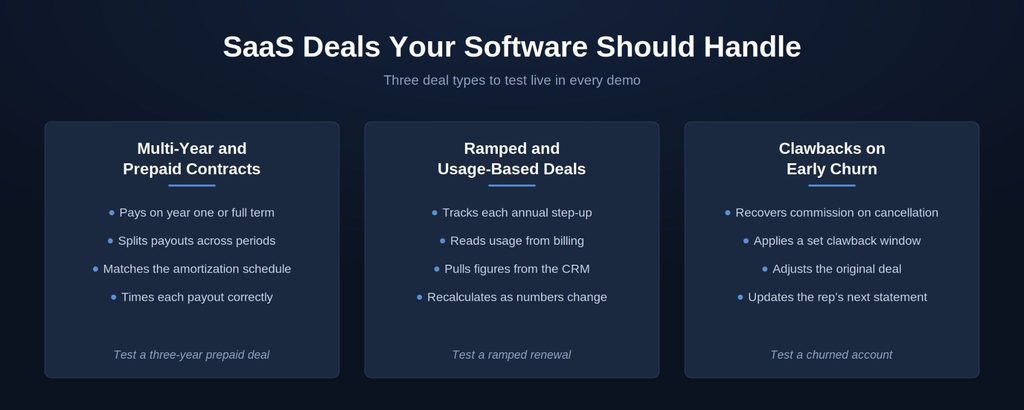
Figure 1: SaaS deals your commission software should handle
Multi-year and prepaid contracts
A three-year deal paid upfront raises two questions: whether the rep is paid on year one or the full contract, and when the payout lands. Check that the tool can split payouts across periods and keep them matched to the amortization schedule finance uses.
Ramped deals and usage-based pricing
Ramped contracts start small and step up each year, and usage-based deals change with consumption. The software should recalculate commissions as each step or usage figure comes in from the CRM or billing system.
Clawbacks on early churn
When a customer cancels in the first months, many SaaS plans take back part of the commission. The test is whether the clawback lands on the right deal and shows up clearly on the rep’s next statement.
Top 5 commission calculation software for SaaS
The table lists the five platforms in ranked order, what each one is best known for in SaaS commission work, and its G2 star rating.
Table 1. The top 5 commission calculation tools for SaaS
| # | Platform | Known for | G2 rating |
|---|---|---|---|
| 1 | QuotaPath | AI plan building for growing teams | 4.8 |
| 2 | Visdum | The fastest implementation in this group | 4.8 |
| 3 | CaptivateIQ | Complex plans and a Gartner Leader ranking | 4.7 |
| 4 | QCommission | An on-premises deployment option for small teams | 4.7 |
| 5 | Performio | Large incentive programs at mid-sized companies | 4.4 |
Source: G2, RFP.wiki, PR Newswire, and QuotaPath.
Notable mentions
These three platforms are common alternatives worth knowing. Each was covered in more depth in earlier QuotaPath comparisons.
Table 2. Notable mentions
| Platform | Known for | G2 rating |
|---|---|---|
| Salesforce Spiff | Commissions built into Salesforce Sales Cloud | 4.6 |
| Everstage | AI agents through Agent Core | 4.8 |
| Xactly | Enterprise incentives with a 5-month average implementation | 4.2 |
Source: G2, Salesforce Ben, and Silicon UK.
How these platforms were ranked
The shortlist started with G2’s sales compensation category and kept tools that SaaS sales teams use. Each was evaluated on whether pricing is public and how G2 reviewers rate the vendor after the sale.
SaaS commission plans change every year, and teams lean on their vendor each time a plan or pay period needs fixing. The table shows two G2 scores out of 10: quality of support and whether the vendor has been a good partner in doing business.
Table 3. Vendor support and partnership, as rated by G2 reviewers
| Platform | Quality of support | Good partner in doing business |
|---|---|---|
| QuotaPath | 9.7 | 9.8 |
| Visdum | 9.6 | 9.4 |
| CaptivateIQ | 9.5 | 9.4 |
| QCommission | 9.6 | 9.4 |
| Performio | 8.8 | 9.3 |
Source: G2 comparison pages.
QuotaPath has the top score on both measures, and Performio trails the group on support.
#1 QuotaPath
G2: 4.8
Best for: teams from seed stage up to about 150 reps that want published pricing and plans they can change without vendor help
QuotaPath is commission software that pulls deal data from the CRM and shows reps their earnings deal by deal. Admins handle routine plan changes themselves, and QuotaPath’s support team steps in on complex ones. For SaaS teams, its AI-Powered Plan Builder turns a written plan into working logic, and Atlas, its AI strategist, validates plans against benchmarks ahead of a new fiscal year.
Pricing
QuotaPath publishes its rates. Growth costs $35 per user each month, and Premium costs $50, each on top of a monthly platform fee. Vendr’s purchase data puts the median QuotaPath contract at $10,032 a year.
Pros
- Reviewers praise its ease of use more than any other feature
- Admins can build plans from a prompt or PDF upload
- G2 reviewers score it 9.8 out of 10 as a business partner
Cons
- Complex plans take more effort to configure
- Payroll sync and API access require the Premium plan
Start a free trial of QuotaPath.
Try the most collaborative solution to manage, track and payout variable compensation. Calculate commissions and pay your team accurately, and on time.
Start Trial#2 Visdum
G2: 4.8
Best for: teams that want a vendor-run setup
Skip it if: you’d rather configure plans yourself from day one
Built as a no-code sales compensation platform, Visdum is described by RFP.wiki as the clearest fit for mid-market SaaS teams. G2 reviewers rate its ease of use at 9.9 out of 10.
Pricing
Visdum doesn’t publish prices. RFP.wiki reports that it charges per payee plus a one-time implementation fee.
Pros
- Its integrations draw the most praise on G2
- Its customer support gets strong marks
Cons
- Reviewers report 7 months to ROI on average
- The mobile experience draws complaints
#3 CaptivateIQ
G2: 4.7
Best for: larger companies with frequently changing plans
Skip it if: you want results within the first quarter
Named a Leader in the 2026 Gartner Magic Quadrant for sales performance management, CaptivateIQ builds commission plans in a spreadsheet-style editor. Mid-market companies account for 67.9% of its G2 reviews.
Pricing
CaptivateIQ sells on custom quotes, and Vendr’s buyer data shows a median contract of $37,044 a year.
Pros
- Its reporting earns strong marks on G2
- Plans stay simple to manage day-to-day
Cons
- New admins face a learning curve
- Reviewers flag gaps in built-in features for their plans
#4 QCommission
G2: 4.7
Best for: small teams that want hands-on support and an on-premises option
Skip it if: you need detailed G2 data on setup time
G2 reviewers place QCommission as the leader in the small-business segment, and the tool covers a wide range of plan types. It offers on-premises deployment from its Premier edition, which is rare in this category.
Pricing
QCommission publishes three editions with monthly minimums of $200, $400, and $600 for Pro, Premier, and Enterprise, respectively.
Pros
- Reviewers say it handles every plan type they use
- The support team is known for its responsiveness
Cons
- On-premises deployment requires the Premier edition or higher
- G2 reviewers report 13 months to ROI on average
#5 Performio
G2: 4.4
Best for: larger sales orgs with strict audit needs
Skip it if: you need to go live within a month
Performio is a sales performance management platform for large incentive programs. Its G2 reviews skew toward mid-sized companies, and reviewers report a 4-month average implementation.
Pricing
Performio sells on a custom annual subscription with a separately scoped implementation fee, according to RFP.wiki.
Pros
- Ease of use tops the list of strengths in its G2 reviews
- It holds a 9.3 out of 10 partnership rating on G2
Cons
- Slow data updates are the most common complaint
- G2 reviewers score its support 8.8 out of 10
Choosing commission calculation software by SaaS stage
Growth stage changes what a SaaS team needs from commission software more than any single feature does.
Seed and early stage (fewer than 15 reps): QuotaPath and QCommission both publish their pricing, and small businesses make up 41.7% of QuotaPath’s G2 reviewers.
Growth stage (15 to 150 reps): QuotaPath and Visdum both handle SaaS plan changes without engineering help. Choose QuotaPath for AI plan strategy, or Visdum if you want its team to handle setup.
Scale stage (more than 150 reps or public-company reporting): Performio and CaptivateIQ suit teams that need deeper audit controls and can absorb a longer rollout.
How to switch commission software without disrupting payouts
When you switch tools, open renewals, active clawback windows, and amortization schedules all have to move over intact. QuotaPath customers on G2 report an average implementation of 2 months.
- Pick a clean cutover date: Start the new tool at the beginning of a pay period or fiscal quarter to avoid splitting one period across two systems.
- Export contract history: Pull every active deal with its start date, term length, and payment schedule, along with any commission still subject to clawback.
- Rebuild plans and test SaaS edge cases: Recreate each plan, then run a multi-year deal and an early cancellation through it before going live.
- Carry over amortization schedules: Give finance the capitalized commission balances from the old system and confirm they match in the new one.
- Run one pay period in parallel: Calculate the same period in both tools and resolve every difference before sharing statements with reps.
Why QuotaPath is the best commission calculation software for SaaS
QuotaPath’s features cover both admins and finance:
- Admins set up plans faster with the AI-Powered Plan Builder, and Atlas flags weak spots in a plan ahead of rollout.
- Finance gets payroll sync with Rippling and reporting for ASC 606.
- Every tier’s price is listed upfront, and G2 reviewers rate QuotaPath highest for support and partnership.
Book a demo to see your SaaS comp plan calculated in QuotaPath.
Disclaimer: Facts checked October 21, 2026. Pricing and ratings change often and should be confirmed with each vendor. If anything here about your product is out of date, contact QuotaPath.
Frequently asked questions
Should SaaS commissions be paid on ARR or total contract value?
SaaS companies use both. Enterprise plans often pay on total contract value and reduce the rate for years two and three of a multi-year deal.
How long should a clawback window be?
QuotaPath’s analysis of more than 20,000 sales conversations found that 60 to 120 days is the most effective clawback window. If your plan doesn’t set one yet, that range is a reasonable place to start.
Do all sales commissions have to be capitalized?
ASC 340-40 includes a practical expedient: if the amortization period would be one year or less, companies can expense the commission as incurred instead. Commissions on annual contracts often qualify, while multi-year deals rarely do.
Sources
- QuotaPath, homepage: https://quotapath.com/
- QuotaPath, pricing page: https://www.quotapath.com/pricing/
- QuotaPath, AI-Powered Plan Builder: https://www.quotapath.com/blog/introducing-ai-powered-plan-builder/
- QuotaPath, Introducing Atlas: https://www.quotapath.com/blog/introducing-atlas-ai-comp-consultant/
- QuotaPath, commission payout software: https://www.quotapath.com/commission-payout-software/
- QuotaPath, 2024 Sales Compensation Plan Report: https://www.quotapath.com/resource/report-solving-biggest-compensation-challenges/
- SaaStr, tips for building your first sales comp plan: https://www.saastr.com/top-tips-to-building-your-very-first-sales-comp-plan
- FASB, ASU 2014-09 (ASC 606 and ASC 340-40): https://storage.fasb.org/ASU%202014-09_Section%20A.pdf
- Deloitte DART, ASC 606 Revenue From Contracts With Customers: https://dart.deloitte.com/USDART/tree/vsid/490068
- G2, Sales Compensation category: https://www.g2.com/categories/sales-compensation
- G2, QuotaPath vs Visdum: https://www.g2.com/compare/quotapath-vs-visdum
- G2, CaptivateIQ vs Easy-Commission vs QuotaPath: https://www.g2.com/compare/captivateiq-vs-easy-commission-vs-quotapath
- G2, QCommission vs Salesforce Spiff vs QuotaPath: https://www.g2.com/compare/qcommission-vs-salesforce-spiff-vs-quotapath
- G2, QCommission vs Xactly: https://www.g2.com/compare/qcommission-vs-xactly
- G2, CaptivateIQ vs QCommission: https://www.g2.com/compare/captivateiq-vs-qcommission
- G2, CaptivateIQ vs Easy-Commission: https://www.g2.com/compare/captivateiq-vs-easy-commission
- G2, Performio vs Sales Cookie: https://www.g2.com/compare/performio-vs-sales-cookie
- G2, Performio vs Xactly: https://www.g2.com/compare/performio-vs-xactly
- G2, Everstage vs QuotaPath: https://www.g2.com/compare/everstage-vs-quotapath
- G2, Xactly reviews: https://www.g2.com/products/xactly/reviews
- G2, Xactly pricing: https://www.g2.com/products/xactly/pricing
- Vendr, QuotaPath pricing data: https://www.vendr.com/marketplace/quotapath
- Vendr, CaptivateIQ pricing data: https://www.vendr.com/marketplace/captivateiq
- RFP.wiki, Visdum vs Sales Cookie: https://www.rfp.wiki/crm-marketing/sales-force-automation-platforms/sales-performance-management/visdum/sales-cookie
- RFP.wiki, Sales Cookie vs Performio: https://www.rfp.wiki/crm-marketing/sales-force-automation-platforms/sales-performance-management/sales-cookie/performio
- RFP.wiki, QCommission vs QuotaPath: https://www.rfp.wiki/crm-marketing/sales-force-automation-platforms/sales-performance-management/qcommission/quotapath
- PR Newswire, CaptivateIQ 2026 Gartner Magic Quadrant: https://www.prnewswire.com/news-releases/captivateiq-named-a-leader-in-the-2026-gartner-magic-quadrant-for-sales-performance-management-302822273.html
- Salesforce Ben, Salesforce to acquire Spiff: https://www.salesforceben.com/salesforce-to-acquire-spiff-automating-sales-commissions/
- Silicon UK, Everstage Agent Core launch: https://www.silicon.co.uk/press-release/everstage-launches-agent-core-the-agentic-intelligence-layer-unifying-sales-performance-management
- Dodo Payments, TCV vs ACV: https://dodopayments.com/blogs/tcv-vs-acv-saas-sales-math/
- QuotaPath, clawback policy best practices: https://www.quotapath.com/blog/clawback-policies-best-practices-report/
- Deloitte, Accounting for Costs of Obtaining a Contract: https://dart.deloitte.com/USDART/home/publications/archive/deloitte-publications/accounting-spotlight/2019/revenue-recognition-accounting-for-costs-obtaining
- HubSpot Marketplace, QuotaPath listing: https://ecosystem.hubspot.com/marketplace/listing/quotapath