If you own commission reporting, you decide what each report includes and when the process has outgrown a spreadsheet. We set out to give you a basis for both: the fields to capture, the view each role reads, the metrics to review each pay period, and the accounting and tax rules a report must meet.
Our sources include 2026 sales performance research, U.S. accounting standards, federal payroll rules, SEC comment-letter analysis, and QuotaPath customer data.
Key takeaways
- Good commission reporting shows how each payout was earned, calculated, approved, and paid. A useful report includes the calculation behind each deal, how close each rep is to quota, the status of each payment and adjustment, and an audit trail of changes. Reps, managers, RevOps, and finance each need their own view of that data.
- Build each view around what its reader does next: reps check pay, managers coach to quota, RevOps fixes records, and finance closes the books.
- Report five metrics every cycle: quota attainment, effective commission rate, cost of commissions, payout accuracy, and anomaly rate.
- When plans gain tiers and split credit or auditors start asking questions, move to a system that recalculates as deals change and locks closed periods.
What is commission reporting?
Deal data from Salesforce, HubSpot, or another CRM feeds every commission report. Plan logic applies rates, tiers, splits, and eligibility rules to each deal, and the sales commission report shows the resulting earnings, attainment, and payout status by person and period. In a live system, those figures update whenever a deal record changes.
Commission reporting means documenting and explaining variable pay for everyone on a sales compensation plan.
Three related terms often get blurred:
Table 1. Commission report vs. statement vs. dashboard
| Term | Primary reader | Question it answers | Time frame |
|---|---|---|---|
| Commission report | RevOps, finance, and sales leaders | What did each person earn, what does the plan cost, and why? | Any period, live or closed |
| Commission statement | One payee | What am I paid for this period, and how was it calculated? | One pay period, final after approval |
| Commission dashboard | Reps, managers, and executives | How is the team pacing toward quota today? | Live, updated depending on deal status |
What a commission report should include
A complete commission report lets readers retrace any payout to the deal, plan rule, and approval behind it. Four components hold the fields that make this possible.
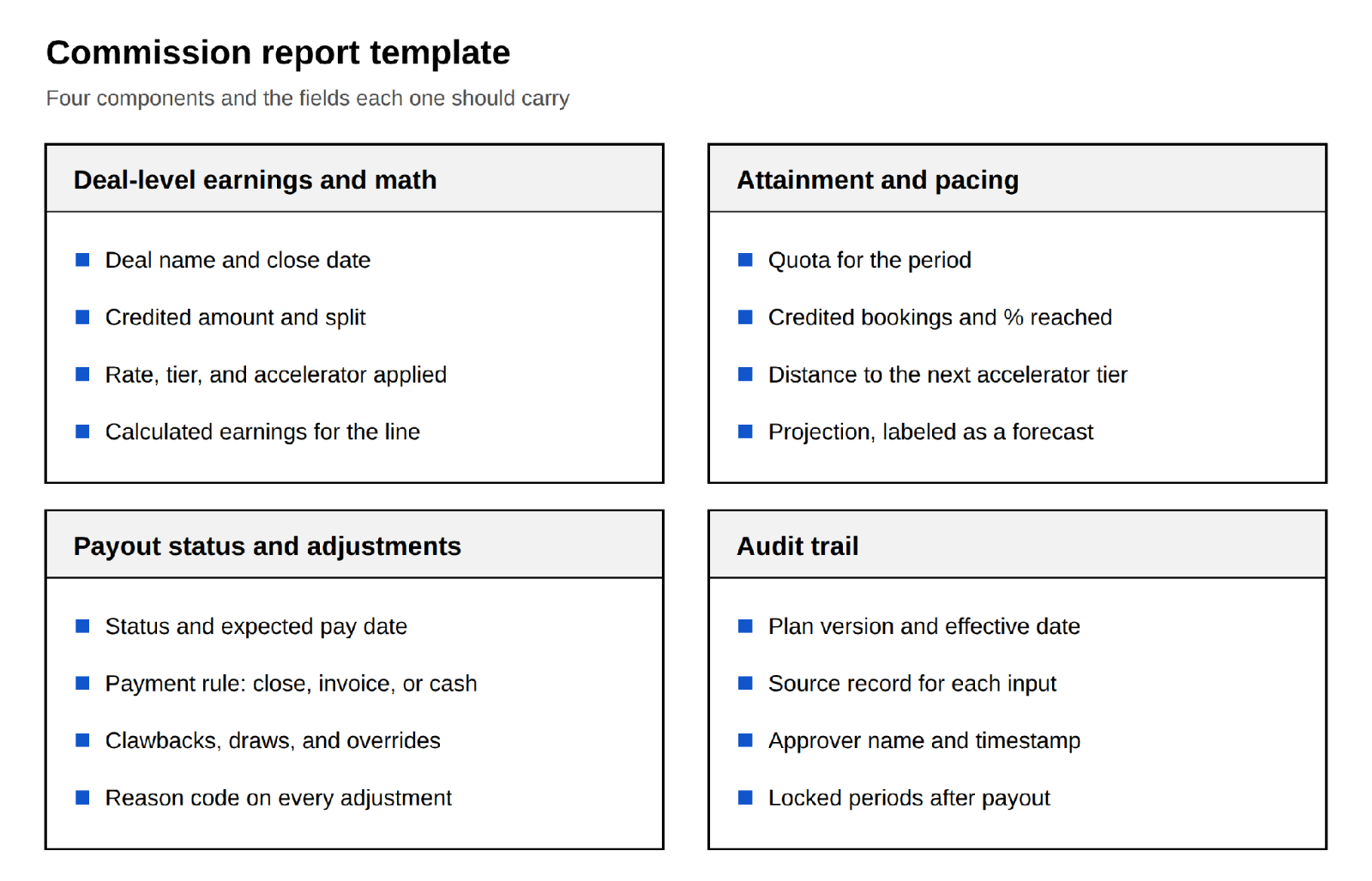
Figure 1. Commission report template, by component.
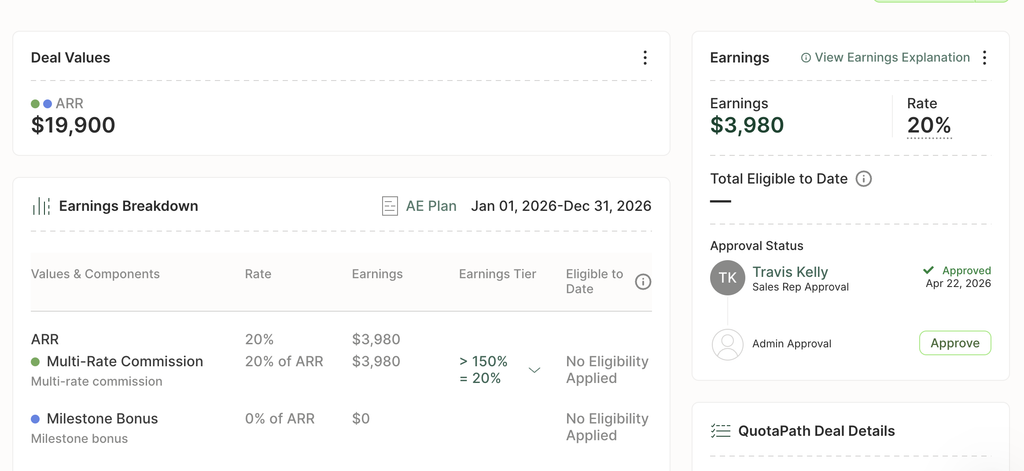
Deal-level earnings with the math behind each number
Every earnings line should tie to one deal. RevOps uses the deal name and close date to find the source CRM record when a number looks wrong. Managers confirm the credited amount and split on shared deals, where the split sets each person’s share. Reps check the rate, tier, and any accelerator before raising a dispute, because those inputs produce the payout.
After Zapier replaced Excel with QuotaPath, its RevOps manager said reps could see “the exact math, and why it’s matching that way,” and payroll prep moved from the 15th of the month to the 5th.
Quota attainment and pacing
Quota, credited bookings, and percentage reached show a rep where they stand, and managers use them to decide who needs coaching. The distance to each accelerator tier shapes which deals a rep works first.
A projection from current pace and weighted pipeline gives leaders an early read on payouts. Label it as a forecast to keep it separate from earned pay. Ramping reps should see their ramped quota.
Payout status, timing, and adjustments
Give each earning a status, such as pending, approved, paid, or held, and an expected pay date. Reps watch the status to see what is coming, and payroll plans each run from the pay date. State the payment rule on the report, whether paid on close, on invoice, or on cash received, since it sets when reps get paid. A QuotaPath post on commission payment terms compares the options.
Adjustments get their own lines and reason codes, covering clawbacks, draw recovery, overrides, and prior-period corrections. Each code tells reps why a check changed and gives finance a reconciling item.
An audit trail finance can defend
An audit trail records which plan version, data, and approver produced each payout. Effective dates on plan changes show auditors which rules applied in each period. Override reasons let finance defend exceptions, and approval timestamps confirm who signed off.
Freeze each period after payout to protect paid history from later CRM edits. Commissions are wages, and IRS Publication 15 tells employers to retain employment tax records for four years or longer. Auditors look for accuracy, consistency, documentation, and internal controls, according to a QuotaPath guide to passing a commission audit.
Commission report views by role
A rep checking a paycheck and a controller closing the month need different parts of one report.
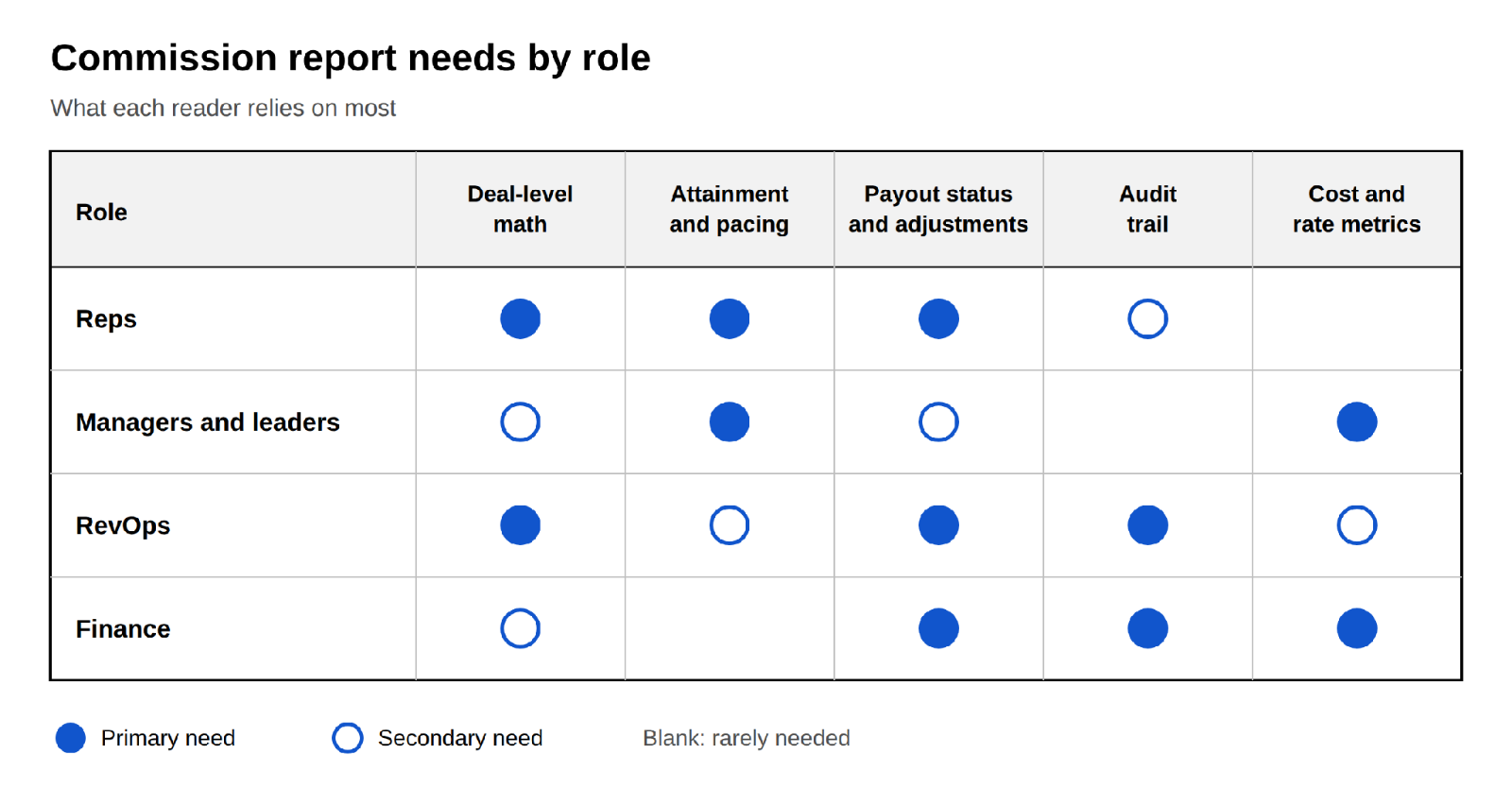
Figure 2. Commission report needs by role
Reps: Earnings and attainment
A rep’s view answers what they have earned and what the next deal will pay. Show current attainment, projected earnings on each open deal, and which amounts are pending or paid. Put the view in the CRM or on mobile, and refresh it as deals move.
Managers and leaders: Team attainment and forecast
Leaders need attainment by rep and segment, the share of reps on pace, and the quarter’s payout forecast. Check the spread of attainment across reps as well as the team average. In QuotaPath, Atlas runs this attainment distribution analysis and flags plans that pay average performers too much.
RevOps: Data accuracy and exceptions
A RevOps view starts with exceptions: deals missing a close date or owner, splits that do not total 100%, reps with no assigned plan, and payouts changed after approval. Link each exception to its CRM record, where the fix belongs. A falling exception count means CRM hygiene is improving.
Finance: Expense, accruals, and reconciliation
For the month-end close, finance pulls three items from the report: commission expense for the period, commissions accrued and still unpaid, and a tie-out between commission totals and the payroll register.
At ECP, a staff accountant who spent days working across five overlapping spreadsheets now finishes each run in a couple of hours.
Which commission report metrics should you track?
Five metrics show whether a comp plan’s spend is working. Outside benchmarks come from a June 2026 survey of 158 B2B companies by The Bridge Group.
Table 2. Commission reporting metrics and benchmarks
| Metric | How to calculate | Who reads it | Benchmark or reference point |
|---|---|---|---|
| Quota attainment | Credited bookings ÷ quota for the period | Reps and managers | 48% of AEs at quota in 2026, 51% in 2024 |
| Effective commission rate | All commissions on a deal ÷ deal value | RevOps and finance | 25% or less combined across all payees, per QuotaPath guidance |
| Cost of commissions | Commission expense ÷ revenue for the period | Finance and the CRO | Quota-to-OTE ratio of 4.6x in 2026, 4.2x in 2024 |
| Payout accuracy | Payouts with no later correction ÷ all payouts | RevOps and finance | None published: use your last four cycles as the baseline |
| Anomaly rate | Payouts flagged as outliers ÷ all payouts | RevOps and finance | No industry figure: flag deals above your rate ceiling |
Worked example: The quota-to-OTE ratio as a cost. Divide 1 by the ratio to get on-target pay as a share of quota. At 4.6x, a rep who finishes exactly at quota costs about 21.7% of their bookings before benefits and taxes, compared with 23.8% at 4.2x.
Benchmark data from QuotaPath puts mid-market SaaS AE plans at a 50/50 pay mix with quota-to-OTE ratios of 3.5x to 4.5x. At those ratios, a 50/50 mix means commissions alone run about 11% to 14% of quota (0.5 ÷ 4.5 and 0.5 ÷ 3.5).
The survey also found 57% of reps at quota in the top third of organizations by AI engagement, versus 39% in the bottom third. The study calls that link observational. Check it in your own attainment data first.
How does commission reporting support ASC 606 and the monthly close?
Under ASU 2014-09, which created ASC 606 and Subtopic 340-40, a commission paid only because a contract was signed is an incremental cost of obtaining it. Companies capitalize recoverable incremental costs and amortize them over the period of benefit, which can include expected renewals. When that period is one year or less, a practical expedient lets them expense the commission immediately.
Worked example: Which commissions count. In a FASB staff paper, a 5% commission on a $500,000 contract creates a $25,000 asset, while $5,000 of legal and travel costs is expensed. When a rep earns 10%, the manager 5%, and a regional manager 3% on each contract, all three commissions are incremental. The report has to capture that 18% combined rate deal by deal.
Subtopic 340-40 requires companies to disclose capitalized commission balances and the amortization recognized each period. Each balance must be traced to a deal, rate, and approval to support the close or an audit request.
SEC staff question those disclosures in comment letters. In one example from Deloitte’s review, staff asked a company with a three-to-seven-year amortization period how renewal commissions fit into it.
On Growth and Premium plans, the QuotaPath Ledger builds amortization schedules from approved earnings and exports a waterfall report for your journal entries. For the accounting background, see the ASC 606 commissions guide on the QuotaPath blog.
Brightmine counts 27 US jurisdictions with pay transparency laws as of October 1, 2026, and role-level pay history lets you check posted OTE ranges against actual pay.
When does real-time reporting matter, and when does a spreadsheet still work?
A spreadsheet still works when one person can verify every payout by hand: one or two reps, a flat rate, and no splits or disputes. Close out each period’s tab after payroll runs and save every plan version.
Spreadsheets break when plans add accelerators, splits, clawbacks, ramps, or mid-year changes, when finance needs ASC 340-40 support, or when headcount outgrows the person maintaining the formulas. Moving off the spreadsheet takes three steps:
- Connect the data once. Sync the CRM, plus billing or accounting where payouts depend on cash.
- Let earnings update with the CRM. Route post-close edits through the adjustment rules you already set.
- Give every reader a live view. Reps, leaders, and finance each see their slice as soon as the data changes.
With the AI-Powered Plan Builder, QuotaPath turns a plan document or a plain-language description into rules that run against your CRM deals. The Growth plan costs $35 per user per month plus a $525 monthly platform fee, billed annually. Custom reporting, payroll sync, and accounting integrations require the Premium plan, listed on the pricing page.
Try the most collaborative solution to manage, track and payout variable compensation. Calculate commissions and pay your team accurately, and on time.
Start TrialImprove your commission reporting with QuotaPath
Pull last month’s report and run three checks: rebuild one payout from the deal in your CRM, confirm every adjustment has a reason, and count the corrections RevOps made by hand. Fix whichever check fails first.
QuotaPath keeps deal data, plan logic, approvals, and amortization in one system, and a 14-day trial lets you test the math on your own deals.
Start a free trial with QuotaPath today.
Frequently asked questions
What does commission reporting software do?
Commission reporting software takes over the manual steps of each pay cycle: pulling CRM deals, applying rates and splits, re-running the math after edits, and building statements and period totals. Your team reviews exceptions and approves payouts. QuotaPath defines the category in a glossary entry and lists what to evaluate in a buyer’s checklist.
Who owns commission reporting, sales ops or finance?
Ownership is usually shared. Sales ops or RevOps owns plan setup, data quality, and rep-facing views, while finance owns approvals, accruals, and accounting treatment. Name one owner for reconciling payouts to payroll each cycle, and give both teams the same report.
What is the difference between a commission report and a commission statement?
A commission statement covers one person for one pay period, and reps review or sign it. A commission report covers many people and periods for the teams who run the plan. Generate both from one calculation so every statement ties to the report’s totals.
How do you keep a commission report accurate when deals change after close?
Recalculate from the live CRM record until the period closes, and then lock it. Book any later change, such as a lower contract value or a corrected split, as an adjustment in the next open period with a reason and an approver. The closed period stays intact, and the rep still sees each change.
How do you report sales commissions for payroll and taxes?
Employee commissions are supplemental wages reported on Form W-2. Under IRS rules, employers can withhold a flat 22% federal rate, rising to a required 37% above $1 million in a year. For nonexempt employees, federal overtime rules count commissions in the regular rate. Contractors receive Form 1099-NEC once 2026 payments reach $2,000. State rules vary.
Disclaimer: Sources and figures were checked on October 20, 2026. For decisions about your own plans, consult your accountant, tax adviser, or counsel.
Sources
- QuotaPath, Zapier Accelerates Commissions and Gains Transparency, February 26, 2026, https://www.quotapath.com/customers/zapier/
- QuotaPath, When should you set your sales commission payment terms for? December 30, 2025, https://www.quotapath.com/blog/sales-commission-payment-terms/
- IRS, Publication 15 (2026), Employer’s Tax Guide, December 15, 2025, https://www.irs.gov/publications/p15
- QuotaPath, How to Pass a Commission Audit Without Losing Your Mind, February 19, 2026, https://www.quotapath.com/blog/pass-commission-audit/
- QuotaPath, Sales Compensation Performance Analytics, June 8, 2026, https://www.quotapath.com/sales-compensation-performance-analytics/
- QuotaPath, ECP Replaces Manual Spreadsheets with QuotaPath & HubSpot, February 6, 2026, https://www.quotapath.com/customers/ecp/
- The Bridge Group, AE Models, Motions & Metrics: 2026 Research Report, June 22, 2026, https://www.bridgegroupinc.com/research/2026-ae-models-motions-metrics
- QuotaPath, Sales Commission Reports in QuotaPath, December 31, 2025, https://www.quotapath.com/blog/sales-commission-reports-in-quotapath/
- QuotaPath, Compensation Benchmarking for SaaS Sales, June 8, 2026, https://www.quotapath.com/compensation-benchmarking-for-saas/
- FASB, ASU No. 2014-09, Revenue from Contracts with Customers (Topic 606), May 2014, https://storage.fasb.org/ASU%202014-09_Section%20A.pdf
- FASB Transition Resource Group, Capitalization and Amortization of Incremental Costs of Obtaining a Contract (via PwC Viewpoint), November 7, 2016, https://viewpoint.pwc.com/dt/us/en/fasb_financial_accou/trg_revenue/trg_revenue_US/capitalization_and_a_US.html
- Deloitte, Roadmap: SEC Comment Letter Considerations, Including Industry Insights, Section 6.5, November 2025, https://dart.deloitte.com/USDART/home/publications/deloitte/additional-deloitte-guidance/roadmap-sec-comment-letter-considerations/chapter-6-industry-specific-topics/6-5-technology-media-telecommunications
- QuotaPath, Pay Sales Commissions, July 7, 2026, https://www.quotapath.com/commission-payout-software/
- QuotaPath, ASC 606 Revenue Recognition: How Commissions Should Be Accounted for, March 19, 2026, https://www.quotapath.com/blog/asc-606-revenue-recognition-automation/
- Brightmine, US Pay Transparency Laws by State and Locality, October 1, 2026, https://www.brightmine.com/us/resources/hr-compliance/pay-transparency/u-s-pay-transparency-laws-by-state-and-locality/
- QuotaPath, Build Sales Compensation Plans, April 3, 2026, https://www.quotapath.com/build-sales-compensation-plans/
- QuotaPath, Pricing, October 2, 2026, https://www.quotapath.com/pricing/
- QuotaPath, Trial Start, May 12, 2026, https://www.quotapath.com/trial-start/
- QuotaPath, Book a Demo, October 2, 2026, https://www.quotapath.com/demo/
- QuotaPath, Commission reporting software, January 30, 2026, https://www.quotapath.com/glossary/commission-reporting-software/
- QuotaPath, How to select your commission tracking software, December 30, 2025, https://www.quotapath.com/blog/commission-tracking-software-buyers-checklist/
- U.S. Department of Labor, 29 CFR 778.117, Commission Payments: General (eCFR), October 16, 2026, https://www.ecfr.gov/current/title-29/subtitle-B/chapter-V/subchapter-B/part-778/subpart-B/subject-group-ECFR7be43dce58760d9/section-778.117