September is consumed by board prep. October brings the close crunch. By November, Finance and RevOps are in a panic, untangling commission disputes that surface at the worst possible time – during board prep or audit- and trying to reconcile accruals from H2 compensation that no one modeled before they went live.
Teams that struggle in Q4 aren’t unlucky; they’re unready. The difference isn’t effort—it’s when certain decisions get made. If October exposes operational weaknesses, the real question is what happened in August before the pressure started to build.
Summary
The strongest RevOps and Finance teams don’t leave commission health to chance. They use August to identify risks early, strengthen financial controls, and prepare for a smoother Q4 by leveraging the five tactics listed below.
- Treat commission data as a financial risk, not an ops inconvenience
- Run a mid-year comp audit before it’s urgent
- Model payout exposure before approving plan changes
- Fix accruals before they become an audit problem
- Set up visibility before reps start asking questions
Design, track, and manage variable incentives with QuotaPath. Give your RevOps, finance, and sales teams transparency into sales compensation.
Talk to Sales1. They Treat Commission Data as a Financial Risk, Not an Ops Inconvenience
The first behavioral split happens in how Finance frames the problem. Most teams treat commission disputes as a sales problem. However, commission processing errors constitute 3-8% of total incentive payouts.
This dirty commission data creates accrual issues that don’t surface until close, and it can create potential ASC 606 implications. Misstated commission expense isn’t just inconvenient; it’s a potentially costly compliance exposure.
Finance teams that own it differently catch it upstream, before it hits the books. As Kenza Sebbar, Director of RevOps at Actabl, said, “For FP&A, it was about trusting the numbers and being audit-ready.”
2. They Run a Mid-Year Comp Audit Before It’s Urgent
Knowing data is a risk is one thing. Building the habit that catches it is another.
The audit isn’t about finding mistakes — it’s about understanding what the plan is actually doing to cost, behavior, and trust. What a comp audit actually checks is:
- Attainment health: Determines whether a realistic percentage of a sales team consistently meets or exceeds their quota within a reasonable timeframe, while quotas remain aligned with business objectives.
- Commission cost vs. margin: Commission expenses help prevent overspending and ensure profitability by reviewing the commission payout ratio, the effective commission rate per deal, and total commissions per product line.
Payout disputes and resolution rate: The number of discrepancies or pay questions per pay period, and how quickly they are successfully addressed or clarified to the rep’s satisfaction. - Whether incentives still match H2 goals: Verifies that the comp plan motivates behaviors that drive the achievement of current business objectives.
August is the best window of time. It’s before H2 ramp, before board prep, and before it’s time for plan changes again. When they finally look, teams find issues such as version control chaos, undocumented overrides, and plan assumptions that expired in March.
3. They Model Payout Exposure Before Approving Plan Changes
After audit comes the harder conversation — what to change, and what it’ll cost. The question isn’t just “does this comp change make sense for sales?” It’s “do we know what this change will cost across every attainment scenario?”
Mid-year comp changes that skip modeling create worse problems than the ones they fix. For instance, the effective commission rate per deal across accelerators and all earners, such as AEs, BDRs, and managers, can add up. “You blink, and you’re paying 35% of a deal in total commissions once you add up everyone involved. That’s a hidden cost finance leaders need to track,” said Ryan Milligan, GTM Leader at QuotaPath.
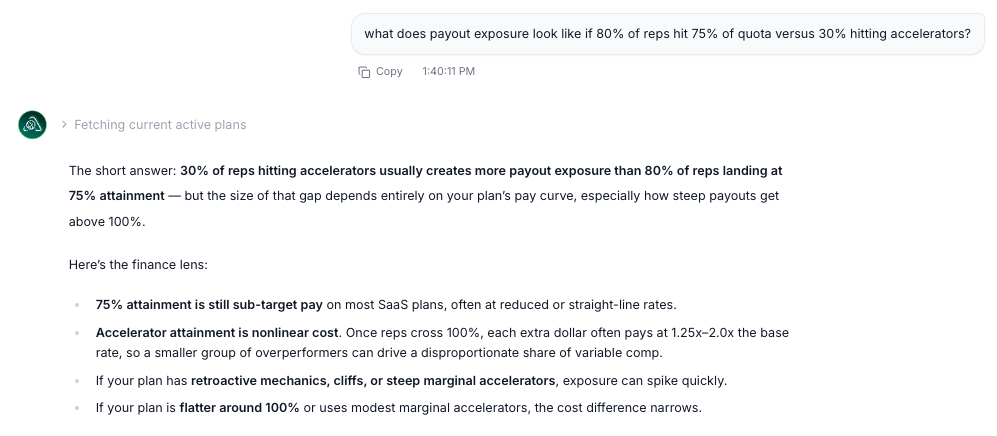
When plan changes go live without scenario testing, you end up with surprise payouts, misaligned accruals, and forecasting gaps. Testing across attainment bands proactively answers the question: What does payout exposure look like if 80% of reps hit 75% of quota versus 30% hitting accelerators?
AI modeling tools that simulate payout exposure across scenarios before any plan change is approved streamline this process. Finance gets a number before they greenlight the change, not after it hits payroll. The result is better forecasts, cleaner audits, and fewer surprises.
4. They Fix Accruals Before They Become an Audit Problem
The comp audit and scenario modeling only matter if the underlying data is clean enough to trust. Clean accruals aren’t just an efficiency win. They’re a risk-mitigation story that Finance should own.
Manual accruals rely on disconnected data sources, introducing version control issues and formula drift. The handoff between commission calculation and Finance reporting is where those inconsistencies are most likely to surface, delaying the close and increasing the risk of payout errors. Mismatched numbers result in delayed closings and payout errors. These inaccuracies frustrate reps and increase compliance risk.
Audit-readiness actually requires clean trails, documented logic, and defensible calculations. That’s the difference between a spreadsheet someone “knows” and a system Finance can confidently stand behind. Commission accounting automation ensures compliance by fulfilling these requirements in a fraction of the time. For instance, one customer reduced accrual time by 90% — from 3–4 days to 20–40 minutes.
The teams left scrambling in October usually have an accrual problem they didn’t catch in August.
5. They Set Up Visibility Before Reps Start Asking Questions
The operational side of commissions is only half the story. The other half is trust, and transparency is how you build it.
When reps can’t see how they’re paid, they resort to building shadow spreadsheets. Dispute volume distracts Finance during close and reduces credibility as they address rep payout questions and discrepancies. Real-time rep visibility minimizes disputes. “I rarely get questions about commissions anymore,” said Liza of Rootly.
This isn’t a rep satisfaction feature — it’s a Finance time-saving feature. Fewer disputes = fewer pulls on Finance’s attention at the worst possible moment.
For Finance, the benefits of rep transparency extend beyond fewer distractions at close. When reps can see how they’re paid and trust the calculations, Finance spends less time resolving disputes and more time supporting forecasting, financial reporting, and strategic planning.
“The only two times I think about commissions now are when payroll is due and during annual planning. That’s it,” said Kenza Sebbar, Director of RevOps at Actabl.
The Real Cost of Waiting Until October
If you choose to wait, it’s not a capability difference; it’s a timing one. Teams that scramble in Q4 usually had the same intention in August. The difference lies in whether the commission infrastructure was treated as ongoing work or a year-end task.
“Delaying until October” compresses the financial close, increases audit risk, and forces Finance and RevOps to untangle undocumented plan changes and rep disputes during one of the busiest periods of the quarter. Problems that could have been addressed proactively in August become a reactive scramble when the business can least afford it.
Commission health isn’t a project; it’s a posture. The teams that finish Q4 clean usually didn’t work harder; they just didn’t let August pass without looking.
Conclusion
If there’s one thing to do this August, don’t wait until October to hear what your commission data has been trying to say all along. Audit it. Model it. Validate it.
Book a demo to see how QuotaPath can streamline your August comp plan audit.