There’s a stretch in every early-stage company’s life where the founder is the sales team.
The pitch, the demo, the negotiation, the contract redlines… all of it falls to the founder.
Then one day, a bottleneck occurs, and it’s the founder right at the middle of it when it comes to revenue, product, hiring, fundraising, and every other thing that needs them.
And it’s at that moment that most founders begin drafting their first sales comp plan. (It’s also usually the moment they make their first expensive comp mistake.)
That’s because, in our experience, we see founders focus on commission math, which is ideal for further along orgs. But for startups, the first comp plan actually comes down to what part of your founder-led motion is actually repeatable by someone who isn’t you?
Below, we’ve outlined a practical framework to help in this instance. The expertise comes from Atlas, QuotaPath’s AI Revenue Strategist, which we built specifically to help revenue leaders work through questions like this one.
Where you see specific benchmarks (OTE ranges, quota multipliers, accelerator rates), those come from Atlas’s proprietary data and the patterns it sees across thousands of early-stage SaaS comp plans.
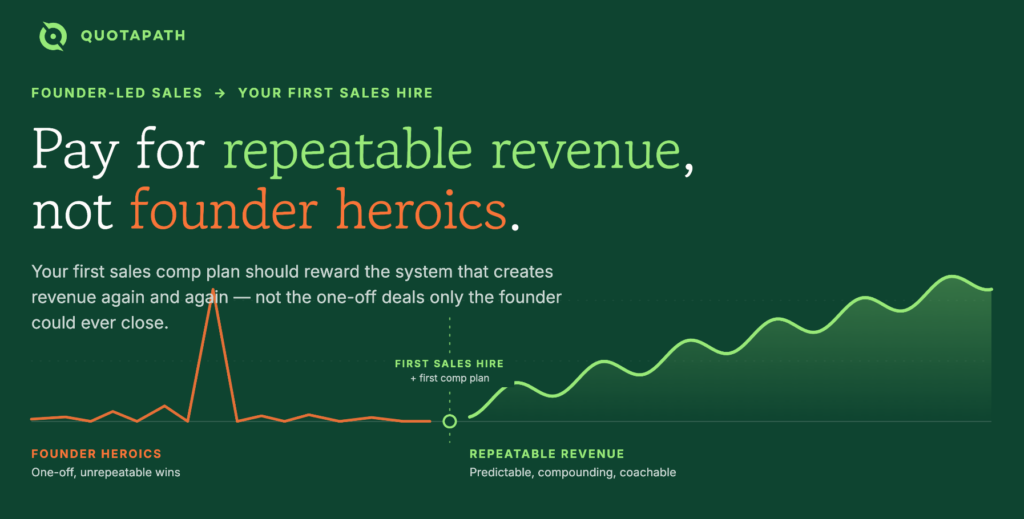
As you read, remember: The first sales comp plan should pay for repeatable revenue creation (and not founder heroics).
Here’s how to build for that.
1. Start by auditing your founder-led motion
You can’t write a comp plan for a job you haven’t defined. Before anything else, document what your motion actually looks like today:
- Average deal size
- Sales cycle length
- Win rate (and how confident you are in that number)
- Inbound vs outbound mix
- Typical buyer and the use case that’s actually closing
Now separate founder advantage from company advantage.
Your brand authority, product depth, executive access, and ability to make decisions on the spot have all been quietly inflating your close rates. Your first sales hire doesn’t get any of that. They get a calendar, a deck, and your blessing.
Pay them on what a non-founder can realistically reproduce. If 30% of your closed-won deals only happened because you personally got on a 30-minute call with the buyer’s CEO, that’s not a comp plan input. Rather, that’s a founder superpower you’ll either need to systematize or stop assuming will scale.
Additionally, define what a great deal actually looks like, not just any deal:
- New logo vs expansion
- Annual vs multi-year
- Upfront cash vs flexible terms
- ICP fit vs opportunistic
Whatever you call a great deal is what your plan should pay for the most.
2. Know when you’re actually ready to hire
Only hire a salesperson when:
- You can describe a basic playbook (even a rough one)
- You see some pattern in ICP, pricing, and close process
- There’s enough lead flow (or outbound capacity) to keep a full-time seller productive
And, resist the urge to over-engineer the plan at this stage.
Simplicity matters more than precision. A complex first plan can hide weak unit economics instead of fixing them, and a comp plan no one understands won’t drive the behavior you want anyway.
3. Design the package around cash efficiency and learning
This first hire is almost always a full-cycle AE, not a specialized SDR-then-handoff role. You’re hiring one person to learn the motion you’ve half-figured out.
A few starting benchmarks from Atlas:
OTE and pay mix
- Early-stage SaaS typically lands at $120K–$180K OTE
- Pay mix is usually 50/50 or 60/40 base/variable
- Higher base = lower turnover risk; lower base = more leverage but more execution risk
Quota
- Early-stage quota-to-OTE ratios are typically 3.0x–4.0x
- At a $150K OTE, that’s roughly $450K–$600K in annual quota
Commission rate
- Calculate your base rate by dividing variable comp by annual quota
- $75K variable / $500K quota = 15% base commission rate
Note: These are starting points.
If your average deal size is $80K, a $500K quota is six wins a year, which is survivable. If your ACV is $8K, you’d need 60+ deals, which probably means you need an SDR more than an AE.
4. Keep the structure boring
The best first comp plan is one your AE can explain back to you in 30 seconds.
What you pay on: New ARR/ACV.
What you don’t pay on: Bookings net of churn, weighted pipeline, and anything that requires a footnote.
Quota period:
- Quarterly if your cycle is 30–90 days (most common)
- Monthly only for very high-velocity SMB motions
- Annual only if your deal count is low and cycles are long
Rate structure:
- Below threshold: reduced or zero accelerator
- 100% to quota: standard rate
- Above quota: modest accelerator, usually 1.25x–1.5x
Modifiers: At most one or two. Common starters:
- Multi-year term bump
- Upfront annual payment bump
- Self-sourced or outbound premium
And, anything you can’t justify in one sentence, cut.
5. Build a ramp *but a short one
- Months 1–3: Reduced quota, or a guaranteed minimum
- Month 4+: Full quota at standard rates
There’s a tradeoff to be aware of. Guarantees make hiring easier and onboarding less stressful, but they decouple pay from performance for too long. Reduced quotas keep pay-for-performance discipline intact, and are usually the cleaner play. Pick one. Don’t do both unless you really mean it.
6. Get crediting and payout timing right early
Most first-year comp disputes don’t come from bad rates. They come from unclear ownership of deals.
Spell out, in writing:
- Who gets paid on founder-assisted deals
- How handoffs work if the founder is still closing late-stage opportunities
- What happens if a deal slips quarters
For payout timing, closed-won/booked ARR is the standard for early SaaS. If you have meaningful collection risk, consider partial holdbacks tied to actual payment, but only if you really need to. Holdbacks tend to complicate trust early.
7. Review every 2–3 quarters
The temptation in year one is to tweak the plan every month. Resist it. Comp plans need enough data to actually learn from.
Review on a 2–3 quarter cadence. Look at:
- Attainment distribution — are people clustered at 100%, or all over the place?
- Cost of sales — commission as a % of new ARR
- Ramp success — are new hires hitting full productivity in your assumed timeline?
- Deal quality — term length, ACV, retention indicators
When you do evolve the plan, the most common next steps are:
- Splitting hunters from farmers
- Carving out separate treatment for renewals and expansion
- Introducing more precise accelerators once the motion is stable
A simple first-hire plan template
If you want a starting point to pressure-test against your own numbers, here’s what Atlas suggests for most early-stage SaaS first-AE plans:
| Component | Recommendation |
|---|---|
| Role | Full-cycle AE |
| OTE | $140K–$160K |
| Mix | 50/50 |
| Quota | 3.5x–4.0x OTE |
| Primary measure | New ARR |
| Payout cadence | Monthly or quarterly payout against quarterly quota |
| Accelerator | 1.25x–1.5x above 100% |
| Ramp | 3 months at reduced quota |
| Modifiers | One for multi-year, one for self-sourced (if strategic) |
Note: This is a baseline. Start with something simple and defensible, then let your actual data tell you where to evolve it.
Design, track, and manage variable incentives with QuotaPath. Give your RevOps, finance, and sales teams transparency into sales compensation.
Talk to SalesBring Atlas into the conversation
If you’re staring down your first sales hire, the questions get specific fast.
- What OTE should I offer in this market?
- What’s the right quota for my deal size?
- Should I cap commissions?
- What happens to founder deals as the new AE ramps?
Atlas was built to answer questions like these with data-backed, logical recommendations grounded in QuotaPath’s proprietary benchmarks. Use Atlas, our AI Renuve Strategist, to model a plan, stress-test your assumptions, and flag when your unit economics don’t actually support the hire you’re about to make.
Further reading: The Ultimate Guide to Founder-Led Sales by Bharathi Masilamani — a useful counterpart focused on the pre-hire stretch of the founder-led journey.