
Sales reps are the obvious commission earners.
They open the pipeline, close the deal, and the line between their effort and the revenue event is short and clean.
But the moment you start thinking about variable pay for marketing, customer success, or product, the picture gets blurrier.
Suddenly, you’re trying to price work that influences revenue indirectly, operates on different timelines, is shared across teams, and is measured through metrics that are harder to attribute cleanly.
Then comes the temptation: “If sales reps are motivated by commission, why wouldn’t a CSM be? Or a demand-gen marketer? Or the PM who shipped the feature that closed the deal?”
Fair thought. And even logical, but it almost always leads to one of two outcomes. Paying twice for the same dollar or paying for outcomes the team can’t really control.
If you’re considering bringing other roles into your incentive strategy, follow our framework below.
Free On-Demand Comp Consultant
Use Atlas, our AI Revenue Strategist, for help creating comp plans for other roles on your team that fit into your business model and existing comp strategy. Try it for free.
Use AtlasThe Principle We Keep Coming Back To:
First and foremost, we should pay variable compensation where a team can materially influence revenue, not simply where revenue happens nearby.
That single sentence does a lot of work.
It rules out paying marketing on closed-won revenue just because pipeline touched a campaign. Rules out paying CS commission on renewals when the AE controls timing. And, it eliminates paying product on bookings when the roadmap is a multi-quarter, multi-team effort. And it leaves room for the cases where variable pay genuinely belongs, which is the rest of this post.
The shorthand: variable pay belongs where a team can directly influence the revenue event, the outcome is measurable, and the payout won’t trigger double-paying or attribution disputes.
Miss any one of those, and a bonus plan is almost always the cleaner instrument.
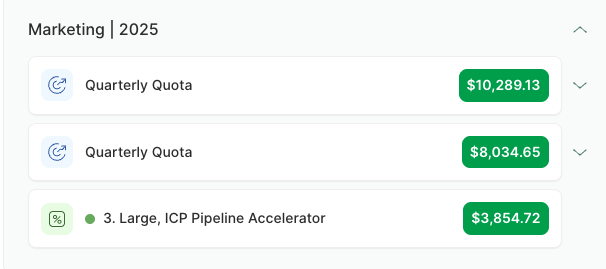
Marketing: Pay variable comp on the revenue marketing actually owns
The most common mistake here is paying marketing on bookings.
Bookings are the wrong unit because sales closes them, brand and demand capture inflate them, and the attribution model is rarely stable enough to defend in a comp dispute. You end up overpaying for revenue marketing influenced but didn’t control.
Where variable pay does make sense in marketing:
- Qualified pipeline created: not lead volume, not MQLs sitting in a dashboard, but pipeline that’s been accepted by sales. This is the cleanest unit because marketing controls the inputs (campaign, targeting, content, conversion path) and the outcome is binary and auditable.
- Sourced revenue, but only if attribution is trusted: this is a higher bar than most companies want to admit. If your attribution model gets re-litigated every quarter, paying marketers on sourced revenue creates a comp dispute on top of a measurement dispute. Don’t do it until the model is stable.
- Specific strategic motions: partner-sourced pipeline, event-driven pipeline, expansion campaigns. These are bounded enough that ownership is clear, which is exactly what makes them safe to comp on.
For most SaaS teams, marketing is better served by a bonus plan tied to pipeline, conversion quality, and CAC efficiency than by rep-style commissions. The bonus framework gives finance a predictable ceiling, gives marketing room to optimize across the funnel, and avoids the trap of paying for the same dollar twice.
Customer Success: Variable pay belongs where CS truly owns the commercial outcome
CS is the function where this question gets the most heated, because the role itself varies widely across companies. At one end, CS is essentially post-sale account management with renewal authority and an expansion quota. At the other end, it’s service and support that protect accounts but don’t control contract timing or commercial terms. Variable pay should follow the role (not the title).
When variable pay makes sense for CS:
- Renewals and gross retention: when the CSM owns the renewal motion (initiates the renewal conversation, negotiates terms, signs the order form), commission on renewals or a GRR bonus is appropriate. The team controls the outcome.
- Expansion influence or direct ownership: if CS is generating expansion pipeline, running the upsell motion, or co-selling with the AE, there’s a legitimate variable-pay design. The cleanest version is a smaller commission on expansion ARR, or a quarterly NRR bonus.
- Adoption milestones that predict retention: only if those metrics are proven leading indicators in your data, not aspirational ones. Paying on a “health score” that hasn’t actually predicted churn is paying on a vibe.
Where to be cautious: if CS is primarily service-oriented and doesn’t control contract timing, commissions create the wrong incentive. If AEs or AMs already own the same expansion dollars, you’re double-paying. If the metric can be gamed through short-term concessions (free months, discounts, scope creep), the comp plan will be gamed.
In practice, CS compensation works best as a bonus-based variable tied to GRR, NRR, and renewal execution, rather than classic new-logo commission. Same outcome, keep CS focused on retention and expansion, without the attribution chaos.
Product: Rarely commissions, sometimes bonuses
Product is where variable pay tends to break down fastest.
The impact is real; a great launch can move the entire revenue curve, but it’s usually indirect, long-cycle, and team-based. Pricing that contribution at the individual level is almost impossible to do fairly, and tying pay to bookings creates the wrong roadmap incentives. You don’t want a PM optimizing the next quarter’s release for what’s most monetizable this quarter.
Instead, you want them building the right product.
Cases where variable pay can work for product:
- Launch success tied to adoption or attach rate: a launch bonus when a new feature hits a specific adoption or attach threshold. The metric is bounded, the timeframe is short, and the team can see how their work translated to outcome.
- Commercial feature rollout with measurable upsell impact: for example, a paid add-on or a tier-unlock feature where the lift can be isolated. This is rare but legitimate.
- Company-level or business-unit bonuses for senior product leadership: VPs of Product and CPOs often have a portion of comp tied to company revenue or retention. That’s appropriate for the role; it’s not appropriate for an IC PM.
For most product teams, the right answer is a company or business-unit bonus, not deal commissions. It keeps the team aligned to revenue without distorting the roadmap.
A Practical Decision Rule
Atlas’s three-part test is the one to use when a leader pushes for commissions on a non-sales team:
-
- Can the team directly influence the revenue event? Not “contribute to,” not “support” — directly influence. If the answer is “well, kind of, in combination with three other teams,” that’s a no.
-
- Can the outcome be measured cleanly? One metric, one source of truth, agreed on before the period starts. If it requires a quarterly attribution debate, the answer is no.
-
- Will the payout avoid double-paying or attribution disputes? If two teams could legitimately claim the same dollar, the comp plan will create conflict, not alignment.
If any of those are missing, a bonus framework is almost always more financially sound.
The Finance Tradeoff
Commission is the right instrument for direct, frequent, transaction-linked influence, you know, the kind of work where the link from action to dollar is short. That’s sales. It’s sometimes CS, when CS owns the renewal motion. It’s occasionally a strategic marketing motion.
Bonuses are the right instrument for shared, delayed, or system-level influence when the work is spread across teams and time. That’s most marketing. It’s most of product, and it’s CS in service-oriented orgs.
The cost risk rises sharply when multiple teams are paid on the same revenue without clear ownership rules. This is called the total commission rate.
When marketing, sales, and CS are all paid on the same renewal, you’ve effectively paid 200-300% commission on that dollar. More importantly, you’ve also set up three teams to argue about who deserves credit.
The Takeaway
Variable pay is powerful when it aligns with influence, measurement, and clear ownership.
And when it’s not? It’s an expensive mistake.
Focus on the question “where does this team actually own a revenue outcome, and what’s the cleanest way to pay them for it?” when considering which teams to enroll under incentive pay and how to pay them.
Sometimes that’s commission. More often, for non-sales teams, it’s a well-designed bonus plan that does the same motivational work without the financial and political downside.
If you’re building or rebuilding any of these plans, the design choice usually matters more than the dollar size. Get the structure right, and the variable pay does what it’s supposed to: focus the team on the outcomes you want to scale.
Atlas is QuotaPath’s AI Revenue Strategist, built on the patterns we see across thousands of comp plans. Want to pressure-test a plan you’re designing? Try it in QuotaPath.