The sales rep hiring process has changed dramatically over the past few years.
SaaS recruiters conduct interviews almost exclusively over video now. Remote sales jobs have exploded in popularity, which has unlocked flexibility around work environments and salary accommodations for the sales representative role.
Even the power dynamic between the interviewer and the interviewee has shifted. Reps must be sold on the opportunity, not the other way around.
That’s especially true for top performers who can quickly hop between roles in search of the most lucrative one.
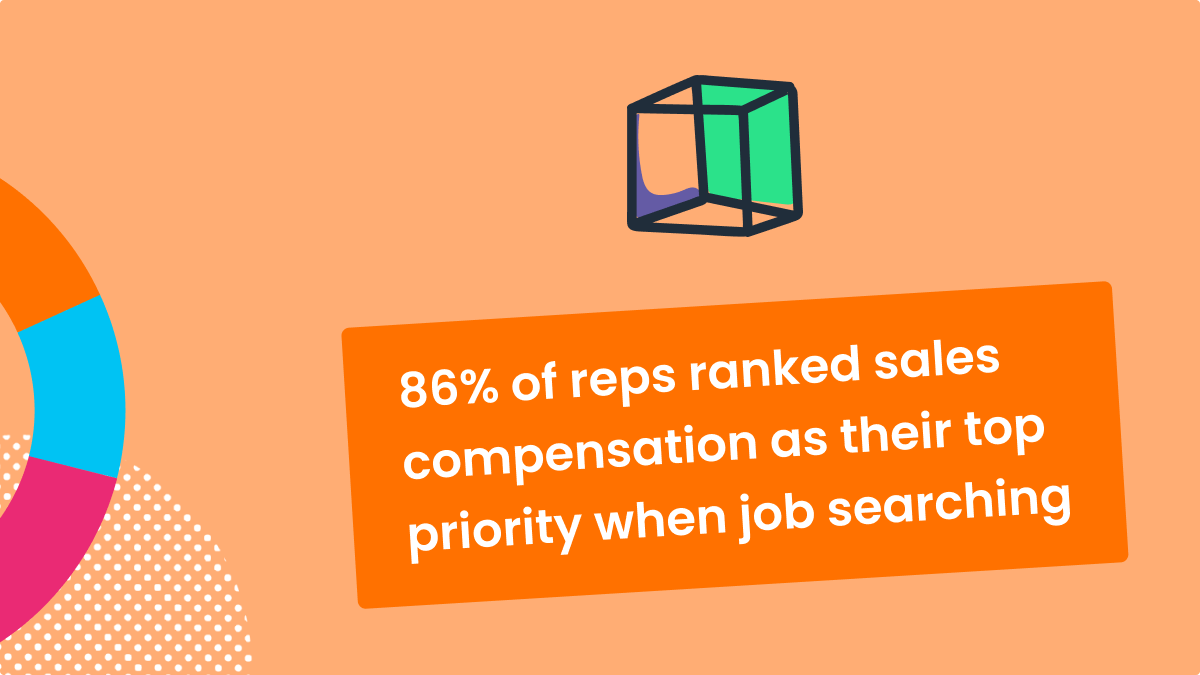
Did you know that 86% of reps rankedsales compensation as their top priority when it comes to job searching? That’s according to a survey we ran over the summer with more than 300 leaders and reps across the SaaS industry.
So, how can recruiters and hiring managers re-think sale rep hiring processes in today’s market?
There are a number of ways to go about this, but we want to focus on sales comp transparency throughout recruiting.
In doing so, you’re saving both your and the job seeker’s time in the case of the OTE not coming close to expectations. But even more, you’re establishing standardization across positions with the same title and making it more equitable.
“By leading with transparent OTE information, we can remove biases that can influence salary negotiations and instead ensure equal pay for equal qualifications,” said QuotaPath VP of Sales and Customer Success Caroline Tarpey.
If that hasn’t convinced you, just remember that an increasing number of states actually require companies by law to disclose salary info in job postings.
Simplifying sales compensation plans
In addition to including standardized salary and OTEs in job descriptions, you should also simplify your comp plans to add transparency to your sales rep hiring process.
This is a subject we talk about at length with RevOps, Finance, and Sales leaders and reps. But one department that benefits from a simplified commission plan that often gets overlooked is recruiting.
The more complexities and commission structures you add to your compensation strategy, the harder it is for your reps to understand it, your leaders to explain it, and your recruiters to sell it to top talent.
“I remember at a previous role, our sales development reps had three different components,” Angie said. “One plan included 20% variable pay tied to activity, 40% from sales accepted opportunities, and the remaining 40% was based on annual recurring revenue if that sales accepted opportunity closed.”
Now imagine explaining that to an entry-level SDR candidate.
“If you explain that to someone who has no sales background prior, you’re going to confuse your candidates,” Angie said. “If they don’t understand their comp plans, it’s harder for candidates to see a path to success in their new role.”
Pro-tip — If your team uses QuotaPath, use our technology as a recruiting tool. Reps reported thatthey have more trust that they’re being paid accurately when an incentive compensation management software runs commissions.
This can come at the end of your hiring manager’s initial conversation.
“When you move to the compensation discussion at the end, be sure to not only affirm the OTE but also the benefits the role provides (such as an attainable variable based on team trends, equity, health care),” Caroline said.
Then, allow candidates time to ask questions.
“This is also a wonderful time to communicate why your organization’s philosophy of standard OTEs at each level is such a benefit to them, and how they can expect to earn promotions to higher levels,” added Caroline.
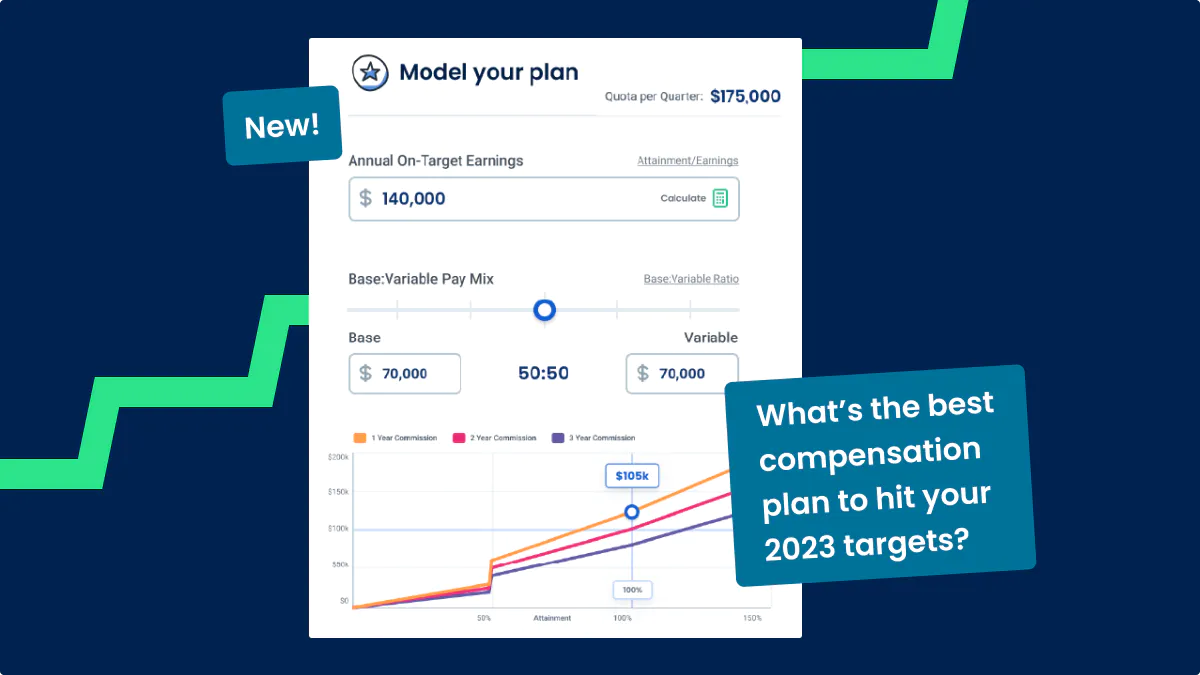
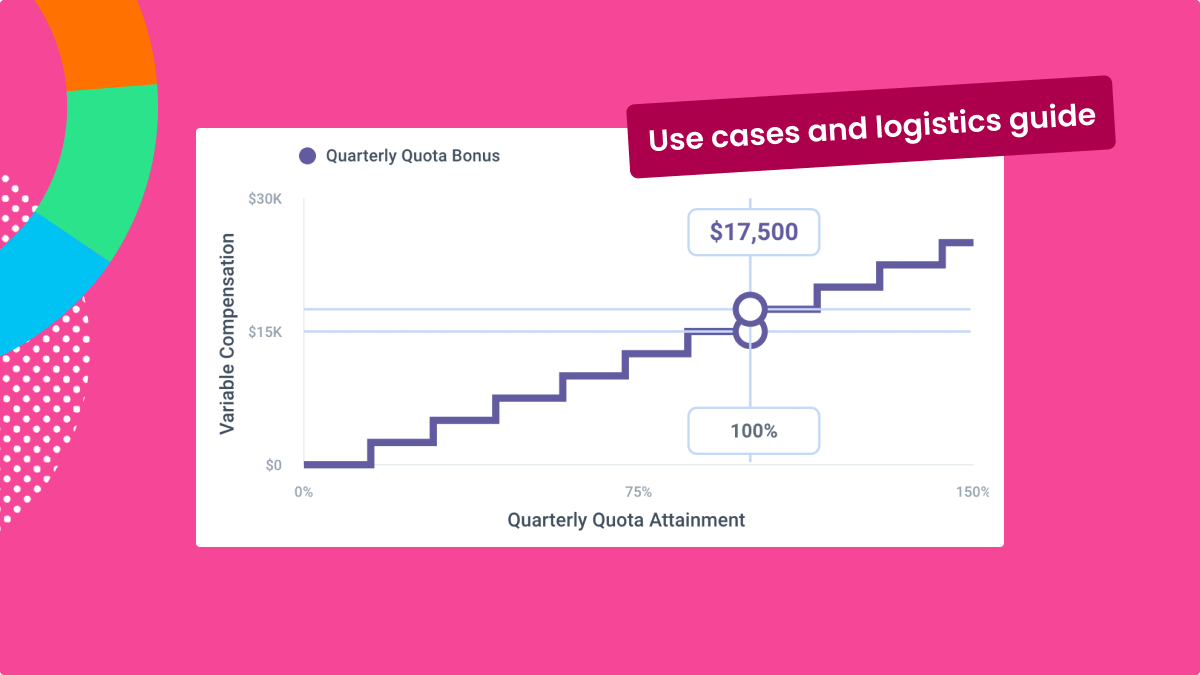
Pro tip — use our Compensation Hub Earnings Curve as a visual to show earnings potential at various attainment levels.
Earnings Curve in Compensation Hub
Final thoughts on the sales rep hiring process
To ensure compensation transparency makes it into your recruiting process, add your details to your job descriptions.
Then, build a standard agenda for the recruiting screen and the hiring managers’ conversations to follow. This should include instructions to tell the candidate upfront that you’ll save time at the end of the meeting to discuss sales compensation plan examples.
“This assures them that they will not leave without covering that important piece and allows them to focus on the rest of the conversation first,” said Caroline.
About QuotaPath
QuotaPath’s commission tracking and earnings forecasting software bring clarity, alignment, and automation to every party tied to sales compensation.
Are you gathering rep feedback on sales compensation plans? If not, please start. Our Sr. Director of RevOps Ryan Milligan shared a few tips on what to ask and what to do with their feedback.
RevOps remains a relatively new field, with many organizations writing the job description for their first RevOps hire as we write this.
At QuotaPath, we’re slightly ahead in our RevOps practice, as we recently celebrated the one-year hiring anniversary of Sr. Director Ryan Milligan. We’ve learned a lot from him over the past 12 months, such as how to run a data-first sales practice that’s both more efficient and effective than before.
We watched him stand up a data warehouse, create a scoring system for customer health, geek out over SQL, and more.
But that’s not where he got his start at QuotaPath.
Instead of jumping head first into SQL, Ryan dedicated his first few weeks gathering feedback from every person on the sales team.
To this day, he continues to meet with reps one-on-one regularly.
“Sometimes RevOps leaders make the mistake of not asking the sales team what they need, what they see in the market, and how they think they should be measured,” Ryan said.
By gathering feedback from each person, Ryan said he learns where he should prioritize his attention and what motivates each person.
The latter is especially important as leaders begin planning out their 2023 sales compensation strategies.
Compensation Hub
Discover, compare, and build compensation plans. Customize compensation models using 9 variables.
Do you feel this comp plan is fair? Why or why not.
Are you incentivized? Why or why not.
Do you understand how you’re paid?
It’s imperative that you ask these questions with reps who aren’t driving the outcomes you aimed to achieve with your comp plan.
“You can figure out pretty quickly if it’s because of the plan that they’re not having success or something else,” Ryan said.
For instance, if the plan pays out higher percentage rates for multi-year deals but reps aren’t selling 2- to 3-year deals, this may indicate there isn’t a big enough difference between your base rate and your multi-year rate.
“Then you can think about, ‘How can I make this more lucrative to motivate you to drive that outcome,’” Ryan said.
One thing to note, is that if you’re going to ask your reps for feedback, you should have a plan in place for what happens to it.
“If you’re not planning to make any changes to the comp plan, and you know the decisions have already been made, don’t ask for feedback,” said Rosalyn Santa Elena, Founder and Chief Revenue Operations Officer at The RevOps Collective.
Similarly, if you collect feedback on sales compensation plans, you need to communicate with your reps what changes went into effect and why. Dedicate a meeting that guides them through the changes and how it impacts them. Show your math and how the company will support them in achieving their numbers.
Reversely, when feedback doesn’t lead to changes, you should update them accordingly and explain why.
“Sales reps tend to giver their RevOps counterparts more honest feedback than they do with their sales managers,” said Jessica Zangre, Head of RevOps with Syncari. “That loop is really important to keep that trust.”
Have a tool in place that makes compensation clear
To continue to build on that trust from your feedback sessions, give your reps full transparency into their real-time and forecasted commissions. Learn more about QuotaPath’s commission tracking and compensation management software by booking a time with our team today.
To survive and thrive in today’s business world, businesses must have a tried-and-true sales process or structure in place. This process is a required pathway that every salesman goes through before closing a deal.
A single-minded focus on success is essential for every sales endeavor, from designing a sales compensation plan to prospecting and eventually closing prospects. A company’s ability to close deals and keep its clients is severely hampered without a simplified sales process. When the business strategy isn’t supported by a thorough sales procedure, data loss, misunderstanding, and poor sales insights are the inevitable results.
This is where customer relationship management (CRM) software can transform your business.
Customer relationship management is more than just CRM; it also handles sales processes and yields much higher sales volumes. It’s obvious that CRM software functions have expanded beyond that of a simple tool used for contact management. Business leaders can better manage customer service and relationships with the help of modern CRM software, which provides everyone on the team with a unified view of data.
The success of your company depends on the effectiveness of your customer service. It’s clear that customers will only remain loyal to companies that can satisfy their increasingly high delivery requirements.
Image via Pexels
Your business needs the capacity to leverage personalized customer interactions and produce consistent user experiences across the board.
You need to think of your CRM software as a tool to increase productivity, enhance sales, and convert leads into customers. Effective use of customer relationship management software has been shown to boost revenue, productivity, and customer satisfaction scores.
Compensation Hub
Discover, compare, and build compensation plans. Customize compensation models using 9 variables.
It’s easy for mistakes to creep in when entering data manually. Consider a scenario in which a virtual call center agent must manually jot down a lead’s details. It’s possible that they’ll enter the wrong information or neglect to include the lead’s contact details.
To reduce the likelihood of these mistakes, customer relationship management systems for sales teams keep track of every interaction a salesperson has within the software, including making contact, making a sale, and following up. Activity feeds and contact profiles displayed in real time show these interactions. Filtering the feed by user or activity makes it easy to get the precise piece of information you need about a lead or an event.
There are also data enrichment tools and data enrichment API available in several sales CRMs that can pull information from other databases and add it to a prospect’s contact card in a matter of seconds. This not only lessens the possibility of representatives acquiring erroneous data but also significantly reduces the time spent exploring leads.
In addition to improving access to reliable and thorough prospect information, CRM software can help you spot performance or operational concerns that may be impeding your company’s expansion.
Connecting with your target customers
Any company that invests in customer relationship management software will see a substantial return on investment because of its ability to connect you with leads.
Without it, your team would have a difficult time prioritizing prospects and reaping the rewards of the effort invested in producing and recruiting new leads.
It’s crucial to have a plan in place for cultivating business opportunities of varying importance. Integrated CRM systems aid in providing a comprehensive picture of leads to relevant departments, allowing them to tailor engagements and swiftly reach important decision-makers.
Consolidating sales operations
Salespeople spend time doing anything from research and cold calling to deal management and going out into the field to close deals. Managers have a lot on their plates between keeping tabs on salespeople’s numbers, scheduling ride-alongs, and educating their staff. Things in your department are likely to become jampacked without a centralized framework for organizing these regular tasks.
Sales CRMs are built to streamline every step of the daily workflow. They can synchronize with your current set of channels and tools, such as your phone system’s automatic call distribution, to make it simple to handle everything in one place.
When information is gathered in one place, it becomes the most reliable source for the entire company. Salespeople get quick access to current data that they need to effectively pursue leads and complete deals. In addition, they don’t have to switch between applications or tabs to interact with leads via all available channels of contact (phone, email, or website chat box).
Boost efficiency in the workplace
Employing the right technology releases your staff from tedious processes and gives salespeople opportunities to advance. In customer service, manual tasks like data entry and locating contact information can be automated or removed. By automating various aspects of the sales, service, and marketing processes, you can free up your staff to focus on developing new leads and nurturing existing ones.
Improving customer service consistency
Consistency continues to be a defining factor in the efficiency of your customer service.
Even great sales reps and goods are only as valuable as the service they come with, and consistency has become the new gold standard. When all relevant teams have real-time access to a customer’s history, they can work together to swiftly deliver individualized communications and solutions. In a nutshell, consistency across communication channels fosters trust and increases the likelihood of future business.
Providing a great customer experience is as important as having an excellent landing page for your website.
Finding weak spots in the sales process
It might be difficult for businesses that don’t employ a sales CRM to analyze performance difficulties. To identify bottlenecks, they have to collect vast volumes of data into spreadsheets and fight with Excel formulae.
One of the best things about CRM software is that it automatically carries out data analysis. Data from your customers is combined into “smart reports” in real time, giving you a glimpse into the overall efficiency of your sales team.
To maximize efficiency, you can use CRM software to plan and prioritize your sales activities and tasks.
Decrease in sales caused by poor sales forecasting
With CRM sales systems, you can track and analyze your deals in real time. Representatives can see which opportunities are more likely to result in a sale and which ones are closers. Managers can more easily coordinate plans and construct effective deals with a clear picture of the pipeline.
Poor insight into sales performance.
Today’s customer relationship management (CRM) software allows users to create custom dashboards from which they can keep tabs on key metrics, assess progress against key performance indicators, and dig deeper into sales reports.
Poor decision-making due to inadequate data access
To streamline procedures and make educated, well-informed decisions, businesses are increasingly turning to CRM software solutions.
Points to consider when choosing sales CRM software
By now, you are well aware of the benefits of sales CRM and its potential for your business.
Now, let’s look at some of the most vital considerations for choosing CRM software.
Choosing CRM software can be difficult if you don’t know what features you need. Is it best to go with the most popular CRM for making sales? The most economical one, perhaps?
However, there are other factors to consider besides cost and reputation when selecting CRM software. Here are some things to think about when you evaluate the potential options for your company’s sales department.
Mobile-friendly application
People are spending less time at their desks these days since they are so frequently on the go for many reasons, including travel and fieldwork. You need access to your sales CRM wherever you go.
Modern sales CRM systems allow you to access your most vital information, reports, and even something as random as a release of liability template from any mobile device, at any time. Those companies that have implemented the change are more likely to meet or exceed their sales targets.
Security
Using a CRM system means storing sensitive client data on the cloud, where it can be accessed by hackers. There are ways to find out how safe the sales CRM that you’re considering is. For instance, you can assess whether the system has been updated to meet the requirements of data privacy regulations such as the General Data Protection Regulation (GDPR).
Integration
A CRM system can help you simplify your business in the same way that optimization tools like Process Bliss business processes do. As a result, you can tell you’ve found the right choice when the sales CRM platform you’re considering has integration capabilities.
Add-ons allow you to automate a large part of your sales process, including the addition of contacts, the scheduling of meetings, the creation and sending of invoices, the exchange of e-signed documents, and the creation of forms.
Improve operational efficiency with a sales CRM
Creating genuine connections with customers is the key to maintaining a steady flow of repeat business. By streamlining and automating routine administrative and data analysis activities, a sales CRM frees up time for reps to focus on developing relationships with prospects. Reps can move leads faster through the sales pipeline since they can build meaningful relationships with more prospects in less time.
About Tanhaz Kamaly – Partnership Executive, UK, Dialpad UK
Tanhaz Kamaly is a Partnership Executive at Dialpad, a modern cloud-hosted business communications platform that turns conversations into the best opportunities, both for businesses and clients with features like the auto attendant by Dialpad. He is well-versed and passionate about helping companies work in constantly evolving contexts, anywhere, anytime. Tanhaz has also written for other domains such as Not Going To Uni and Corporate Vision Magazine.
Every month, QuotaPath customers nominate one of their teammates for Quokka of the Month, a peer recognition award. We’re thrilled to announce our QuokkaPath October winner below. To nominate a teammate, see past winners, and learn more about this initiative, check out QuokkaPath.
Nominated for her strong partner relationship with her account executive and for being a top performer on her team, Amita Singh is October’s QuotaPath Quokka of the Month!
Amita, who has worked in tech sales previously at eBay and Oracle, today supports the digital coaching platform CoachHub as a Senior Learning & Development Specialist for their UK/Ireland (UKI) region.
Head of Sales Development Karla Gordovil nominated Amita, praising her ability to serve as a partner to the AE team and drive high conversion rates from meetings to open opportunities.
“The biggest challenge in this role is to be resilient while facing a lot of rejections, convincing the businesses to diverge their financial resources towards digital coaching or update their existing solutions,” said Amita. “To be successful in this role, one definitely needs to step into the customer’s shoes and understand their pain points. It’s crucial to understand exactly the problem you’re trying to solve and customize your pitch accordingly.”
They have been instrumental from day one in my journey and my success so far and helped me integrate into an entirely new culture.
What do you hope to accomplish next?
I strive to grow up the ladder in the sales org. and take on additional responsibilities. I would love to have more meaningful conversations with customers and play my part in the future of digital coaching.
How would you describe the working environment at CoachHub?
The work environment at CoachHub is extremely positive and collaborative, We have people from diverse backgrounds and experiences. And as they say, selling is a team sport, the diverse team at CoachHub brings in its own unique strengths and ways of solving problems. CoachHub definitely lives up to its core value of ‘culture first’ by letting people from different backgrounds and cultures to be their own selves and create a positive impact. We love celebrating each other’s successes and wins and together we form a huge community of sales folks working towards a common goal.
Lastly, what do you enjoy doing when you’re not at work?
When I’m not at work I’m mostly spending time with my friends and family or indulging in binge-watching.
Thanks for sharing, Amita! Congrats again, and cheers to your success.
About QuokkaPath
Like the “happiest animal on earth,” the quokka, we’re happiest when our customers excel!
That’s why we welcome customer nominations every month to celebrate someone on their team who has excelled in their role.
“Quokkas of the Months” earn permanent spots in our Quokka Hall of Fame. Plus, the winners, and those who nominated them, receive quokka-filled swag packs.
To nominate a teammate for November, submit your nominations here.
About QuotaPath
QuotaPath provides sales compensation and commission tracking solutions for GTM organizations. We blend an intuitive user experience with a highly technical backend to get Sales, RevOps, and Finance all on the same page when it comes to compensation.
To see if we’re the right fit for your organization, schedule a time to chat with our team.
Businesses expand internationally for many reasons. For instance, entering an unchartered market can offer new revenue opportunities, provide access to a broader talent pool, and allow product global brand exposure.
But with those lucrative opportunities come many challenges.
Specifically — the challenge of the unknown.
When companies expand internationally, they typically lack visibility into the buyers’ behavior, purchase power, and brand recognition. Strategies that work well for one company, or in one territory, won’t necessarily work for another.
As such, leaders need to proceed with caution.
Compensation Hub
Discover, compare, and build compensation plans. Customize compensation models using 9 variables.
Sales territory planning can be tricky, but it’s especially challenging to get new territories right with so many unknowns. The more you know, the easier it is to create territories that deliver results and support your sales reps.
Constant territory changes can frustrate and demotivate sales reps, which reduces your sales team’s productivity. And, territories with vastly different opportunities and income potential result in uneven compensation distribution across your sales team. This can cause reps to leave for more equitable opportunities elsewhere.
Best practices for territory planning
Now for the good stuff. Although entering a new territory poses its challenges, best practices exist to help.
Align territories so they are fair and equitable
Strive to give reps in the same role books of business that are equal in size and quality, so everyone has the same potential to achieve their goals and drive revenue, regardless of tenure.
Distribute opportunities evenly across the team
Use a round-robin distribution of new opportunities from the beginning so all team members have the same chance to succeed. Plus, as new reps join the organization, they’ll have the same growth experiences. This approach is scalable and prevents favoritism. Scalability facilitates fiscal planning, preventing over or under-hiring for new markets.
Give SDRs their own accounts
Don’t leave yourself with a pipeline shortfall due to SDR/AE pods. Give SDRs their own accounts that they’re fully responsible for. These should be accounts with the greatest probability of converting to opportunities. This gives SDRs a better chance to deeply understand their accounts and do everything possible to convert these ideal customer profiles (ICP) accounts.
If they aren’t successful in penetrating the account, they can put it back into nurture, and give someone else the opportunity to work it. And, if the SDR learns that the timing isn’t right due to a contract obligation ending on a certain date, the rep gets credit for obtaining that information and adding it to the CRM.
Plus, in this system, AEs have their own accounts they can self-source as well.
Leverage your ICP as you expand
Create your ideal customer profile (ICP) based on the characteristics of accounts that have historically signed the largest deals with your company. Look at things like employee count, user headcount, industry, and any software the business uses that interfaces with yours (if applicable). Create a list of prospective customers that match your ICP and evenly distribute them to your sales team.
When expanding, experiment with a variation of your ICP, and change only one characteristic — perhaps geographic location. Create a list of these and evenly distribute them to your team. This minimizes the risk carried by any one rep while you’re testing new ICPs. Then, expand on that ICP once you’ve proven it’s valid for your product.
Account scoring is multidimensional
Score accounts in various ways when assessing them for fit. Some ways to approach this include:
Fit against your ICP
Potential for future value or growth
Timing as to whether the account is ready to consider what you’re selling, for both new prospects and existing accounts to measure upsell potential
Customer health–consider things like if the account has found value in your product, are users logging into your solution frequently, how many users are logging in, is the account growing or scaling and is the account economically healthy
Remember to check with your SDR team to make sure they’re receiving good quality leads based on the prospect scoring. Adjust scoring as needed so you don’t waste reps’ time on bad leads.
Your Guide to Setting, Calculating and Tracking Sales Compensation
Design and execute a compensation strategy that rewards and motivates your reps, aligns to business goals, and drives revenue.
In new market territories, you don’t have a basis to set quotas or any way to know what quota attainment will be, so it’s best to eliminate decelerators and accelerators when creating your commission plan.
One element that is good to add in new territories is new logo bonuses. Getting a few early customers is crucial, so reward your reps for closing them. Consider offering an extra $1,000 for the first five new customers.
4. Do your research
Graham suggests that one way to overcome the OTE/pay mix difference between countries is to connect with people at companies in the region where you’re planning to expand and ask them.
5. Look at historical data to set initial quotas
Setting quotas for the first time in new territories can be tricky. One place to start is to look back at the early days of your company when you first launched. Look at the historical information from when you lacked marketing resources.
You can also model it like a new hire ramp period since you don’t just open a new market entirely cold. You likely have some customers in the region already and then start to build on your current customer base from there.
6. Consider offering a non-recoverable draw initially
Start with a comp plan with a guarantee of at least 70% of your variable. This is a lot like a non recoverable draw. For example, if your variable is $5K per month and reps get paid 10% on everything they sell, then they are guaranteed at least $3K per month for the first six months, like a non recoverable draw.
7. Start simple and adjust over time
Make your comp plan simple initially. A couple of comp plan structures to use for a new territory include Single Rate and Single-rate bonus.
Single Rate Bonus Compensation Plan
Understand that the first comp plan for a new territory is not perfect. You must be willing to change it. Handle this by telling people as you hire them, so they are prepared. Your plan should evolve as you get more data after 6 to 12 months. This will help you create a comp plan aligned with your business metrics and goals.
Bonus tips
Graham had a couple of non-comp related bonus tips:
Have a specific reason to be in the new territory.
Hire someone from a competitor — get an early employee who worked at a competitor in the new territory for a huge advantage as you expand.
It’s time to get started on your comp plan for a new territory
There are risks associated with expanding into new sales territories, but knowledge is power.
So, do your research and select the territory that’s the best match for your business. Design your new territories using the best practices listed above. Then consider Graham’s tips as you build a comp plan for a new territory.
Sales commissions can be complicated. Reduce friction and errors with QuotaPath and HubSpot commission tracking.This is a guest blog from HubSpot.
Sales teams across most industries earn variable compensation through a commission-based model. This approach often attracts top-tier sales reps who know they can close lots of deals, resulting in particularly high OTEs. Plus, for junior reps just getting started, variable pay acts as a great motivational tool to ramp up quickly.
But from a logistical standpoint, commission can be complicated.
Scratch that, commission IS complicated.
RevOps teams and finance leaders need to prepare to pay sales reps the exact amount every pay period. Since the number fluctuates between pay periods, errors are more common than they should be.
Did you know that 80% of companies admitted to paying sales commissions incorrectly due to human error, discrepancies, clawbacks, and more?
That’s astronomical, and frankly, unacceptable.
Fortunately, there’s a fix for that. Enter QuotaPath and HubSpot commission tracking.
HubSpot is an easy-to-use CRM that powers sales, marketing, and customer care activities to keep details about every prospect and customer in one place. When integrated with QuotaPath, HubSpot adds real-time commission tracking with deal and earnings data to its list of solutions.
There’s so much value in having one source of truth.
By syncing QuotaPath with HubSpot, users eliminate manual commission calculations, and with it, the risk of human error. The rep-friendly view also unlocks instant visibility into attainment and forecasted earnings data. This allows reps to see how their sales pipeline translates into future commissions.
Here are three ways that sales teams can use QuotaPath and HubSpot to prevent pay discrepancies, automate manual workflows, and ensure reps receive every cent of their rightfully earned commissions.
Save time, improve ROI, and reduce pay errors with QuotaPath and HubSpot commission tracking
3. RevOps teams can ensure variable compensation is right every time
The QuotaPath platform handles everything from designing and modeling compensation plans, to automated commission tracking and payouts.
All the underlying deal data in HubSpot feeds directly into QuotaPath so that commission info is always accurate and in real-time. No more double data entry. And no manual refreshes.
With shared dashboards, sales, RevOps, finance, and leadership have access to easier communication and greater clarity. Everyone’s looking at the same numbers, which reduces the discrepancies and allows everyone to focus on the job at hand.
By automating the commission process, RevOps, finance, and sales teams reduce the time spent managing payment and reduce the risk of errors and ASC-606 compliance issues.
Imagine a RevOps and finance team at a B2B SaaS company processing payroll.
Every month, they dig into the performance of each sales rep and see how much they’re owed in commission on top of their base pay.
Amounts differ for every rep according to their performance. One rep earns 8% on one deal and 10.5% on another that’s tied to a different product. The latter deal also unlocked an accelerator for the rep, which boosts the commission rate up to 14%. Oh, and there was a Q3 SPIF, too. Now rinse and repeat for 39 reps.
See? It’s a time-consuming process. And because deal data often won’t sync from a CRM to a company’s commission tracking platform, it’s a process that’s rife with error.
But with HubSpot and QuotaPath, sales rep deal data automatically flows from HubSpot to QuotaPath and an automated, accurate commission payout process follows.
It saves RevOps and finance teams an average of 17 hours on commissions and helps prevent pay discrepancies (like from a last-minute closed deal.)
QuotPath and HubSpot commission tracking
Compensation Hub
Discover, compare, and build compensation plans. Customize compensation models using 9 variables.
The more frequently you measure your progress toward a goal, the more likely you are to achieve it. That’s why companies typically see increases in quota attainment from 5 to 25% after implementing QuotaPath.
QuotaPath’s forecasting software capabilities
Build a Sales Funnel
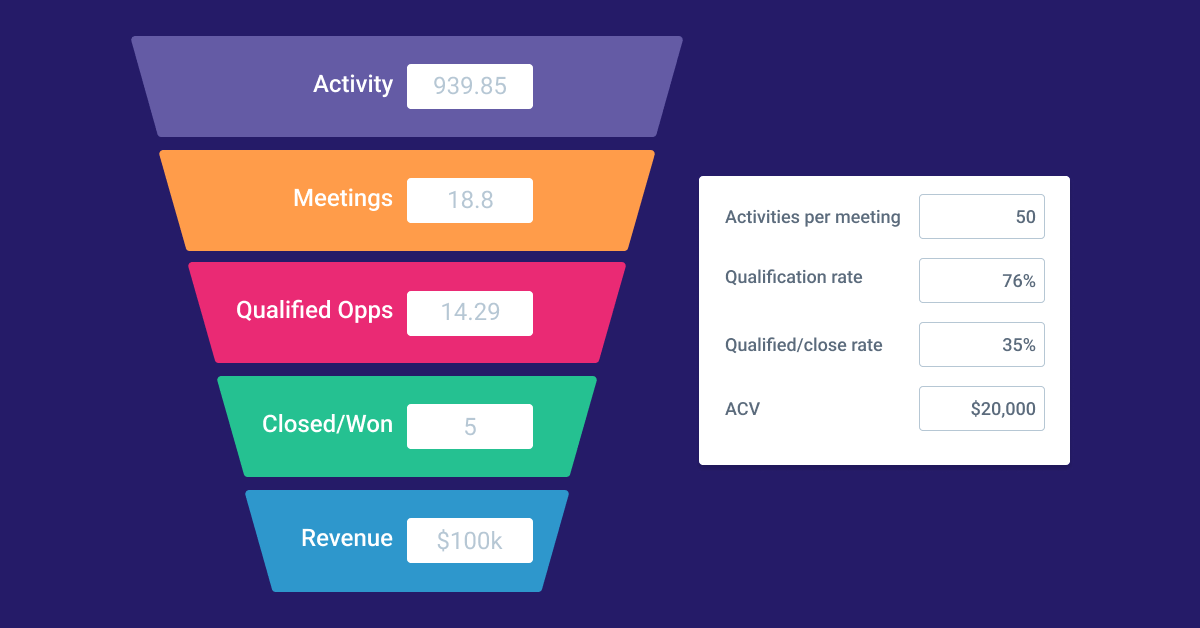
Use our free sales funnel resource to see how many meetings your team needs to book to hit quota.
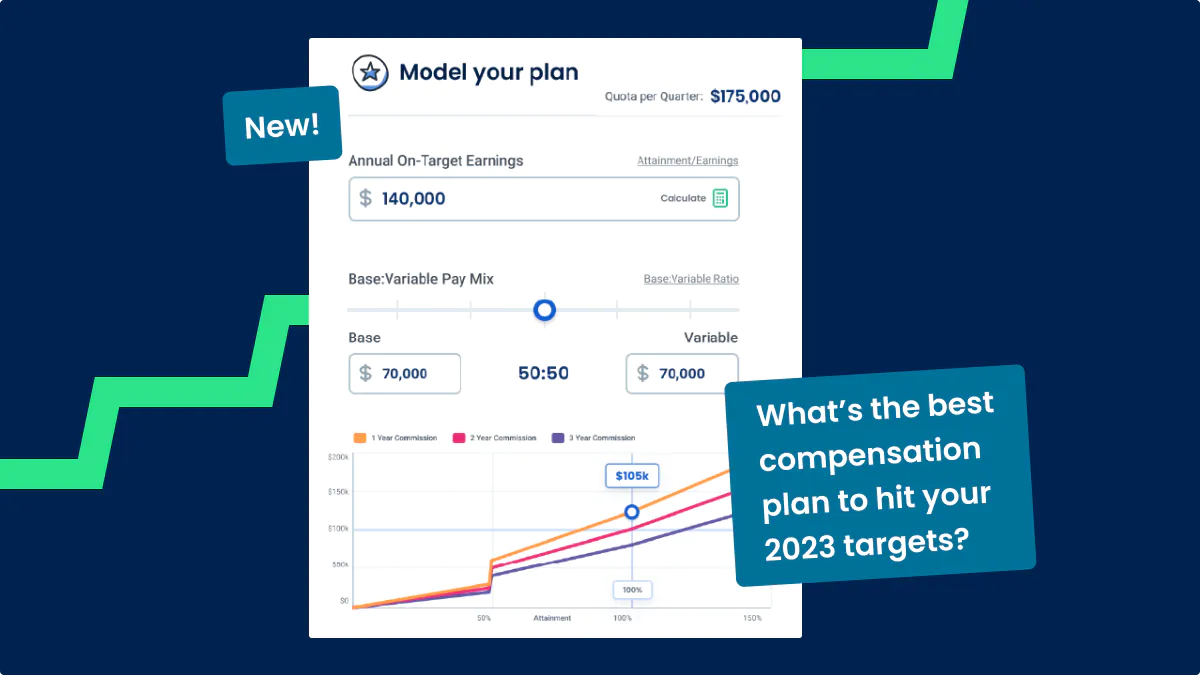
Choosing an appropriatecommission structure is equally challenging. But with QuotaPath’s Compensation Hub, teams can plug in various figures and projections into the modeler and choose which comp plan makes sense for each new class of sales hires.
Onboard by your next commission cycle
Don’t guess about sales compensation
The most important way to keep your sales teams happy is to consistently pay them correctly and on time every pay period. Doing otherwise causes friction within the sales org and leads to turnover.
Ensure your compensation structures are transparent and paid out accurately with QuotaPath and HubSpot.
This blog marks the fourth and final blog of our series featuring comp plan examples for account executives from industry leaders. In case you missed our previous posts, catch up on the first, second, and third blogs.
Despite a looming recession and ongoing tech layoffs, sales reps remain in power when it comes to their compensation. If they don’t like your plan, they’ll hop to the next highest-paying company.
“Your comp plan is one of the biggest recruiting tools to attract top reps,” said Andrew de Geofroy, SVP, Global Revenue Platform for Quantive.
At a time when rep tenure continues to shrink, compensation packages also act as a driver in retaining your reps.
But it’s never been simple, despite our incessant calls for simpler plans.
“The number of people who come to me and ask me to build their comp plan is startling,” said Beekeeper CRO Kevin McKeown.
To help, we asked Andrew, Kevin, and Insight Partners EVP, Sales & Customer Success Hilary Headlee and Operating Partner, Sales & Customer Success Pablo Dominguez to share their compensation best practices.
Plus, our four contributors shared their top comp plan examples for account executives below.
Hilary: Shorter quota periods
“It can be really tough to look into the crystal ball and get your comp plan accurate for the year,” Hilary said.
To overcome this, Hilary suggested rolling out quotas on a quarterly or bi-annual basis (depending on the role) in place of an annual quota.
“This approach takes a lot of trust from your sellers to not see an annual number,” Hilary said.
It can also be arduous for the Finance and Ops team to maintain and roll out, but that shouldn’t be a dealbreaker.
“You can make modifications once a year or a couple of times a year if you need to, especially if you’re rolling out a new product-led growth motion, or jumping into e-commerce or a new market,” Hilary said.
Andrew: Factor ramp time
Assume all new hires will not be productive toward quota until fully ramping up. Set your ramp times to align with sales cycles, and be prepared to adjust them if your sales cycles change.
For example, Andrew’s company switched from a 90-day ramp-up to a 6-month one because the former didn’t account for their long, enterprise sales cycles.
Now it’s six months, and reps have a $0 target until they fully ramp.
However, should they book business, the rep retires that quota earns commissions, and moves toward the accelerator bands.
Pablo: Tease it with a “focus group” of reps
Once you have the initial compensation plan created, Pablo recommends testing it through your best first-line manager or your best rep.
This will allow you to get a sense of how other reps will perceive it or take advantage of it.
“Ask them, ‘if we made this change, how would you react?’” said Pablo. “Would it change your behavior? See what they say. Get their feedback.”
They’ll let you know how they would game it.
“Your best reps always want what’s best for the company and themselves, so they’ll usually be honest and help you understand if the plan changes will land well,” Pablo said.
Comp plan examples
Kevin’s plan in Compensation Hub
Kevin’s plan to increase the health of early-stage companies:
Does your customer acquisition cost greater than one year? Multi-year deals can help ensure your business has lifetime value.
To lock in those multi-year deals, incentivize your reps to sell them by building accelerators into your comp plan. Every additional year after one year rewards a higher commission rate.
“We’re early stage, we’re trying to get CAC under 1 year,” Kevin said. “Until we can get our top-of-funnel more efficient and CAC in line, these multi-years are what makes the unit economics really healthy.”
Longer contracts typically mean your competition can’t get to them at least until your contract is up. The more multi-year deals your team sells, the larger the impact on your targeted market, and the fewer chances your competition can sneak in to scoop your clients.
“Multi-year contracts also show that it’s a good deal,” Hilary said. “If somebody is willing to sign up and sign a contract, and really not be able to get out of it for two, three or four years, they are buying into what that rep is selling and positioning from a value standpoint.”
Andrew’s plan in Compensation HubPablo’s plan in Compensation Hub
Pablo’s early-stage accelerator plan:
“For an early-stage company between zero to $10 million in annual recurring revenue, I love a flat-rate commission with an accelerator,” Pablo said.
A plan such as Pablo’s maintains simplicity but pays competitively with the added incentive of the accelerator.
While the above modeler activates a 1.5x accelerator once the rep passes 100% quota, Pablo’s ideal plan would actually include an accelerator 2x that of the flat commission rate.
“When I worked in a public company and a private company, I never had accelerators less than 2x, and then I bumped to 3x,” Pablo said. “I love to pay those top 10% of reps a shitload.”
QuotaPath’s newest (free) resource, Compensation Hub, invites Sales, RevOps, and Finance leaders to discover, compare, customize, and share compensation models. Strike the right balance between pay and performance to successfully align your compensation to your business strategy.
About QuotaPath
QuotaPath provides a sales compensation and commission tracking platform for revenue teams large and small. Handling some of the most complex comp plans out there, we pair a simple user experience with a highly technical backend. QuotaPath is the only solution fit to get Sales, RevOps, and Finance all on the same page.
To see how we fit into your tech stack, check out our integrations page. To learn more, book a time with a member of our team today.
Our contributing writer and former sales development representative Cody Short authored “SDR Compensation Plans to consider for 2023.”
In 2015, I moved to Austin, TX, to start my career in tech sales. I worked at a large Fortune 500 company in an entry-level position role as a Business Development Representative (BDR).
BDRs, also referred to as sales development reps (SDR) or market development reps (MDR), do the grunt work. They are often a prospect’s first impression of a company. Because of this, reps like myself looked to be compensated well for their work.
In my first role as a BDR, I earned variable pay based on the Qualified Opportunity plan. My team and I had a quarterly quota that entailed bringing in nine qualified opportunities. Those nine opportunities could fall into two categories: Stage One and Stage Two, and we had to bring in five and four opportunities, respectively.
My company defined Stage One opportunities as prospects we booked for a meeting who qualified to buy the product according to budget, need, integration capability, and buy-in from the decision maker.
Stage Two entailed everything from Stage One with the addition of another meeting booked to move the conversation forward. At the handoff between the SDR and the account executive (AE), the AE would then classify which stage the opportunity falls under.
This is the type of compensation plan that I had as an SDR. A single bonus rate is applied to every qualified lead that an SDR creates. This plan allows for an SDR to get paid on every opportunity they pass on for an AE to work. The most important guideline to establish beforehand leaders involves clearly defining what classifies as a qualified opportunity.
For instance, remember Stage One and Stage Two opportunities?
You can create something similar that is easily trackable with a scoring system. I had to bring in five Stage One and four Stage Two opportunities, and that was how my manager kept track of my success and quota.
I like the Qualified Bonus Opportunity planbecause it incentives the SDR to create quality leads for the AE. And, as a result, builds a good rapport between SDRs and AEs.
At that conversion rate and paired with this compensation structure, the SDR will focus on generating qualified leads and gain an extra kicker upon those leads closing.
Winning the deal leans entirely on the AE — not the SDR. So, if an SDR hits 100% of their qualified opportunities quota, anything they make on top of that from a closed/won deal is the cherry on top!
Here’s an example: If an SDR hits 100% of her quarterly quota, she earns $5,950 for the quarter. That’s $2,975 from seven qualified opportunities at $425 each, plus an additional $2,975 from a quarterly quota of $175K in closed/won opportunities paid at 1.7%.
Not bad. Not bad at all.
About QuotaPath and Compensation Hub
QuotaPath’s new free (and ungated) resource, Compensation Hub, allows sales leaders to discover, compare, build, and customize compensation models from 15 templates. Adjust variables to your business and evaluate and optimize comp plans to ensure they’re driving the right results. Share with your team and automate it directly in QuotaPath.
Deliver visibility, automation, and seamlessness across the entire sales compensation process by booking a demo here.
This blog is our third in a four-part series featuring comp plan examples for account executives from industry leaders. In case you missed our previous posts, catch up on the firstand second blogs featuring six sales experts.
Bad compensation plans leave scars.
“Compensation is part of the core foundation of trust between the company and the individuals,” said Philip Charm, Co-Founder of Climate Club.
Break that trust with a bad comp plan, and you face irrefutable damage in the form of rep exits.
“For many people like me who have tried to design comp plans early in a company’s life, we have scars from the experiences we’ve seen or when we’ve been taken advantage of,” Philip said.
That’s why it’s so important to start simple in your design, stay hyper-aware of changes in sales and customer cycles, and, most importantly, keep everyone on your team updated on their comp along the way.
How you introduce a comp plan and — any changes to it — plays a huge factor in how your reps will receive it.
The trust in the comp plan starts with its rollout.
Compensation Hub
Discover, compare, and build compensation plans. Customize compensation models using 9 variables.
After the meeting, post a draft of plan changes on Slack and let people respond to it. Be active in the comments. Look out for good ideas, because your reps will have two to three good ones, and explain why you can’t run the bad ones.
“Your salespeople deserve to know why the design is the way it is and why changes they propose can’t be done,” Mark added.
By the time you roll it out then, there shouldn’t be any surprises.
In addition to the rollout, Mark, Philip, and Demandbase VP of Go-To-Market Asher Mathew offered some additional sales compensation best practices. Read on for tips and three commission pay examples.
How to fix your comp plan
Mark: Design begins at the C-suite.
Start your design at the C-level and with your board. Identify three to five strategic objectives for the company over the next quarter or year.
“Then ask, can any of those priorities be reinforced with sales compensation design?” Mark said.
Sometimes you can’t.
“But sometimes you can,” Mark said. “And if you can, you do it. In my experience, that’s the No. 1 tactical implementation that will drive the strategic objective. Much more than the CEO saying this is what we’re trying to do.”
Philip: Hold off on variable pay when you’re just getting started.
Philip’s tip for teams hiring their first sales rep is to not offer variable pay just yet. Instead, make it clear they’re getting a solid base salary and equity in the company.
“To me, this is a best practice,” Philip said. “It’s the best way to balance upside and downside risk.”
In setting it up this way, you’re incentivizing your rep, as an owner of the company via larger equity than a traditional sales rep, and capturing the value of that growth.
If you go this route, know that this hire is a tough hire to find.
“This hire tends to not be from an enterprise selling background. Rather, they’re more a true business development professional,” Philip added.
Asher: Don’t pull too many levers.
“What doesn’t work in comp plans is when you use a plan to brute-force a go-to-market motion,” Asher said.
Think about the well-being of your sales force. High-commission plans filled with incentives, spiffs, and accelerators can overcrowd a plan and backfire.
“Your reps may run really fast for a bit, but when you burn them, you churn them,” Asher said.
He also mentioned the importance of understanding your risk profile when evaluating base to variable pay splits. The closer and more control a rep has over the conversation with the customer, the more risk they can take on in their plan. AKA: higher commission ratio.
“The accelerate and decelerate plan is one of the best generic models,” Mark said. “It makes the performance payout extreme.”
When a rep doesn’t do well, they really don’t do very well.
“But when you do well, you do really well,” Mark added. “It accentuates the motivation of a commission plan.”
For enterprise reps, Philip recommends offering an OTE of no less than $225K. As far as other elements of the compensation structure, Philip said he loves the idea of an accelerator.
However, when you’re building an enterprise team from scratch and don’t have historical data on past performance, a Single Rate Commission plan with a flat 10% on every deal works well.
This plan pays your reps competitively since they’re bringing in larger deals and gives your team time to understand the cost of sales, expectations, and payback periods.
Above, Asher mentioned the need to recognize your business’s risk factor as it pertains to compensation. The riskiest of compensation plans for the rep is the commission-only plan. But for the business, that’s the least risky.
“One-hundred percent commissions is the fastest way to learn sales,” Asher said. “You get a ton of exposure and education quickly.”
In his plan, he adds accelerators that raise the base rate from 10% to 15% after the rep achieves 100% attainment.
Our newest (free) resource, Compensation Hub, invites Sales, RevOps, and Finance leaders to discover, compare, customize, and share compensation models. Strike the right balance between pay and performance to align your sales compensation to your business strategy.
About QuotaPath
QuotaPath provides a sales compensation and commission tracking platform for GTM teams of all sizes. Pairing a fun-to-run user experience with a highly technical backend, QuotaPath is the only solution fit to get Sales, RevOps, and Finance on the same page for compensation.
Check out our integrations page to see how we fit into your tech stack. And, to learn more, book a time with a member of our team today.
As much as we love sales commissions, we also appreciate strong sample bonus structures.
We’ll dive into four of our most widely adopted account executive (AE) bonus structures, but before we do, let’s first differentiate between bonus and commission.
Companies award bonuses, or a pre-determined amount of money, when a rep achieves a set goal. Sales commissions represent a percentage of the total revenue tied to a won deal.
In practice, we might see a company pay an AE a $2,000 bonus when they hit their monthly quota of $25,000. If the company paid commissions instead of bonuses, and if it took the rep three deals to hit $25K, the rep might earn 10% of the total revenue for each of the three deals.
Create Compensation Plans with confidence
RevOps, sales leaders, and finance teams use our free tool to ensure reps’ on-target earnings and quotas line up with industry standards. Customize plans with accelerators, bonuses, and more, by adjusting 9 variables.
This compensation plan pays AEs a single milestone bonus once a rep hits quota. This plan offers a variable pay package with low financial risk from the lens of the company.
One thing to note about the milestone bonus compensation plan is that reps do not earn any incentive pay until they reach quota. They only earn the bonus upon hitting target.
A structure such as this encourages reps to consistently hit quota every month while protecting the business from inflated commissions. That’s because the maximum bonus payout is the pre-determined bonus amount.
Why don’t we love it? Because of the risk of sandbagging.
If a rep hits quota early in the month, they might sandbag deals until the next month. This enables them to secure the milestone bonus ahead of next month.
To model the milestone bonus with your own business inputs, use our ungated modeler.
Single Rate Bonus (Revenue) Modeler in Compensation Hub
With the revenue-based single rate bonus, the bonus rate remains the same regardless if the rep hits quota.
We like this one for two reasons. First, reps understand it. It’s easy to explain, and reps know how to make money. Second, this compensation structure allows for quick adjustments that can help steer selling behaviors. For instance, you could increase the rate to motivate reps to sell a specific product or de-motivate reps from selling one when trying to sunset a product.
To set your bonus rate:
Figure out how many deals you want your reps to close during the quota period.
Determine this by solving for how many deals your reps need to collectively close in order to reach the financial target.
Find the applicable bonus for your quota period. For annual quotas, this number will match your annual variable set for OTE. If it’s quarterly, divide the annual bonus by 4, and if it’s monthly divide by 12.
Example:
Annual target: 10 deals per quarter
Annual bonus: $80K
Quarterly bonus: $20K
Bonus per deal: $2K
Under the revenue-based single-rate bonus, not to be confused with the quantity-based bonus below, the company pays out a flat bonus for every quota attainment point earned.
This sales bonus structure works great for sales teams with quotas that change over time or for those with “busy seasons” throughout the year.
This one differs from the revenue one above by paying a flat bonus on every single deal regardless of quota attainment. We consider it the most basic bonus format and recommend implementing it when you have consistent contract values in place.
One thing to remember is that this plan does not account for deal discounts. That means that no matter how much or how little a rep discounts a deal, their bonus remains the same. As a result, we usually see teams discount more frequently because their variable remains intact.
In the plan pictured above, the quantity-based single rate bonus plan pays $2,500 on every deal.
Multiple Rate Bonus (Revenue) Modeler in Compensation Hub
Multiple rate bonus (revenue)
We like this model because it rewards overperformance and gives your reps a reason to keep bringing in deals after passing goal.
Now, if you prefer to pay a commission rate versus a revenue-based bonus tied to attainment points, check out the Commission with Accelerators plan.
Thanks for talking sample bonus structures with us!
For more widely adopted compensation structures, check out Compensation Hub.
About Compensation Hub
Our newest (free) resource, Compensation Hub, invites Sales, RevOps, and Finance leaders to discover, compare, customize, and share compensation models. Strike the right balance between pay and performance to successfully align your compensation strategy to your business strategy.
About QuotaPath
QuotaPath provides a commission tracking and sales compensation platform for revenue teams of all sizes. We’re the only solution fit to get Sales, RevOps, and Finance on the same page.
To see how we fit into your tech stack, check out our integrations page. Learn more by booking a time with a member of our team today.
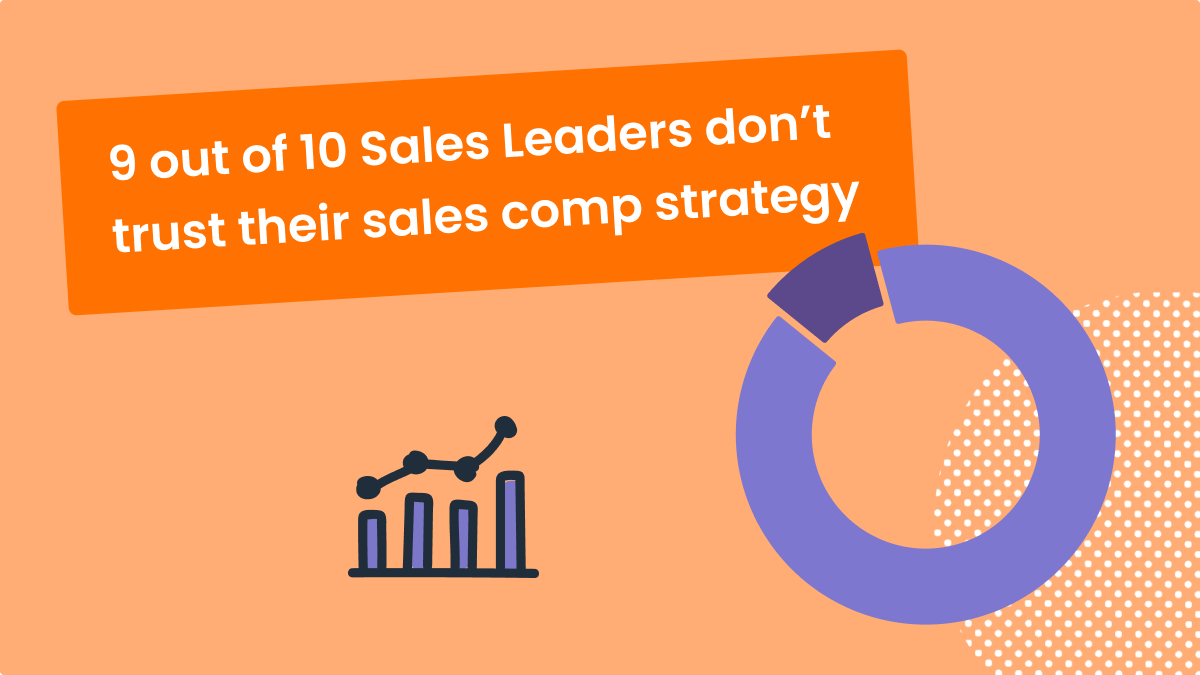
With 38 questions around sales commissions structure, ownership, and rep motivation, we aimed to uncover where organizations struggle the most. What we found was the startling realization that 9 out of 10 leaders don’t trust they have the right compensation strategy in place.
This lack of trust spills into the individual contributor (IC) roles, where 75% of sales reps admitted they don’t trust their companies to pay them fairly.
Below, we reviewed our biggest takeaways with immediate steps your organization can take to right your commission plan.
Base to Variable Pay split
5. The “most common” tiered commission structure
Based on the data from the survey, we built out the most widely adopted sales commission structure for SaaS sales compensation.
The components of this plan include:
Base salary: 50% of OTE
Quota period: Quarterly
Quota:OTE ratio: 4-7x
Components: Accelerators and decelerators tied to quota attainment
Payment schedule: The majority of companies pay commissions upon the deal closing (vs. invoice payment, or usage-based models)
For early-stage companies, sales leadership most frequently led the design of the compensation plan. That responsibility pivoted to RevOps for later-stage companies. And, at both stages, leaders introduced new comp plans most frequently on a yearly basis.
Now, if your compensation plans fall outside of these trends, that’s okay.
Your plan should reflect your business, so if your sales cycles, revenue, and maturity curves don’t follow suit with another organization’s, then your comp plan shouldn’t follow either.
Compensation Hub
Discover, compare, and build compensation plans. Customize compensation models using 9 variables.
“If you have inconsistent plans for each person in your organization, you end up underpaying women and people of color,” said Graham Collins, our Chief of Staff.
Our VP of Sales Caroline Tarpey agreed and mentioned how standardizing plans impacts recruiting efforts.
“People crave transparency in our organizations. When we standardize these, we’re giving that equitable opportunity to the team,” said Caroline. “We’ve seen it become a tool in the recruiting process. It’s viewed as very positive across the board.”
Pro tip: Use Compensation Hub to standardize your plans for all ICs who share the same title. You can then use the Growth Curve in the top right corner to show job recruits their earnings potential according to your business metrics.
3. Reps trust comp plans built by Sales Leadership the most
Given that Sales Leaders typically emphasize what’s best for the rep versus Finance, it’s no surprise that reps trust plans designed by their leadership.
What is surprising, however, is the downward trend of reps lacking trust in plans built by RevOps. For instance, in a survey we conducted in 2020, reps had the most confidence in the plans RevOps created.
This shift tells us that RevOps can do a better job collecting feedback from their sales teams.
Our Sr. Director of RevOps, Ryan Milligan, does this by hosting monthly one-on-ones with every member of the sales org.
No matter which department runs compensation planning, remember to keep your reps in the loop on future comp plan changes. Ask for feedback, and explain the math and the reasoning behind the different mechanics of the plan. Most importantly, share how the company will help them reach their targets.
Conversely, ICs who received plans once a year felt most confident that their pay was accurate.
So, what’s the takeaway here?
Fewer changes equal more trust.
In our experience, we see leaders issue more comp plan changes with the presence of a volatile market, uncertainties or changes to sales cycles and pricing, and shifts in strategic business objectives.
One way to get ahead of those changes, and foster trust along the way, is to come up with the business goals first, then leverage the comp plan to drive those. That means if your company introduces a new product while sunsetting another, your comp plan should pay enough on the new product to motivate reps to sell that over the existing one.
Setting expectations from the onset will also establish trust. If you think you’ll have to modify your plans throughout the year, be upfront with your reps to avoid blind sighting them later. For help rolling out changes, check out this example compensation communication plan.
1. 86% of reps rank compensation as their top priority when job hunting
“Having this compensation conversation early on in the interview process is really important,” Graham said.
Your recruits will ask about it, so it’s on you to share transparently. Show them their earnings potential (feel free to use Compensation Hub’s Growth Curve as a visual). A good interviewer will ask how many of your reps actually hit their on-target earnings (OTE), so be prepared to speak to that percentage.
Note: If your attainment is less than 80%, that may signal future changes to your comp plans.
To ensure your base salaries and variable pay packages compete with market standards, invite your People Team to the table. They play a critical role in securing solid sales talent and will bring market data to the conversation.
About Compensation Hub
QuotaPath’s newest (free) resource, Compensation Hub, invites Sales, RevOps, and Finance leaders to discover, compare, customize, and share compensation models. Strike the right balance between pay and performance to successfully align your compensation strategy to your business strategy.
About QuotaPath
QuotaPath provides a sales compensation and commission tracking platform for scaling GTM teams. Pairing an easy-to-use user experience with a highly technical backend, QuotaPath is the only solution fit to get Sales, RevOps, and Finance all on the same page.
To see how we fit into your tech stack, check out our integrations page. To learn more, book a time with a member of our team today.
This blog is the second in a four-part series featuring comp plan examples for account executives from industry leaders. To catch the first blog, featuring Liz Christo, Amy Volas, and Kevin “KD” Dorsey, check it out here.
Prior to founding RevGenius, Jared Robin sold for one of the largest transportation and shipping vendors in the world.
The company itself? Phenomenal, said Jared, while reflecting on his 7-year tenure.
But the compensation plans? Yikes.
“What makes sales compensation so hard is that people organize the plans without transparency,” said Jared. “At that company, nobody at the VP level understood how reps could get 100 percent to goal.”
That meant reps couldn’t map it out for themselves either.
“Everybody had different sized goals that combined maintaining a current book of business and net new,” Jared added. “My territory may have been $4M, while someone else at my exact level may have had a quota of $5M. Our gates were different, too.”
Compensation Hub
Discover, compare, and build compensation plans. Customize compensation models using 9 variables.
“You’re trying to solve for a plan that the reps understand and know exactly what they need to do to make more money and why they should bring in one more deal,” Sam said.
So, instead of trying to model the perfect plan that accounts for every edge case, strive for simple, standardized plans that bring transparency and motivation.
Impact on gender pay gaps
Another setback that often goes understated when it comes to complicated, non-standardized comp plans is the pay discrepancies that unfold between men and women in sales.
Lori Richardson, Founder of WOMEN Sales Pros, Harvard Business School Sales Coach, and Growth Strategist for Score More Sales, experienced this firsthand.
“Some people are just flat-out paid differently,” Lori said. “That happened to me. I found that my male counterparts were paid more, even though they had no more experience than me.”
While Lori spoke directly to the interview and negotiation differences between men and women in sales, inconsistent, complex, non-standardized plans can also contribute to unequal pay. The more plans and mechanics across plans, the greater the risk of paying team members unfairly.
That’s why we encourage organizations to be open (and upfront) with on-target earning potential and compensation details.
“I’m a big proponent of putting salaries and compensation information publicly available on job posts,” said QuotaPath’s Chief of Staff Graham Collins. “It doesn’t make sense that every single person in a sales organization gets paid the exact same, but by putting a structure behind it that is widely understood and that commensurates the amount of money they’re earning with their quota, you’re making it fair.”
Fair plans
To save leaders from the instinctual reflex to overcomplicate plans that Sam called out, use our newest resource Compensation Hub.
This library of 15 sales commission structures enables leaders to discover, compare, customize, and share fair and standardized plans that align compensation strategies to business goals.
Each plan includes a modeler with nine customizable inputs. Leaders can experiment with different figures to run scenarios based on historical or projected data on deal sizes, annualized quota, and more. Then, once you’ve got a plan that meets your needs, share and save it with members of your team.
To get started, check out the plans Lori, Jared, and Sam put together below. Plug in your own inputs to see if they’d fit your business. And, for more commission structure templates, visit Compensation Hub.
For an easily understandable plan that guarantees renewals and pays reps more upfront, look no further than Jared’s plan.
The Commission with Contract Term Multiplier plan pays a higher commission percentage when a rep signs up a customer for more than one year. This encourages multi-year deals and rewards reps accordingly for pushing for longer terms.
A note, typically we don’t see contracts that exceed three-year terms.
Earnings Rules: 10% rate on all contracts one year or less
12.5% rate for all contracts greater than one year
Sam’s productivity plan
We see mixed reviews of decelerators, but one person who is a fan of them is Sam. His plan of choice is the Commission with Accelerators and Decelerators.
“When a rep misses their number badly, it cascades upward,” Sam said. “I think it’s pretty compelling when a 10% miss on a $20M business equates to $2M. That’s why I think having a baseline level of productivity and performance like a decelerator should be baked into the comp plan.”
Annualized Quota: $560K Earnings rule: 0% to 50% of quota = 5% decelerator
50% to 100% = 10% base rate
100% and above = 15% accelerator
About Compensation Hub
QuotaPath’s newest (free) resource invites Sales, RevOps, and Finance leaders to discover, compare, customize, and share compensation models. Strike the right balance between pay and performance to successfully align your compensation strategy to your business strategy.
About QuotaPath
QuotaPath provides a sales compensation and commission tracking platform for scaling GTM teams. Pairing an easy-to-use user experience with a highly technical backend, QuotaPath is the only solution fit to get Sales, RevOps, and Finance all on the same page.
To see how we fit into your tech stack, check out our integrations page. To learn more, book a time with a member of our team today.
To provide the best experiences, we use technologies like cookies to store and/or access device information. Consenting to these technologies will allow us to process data such as browsing behavior or unique IDs on this site. Not consenting or withdrawing consent, may adversely affect certain features and functions.
Functional
Always active
The technical storage or access is strictly necessary for the legitimate purpose of enabling the use of a specific service explicitly requested by the subscriber or user, or for the sole purpose of carrying out the transmission of a communication over an electronic communications network.
Preferences
The technical storage or access is necessary for the legitimate purpose of storing preferences that are not requested by the subscriber or user.
Statistics
The technical storage or access that is used exclusively for statistical purposes.The technical storage or access that is used exclusively for anonymous statistical purposes. Without a subpoena, voluntary compliance on the part of your Internet Service Provider, or additional records from a third party, information stored or retrieved for this purpose alone cannot usually be used to identify you.
Marketing
The technical storage or access is required to create user profiles to send advertising, or to track the user on a website or across several websites for similar marketing purposes.






















Recent Comments