The 5 biggest takeaways from our 2023 Sales Compensation Trends survey

2023 compensation analysis

In August, wesurveyed more than 300 leaders and sales reps to get a pulse on today’s sales compensation trends.

With 38 questions around sales commissions structure, ownership, and rep motivation, we aimed to uncover where organizations struggle the most. What we found was the startling realization that 9 out of 10 leaders don’t trust they have the right compensation strategy in place. 

This lack of trust spills into the individual contributor (IC) roles, where 75% of sales reps admitted they don’t trust their companies to pay them fairly. 

Below, we reviewed our biggest takeaways with immediate steps your organization can take to right your commission plan.

Base to Variable Pay split

5. The “most common” tiered commission structure

Based on the data from the survey, we built out the most widely adopted sales commission structure for SaaS sales compensation.

The components of this plan include:

  • Base salary: 50% of OTE
  • Quota period: Quarterly
  • Quota:OTE ratio: 4-7x
  • Components: Accelerators and decelerators tied to quota attainment
  • Payment schedule: The majority of companies pay commissions upon the deal closing (vs. invoice payment, or usage-based models)

For early-stage companies, sales leadership most frequently led the design of the compensation plan. That responsibility pivoted to RevOps for later-stage companies. And, at both stages, leaders introduced new comp plans most frequently on a yearly basis. 

Build and model this plan in Compensation Hub. 

Now, if your compensation plans fall outside of these trends, that’s okay.

Your plan should reflect your business, so if your sales cycles, revenue, and maturity curves don’t follow suit with another organization’s, then your comp plan shouldn’t follow either.

compensation hub resource

Compensation Hub

Discover, compare, and build compensation plans. Customize compensation models using 9 variables.

Find Compensation Plans

“If you have inconsistent plans for each person in your organization, you end up underpaying women and people of color,” said Graham Collins, our Chief of Staff.

Our VP of Sales Caroline Tarpey agreed and mentioned how standardizing plans impacts recruiting efforts.

“People crave transparency in our organizations. When we standardize these, we’re giving that equitable opportunity to the team,” said Caroline. “We’ve seen it become a tool in the recruiting process. It’s viewed as very positive across the board.”

Pro tip: Use Compensation Hub to standardize your plans for all ICs who share the same title. You can then use the Growth Curve in the top right corner to show job recruits their earnings potential according to your business metrics.

3. Reps trust comp plans built by Sales Leadership the most

Given that Sales Leaders typically emphasize what’s best for the rep versus Finance, it’s no surprise that reps trust plans designed by their leadership.

What is surprising, however, is the downward trend of reps lacking trust in plans built by RevOps. For instance, in a survey we conducted in 2020, reps had the most confidence in the plans RevOps created.

This shift tells us that RevOps can do a better job collecting feedback from their sales teams. 

Our Sr. Director of RevOps, Ryan Milligan, does this by hosting monthly one-on-ones with every member of the sales org.

No matter which department runs compensation planning, remember to keep your reps in the loop on future comp plan changes. Ask for feedback, and explain the math and the reasoning behind the different mechanics of the plan. Most importantly, share how the company will help them reach their targets.
Conversely, ICs who received plans once a year felt most confident that their pay was accurate.

So, what’s the takeaway here?

Fewer changes equal more trust.

In our experience, we see leaders issue more comp plan changes with the presence of a volatile market, uncertainties or changes to sales cycles and pricing, and shifts in strategic business objectives.

One way to get ahead of those changes, and foster trust along the way, is to come up with the business goals first, then leverage the comp plan to drive those. That means if your company introduces a new product while sunsetting another, your comp plan should pay enough on the new product to motivate reps to sell that over the existing one.

Setting expectations from the onset will also establish trust. If you think you’ll have to modify your plans throughout the year, be upfront with your reps to avoid blind sighting them later. For help rolling out changes, check out this example compensation communication plan

Pro tip: Run different scenarios and experiment with a compensation plan template and modeler in our free, ungated resource, Compensation Hub. As an example, if predictable revenue is a goal, consider the Single Rate Commission with Contract Term Multiplier plan or the Commission with Multi-Year Accelerators plan.

1. 86% of reps rank compensation as their top priority when job hunting

“Having this compensation conversation early on in the interview process is really important,” Graham said.

Your recruits will ask about it, so it’s on you to share transparently. Show them their earnings potential (feel free to use Compensation Hub’s Growth Curve as a visual). A good interviewer will ask how many of your reps actually hit their on-target earnings (OTE), so be prepared to speak to that percentage. 

Note: If your attainment is less than 80%, that may signal future changes to your comp plans. 

To ensure your base salaries and variable pay packages compete with market standards, invite your People Team to the table. They play a critical role in securing solid sales talent and will bring market data to the conversation. 

About Compensation Hub

QuotaPath’s newest (free) resource, Compensation Hub, invites Sales, RevOps, and Finance leaders to discover, compare, customize, and share compensation models. Strike the right balance between pay and performance to successfully align your compensation strategy to your business strategy.

About QuotaPath

QuotaPath provides a sales compensation and commission tracking platform for scaling GTM teams. Pairing an easy-to-use user experience with a highly technical backend, QuotaPath is the only solution fit to get Sales, RevOps, and Finance all on the same page. 

To see how we fit into your tech stack, check out our integrations page. To learn more, book a time with a member of our team today. 

The problem with complex comp plans (and how to fix them)

transparent compensation plans

This blog is the second in a four-part series featuring comp plan examples for account executives from industry leaders. To catch the first blog, featuring Liz Christo, Amy Volas, and Kevin “KD” Dorsey, check it out here

Prior to founding RevGenius, Jared Robin sold for one of the largest transportation and shipping vendors in the world. 

The company itself? Phenomenal, said Jared, while reflecting on his 7-year tenure.

But the compensation plans? Yikes.

“What makes sales compensation so hard is that people organize the plans without transparency,” said Jared. “At that company, nobody at the VP level understood how reps could get 100 percent to goal.”

That meant reps couldn’t map it out for themselves either.

“Everybody had different sized goals that combined maintaining a current book of business and net new,” Jared added. “My territory may have been $4M, while someone else at my exact level may have had a quota of $5M. Our gates were different, too.”

compensation hub resource

Compensation Hub

Discover, compare, and build compensation plans. Customize compensation models using 9 variables.

Find Compensation Plans

“You’re trying to solve for a plan that the reps understand and know exactly what they need to do to make more money and why they should bring in one more deal,” Sam said. 

So, instead of trying to model the perfect plan that accounts for every edge case, strive for simple, standardized plans that bring transparency and motivation. 

Impact on gender pay gaps

Another setback that often goes understated when it comes to complicated, non-standardized comp plans is the pay discrepancies that unfold between men and women in sales.

Lori Richardson, Founder of WOMEN Sales Pros, Harvard Business School Sales Coach, and Growth Strategist for Score More Sales, experienced this firsthand.

“Some people are just flat-out paid differently,” Lori said. “That happened to me. I found that my male counterparts were paid more, even though they had no more experience than me.” 

While Lori spoke directly to the interview and negotiation differences between men and women in sales, inconsistent, complex, non-standardized plans can also contribute to unequal pay. The more plans and mechanics across plans, the greater the risk of paying team members unfairly. 

That’s why we encourage organizations to be open (and upfront) with on-target earning potential and compensation details. 

“I’m a big proponent of putting salaries and compensation information publicly available on job posts,” said QuotaPath’s Chief of Staff Graham Collins. “It doesn’t make sense that every single person in a sales organization gets paid the exact same, but by putting a structure behind it that is widely understood and that commensurates the amount of money they’re earning with their quota, you’re making it fair.”

Fair plans

To save leaders from the instinctual reflex to overcomplicate plans that Sam called out, use our newest resource Compensation Hub

This library of 15 sales commission structures enables leaders to discover, compare, customize, and share fair and standardized plans that align compensation strategies to business goals.

Each plan includes a modeler with nine customizable inputs. Leaders can experiment with different figures to run scenarios based on historical or projected data on deal sizes, annualized quota, and more. Then, once you’ve got a plan that meets your needs, share and save it with members of your team. 

To get started, check out the plans Lori, Jared, and Sam put together below. Plug in your own inputs to see if they’d fit your business. And, for more commission structure templates, visit Compensation Hub.

View Lori’s plan: Single Rate Commission

Annual OTE: $160K
Base Variable Pay mix: 40:60

Jared’s comp recipe for renewals

For an easily understandable plan that guarantees renewals and pays reps more upfront, look no further than Jared’s plan. 

The Commission with Contract Term Multiplier plan pays a higher commission percentage when a rep signs up a customer for more than one year. This encourages multi-year deals and rewards reps accordingly for pushing for longer terms. 

A note, typically we don’t see contracts that exceed three-year terms. 

View Jared’s Plan: Commission with Contract Term Multiplier

Annual OTE: $200K

Earnings Rules: 10% rate on all contracts one year or less

    12.5% rate for all contracts greater than one year

Sam’s productivity plan

We see mixed reviews of decelerators, but one person who is a fan of them is Sam. His plan of choice is the Commission with Accelerators and Decelerators. 

“When a rep misses their number badly, it cascades upward,” Sam said. “I think it’s pretty compelling when a 10% miss on a $20M business equates to $2M. That’s why I think having a baseline level of productivity and performance like a decelerator should be baked into the comp plan.”

Do you agree? 

View Sam’s Plan: ​​Commission with Accelerators & Decelerators

Annualized Quota: $560K
Earnings rule: 0% to 50% of quota = 5% decelerator

50% to 100% = 10% base rate

100% and above = 15% accelerator

About Compensation Hub

QuotaPath’s newest (free) resource invites Sales, RevOps, and Finance leaders to discover, compare, customize, and share compensation models. Strike the right balance between pay and performance to successfully align your compensation strategy to your business strategy.

About QuotaPath

QuotaPath provides a sales compensation and commission tracking platform for scaling GTM teams. Pairing an easy-to-use user experience with a highly technical backend, QuotaPath is the only solution fit to get Sales, RevOps, and Finance all on the same page. 

To see how we fit into your tech stack, check out our integrations page. To learn more, book a time with a member of our team today. 

How to include Finance in sales comp planning

how to prepare your comp plan for finance

Sales representatives have the least confidence when Finance takes the lead on sales comp planning. Conversely, sales reps have the most confidence when Sales Leaders come up with the commission structure template.

That’s according to our “Sales Compensation Trends in 2023” survey.

We have a few hypotheses as to why, but we think the biggest cause stems from the misconception that Finance only looks out for the bottom line rather than considering what’s best for the rep.

“When the Finance team gets too involved, they tend to think about everything from just the cost perspective,” said Kevin McKeown, CRO at Beekeeper. “Comp planning usually goes sideways when someone without a sales mindset is driving the process.”

But that’s not the case here at QuotaPath.

Our VP of Finance Ryan Macia and Senior Financial Analyst Jonathan Mann shared their takes on how Finance teams can better balance rep motivations with profitability.

compensation hub resource

Compensation Hub

Discover, compare, and build compensation plans. Customize compensation models using 9 variables.

Find Compensation Plans

Start with a pre-proposal from Sales

Your comp design process starts with Sales.

Ryan and Jonathan both suggested inviting Finance into the conversation after Sales puts together a proposal.

“I prefer when Sales comes to us with options and pre-proposals,” Ryan said. “I don’t like starting from scratch. If you can come to me with some concepts that you think will motivate the team, then we can determine if it will break the bottom line.”

Bringing options and a blueprint gives Finance enough of a baseline to begin pressure testing different outcomes and edge cases.

For example, a VP of Sales presents Finance with an Account Manager compensation plan built to drive upsells and retention. However, the plan includes an upsell quota and retention target tied to net revenue retention.

See the issue?

There’s an overlap with a “double dipping” of earnings since the rep would get paid on upsells and again via net revenue retention, which has upsells included.

“In that case, I’d recommend changing net revenue retention to gross revenue retention,” Ryan said.

In doing so, this addresses what the business aims to solve for — more upsells and retention — without paying an AM twice for the same thing.

Have Sales leadership collect feedback

Secondly, leave it to Sales to collect Feedback.

Rep feedback plays a critical role in compensation plan design, but it’s on the Sales leaders to gather it from the reps — not Finance.

This will allow you to get a sense of how other reps perceive it or take advantage of it before you bring the proposal to Finance.

“Ask them, ‘if we made this change, how would you react?’” said Pablo Dominguez, Operating Partner, Sales and Customer Success at Insight Partners. “Your best reps always want what’s best for the company and themselves, so they’ll usually be honest and help you understand if the plan changes will resonate with the team.”

We recently went through this process here at QuotaPath.

After spinning up our first Business Development team and corresponding BDR/SDR compensation plan, we asked our rep about her compensation plan, which pays her out on demos set.

She shared that she’d also like to be incentivized by demos that go on to close with the sales rep. This introduces a quality component and encourages setting demos with higher chances of closing.

“We’ll take that feedback,” Ryan said. “We want to excite and motivate our reps, and we want a plan to incentivize our aligned interest.”

Navigating Commissions & Compensation Planning in a Volatile Job Market

Learn how four leaders approach sales compensation strategy to accommodate today’s economic landscape.

Download now

To help find a plan for 2023, check out our plan modeler, Compensation Hub

About Compensation Hub

QuotaPath’s newest free resource, Compensation Hub, invites Sales, RevOps, and Finance leaders to discover, compare, customize, and share compensation models. Run scenarios through 15 vetted compensation structures and strike the right balance between pay and performance.

About QuotaPath

QuotaPath provides commission tracking and sales compensation management for scaling revenue teams. With a simple UX and a highly technical backend, QuotaPath can handle even the most complex compensation plans for some of the largest sales organizations. We’re the only solution to get Sales, RevOps, and Finance all on the same page.

Check out our integrations page to see how we fit into your tech stack. To learn more, book a time with a member of our team today.
Discover, compare, customize and share comp models with Compensation Hub

compensation hub launch

After 400-plus compensation consultation calls, we understand the market’s need for more accessible and customizable compensation planning tools and models. 

That’s why we launched Compensation Hub, with 15 of the most frequently used sales plans to allow you to discover, compare, customize, and share.

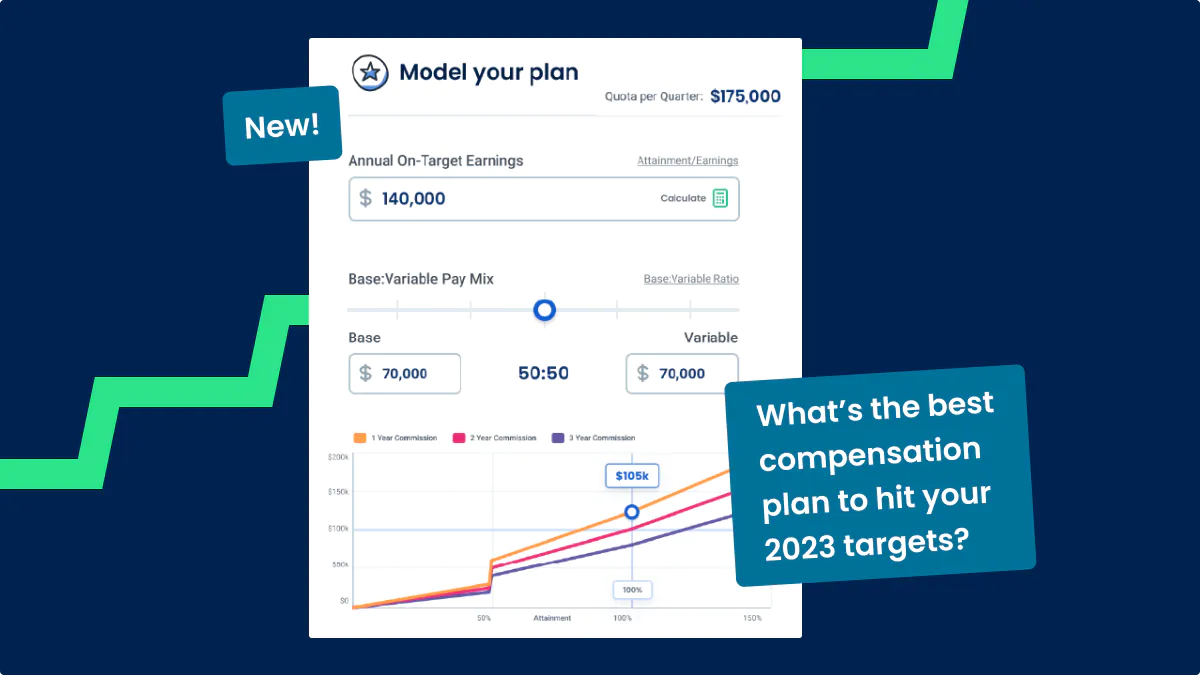
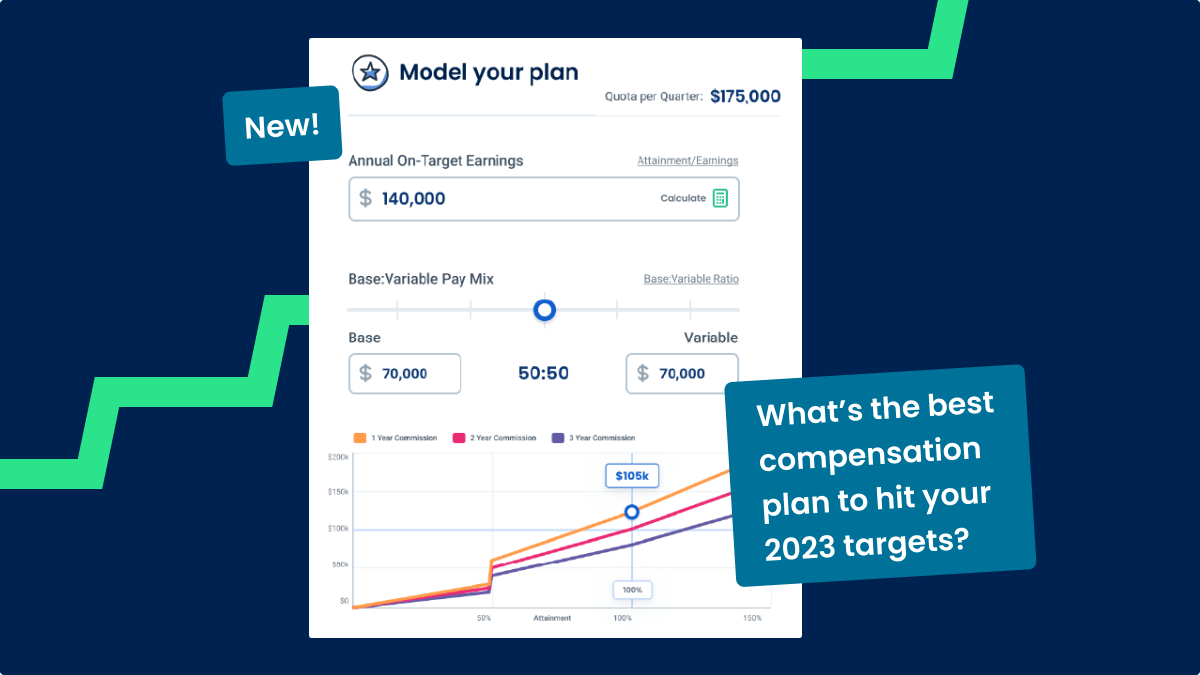
Wondering what the best compensation plan will be to hit your 2023 targets? Trying to model out a plan for your new SDR team? If you have questions about the best compensation plan to meet your evolving business goals, uncover the right solution using Compensation Hub.

“Designing the perfect deal and aligning compensation to that perfect deal can be tricky,” said Pavilion Founder and CEO Sam Jacobs. “When it comes to the startup industry, the market makes it hard. People pay unsustainable rates ignoring the true economics of the business and acting like they have zero churn.”

With Compensation Hub, avoid these pitfalls by customizing and sharing your plans across Sales, RevOps, and Finance leadership.

“If you can find a plan you like, then you can quickly goal search it to your business economics,” said Kevin McKeown, CRO at Beekeeper. “It’s very cool.”

No more guessing what plan might work. 

Instead, use Compensation Hub to run scenarios based on historical or projected data and tailor a plan accordingly. Remove the uncertainties and drive efficiency across the organization to attract and retain talent. Incentivize outputs that spread alignment throughout your business.

And, most importantly, build trust and transparency across your organization. 

How Compensation Hub works

Staying true to QuotaPath, Compensation Hub’s functionality kicks off with the sales reps in mind. When using the modeler, start with your rep’s OTE, then adjust your plan’s key variables to achieve that desired number. 

For example, if you set your OTE to $180K, and your team follows a quarterly quota frequency with an ACV of $30K, your reps should average 5.8 deals per quarter in order to hit their target. That’s according to Compensation Hub.  

After setting variables that get your plan in a good spot, Compensation Hub suggests rules tied to commission and bonus rates. 

For instance, an Account Executive Commission Plan with Accelerators shows a plan featuring a two-tiered commission structure. This includes a 10% rate on all deals won between 0 and 100% attainment. Then a 15% commission rate applies to all deals after hitting quota. 

To estimate how much a rep earns overtime under the given earnings rules, check out the Growth Curve in the top right corner. Get Sales, RevOps, and Finance all on the same page regarding reps’ earning potential under a given plan. 

“One of QuotaPath’s core missions is to create alignment and clarity throughout the entire compensation process and across all departments. This starts with the very first conversations around compensation for a given role,” said QuotaPath Co-Founder and Head of Product Cole Evetts

FAQs

When should I use Compensation Hub?

Anytime you:

  • Question the effectiveness of your existing compensation plans
  • Want to run different variable scenarios 
  • Need a new comp plan (new team, territory, product, segment, etc)

What plan should I start with?

Our favorite answer to this question is “it depends,” which certainly is not the answer you seek. 

But, if you’re building out the first-ever comp plan at your organization, start simple. The Single Rate Commission is a fan-favorite of Women in Sales Leader Lori Richardson, for instance. Or, if you’re looking to push and reward reps for surpassing quota, see Commission Plan with Accelerators

A more complex plan might be in your wheelhouse for sales teams looking to change certain selling behaviors based on historical performance and new business targets. Consider the Single Rate Commission with Contract Term Multiplier if your goal involves securing longer-year contracts. 

Why is sales compensation so hard?

3 ae sample compensation plans

This blog marks the first of four in a series highlighting the challenges and solutions around sales compensation planning and comp plan examples. Our contributors span the sales industry and have experience at the startup, mid-market, and enterprise levels. 

As our Compensation Trends Survey indicated, just 9% of leaders feel confident they have the best sales commission structure in place for their business. 

Reps, too, aren’t feeling the love for sales compensation, citing frustrations over a lack of understanding and lack of motivation when it comes to their plans. Two important components considering that more than 50% of reps put on-target earnings at the top of their list when considering job options, according to our survey. 

But why is it so hard to align reps and leaders? 

Is it the poor habits of sales leaders trying to force a plan that worked at a previous company onto a new team? An oversight to leave out the goals of the individual contributors when considering those of the company? Or, is it the pressure of having to anticipate a team’s performance that comes with no guarantees?

Twist. It’s all three, and then some.

compensation hub resource

Compensation Hub

Discover, compare, and build compensation plans. Customize compensation models using 9 variables.

Find Compensation Plans

As such, leaders fail to recognize the nuances between roles and a disconnect builds between what’s happening on the front line versus what’s happening operationally.

Sales Leader, Advisor, and Coach at Winning By Design, Kevin “KD” Dorsey called that disconnect a “misalignment between people and goals.”

“You have to understand how individuals make decisions when it comes to compensation,” KD said. “The person element in the plan is where the struggle lies. The plan always makes sense in a spreadsheet, but once it hits the people, it breaks.

The ripple effects on your business and people

“Bad plans lead to reps completely outperforming expectations, someone trying to ratchet it back, and more often than not, you end up with salespeople who can’t hit their OTE, resulting in high turnover,” Liz said. 

The latter is especially crippling when sales turnover jumped 39 percent quarter over quarter a year ago over the previous three months and when sales jobs ranked as the second highest in demand role across the world, per a LinkedIn report.

So, how can you approach sales compensation in a way that promotes good selling behavior, rewards competitively, and drives your business goals? 

Liz, Amy, and Kevin shared steps to immediately implement in your comp planning process. We also feature their favorite comp plans below, which you can also check out in Compensation Hub

KD: Make it simple. My comp plans today have three drivers at most. 

Out of the 40 comp plans I’ve built in my career, the worst plan was an absolute dumpster fire. I paid off both revenue and self-generated pipeline, and your close rate. I wanted to pay them to do all the things I asked them to do, which resulted in a super complicated plan.

The second plan I ever made though was actually the best one, and I’ll probably never be able to do it again. It paid on recurring revenue based on quota attainment and it made people think long-term. 

You didn’t make a lot of money right away, but it built up over time. You were always chasing that accelerated rate because if your percentage was 12 points on a million ARR or 12 points on $50K MRR, once you got to 15%, it was a huge hump in pay. 

This plan also made it so I could tell someone where they were capped on OTE based on their churn rate. I could say, ‘You’re never going to make more than $92K in this role unless you improve the types of deals that you’re closing.’

It was so simple, and it worked so well.

Amy: You have to understand the market. 

What does the job require to do the job well? Do you even know what the job or role is? 

Most people make the mistake of assuming and don’t understand it as a result. We absolutely need RevOps and accounting involved in building the plans. It’s an ecosystem and not an us versus them. But if you’re relying on an algorithm that nobody understands, and now I need a legend to figure out how I get paid, that’s not going to bode well for anybody involved. 

 Understand how your buyers buy, what it takes to be successful, how long it takes to build a pipeline, and then start mapping that back.

Start with what is the work within the segment that’s required to do this.

For instance, my background in enterprise sales has some heavy-duty, gnarly, complex multi-threaded global accounts. It takes an average of 12 months at the very least to build a pipeline. If you design a comp plan for a commercial team, and you expect production in three months, that creates a huge disconnect. 

 Understand how your buyers buy, what it takes to be successful, how long it takes to build a pipeline, and then start mapping that back.

compensation hub resource

Compensation Hub

Discover, compare, and build compensation plans. Customize compensation models using 9 variables.

Find Compensation Plans

The beauty of reps is that they are motivated by sales compensation plans. So if you roll out a bad plan, they will find the loopholes.

Lastly, test the changes. Try new models of the comp plan without rolling out one huge adjustment. Test them in a more controlled environment and add gradual changes.

Comp plan examples

We hope you found Amy’s, Liz’s, and KD’s tips helpful. We know we certainly did. But now let’s see their compensation philosophies in action. We asked each leader to pick a successful tiered sales commission structure that they’ve implemented. 

Feel free to borrow their plans but be sure to plug in your business inputs so that it aligns properly. If not a fit, explore a different compensation plan template from the 15 structures in Compensation Hub.

Amy’s most effective plan for Enterprise AEs

One thing to keep in mind when it comes to enterprise compensation plans is that reps typically run the full cycle with the customer. This means that an account manager or customer success rep does not step in once the deal wraps.

The comp plan should match. Enterprise reps should earn commissions when securing the new account, retaining that account, and when expanding the account.

Amy’s plan: Accelerators with Milestone Bonus 

Annual OTE: $320K
Base to variable: $160K | $160K

Liz’s most impactful comp plan for Post-Series A, Series B Companies

Liz primarily supports startup teams who fall between Series A and Series B funding rounds. Although we recommend a Quota:OTE multiplier of 5x, given the stages of the companies she works with, you’ll notice her plan includes a 4x multiplier.

A sales compensation plan like this one provides flexibility to adjust the plan on a more regular basis as sales cycles change while they scale. 

This multi-tier plan includes two rates, a 10% commission rate on all deals before achieving 100% quota, and a bump to 15% after hitting the full target. Her only change would be to add two more tiers, which would add a gradual increase in commission rates as the rep moves toward the goal.

Liz’s plan: Commission with Accelerators

Annual Quota: $750K
Base to variable: $75K | $75K

KD’s “dollar in/dollar out” comp plan

KD’s okay with a decelerator as long as they aren’t super extreme. Unlike a cliff, which doesn’t pay a rep anything until they hit specified attainment, a decelerator pays a percentage. The caveat is that it pays at a lesser rate than the plan’s base rate until the rep hits the attainment level that bumps them to the base rate.

His plan does a great job of eliminating the risk of sandbagging. 

KD’s plan: Commission with Accelerators and Decelerators

Annual OTE: $175,000
Base to variable: $105K | $70K

Want to see more plans from sales leaders throughout the industry? Check back next week for three more

compensation hub resource

Compensation Hub

Discover, compare, and build compensation plans. Customize compensation models using 9 variables.

Find Compensation Plans

Check out our integrations page to see how we fit into your tech stack. To learn more, book a time with a member of our team today. 
Meet QuokaPath’s September Winner: Courtney Billingsley

september quokka winner

Every month, QuotaPath collects nominations from our customers to name a Quokka of the Month. We’re thrilled to announce our QuokkaPath September winner below. To nominate a teammate, see past winners, and learn more about this peer recognition initiative, check out QuokkaPath.

A volunteer at her core, Courtney Billingsley from Virtuous is this month’s Quokka of the Month.

“Courtney is deeply passionate about the work she does and about our customers,” wrote Samantha Lovewell in Courtney’s nomination. “On top of that, she is always willing to support her teammates, lend advice, collaborate, and goes the extra mile for everyone.”

With over a decade of professional experience in the non-profit sector, including time at the ALS Association and Boys & Girls Club, Courtney joined Virtuous two years ago.

The move makes sense when you consider what Virtuous offers, a CRM tailored to nonprofits

“Helping nonprofit organizations increase their generosity and further their mission continues to be a defining achievement of my career as an Account Manager,” Courtney said. “It’s such a rewarding experience to work with them and push their momentum forward.”

In her time there, Courtney has developed an empathetic, curious approach to her role that’s contributed to her success. 

“I work to understand the true customer challenge or opportunity and propose a solution that best services their teams in a user-friendly way,” Courtney said. 

This genuine and attentive style hasn’t gone unnoticed by her coworkers.

“She is truly a wonderful coworker,” Samantha said. 

Likewise, Courtney had nothing but praise for her teammates and credited them for her own development.

“My colleagues continue to provide new insights and encourage me to embody customer service every day,” Courtney said. “They’re helping me achieve these wins!”

More on Courtney, September’s QuokkaPath Winner

Tell us more about your volunteer work.

In this season of life, I’m working to volunteer in ways that can include my kids. This shows them the impact and importance of serving others. 

From making stockings or Easter baskets for children in foster care to volunteering in their schools directly, I love being able to include them in these activities. 

How does Virtuous embed volunteer work into its core mission?

Because Virtuous serves exclusively non-profit organizations, volunteering is a core piece of our company culture. Each month, Virtuos requires us to spend a minimum of two hours volunteering.

Just this month, the entire company came together to volunteer in a variety of ways to continue this commitment. 

What do you hope to accomplish next in your career?

I hope to continue growing in my ability to support my teammates in producing strategies for our customers and supporting each of them in being the best version of themselves!

Lastly, when you’re not at work or volunteering, what else do you enjoy doing?

When not working, I enjoy golfing, reading, and hanging out with my husband and 2 kids. 

About QuokkaPath

Like a flock of smiling quokkas, we’re happiest when our customers excel! 

That’s why we invite our customers to nominate someone from their team who has gone above and beyond. From there, a QuotaPath Quokka Committee selects a winner.

“Quokkas of the Months” earn permanent spots in our Quokka Hall of Fame. Plus, the winners, and those who nominated them, receive quokka-filled swag packs.

Congrats again, Courtney, and thank you for sharing your story!

 Nominate a teammate for October by submitting your nominations here.

About QuotaPath

QuotaPath provides sales compensation and commission tracking solutions for scaling GTM organizations. Pairing an easy-to-use user experience with a highly technical backend, QuotaPath represents the only solution fit for Sales, RevOps, and Finance all on the same page. 

Schedule a time to chat with our team.

5 takeaways from SaaStr 2022

saastr

SaaStr 2022 marked my third attendance at the SaaS community event, and, honestly, it was the best to date.

I went out to San Mateo, CA, with seven QuotaPath team members spanning Sales, Marketing, and Product. Some of those seven attended last year with me and agreed that the depth and quality of conversations far surpassed those of 2021. (Readlast year’s recap here.)

You can check out my full speaking session below with guest Liz Christo of Stage 2 Capital. She and I went through compensation best practices that scale with your teams.

After a full week and many back and forths between San Mateo and San Francisco, here are my key takeaways from SaaStr 2022.

  1. Deeper conversations

We held a lot of wonderful conversations last year with people about QuotaPath, but this year, they went much deeper.

I noticed a vulnerability amongst other founders and leaders we met with and a willingness to share their growth challenges. This I credit to our product being further along. For instance, now that we have a universal API, we can partner with any company and keep the conversation going. 

  1. Executive burnout is for real

Those growth challenges mentioned above segue into my next point about executive burnout. 

The “grow at all cost” model over the past 24 months set forth by venture firms has burned out top execs. I learned from my one-off conversations at SaaStr that a lot of leaders have taken a step back into consulting roles to take a breath and plan their next move.

The reason for their exits typically landed into one of three buckets.

The first — they joined a startup that wasn’t what it was hyped up to be.

The second, they left after their startup did really well, found wealth, and took a step back. 

Or, third, they saw a fledgling company through its end and practiced “quiet quitting” until it wrapped.

While I don’t have a solution in mind at the moment, I do recognize that a mass “reset” of sorts is taking place amongst employees. The start of 2023 should be interesting. 

  1. Increased international presence

I also noticed a lot more international folks in attendance this year than in 2021, which we can chalk up to COVID-19’s presence in 2021. 

Still, it was super interesting to hear how our international industry leaders think about compensation — and especially interesting how they turn to American technologies and media for their source of truth. 

I hadn’t expected that and was surprised to hear how many international companies leverage HubSpot as their CRM. 

  1. There is no better time than now for Compensation Hub

Additionally, we already knew this, but SaaStr re-confirmed the value of QuotaPath’s Oct. 4 launch of Compensation Hub.

Everyone asked us about compensation plan design and how we think about specific scenarios. We also spoke with a lot of founders planning their first sales hires. 

After giving a broad overview of our newest free resource that models sample compensation plans based on customizable business variables, I heard a universal, “Wow that will be amazing.”

They understood the big picture and where we can take Compensation Hub.

  1. Content improvements

We had a great time and held hundreds of meaningful conversations between the eight of us, but I still felt SaaStr 2022 content from the key speakers could improve. 

Product-led growth (PLG) topics remained popular on the presentation front, and I found Mark Roberge’s particularly interesting

But overall, the content was so-so, and I’m over panels.  

I’d love to see more vetted content, especially for the key speakers from larger companies. For panels, I’d love to see a bigger effort to match people up appropriately and find really good speakers.

As for next year, we plan to return. Maybe in 2023, we can run a RevOps event centered on Compensation Hub. 

Lastly, traveling between San Francisco and San Mateo is not fun. 

I made that trip four times last week, and it was terrible. If any founder can find a way to make that commute less painful, I’m interested in learning more.

About QuotaPath

QuotaPath provides sales compensation and commission tracking sales enablement software for scaling GTM organizations. Pairing an easy-to-use user experience with a highly technical backend, QuotaPath is the only solution fit to get Sales, RevOps, and Finance on the same page. 

To see how we fit into your tech stack, check out our integrations page. And, to learn more, book a time with a member of our team today. 

About Compensation Hub – coming Oct. 4!

QuotaPath’s newest (free) resource invites Sales, RevOps, and Finance leaders to discover, compare, customize, and share compensation models. Strike the right balance between pay and performance to successfully align your compensation strategy to your business strategy.

Be the first to know when Compensation Hub launches.

Is your commission check wrong?

commission checks

In the world of sales, it’s common to receive an incorrect commission check. Most times, it’s not done on purpose, but instead, a mistake occurred along the way. The challenge becomes finding out where and when the error happened, who will fix it, and how to avoid the issue in the future. 

The most common commission error stems from the manual entry of commissions in spreadsheets. Compensation changes, non-standardized compensation plans, lack of transparency, and commission payouts taking a backseat to the standard paychecks also lead to more errors. 

We recognize these issues. We’ve experienced them first-hand and understand how errors within the commission tracking process can lead to inconsistencies and ultimately incorrect commission checks. Our software solves inaccuracies by automating and calculating commissions in real time based on the data that’s in your CRM. Automation makes commission tracking more accurate and transparent for everyone involved in the compensation process, reps included. 

Speaking of reps, when compensation mistakes bubble up, it’s, unfortunately, the rep who bears the burden the most. And that burden takes form in an incorrect commission check.

For those not using QuotaPath (yet), we tapped one of our account executives to offer his guidance on how to check if your commission payment is correct. 

Meet Travis Longden.

He’s worked in sales since 2013 and specifically SaaS sales since 2016. He’s experienced a few incorrect commission checks before, but he’s always had a system in place to double-check the numbers. 

Your Guide to Setting, Calculating and Tracking Sales Compensation

Design and execute a compensation strategy that rewards and motivates your reps, aligns to business goals, and drives revenue.

Download the free ebook

Outside of cross-referencing your numbers through a spreadsheet, what other steps have you taken to check the accuracy of your numbers? 

Once that mistake happened the first time, I began auditing my paychecks as well by going back through to identify any errors. Outside of spreadsheets and calculations, there’s no real way to audit anything like that. At my previous employer, we had a couple of other sales tools that would have features as to when deals shipped or counted toward my commissions. But honestly, the tool was so complex that putting the time in didn’t warrant the effort into doing it, unless I knew there was a huge difference in my check. 

When you first joined QuotaPath were you still double-checking your numbers? 

It took about 3 months for me to realize I can trust QuotaPath’s commission tool without having to double-check my numbers every week.

How has QuotaPath helped you understand your commissions compared to past processes?

QuotaPath helped me see real-time capabilities. When I close a deal, I can immediately see how it impacts my numbers. With native integrations that update my deal information directly from the CRM, QuotaPath will accurately reflect the deal data. 

About QuotaPath

QuotaPath helps businesses automate and calculate commissions without error while delivering transparency and consistency to earnings data. The easy-to-use dashboard shows Sales, Finance, and executive team quota attainment, commission goals, and to-date and forecasted annual recurring revenue. To see QuotaPath’s real-time analytics, check us out by booking a demo with our team.

How to calculate commission

how to calculate commissions blog

A commission plan with accelerators, bonuses, and spiffs can motivate positive selling behaviors but only if you can see how close you are to reaching key milestones and thresholds. In the absence of a sales compensation calculator to automate the process, figuring out where you stand can be difficult. This is especially true for a complex commission plan with a math-intensive and code-heavy commission formula in excel that’s tough to run if you’re not a finance professional. The inability to project how much you’ll earn on a given deal, or how much you should anticipate receiving in your upcoming commission check, can leave you feeling frustrated, demotivated, and uninspired.

We’re here to help. In this article, we’ll guide you through the proper steps of how to calculate commission easily and correctly, so you always know where you stand.

Try QuotaPath for free

Try the most collaborative solution to manage, track and payout variable compensation. Calculate commissions and pay your team accurately, and on time.

Start Trial

Getting to know your commission plan

Commission plan definition: a framework used to calculate the amount of money a sales rep earns based on their progress against specific criteria. Compensation plans often consist of base salary, commissions, and bonuses. Different types of commission plans include:

  • Straight commission, also referred to as 100% commission, where pay is entirely based on sales earnings with no base salary or guaranteed pay.
  • Base salary plus commission examples. The base salary plus commission is one of the most common compensation structures. It includes a base salary plus a commission rate.
  • Single rate, also known as flat rate or fixed rate commissions, is the most basic form of sales commission where earnings are calculated based on a set percentage of the value of deals closed.
  •  Multiple rate plans assign different percentages to deals closed based on quota attainment, deal size, or total amount sold during the month or quarter. We also hear this type of plan called accelerators, escalators, tiered commissions, or multipliers.
  • Gross-margin plans take a similar approach as single-rate plans except commissions are calculated based on a percentage of gross revenue collected.
  • Territory volume models are used in team sales situations where a team collaborates to sell into a specific region or vertical. These are single-rate commissions that are split evenly between the territory team members.

    Bonuses are calculated differently than commissions. A commission is a percentage of a revenue number and a bonus is a set amount of money earned for doing a specific action.
  • Milestone bonus is a set amount of money paid for doing a specific task when certain stipulations are met.
  •  Multiple rate bonus varies based on criteria like quota attainment, size of the deal, or length of the contract.
  • Single rate bonus, sometimes called spiffs or incentives, are a set amount of money for completing a specific action and doesn’t change based on the number of times the action is completed.

    Draw against commission reduces the cashflow inconsistencies of a commission-based income by allowing a rep to borrow against future commissions so the money is there when you need it most to pay for basic living expenses. There are two main types of sales commission draw—recoverable draw and non-recoverable draw.

Steps to calculate commission

Here are some basic steps for calculating your commissions.

  1. Determine the commission period. Is it biweekly, monthly, or quarterly?
  2. Calculate the total commission base you made during the period. This equals the value of deals closed during the period or the gross revenue for percentage calculations. If percentages vary by product type, calculate these values for each product type. And if you receive bonuses tally up period totals for each bonus type.
  3. Multiply your commission rate by your commission base. These calculations will vary by plan. See below.
  4. Take variable commission rates into account, if applicable.
  5. Allow for tiered commission rates.
  6. Complete any additional applicable calculations and adjustments like overrides, deductions for returns, and commission splits for shared territories.
Create Compensation Plans with confidence

RevOps, sales leaders, and finance teams use our free tool to ensure reps’ on-target earnings and quotas line up with industry standards. Customize plans with accelerators, bonuses, and more, by adjusting 9 variables.

Build a Comp Plan

How to calculate commission

Below, we laid out examples of commission calculations for the various commission plans discussed above.

Straight commission

James sells cars. He earns 2% commission on all sales. If his total sales for the month comes to $350,000, he is paid $7,000.

Commission Percentage X Total Sales = Commission Amount

0.02 X 350,000 = $7,000

Single rate

A salesperson earns $1,000 per month in salary plus 10% commission. If they sell $25,000 worth of product in a month, they earn $3,500: $1,000 salary plus $2,500 commission.

Single rate commission calculation:

Commission Percentage X $ Amount Sold = Commission Amount

.10 x 25,000 = $2,500

Multiple rate

A sales rep’s base commission is 4% up to $150,000 in sales. The commission increases to 8% for all sales above that amount. If the rep closes $250,000 in sales, they receive

Multi-rate commission calculation:

.04 x 150,000 = 6,000

.08 x (250,000 – 150,000) = .08 x 100,000 = 8,000

6,000 + 8,000 = 14,000 commission for the period

Gross Margin

A salesperson sells an $80,000 car that costs the dealership $50,000, so the gross margin is $30,000. The salesperson earns 8% on the margin or $2,400 in commission.

Gross margin commission calculation:

Total Sale Price – Cost = Gross Margin

Gross Margin X Commission Percentage = Total Commission 

80,000 – 50,000 = 30,000

30,000 X .08 = 2,400

Territory volume

Three reps share a quota of $150,000 per month for sales in the state of Michigan. If one rep closed $60,000, the second closed $50,000, and the third sold $40,000, then the team reached their goal. So, the three reps will evenly divide the 10% commission, receiving $5,000 in earnings each. 

Territory volume commission calculation:

Total Monthly Territory Sales X Commission Percentage = Total Commissions

Total Commissions ÷ Number of Territory Reps = Commissions per Sales Rep

60,000 + 50,000 + 40,000 = 150,000

150,000 X 0.10 = 1,500

15,000 ÷ 3 = 5,000

Milestone bonus

An Account Executive has a monthly quota of $40,000 and when they hit that quota, they get a $3,000 bonus.

Multiple rate bonus

A Sales Manager receives a $1,200 bonus for each deal their team members close for product X and a $2,400 bonus for each deal their team members close for product Y.

Single rate bonus

A Sales Development Representative has a monthly goal of setting 35 meetings and earns a $150 bonus for every meeting that occurs.

Draw against commission

A sales rep’sOn-Target Earnings (OTE) is $5,000 per month in commission. The rep receives a $2,500 per month recoverable draw during their onboarding period. If this rep’s sales only generate $1,500 in commissions their first month, they receive a $1,000, for a total of $2,500 in commissions that month. The company will recover the draw amount during future pay periods when the rep’s commissions exceed the allotted draw amount.

Potential Draw – Earned Commissions = Repayment amount

$2,500 – $1,500 = $1,000

Streamline commissions for your RevOps, Finance, and Sales teams

Design, track, and manage variable incentives with QuotaPath. Give your RevOps, finance, and sales teams transparency into sales compensation.

Talk to Sales

Simplify the process by making your plans less complex

Complex commission plans can be a motivational force when you know where you stand in relation to your goals, quotas, milestones, and bonus targets. The more complicated the compensation plan, the more difficult it becomes to track your commissions and progress throughout a given period. This is especially true if you’re relying on a formula-laden excel spreadsheet.

Looking for an easier way? QuotaPath can automate the entire sales compensation process so reps and leaders can easily track their progress throughout the sales period. Try QuotaPath for free or learn more by booking time with our team today. 

Does your comp plan encourage sandbagging in sales?

what is sandbagging in sales

Ready for this? If there is sandbagging in sales at your company, it’s your fault.
Reps sandbag deals for a reason and oftentimes that reason makes sense based on what you’ve told them to do. Read on to learn when sandbagging deals occur, instances it might actually be appropriate, and how to discourage this behavior from the beginning.

What is sandbagging in sales?

Sandbagging in sales occurs when a salesperson intentionally delays closing a deal to ensure better results in the future. 

Reps might sandbag by delaying sending an agreement for signature, holding off on post-meeting follow-ups, adding unnecessary steps in the closing process (think: NDAs, legal review, or proofs of concepts), or slowly responding to emails from customers and prospects.

Try QuotaPath for free

Try the most collaborative solution to manage, track and payout variable compensation. Calculate commissions and pay your team accurately, and on time.

Start Trial

Why does sandbagging occur?

Salespeople sandbag deals for a couple of reasons, but the two primary reasons are to work the sales commission structure and to showcase consistency.

  1. Commission

    Most commonly, reps sandbag deals because they believe they will earn more in the long run by closing it at a later time. That might be because of a commission cap, an upcoming change to a comp plan, or to hit an accelerator. Whatever the reason, they see more dollar signs when they think about postponing a signature.
  1. Consistency

    Secondly, to appear consistent across quarters, a rep may intentionally schedule a deal into the next one. For instance, say you’re a rep who has already hit their quota for the quarter. You have a vacation coming up next month and don’t want to go away for two weeks without closing a deal. This is a perfect example of when a seller might sandbag a deal after already achieving target. 

Downsides of sandbagging

While reps sandbag to game the system a bit, they put a lot at risk by delaying a deal. The longer the delay — the greater the risk.

A good rule of thumb? Remember that you can’t guarantee a deal until it closes. Even if you feel really good about it, have a verbal confirmation that the customer intends to sign or you’re in the room with the buyer who has a pen in hand, you can’t count it until finalizing the paperwork.

Maybe a competitor comes in at the last minute and undercuts you. Maybe your champion gets laid off.

If you delay the signing of the deal for any reason, you add risk.

Other downsides include unexpected comp plan changes that reduce your sales commission rates or shifts to your territory design.

How to prevent sandbagging in sales

So, how can you prevent sandbagging in sales from happening? There is no tried and true way to avoid it, but there are three ways to reduce the likelihood.

  1. Compensation plan

    Start by looking at your sales compensation. If you have very generous accelerators or very punitive decelerators, your reps are more likely to sandbag deals in order to maximize their earnings. To head off sandbagging, remove decelerators (and cliffs) or make the accelerators less enticing. You can also create a rule around year-to-date performance. This ensures a rep won’t miss quota two quarters in a row followed by a quarter 300% over goal. Also, remove your commission cap
  1. Sales training and coaching

    Create a culture where it is unacceptable to even hint at sandbagging deals. If your team focuses on winning deals as quickly as possible, then the results will follow. Weekly deal reviews with solid next steps – and accountability – go a long way.
  1. Process

    Lastly, lean on technology. Technology can help prevent sandbagging. You should have notes for each deal if you record your sales calls. If that’s the case, it makes it harder for a rep to fudge the details of what a customer said because you’ll have full visibility into these calls. 

Remember, the goal isn’t to entirely eliminate sandbagging by these methods. Rather, it’s to reduce the incentive so reps don’t think it’s worth it. 

Upsides of sandbagging

Okay, this is the part where I might ruffle some feathers. I had a boss once tell me, “If I ever catch you sandbagging a deal, I’ll fire you on the spot.” But, as you’ll see in the examples below, sometimes there are advantages for reps to sandbag deals

But what about the company? 

The biggest argument I’ve seen from a leadership lens in favor of sandbagging goes back to establishing consistency over time. Some sales teams have “lumpy” results, meaning they have quarters where they hit 200% of quota and some quarters where they hit 40% of quota. 

A sales leader might think to themselves, “I wish they would just hit 100% every quarter instead!” 

However, sandbagging is not the way to accomplish that. 

Instead, build your sales comp to discourage lumpiness. Are the accelerators too aggressive? If so, you might be encouraging overperformance at the expense of the following quarters. Do you have a commission floor? If so, maybe sandbagging is actually your issue, not the solution.

Create Compensation Plans with confidence

RevOps, sales leaders, and finance teams use our free tool to ensure reps’ on-target earnings and quotas line up with industry standards. Customize plans with accelerators, bonuses, and more, by adjusting 9 variables.

Build a Comp Plan

Examples of sandbagging

Below, I’ve outlined a few examples of sandbagging. If you’re a leader in sales, these should sound familiar.

Account Executive sandbagging in sales example:

Jennifer is an Account Executive at a high-growth SaaS startup called Naturize. Naturize sells software to help its customers encourage employees to go on more hikes for their mental health. Naturize’s compensation plan pays Jennifer 10% of every deal she sells. She also earns a Milestone Bonus, a flat $2,000 bonus, if she hits 100% of her monthly quota. She had a great January, already at 120% of quota, and has collected her Milestone Bonus.

February, however, isn’t looking so hot. Her pipeline dried up a bit, but she continues to work a deal through legal that she could close in January if she pushes her legal department.

It’s worth about 75% of her quota. If she closes it in January, she pretty much guarantees to miss her February quota (and therefore her February Milestone Bonus). On January 25, she decides she’ll sandbag this deal, and… what do you know! It closes on February 3 and she’s able to easily come up with the rest of her quota to earn her Milestone Bonus. 

SDR sandbagging example: 

Davis is an SDR at a B2B SaaS company called Alttitude. Alttitude is a tool that automates checklists for companies. It’s Davis’s job to schedule demos for Account Executives, and they get paid $100 for each demo that occurs. However, there is a quota of 20 demos per month. For every demo after the 20 target, Davis earns a reduced rate of $10 per demo. It’s late in April and Davis has enough demos scheduled to hit quota. 

Davis secures a hot lead on the phone who says this tool sounds perfect. Now they have to decide on whether or not to sandbag this demo to next month. If they book it for this month, they’ll only earn $10. If they schedule it for next month, $100 in their pocket. They sandbag the demo to next month by claiming the AE’s schedule is “just too busy this week”. 

Account Manager sandbagging example: 

Justin is an Account Manager at a company called Mixxter that sells high-tech bakery equipment. Mixxter sells hardware but makes most of its income off the software that runs the hardware. It’s his job to maintain customer relationships and also upsell bakeries when they need more hardware or additional software. He gets paid 10% of any upsells he closes each quarter. However, Mixxter doesn’t want Justin spending all his time on upsells, thereby forgetting about contract renewals. So Mixxter’s CFO puts in a commission cap for upsells. Once Justin hits $100k in upsells each quarter, he is no longer eligible for commission on further upsells. 

Well, one day a small bakery comes to him and says they acquired a competitor and are expanding to 10 more locations. He is excited about this upsell opportunity until he remembers he’s already approaching that commission cap and he’s only halfway through the quarter. 

So, he tells the customer that it would be better to slowly expand their account over the next 6 months rather than all at once. The customer initially agrees, but when he calls them on the first day of the next quarter, they have actually signed a deal with Divimixon, Mixxter’s biggest competitor. The upsell vanished and in its place, churn appeared. 

To sandbag or not to sandbag

See the dilemma? Sometimes it absolutely makes sense to sandbag from the rep’s perspective if a company writes a comp plan that indirectly encourages it.

Unsure if your comp plan promotes sandbagging? Let’s chat.

Streamline commissions for your RevOps, Finance, and Sales teams

Design, track, and manage variable incentives with QuotaPath. Give your RevOps, finance, and sales teams transparency into sales compensation.

Talk to Sales

About QuotaPath

QuotaPath’s sales commission software pairs an easy-to-use experience with a highly technical backend. That’s why so many teams use us to get Sales, RevOps, and Finance all on the same page when it comes to sales compensation.

To see how we fit into your tech stack, check out our integrations page. And, to learn more, book a time with a member of our team today.

A call for pricing transparency

pricing transparency

QuotaPath CEO and Co-Founder AJ Bruno authored this blog on SaaS pricing transparency.

Almost all the information we need today we can access at our fingertips.

In SaaS, that means buyers have grown more sophisticated over the past several years. So much so, that we can now buy and sell cars, homes, and even commercial real estate entirely online.

As the shift to shopping for major investments online has intensified, buyers have gotten smarter too. 

Modern shoppers know how to educate themselves, and they know what they’re looking for and how to get the information they need. Whether it’s via Google search, posing a question in a community forum, or seeing what their friend at a different company uses, people know how to shop. And, in most cases, the buyer doesn’t even need the help of a salesperson until they feel fully prepared to buy.  

Still, despite so much of the sales process depending on the shopper’s online research, one B2B trend continues to loom that disrupts this self-buying journey. 

A pricing page absent of pricing. 

Non-transparent pricing in a transparent buyers era

We all know the feeling of exploring a product only to have trouble locating the actual cost. Just imagine if gated pricing came up in our day-to-day lives as much as it does in SaaS.

After days dedicated to scouring the internet for the perfect lawn mower, you finally found the one.

The only thing you don’t know is how much it costs. And, guess what? The path to find pricing is convoluted and filled with pitstops.

So you set off on a pricing expedition.

You may initially do some “sleuthing” that will lead you to the dark recesses of the internet, but alas, it seems that companies try their best to scrub this data. So, your second stop: a call with the business development representative, who has never actually used this lawn mower. Better yet, they have never mowed a lawn.

They ask you several questions to measure how likely you are to buy, despite your hours of research leading into the call. 

The call concludes. Congratulations, they’ve deemed you a qualified buyer! 

But sorry, to get the price, you’ll have to speak to a more senior lawn expert. On to your next stop. 

After walking you through how the lawn mower works and why it’s better than the other lawn mowers, you finally arrive at pricing. The twist — it’s a number much larger than you anticipated. The rep hears the shock in your voice. You tell him this falls outside of your budget and comes in much higher than other similar lawnmowers.

“We’re willing to work with you,” he says before quoting a price much lower.

You take some time to think about it but leave the call confused. Why was it so hard to get pricing? Why did the company instantly offer a lower price? Is that the true price of the product or were they overquoting me in hopes that I would be willing to pay? 

Am I being played here?

We’d all lose our minds if this is the process we endured regularly. 

It’s not a great experience. It dampens the customer journey and ultimately the sales cycle. 

We have to move away from gated pricing and allow people interested in our products to “qualify” themselves. I use qualify loosely because the interest in your product should be enough. If someone spent enough time exploring your product on your website, or through another avenue and landed on your pricing page, that’s intent to buy.  

Clear buying decision needs to be in the product and ultimately your website.

Moreso, your website represents your number one marketing tool. Whether a visitor browses or actively explores your solution, they’re engaging with your best marketing asset. Your website should answer almost all the questions a buyer might have, especially pricing.

If you don’t want your competitors to see, or you think you need to prove the value of your product before sticker shock, re-think leaving your pricing offline.

Customer-centric and product-centric organizations provide pricing visibility. For those who don’t, I question your customer- and product-centricity. 

Sales Compensation Calculator

Calculate OTEs, sales quotas, and commission rates to design your sales compensation plans.

Try for Free

QuotaPath’s pricing transparency

QuotaPath provides sales compensation and commission tracking for scaling GTM organizations. Pairing an easy-to-use user experience with a highly technical backend, QuotaPath is the only solution fit to get Sales, RevOps, and Finance all on the same page.

To see how we fit into your tech stack, check out our integrations page. And, to learn more, book a time with a member of our team today. Want to know our price? Check out our pricing page, complete with prices.

Logo commissions: what they are and how to comp them

logo commissions blog

Sales incentive compensation often features multiple avenues for reps to earn variable pay, such as bonuses on logo commissions or multi-tier commission structures like accelerators.

We like to refer to these rules as “paths,” or the different ways a rep can earn sales compensation within a comp plan. 

Some other paths might include milestone bonuses, accelerators with cliffs, single-rate bonuses, or any combination of the three, but this blog focuses on logo commissions.

Designing compensation plans? Here’s what you need to know about logo commissions.

Free Sales Commission Calculator Template

A free spreadsheet to simplify the commission tracking process. Track what you or your team have earned in 4 inputs.

Download Now

What are logo commissions?

First, let’s clarify.

This article will not explore how to commission a graphic designer to draw up your business logo. If that’s why you’re here, this blog will only bring disappointment. For that info, kindly redirect here and come back when you need to automate sales commission tracking. Thanks for stopping by.

Still here? Great!

In software sales commissions, revenue leaders sometimes reward higher payouts on deals based on logos.

For instance, if the organization aims to close the top 15 logos of a specific industry, the comp structure will reflect higher commissions or bonuses accordingly.

One step further, let’s say we’re an HR rewards platform and we’re targeting the real estate tech industry. Our base salary plus commission structure pays a flat 12% commission rate for deals that include enterprise-defined reality tech firms, like Zumper, OpenDoor, and Zillow. This rate comes in marginally larger than the standard commission rate of 8% on all other deals under this comp plan. 

This technique acts as a great way to motivate reps to go after those jewel accounts and works synchronously with account-based marketing (ABM) campaigns.

However, if reps focus too much of their attention solely on prospects that fall under logo commission guidelines, they may miss out on deals with other ideal customer profiles (ICP). 

So, while we suggest logo incentives, we recommend not making it the main driver of your comp plan. 

Logo commissions as a SPIF

Instead of carving out and reserving space for logo commissions with your comp plan (remember, less is more), some teams insert logo-based payouts as a SPIF. A SPIF represents a short-term mechanic of the overall comp plan. Leaders typically implement these on an ad-hoc basis throughout the year. 

Logo SPIFs might include customers won from a competitive takeaway or a larger customer from a specific industry. The latter can create credibility for your organization, like the example above. Sometimes, sales teams will pay a SPIF to lock in a lighthouse customer in a new market, territory, or country. 

TIP: If you’re considering adding logo commissions to your pay structure, test it as a SPIF beforehand to see how it impacts your outcomes. If it doesn’t alter selling behaviors, then no need to add it to your plan. 

Calculate OTE:Quota ratios

Use this free calculator to ensure your reps’ on-target earnings and quotas mirror what they’re bringing in for the business.

Try it Now

Logo commission pay examples

Next up: examples!

The most important piece to remember, and in comp planning, is to clearly define the rules around how the rep earns the extra payout. This will ensure everyone understands sales reps commissions.

Below, we’ve listed some examples that include strict guidelines.

Example 1: For signed customers with employee counts above 200, the rep takes home a single-rate bonus of $500.

Example 2: The rep earns a flat $1,000 bonus for signing up any companies between 200 and 1,000 employees.

Example 3: The rep collects $2,000 on every deal for companies with 1000-plus employees.

Or, perhaps a company pays a logo bonus based on contract value. 

Example 4: For any contract value more than $5,000, the rep receives a single-rate bonus of $500.

Example 5: Reps earn $1,000 on any contract valued between $5,000 and $10,000.

Example 6: For any deal larger than $10,000, the rep collects a $2,000 bonus

Tracking logo commissions in QuotaPath

Historically, Sales and Finance have manually tracked logo commissions under their own system — reps, too. Who else do you think is Googling “how to calculate commission?” 

No need, my friends. QuotaPath exists so that all you have to do is add the SPIF into the platform. We’ll take it from there and automatically track it. Or, team up with us to design your comp plan with logo bonuses with our guidance. We’ll ensure it maps correctly in the system.

You can read about our customerPrefect’s experience with the platform. Prefect specifically runs “logo bounties,” which counts as the second big driver of their comp plan. Instead of a percentage, Prefect’s team earns a flat-rate bonus based on deal size.

“It sounds like a SPIF, but it’s part of the comp plan on a recurring basis,” Prefect Head of Finance Thomas Egbert said. 

Want to learn more? Book a time with us today to see if we’re a match.