How to Track Split Commissions Between Sales Reps

splitting commissions

Split commissions have become increasingly common when multiple reps work together to close the same deal. SDRs, AEs, AMs, overlay roles, and channel partners collaborate across various stages of the sales process to secure business. Although collaborative selling increases close rates, shortens sales cycles, drives product-led growth, and improves customer satisfaction, it can create conflicts over shared quota credit and fair compensation.

Without proper systems, tracking who gets what share becomes complex and prone to disputes. Spreadsheets, manual calculations, and unclear payout rules often lead to errors, delays, and frustration for both reps and finance teams.

In this blog, we’ll share best practices for effectively managing and tracking split commissions between sales reps, how to avoid common pitfalls, and why QuotaPath is the best solution.

Streamline commissions for your RevOps, Finance, and Sales teams

Design, track, and manage variable incentives with QuotaPath. Give your RevOps, finance, and sales teams transparency into sales compensation.

Talk to Sales

Tracking Split Commissions

When multiple people contribute to closing a deal, defining who earns what portion of the payout becomes essential to maintaining trust and motivation.

Shared commission structures explained

A shared commission structure, also known as a split commission, occurs when two or more reps share credit and payout for the same deal. Instead of one seller receiving the full commission, the total earnings are divided based on each person’s role or contribution.

Shared commissions are common in collaborative sales motions such as co-selling, SDR-sourced and AE-closed deals, account manager and AE partnerships, or territory handoffs between reps. These structures ensure everyone who helps advance or close business receives fair recognition for their impact.

When designed well, shared commissions encourage teamwork, transparency, and fairness across the revenue organization. However, when tracked manually, such as in spreadsheets, split commissions can create disputes, confusion, or shadow accounting as reps attempt to verify their own numbers. That’s why clear rules and automated tracking systems are crucial for accurately managing deal splits and keeping teams aligned.
How to Set Up Split Commissions the Right Way

Follow these three steps to create a clearly defined and accurately tracked shared incentive program with confidence.

Step 1: Decide How Credit Is Split

Start by determining credit allocation among contributors. Popular options for deal splits include percent-based splits and fixed-dollar splits. A percent-based split awards each rep a designated percentage of the total commission. By contrast, a fixed-dollar model rewards each participant with a set amount regardless of the deal’s value.

After deciding how to split the commission, designate who receives the primary or assist credit. Primary credit usually goes to the rep who closes the deal, while assist credit recognizes supporting roles. Finally, determine how the split affects quota retirement by specifying the amount of quota credit each participant will receive. Aligning payout logic and quota credit ensures accurate performance tracking and reinforces fairness across the sales team.

Step 2: Set Eligibility and Timing (Bookings vs. Cash)

Establishing commission payout rules tied to the deal stage and cash collection is crucial when setting up split commissions. Tying shared commissions to the deal stage clearly defines what each team member must do to qualify for their portion of the incentive pay. Rules based on cash collection determine when commission is paid, either when the deal is closed or when a cash payment is received. Clearly defining these rules prevents confusion and disputes while building trust.

Step 3: Capture Splits in Your Plan, Not in Spreadsheets

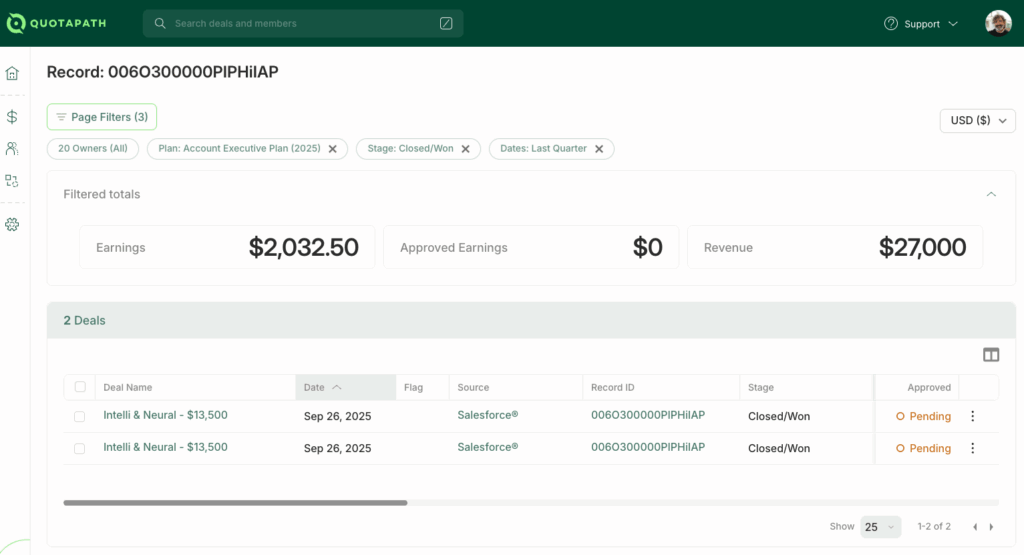
Using spreadsheets as a commission tracker can lead to errors due to manual data entry, incorrect formulas, and increasingly complex plans. This leads to mistrust when numbers don’t align. Avoid these issues by automating split commission tracking with an incentive compensation management platform like QuotaPath. QuotaPath supports deal splits in complex plans, ensuring every contributor’s share is accurate, transparent, and automatically updated.

Tracking Splits in QuotaPath (from CRM to payout)

QuotaPath makes it easy to track split commissions between sales reps by connecting every step of the process, from deal data to payout approvals, in one transparent workflow. Instead of managing multiple spreadsheets or systems, teams can view, calculate, and verify earnings in real time, ensuring accuracy and alignment across Sales, RevOps, and Finance.

Sync Deals from Salesforce or HubSpot Instantly

QuotaPath connects directly to Salesforce or HubSpot, pulling in deal data, like closed-won amounts, owner details, and contract terms, without the need for manual uploads or spreadsheets. With accurate CRM data and split ownership fields, teams can trust that the right numbers flow seamlessly into sales commission calculations, ensuring current earnings and accurate payouts.

Model and Automate Deal Splits in the Plan Builder

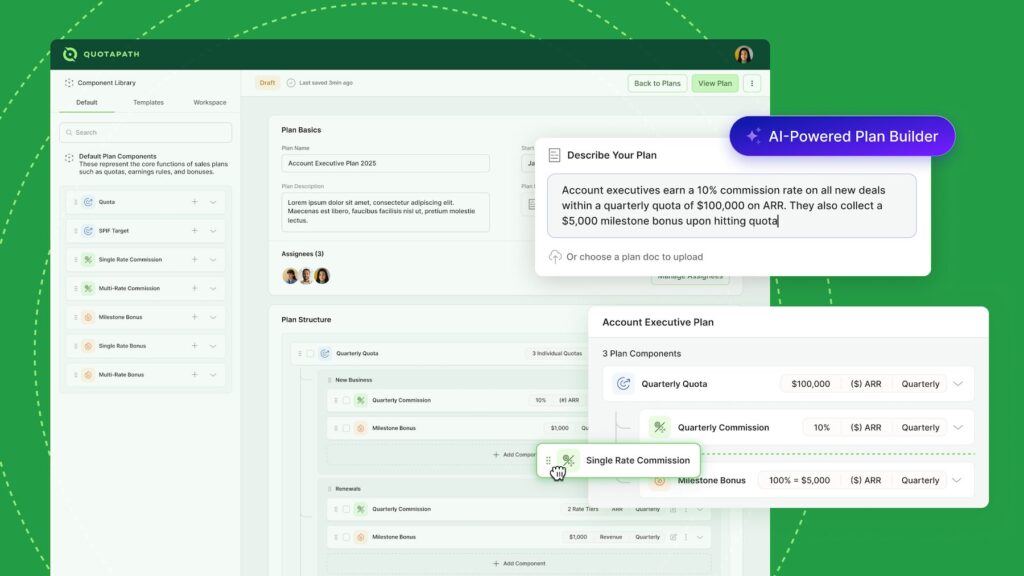
QuotaPath’s AI-powered plan builder streamlines the creation and automation of compensation plans that include deal splits. You can quickly and easily model variants in Plan Builder to visualize the plan before plan rollout, ensuring accuracy. Drag and drop components to build or modify plan structures, model deal split scenarios, and instantly preview how changes affect payouts. Testing these variants before rollout ensures accuracy and saves time.

Approve, Audit, and Schedule Payouts with Confidence

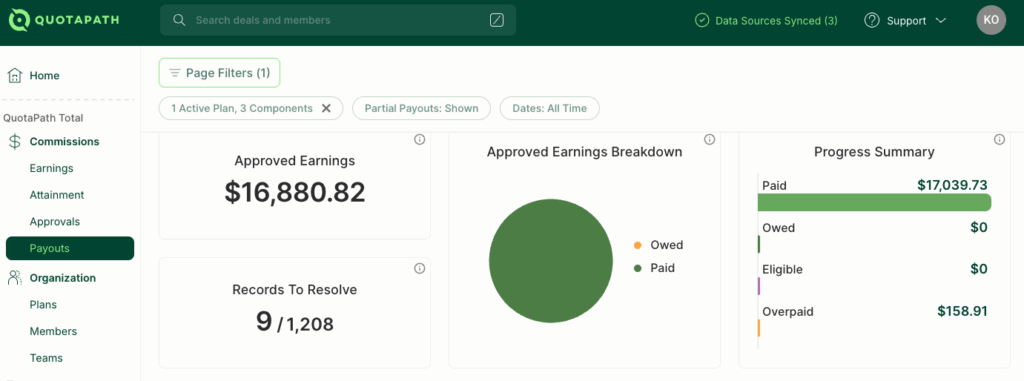
QuotaPath’s customizable approval workflows ensure accuracy and transparency at every step. Managers and reps can review earnings for accuracy before payouts are scheduled, preventing disputes, saving time, and building trust.
avoid commission errors
Resolve commission disputes in-app

Avoid Errors and Disputes on Split Commissions

Follow these best practices to maintain transparency, prevent disputes, and protect audit trails across split payouts.

One source of truth with deal breakdowns

Sales dashboards in QuotaPath provide transparent deal views, allowing each rep to see how and why they earned commissions, reducing misunderstandings while boosting trust and motivation.

Resolve disputes fast with in-app tools

In-app communication tools, such as QuotaPath’s Deal Flagging, enable reps to raise potential issues directly within the platform, creating a clear record for quick dispute resolution and preserving rep confidence.

Lock past periods to protect audit trails

Freeze finalized payout periods to preserve accurate records and maintain audit trails across split payouts. Locking past periods prevents retroactive changes, ensuring that historical earnings remain consistent with approved deals and protecting data integrity for audits and compliance purposes.

Closing the Loop on Split Commissions

With automation, it’s easy to finalize and send commissions to payroll confidently.

Finalize approval with confidence

Confidently finalize payout approvals in QuotaPath, knowing every deal, split, and calculation has been validated throughout the workflow. Transparent review and approval processes ensure commissions are accurate, compliant, and ready for processing.

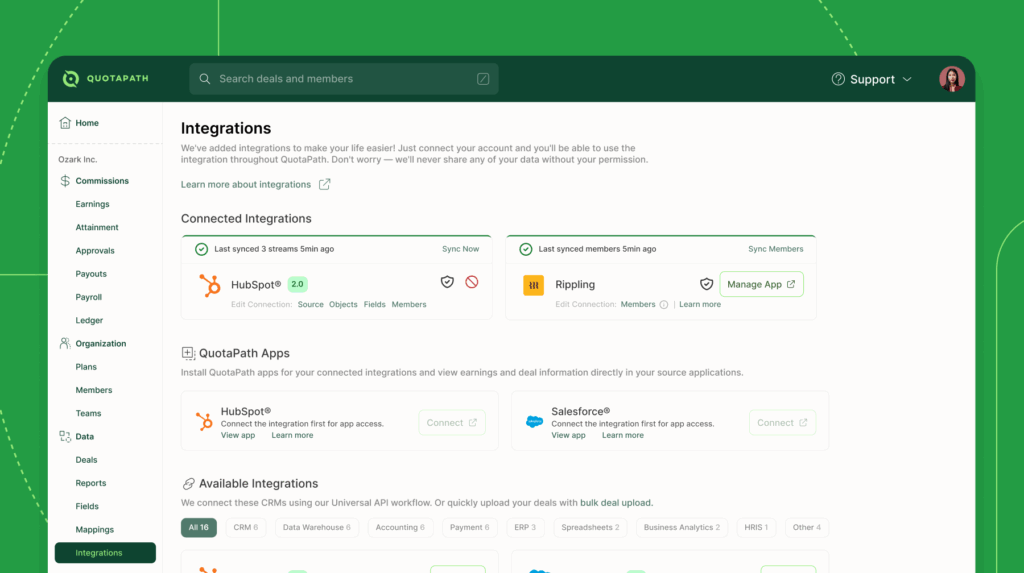
Push commissions straight to payroll with Rippling integration

Once commissions are approved, send them directly to payroll in just a few clicks with QuotaPath’s Rippling integration—no spreadsheets or manual reformatting required.

Why QuotaPath for Split Commissions

QuotaPath makes it easy to track split commissions between sales reps. With transparency at every step and compensation automation, plus seamless CRM and payroll integrations, QuotaPath eliminates manual errors and confusion from tracking shared commission structures. The result is faster, more accurate payouts, higher trust across teams, and motivated reps who understand their earnings calculations.

Ready to simplify split commissions? Try QuotaPath’s automated deal split tracking. Book a demo today.


How to Test Your Comp Plan

test comp plans

Before rolling out any new plan, it’s essential to test it first. Otherwise, you risk overpayment, underpayment, or demotivating reps. QuotaPath’s 2024 Sales Compensation Plan Report showed that 65% of companies have had at least one rep quit over compensation discrepancies in the last two years.

Even small miscalculations can have outsized impacts. Overpayments can impact budgets, while underpayments can erode trust and morale, especially when payouts fall short of expectations. A plan that looks good on paper can quickly backfire in practice if it hasn’t been tested against real performance data.

Testing prevents surprises and builds trust between Finance and Sales. It ensures everyone can move forward with confidence, knowing payouts are accurate, goals are attainable, and the plan will perform as intended once it goes live.

Below, we’ll discuss:

  • How testing prevents costly surprises by catching over/underpayments early and ensuring reps trust the accuracy and fairness of payouts.
  • Using Draft Mode and modeling in QuotaPath to let teams safely simulate plan performance using real CRM data to identify edge cases, validate assumptions, and stress-test sustainability.
  • Pressure testing with realistic scenarios, like sensitivity analysis, past data overlays, and scenario planning, reveals misalignments before plans go live.
  • How validated plans build confidence, reducing disputes, motivating reps, and giving Finance and Sales alignment on budget impact before rollout.
test comp plans with quotapath's draft plans
Draft Mode in QuotaPath

Testing Prevents Costly Surprises

The fastest way a comp plan can go off the rails is through untested assumptions.

Even one misaligned rate, missing threshold, or incorrectly stacked incentive can swing payouts far beyond what Finance intended, or far below what reps expect. These discrepancies aren’t just numbers on a spreadsheet; they translate directly into budget strain, lost trust, and, in many cases, employee churn. When the math doesn’t match the message, reps lose confidence not only in the plan but in the process behind it.

Testing early protects against surprises by revealing how a plan behaves in real conditions, not just in theoretical models. By previewing payouts using historic data and realistic performance scenarios, leaders can identify where compensation outcomes deviate from expectations. This prevents overpayment, which can quietly balloon commission expenses, and underpayment, which erodes morale and credibility. When teams validate the details before rollout, they avoid last-minute fire drills and tense conversations with reps.

A well-tested plan also strengthens the relationship between Finance and Sales.

Instead of debating numbers after the fact, both teams can evaluate a shared view of modeled results before the plan goes live. This transparency fosters alignment, ensures the plan reflects both budget realities and sales incentives, and gives every stakeholder, from executives to reps, confidence that the payout structure is accurate, intentional, and fair.

Start with Draft Mode and Modeling in QuotaPath

So, how do you test?

The safest way to test a comp plan is to test a new plan against previous data.

In QuotaPath, for example, you build a plan in draft mode, which allows leaders to design and test compensation plans in-app before rolling them out. Think of it as a safe sandbox where you can run plan proposals against current CRM data to estimate the team’s total commissions, identify potential edge cases, and assess how achievable your goals are.

Our customers actually requested the commission plan draft mode feature, and our product team responded by building it.

“Really early on, we provided feedback about wanting to mock up a plan and run scenarios without using the production environment. During our time as customers, QuotaPath built and released Draft Plans. We’ve used it for at least one year of commission planning,” said Genevieve Moss-Hawkins, Systems Operations Manager at NeuroFlow.

Once a plan is set up in Draft Mode, QuotaPath’s compensation modeling tools make it easy to simulate performance scenarios.

For instance, running last year’s sales data against a new plan to spot misalignments or layering in a multi-year accelerator or SPIF to see the impact on compensation costs. Modeling a comp plan shows whether payouts are sustainable if reps outperform, helping Finance and Sales validate plan assumptions and confidently move forward.

Pressure Test with Realistic Scenarios

Once you’ve built a plan in draft mode, the next step is to pressure test it. Check out these Finance Leader-approved best practices to test your comp plan.

  • Run sensitivity analysis: Test individual components, such as quota to OTE, actual commission rates, and SPIFs.
  • Overlay on past data: Apply last year’s results to this year’s plan to see how it would pay someone under the proposed plan.
  • Check bottom-line impact: Start with total commission expense, then work backward.
  • Scenario planning: Model outcomes to see what happens if reps hit 100%, 120%, or higher.
  • Catch overlaps: Ensure bonuses, accelerators, and multipliers don’t stack in unintended ways.

Validate with Past Data

Another effective method is to stress test your plan against past performance. Overlaying last year’s sales data to see how payouts would differ helps confirm that the proposed plan won’t break the budget.

This helps Finance and Sales align faster by comparing modeling versus actual results, identifying and mitigating risks. QuotaPath facilitates this with in-app plan modeling and reporting, eliminating the need for multiple spreadsheets and saving time while increasing accuracy.

Build Confidence Before Rollout

After testing your plan, you’ll have data-backed confidence to roll it out. Testing is not just beneficial for Finance, but also for building rep trust. In fact, testing a plan reduces disputes and motivates reps because payouts feel fair. So, leaders should iterate and retest regularly, not just annually, to keep comp plans aligned with changing conditions.

“I made the pitch to [sales leadership. ‘Hey, look we have these incentive plans, there’s no visibility for the reps on how their pipeline translates to earnings…’ I loved that you could model out the pipeline. because I wanted reps to be able to really see how their pipeline could translate into earnings,” said Thomas Egbert, Head of Finance at Prefect.

Try QuotaPath for free

Try the most collaborative solution to manage, track and payout variable compensation. Calculate commissions and pay your team accurately, and on time.

Start Trial

Next Steps: Test Your Plan in QuotaPath

Ready to see how your comp plan performs under pressure? Look no further if you’re wondering how to test your comp plan. QuotaPath simplifies comp plan modeling and sales commission testing. Start with QuotaPath’s Compensation Hub and AI-powered plan builder. Then, leverage in-app tools to test, model, and refine plans in minutes.

See for yourself. Sign up for a free trial or schedule a demo today.

Immediate ROI: How HydroCorp Transformed Commissions with QuotaPath

quotapath customer success story

An estimated 88% of spreadsheets contain errors, which increases the likelihood of paying reps incorrectly, particularly in thriving companies. The reality for many RevOps and Finance teams includes growing headcount, multiple compensation plans, and error-prone manual processes. HydroCorp is a real-world example of this challenge. Read on to see how they essentially paid for QuotaPath in one month by catching the commission errors that they had made previously.

Streamline commissions for your RevOps, Finance, and Sales teams

Design, track, and manage variable incentives with QuotaPath. Give your RevOps, finance, and sales teams transparency into sales compensation.

Talk to Sales


The Breaking Point: When Spreadsheets Couldn’t Keep Up

David Taub is the Senior Director of Revenue Operations at HydroCorp. As their RevOps lead, David is responsible for the entire commission process. HydroCorp doubled in headcount after receiving private equity funding, growing to 15 team members in a matter of months.

At the time, one staff accountant was managing compensation with manual spreadsheets. It took her three to five days to process commissions that contained a fair number of mistakes, resulting in frequent over- or underpayments. Consequently, David quickly recognized their existing process was unsustainable, making it easy for David to put together a business case for a commission tool.

Why HydroCorp Chose QuotaPath

David heard QuotaPath repeatedly recommended in his RevOps communities. After completing his due diligence, he chose QuotaPath based on community word of mouth, price, and ease of use.

Contributing to David’s selection was his ability to test QuotaPath with a free trial, allowing him to “play around with the system and see how it worked”. Other key considerations were the ease of building comp plans compared to legacy players that were more “formulaic,” the white-glove onboarding with lots of support, and continuity with one CSM.

Try QuotaPath for free

Try the most collaborative solution to manage, track and payout variable compensation. Calculate commissions and pay your team accurately, and on time.

Start Trial

One Month to ROI

When HydroCorp started with QuotaPath, David rebuilt the past year’s plans to confirm accuracy, revealing costly errors. As David explained, “I took all the data from the 2023 comp plan that was tracked in Excel, built it into QuotaPath, and it caught a lot of mistakes.”

“We essentially paid for QuotaPath in one month!” For HydroCorp, the ROI of QuotaPath came from the platform catching overpayments and ensuring accuracy.

roi calculator quotapath

ROI Calculator

Calculate the potential return on investment for implementing QuotaPath in your organization.

Use Calculator

Time Back and Transparency Forward

Not only did HydroCorp achieve a rapid ROI, but David also regained time and improved transparency across the entire team.

  • From 3–5 days to just a couple of hours.
  • QuotaPath as the single source of truth.
  • Reps gained visibility into earnings and forecasting.
    •   Example: David said his SDRs now track the eligibility of deals and meetings.
  • Reduced back-and-forth between Sales and Finance.

“What used to probably take me three to five days and a whole lot of back and forth…takes a couple hours,” David said. “It essentially…is the source of truth. I now run everything through QuotaPath…There’s full visibility for everything.”

Adoption Wins: Reps and Finance Aligned

Adoption delivered various perks. 

“Every time I show it to them, they get re-surprised to see information in there,” said David.

Power users love the pipeline forecasting, leaderboards, and visibility that QuotaPath gives them. It enables them to routinely track deals and meetings, confirming they’re getting paid according to their incentive plan. In fact, one HydroCorp seller told David that at a past company, the compensation system was so unreliable that they actually quit. With QuotaPath, that same rep now has complete visibility and confidence in their earnings.

Support & Partnership: “Continuity Has Been Great”

Implementation and ongoing support have been consistently available, addressing questions and providing guidance on effective use of QuotaPath. David has had one dedicated CSM, with whom he meets weekly and has quarterly check-ins. She always responds promptly to his emails when he has questions. In fact, David’s CSM recorded a 30-minute presentation for new reps, which shows them how to forecast deals, pull information, and view QuotaPath as a rep.

David described his seamless support experience by saying, “My implementation person is my CSM is my account manager.”

Scaling with Confidence

Once implementation was complete, David and the HydroCorp team were able to scale more efficiently. They’ve grown from 2 sellers to 23 QuotaPath users. Every time David adds a new user, he enters them in the system, sends them plan documents to sign, and orients them to QuotaPath, giving them the option to poke around and reach out with questions. As David said, “It’s really easy to get started.”

This simplicity, combined with flexible integration, enables HydroCorp to scale with confidence, with a single source of truth for Salesforce, Intacct, CRM, and ERP data. After all, “The whole reason we bought a platform was because we’re scaling,” said David.

HydroCorp’s Takeaway

Ultimately, David describes QuotaPath by saying, “Big product, small company. Product value is off the charts compared to legacy players,” and as a “mid-market sweet spot.” HydroCorp achieved ROI in 1 month after implementing QuotaPath. They are benefiting from the platform’s scalability and transparency, finding it easy to add new users and keep everyone on the same page as they grow.

See how QuotaPath can help you scale commissions with transparency and accuracy. Request a demo today.

How to Simplify Complex Compensation Logic with Rate Formulas

formulas

If your compensation plan uses stacking multipliers, attainment-based commission rates, or dynamic rates based on contract length, first, know that you’re not alone.

These structures drive performance but can get complicated fast when built using traditional comp tools.

That’s why we launched Rate Formulas, now available to customers on our Growth plan and above.

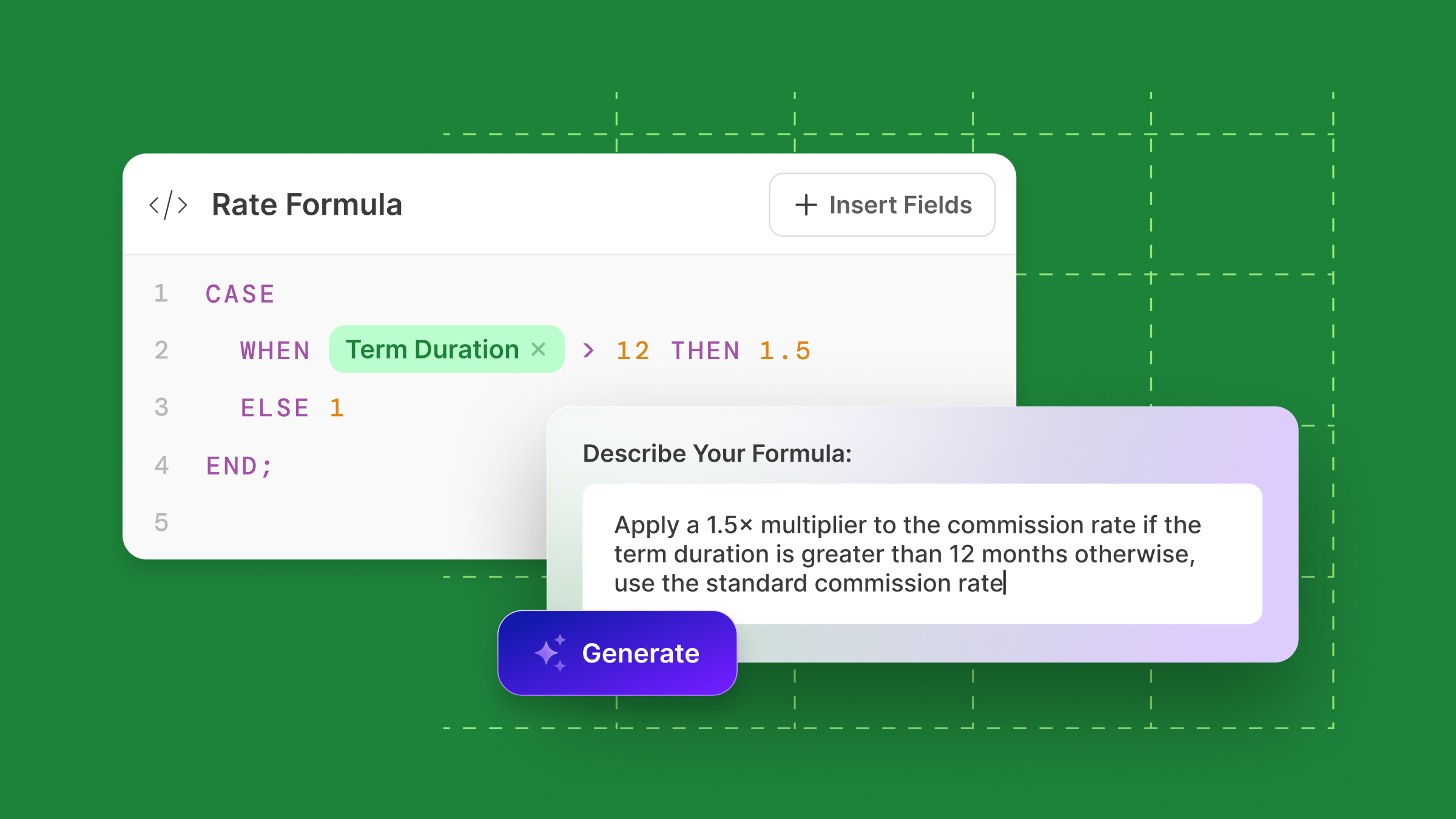
Rate Formulas allow you to define SQL-style multipliers directly within a component, making it possible to support complex earnings logic without adding unnecessary paths, extra mappings, or manual updates.

You don’t even have to know SQL to implement. Instead, use your AI Formula Generator by entering a prompt or copying and pasting an Excel formula.

Learn more below.

When should you use Rate Formulas?

Let’s walk through a few examples:

  • Multi-year contracts (reps earn more when upon closing longer deals): Say you want to pay reps more when a contract term exceeds 12 months. Rather than creating multiple components or manual overrides, you can now write stacking logic (e.g. AND if >24 then 2x)  through a formula like:
    • CASE
    • WHEN term_duration >= 36 THEN 2
    • WHEN term_duration >= 24 THEN 1.75
    • WHEN term_duration >= 12 THEN 1.5
    • ELSE 1
    • END
  • Attainment-based accelerators: For every 1% over quota, you want to boost the rep’s commission rate by 0.1%. Instead of managing 50 different tiers, just use a formula that calculates the exact adjustment based on the rep’s attainment percentage.
    • {Rate} + (({Quota_Attainment} – 1) * 0.001)
  • Stacked bonuses: Want to increase rates only when two conditions are met (like quota attainment and a specific product sold)? You can write logic that accounts for both conditions in one place.
    • WHEN {Quota_Attainment} >= 1
    • AND {Product_Type} = ‘Enterprise Plan’
    • THEN {Rate} * 1.25
    • ELSE {Rate}

Don’t know SQL? We’ve got you.

Even better, if you’re not familiar with SQL, our built-in AI Formula Generator can write the logic for you. Just describe what you’re trying to do or drop an Excel formula in our AI-powered Formula Generator and QuotaPath will create the formula. You can review, edit, or use it as-is.

Example: “Increase the rep’s commission rate by 10% if the contract term is longer than 12 months and they’ve hit at least 100% of quota.”

With Rate Formulas, you get a cleaner, more maintainable plan while reps get full visibility into how their earnings are calculated.

💡 Note: This feature is available on Growth and above. If you’re currently on Essential and want access, reach out to your Account Team.

To see it live, book a demo with our team here

10 Ways We’re Using AI at QuotaPath

10 ways we're using AI

This is a blog authored by our Director of RevOps and AI, Brandon Smith. 

We’re using AI… and we’re building with it, too.

Plus, it’s not just our engineers; it’s everyone.

Every Friday at QuotaPath, something special happens: we clear a few hours, open up our laptops, and jump into what we call Vibe Coding Fridays.

It’s an optional playground where folks from every department (Sales, Product, Customer Success, Engineering, Marketing, Partnerships, Executive Leadership) come together to explore, learn, and build with AI. 

No coding experience required. Just curiosity, collaboration, and a shared mindset grounded in creation and experimentation. 

We’ve already built tools to improve our workflows, prototype product design, and deliver better experiences for our customers. With platforms like Claude, Cursor, Replit, and others in our toolkit, our team is turning experimentation into real business value.

This is especially timely as teams continue to determine how to adopt AI across their general practices for both internal and external use.

So, to help, here are 10 ways we’re using AI to improve operations and our product, and offer better support to our customers.

Check out our use cases below. 

Streamline commissions for your RevOps, Finance, and Sales teams

Design, track, and manage variable incentives with QuotaPath. Give your RevOps, finance, and sales teams transparency into sales compensation.

Talk to Sales

10. Prototyping & Microtool Building (Replit)

First, we use Replit to rapidly spin up small tools and prototypes, like internal dashboards to customer-facing mockups. 

It’s a fast, low-friction way to test ideas and iterate quickly.

9. Customer Deck Creation (Zapier)

Next, we leverage Zapier to auto-generate personalized customer decks using deal data and ICP info. It saves time and ensures every deck is relevant and tailored—without starting from scratch.

8. Lead Scoring & Routing (Clay + Default)

Additionally, we combine Clay and Default to enrich and score inbound leads on the marketing side, so the right reps see the most valuable leads first. Smarter routing = better conversion.

7. Deal & Account Health Analysis (Momentum)

We also implemented Momentum this past year to log call notes, and more importantly, surface red flags and engagement trends to help us assess deal health before it’s too late. (See another use case below.)

6. Presentation Building (Gamma)

I’ve personally used Gamma to turn my outlines and ideas into polished presentations in minutes for super clean storytelling. 

5. Writing Follow-Up Emails + Inbox Cleanup (Fyxer.ai)

We implemented Fyxer.ai, too, to draft post-meeting follow-ups and organize our inboxes so we stay focused on high-impact work.

4. Call Coaching Scorecards (Gong)

With Gong, we use AI-generated scorecards to highlight what’s working (and what’s not) on sales calls. It’s made coaching easier, more consistent, and data-driven.

Plus, our Director of Content has used anonymized call recordings to help shape data-filled reports we publish quarterly.

ai use case quotapath

3. AI-Powered Plan Builder (QuotaPath)

Within our sales compensation software, our AI-Powered Plan Builder (which we launched about a year ago) helps users create comp plans within QuotaPath via prompt or by uploading a PDF. It simplifies a traditionally complex, click-heavy process.

2. Customer Testimonial GPT (OpenAI)

Using OpenAI, we built an internal GPT that turns customer conversations into publishable customer success stories and acts as an on-demand library for short, usable quotes for marketing and sales. 

It’s fast, accurate, and surprisingly human.

1. CRM Data Capture from Calls, Emails, and Meetings (Momentum)

We’re also using Momentum to auto-sync meeting notes, emails, and activity into our CRM, keeping records accurate and up to date (without that traditional manual entry). This has saved our sales team a ton of time. 

Final Thoughts

As you can see, we’ve really embraced this technology across our org. The result? We’re moving faster, maintaining alignment, and building better. 

And with Vibe Coding Fridays, we’re creating space for everyone at QuotaPath to experiment, learn, and grow.

What are we missing? How are you using AI?  DM us or drop a note. We love sharing ideas.

Alternative to Excel for Commission Tracking: Better Tools for Sales Teams

Alternative to Excel for Commission Tracking

Excel is the default starting point for commission tracking. In fact, with 63% market share, spreadsheets are our most common competitor.

For small teams or simple compensation plans, Excel offers flexibility and familiarity. However, as organizations scale, manual formulas and version-controlled files become increasingly complex to manage. Errors creep in, approvals slow down, and maintaining audit-ready records becomes a full-time job. Even small plan or quota changes can ripple across dozens of tabs, increasing the risk of payout mistakes and compliance risks.

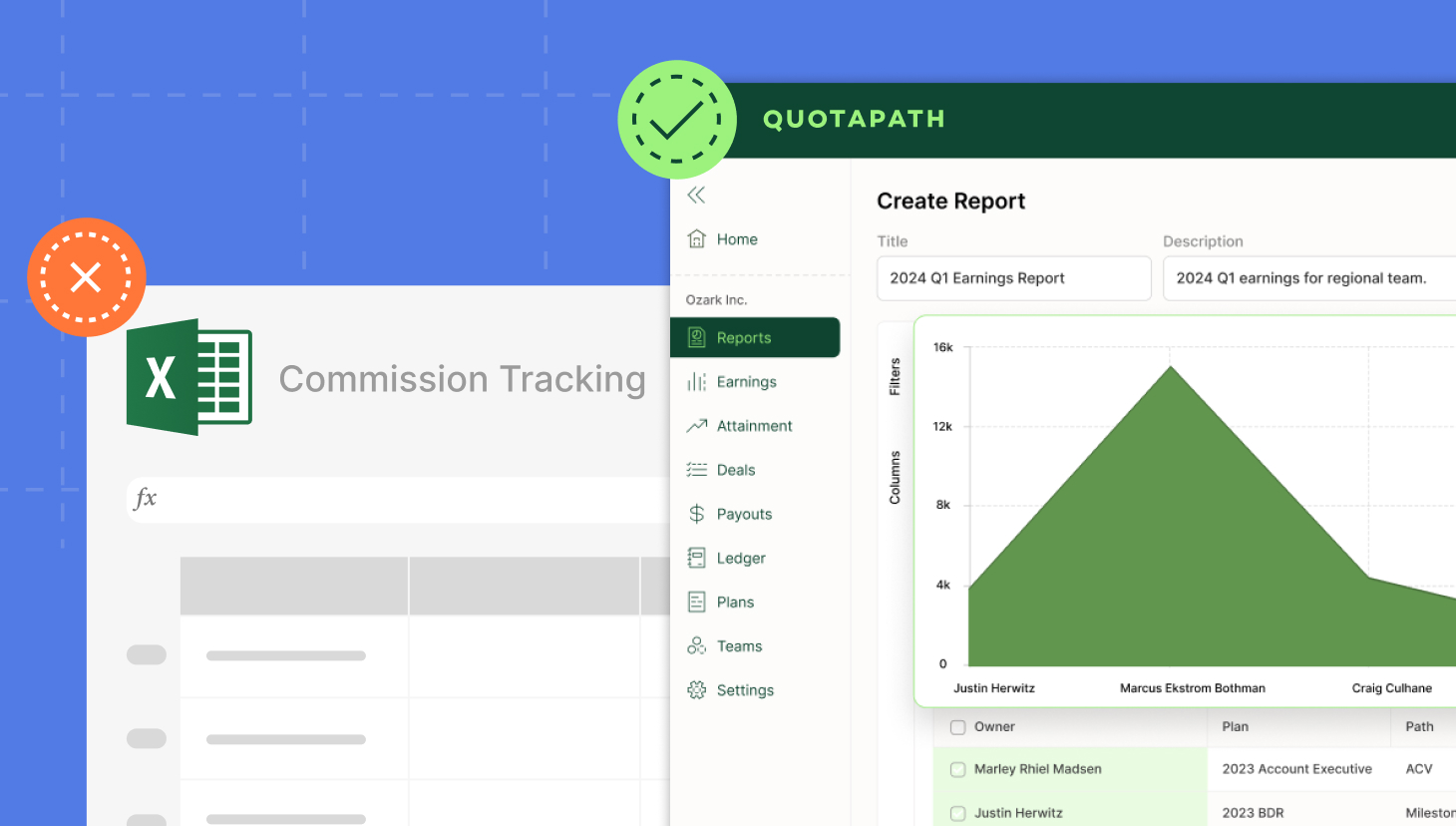
At that point, teams begin to look for an alternative to Excel for commission tracking that automates calculations, syncs with CRM data, and provides real-time visibility into earnings and forecasts.

In this guide, we’ll explore what to look for in an Excel alternative and why modern commission tracking software outperforms spreadsheets. Then we’ll explore how QuotaPath delivers the best of both worlds, combining automation tools with a free commission template for teams that are not yet ready to replace Excel.

What to Look for in an Excel Alternative

Look for these must-have features as you consider an Excel alternative for sales commissions.

Real-Time Sync with CRM

Native CRM integrations transform manual commission tracking into an automated workflow. By connecting commission tracking software to Salesforce or HubSpot, deals marked “closed-won” automatically trigger calculations and updates, removing the need for spreadsheet uploads or duplicate data entry.

Salesforce commission tracking enhances accuracy and speed by syncing deal data, earnings, and approvals in real-time. Likewise, HubSpot commission tracking enables reps to view live quota progress and commission forecasts directly within their CRM, without needing to switch apps. Managers can track performance, model payouts, and forecast commission expenses from the same view.

“The QuotaPath app card sits right inside HubSpot,” said Eric Baum, CEO of Bluleadz. “Reps, managers, and our accounting department can see all the data they need, without ever leaving HubSpot.”

“The sales team loves having the ability to see their pipeline, forecast potential commissions, and understand exactly how payouts are calculated and when they’ll receive them,” said Genevieve Moss-Hawkins, Systems Operations Manager at NeuroFlow. QuotaPath’s real-time sync with CRM gives sales and finance a single, trusted source of truth.

Multi-Tier Approvals

Commission accuracy depends on shared accountability. QuotaPath’s multi-tier approvals feature enables you to set up approval steps at the rep, manager, executive, and finance levels, ensuring accuracy and saving time. This workflow increases transparency and strengthens trust across sales, finance, and legal by allowing reps to approve their numbers before leadership signs off.

Plan Modeling

According to our report, 91% of surveyed companies fell short of quota attainment, with 31% of revenue leaders citing unrealistic quotas. Designing a comp plan isn’t only about creating an enticing plan, as it directly affects profitability, performance, and morale.

Features like QuotaPath’s Plan Modeling and Draft Plans enable leaders to pressure-test compensation scenarios without disrupting existing plans by utilizing historical data. Plan modeling helps leaders prevent costly compensation outcomes such as missed revenue goals, overpaid commissions, and rep turnover due to a lack of trust and transparency.

Streamline commissions for your RevOps, Finance, and Sales teams

Design, track, and manage variable incentives with QuotaPath. Give your RevOps, finance, and sales teams transparency into sales compensation.

Talk to Sales

Forecasting & Rep-Level Visibility

QuotaPath enables reps to see quota progress and run “what-if” scenarios that forecast potential earnings from deals in their pipeline. This keeps them motivated while helping them prioritize opportunities that will help them reach the next incentive milestone.

“The tool allows me to seamlessly automate everyone’s commissions into one platform so that sales reps, customer success managers, SDRs, and revenue management can view their own commissions in the tool. This makes troubleshooting easier when needed. It’s easy to reference and the information is made to be transparent for the entire revenue team,” according to Katie at Muck Rack.

Real-time reporting connects performance data to payout forecasts, allowing finance leaders to anticipate commission liability, monitor margins, and validate compensation costs before payroll.

Why Commission Software Beats the Rest

Excel vs commission software. Here’s what makes commission tracking software a superior alternative to Excel for commission tracking.

Automates Calculations and Reduces Errors

Nearly 80% of organizations admit to making compensation mistakes when using spreadsheets. Switching to a commission tracking spreadsheet alternative automates compensation management, resulting in error-free commission calculations. In fact, companies that fully adopt their finance technologies see a 75% reduction in errors, according to Gartner, revealing that commission payout automation increases accuracy.

Real-Time Earnings and Quota Visibility

Commission software improves rep visibility in the numbers they need to track quota progress. Visibility improves motivation and reduces mental stress, enabling sales reps to focus on selling instead of stressing about hitting quota. “A compensation plan is one lever that a leader can lean on to reduce stressors. Having a clear understanding of their comp plan and how they make money is so important,” according to Jeff Riseley. This level of transparency also boosts productivity. According to Betterworks, transparency motivates employee efficiency and engagement.

Approvals, Audit Trails, and Compliance

Manual compensation processes hinder commission approvals and compliance, as well as lead to inaccurate documentation. When you replace Excel for commission tracking, payout automation streamlines processes such as approval flows, audit trail creation, forecasting accuracy, ASC 606 compliance, and audit readiness.  This gives finance peace of mind.

Seamless CRM and Payroll Integration

QuotaPath’s integration with Rippling creates a seamless connection that automates commission payments from calculation to payout. This payroll integration enables finance and HR teams to push commission earnings into payroll. This eliminates tedious manual processes, saving finance and admin time while boosting accuracy.

“QuotaPath had already simplified how we calculate commissions. So, when QuotaPath launched its Rippling integration, I joined to see if it could streamline the last mile of my workflow: filling in the gaps between commission payouts and running payroll.

It worked better than I could’ve ever imagined. The integration fast-tracked pay runs, and even pushed us to bring more of our commissions into QuotaPath instead of calculating them manually,” according to Joan Schiffer, Director of Accounting at Virtuous.

Try QuotaPath for free

Try the most collaborative solution to manage, track and payout variable compensation. Calculate commissions and pay your team accurately, and on time.

Start Trial

Outgrow Excel with QuotaPath

If you’re ready to move beyond manual spreadsheets, QuotaPath is how to replace Excel for commissions while increasing accuracy, transparency, and scalability. The platform automates the entire commission process, from calculation to payout, while giving every team real-time visibility and control.

Here’s what you can expect:

  • Automated tracking & payouts
  • Error-free commission calculations
  • Live dashboards and forecasting
  • Audit trails and approvals
  • Salesforce & HubSpot native sync

Not ready for software? Include CTA to try QuotaPath’s Excel commission template as a free starting point. 

10 Ways to Reduce the B2B SaaS Sales Cycle and Close More Deals

Shorten the B2B SaaS Sales Cycle

The B2B SaaS market is certainly booming. It was estimated to be worth around $197 billion globally in 2023, and is predicted to reach $247 billion in 2024. It seems there is no shortage of companies looking for software solutions to help streamline their operations and improve productivity. 

However, while you might have plenty of leads coming in, one of the biggest challenges often faced in the industry is the length of the sales cycle and how long it takes to turn those prospects into actual paying customers. A sales cycle that drags on isn’t just frustrating for your sales team, who want to close deals; it can also drain resources and impact your bottom line and the overall growth of your business.  

So, how can you make your sales cycle more efficient and ultimately generate more revenue, faster? Let’s look at 10 strategies to speed things up.

1. Know Your Ideal Customer

    The essential part of the sales process? Ensuring you’re speaking to somebody genuinely interested in purchasing your product. An Ideal Customer Profile (ICP) is like a blueprint of the kind of customer that your product or service would be most beneficial to. 

    Think about it: your product is best suited for them, and this makes them most likely to buy, which in turn means that you waste less time on dead leads and put your efforts into those prospects who are most likely to convert. Your ICP should include details like industry, company size, geographic location, and any other information you believe will make your product more relevant to them.

    Defining Your ICP

    Analyze your best customers

    Look at your existing customer base and who your best customers are. What sort of things do they have in common? Looking for commonalities, like a certain industry or business size, can give you clues as to the sort of customer who gets the most value from your product.

    Segment the market with data analytics

    Use analytic tools for market segmentation. This means you can divide your target market into different groups based on their company profile. 

    For example, you might notice that medium-sized companies with between 200 and 500 employees most consistently convert in your pipeline, so these should be your key focus. 

    By segmenting your target market, you can exclude these types of prospects and focus your sales and marketing efforts on groups most likely to yield the best returns.

    Regularly update your Ideal Customer Profile (ICP)

    Market dynamics and customer needs change all the time, meaning defining your ICP is not a set-and-forget process. 

    Keep a close eye on what is happening in your pipeline and the wider market, and update your ICP as needed.

    2. Use Data-Driven Insights

      Using data-driven insights helps to do away with guesswork and make informed decisions at every step of the sales process. This reduces the need for trial and error and increases the chances of getting it right the first time. Use tools like CRM systems, marketing automation platforms, analytics software, or customer support software to track and review data, customer interactions, and sales activities. 

      You can then look for patterns and trends that will help you predict which sales leads are most likely to turn into sales and at which point in the sales cycle. A data integration process brings together disparate sources of information to break down silos and help you use data to best effect. 

      It’s important to stay abreast of CRM marketing trends, as these trends can provide insights into new tools and strategies that enhance customer engagement and lead conversion.

      Additionally, you may use this data to create a 360 customer view. Knowing this, you can individualize communications in ways that mirror the uniqueness of your customers’ needs and preferences. This makes your sales team’s interactions more meaningful toward each customer, which can lead to more opportunities for successful sales.

      Image of lap top open with charts
      Image via Pexels

      Implementing Data-Driven Strategies

      • Central CRM system: Adopt a CRM solution that truly centralizes customer information so your sales team does not waste time looking for information. This speeds up the process of communication and follow-ups. 
      • Predictive analytics: Use predictive analytics to forecast sales.
      • Monitor SERP results: Keep an eye on your B2B SEO strategy, and adjust if your rankings start to drop.
      • Continuously review and adjust strategies: Regularly review and tune strategies based on insights from the data.

      3. Optimize Lead Qualification

        This may sound counterintuitive, as it seems you are only going to lengthen the sales cycle with this extra step, but practicing lead qualification can actually shorten the sales cycle. The better the qualification process, the better the gatekeeper it serves for your sales pipeline. 

        One way to do this is by using a scoring methodology before passing the leads to the sales team. This method allows the sales team to distinguish between a prospect or lead, so they can concentrate on only those prospects who identify under your buyer persona and have an actual interest in what you are selling.

        How to Optimize Lead Qualification

        • Develop a lead-scoring framework: Look for any common factors amongst your customers that most often convert. This could be things like the size of their organization, the industry they’re in, the prospect’s job title, or the location of the business. For example, you might spot that initial enquiries made by decision-makers within medium-sized businesses convert more often and faster than those from more junior roles in large organizations. In addition to this, analyze any behavioral data you have on your prospects. Website visits, content downloads, email opens, and webinar attendance can all indicate more interest in your products and a more promising lead. 
        • Score each of the demographic and behavioral factors: Now, give each of these demographic and behavioral factors a score. You want to give the highest scores to industry targets or high-value actions, like requesting a product demo or scheduling a discovery call. B2B database providers can provide a solution to store this information for you.
        • Establish a scoring threshold: Once you have a scoring system in place, establish a threshold that a lead must meet or exceed for you to consider them qualified. This system means that only quality leads that have a high chance of converting are put into the hands of the sales team.

        4. Increase Your Value Proposition

          A strong value proposition clearly highlights your product’s unique benefits for customers to see. Getting this right can shorten your sales cycle from day one. 

          How? It can help in two ways. Firstly, it allows you to filter out any leads where your product doesn’t address their business need. By giving prospects the information on your product from the start, they will have a better idea if it’s a good fit for them without wasting your sales team’s time following up on dead-end inquiries.

          Secondly, a strong value proposition should do half the sales job for you. It will address the pain points of your target audiences and demonstrate how you will solve them, effectively already warming up leads to what you have to offer and getting them excited about your product.

          Tips for Developing a Value Proposition

          Woman on lap top at work and talking on phone
          Image via Pexels
          • Outline the key benefits and ROI: Include examples and data that show prospects in a tangible way how your product could save them time, reduce costs, or increase productivity. 
          • Provide social proof via case studies and testimonials: Include case studies and quotes from satisfied customers to build credibility and trust in new contacts (we’ll cover this in more detail later).
          • Personalize your message for each audience segment: Show that you understand their individual pain points and priorities by replacing generic sales messages with personalized ones that take into account things like your prospect’s industry, business size, or job role.
             

          5. Streamline Your Sales Process

            To shorten the sales cycle, your sales team needs to be able to move prospects through the pipeline as quickly and efficiently as possible. This doesn’t mean getting sloppy or cutting corners, but making sure that each step of the process is working as smoothly as it can. 

            Start by mapping out each stage of the sales process and identifying any points of friction or inefficiency that are causing your sales process to go from speeding along to grinding to a halt. This map details how prospects move along the sales journey from one step to another and typically includes activities like lead generation, initial contact, needs assessment, proposal, negotiation, and closing. 

            Accompanying each step should be specific actions, who is responsible for them, and the ideal outcome. For example, when it comes to the needs assessment, your action could be having a rep host a discovery call to learn more about the prospect’s challenges and goals. 

            Look into historical data to see where, in this process, prospects most often drop off or deals get stuck in your pipeline. Then, speak to the sales team to understand what isn’t working and where the bottlenecks are. 

            You can keep on top of the ongoing performance of your sales process by keeping watch on metrics like conversion rates, average deal cycle length, and win rates. Depending on the methods you prefer, it can be worth investing in Kanban software or task management tools to monitor the process.

            Streamlining Strategies

            Here are some ideas for ways you can speed up the sales process:

            • Standardize your sales process and activities: Free up your sales team’s time by standardizing repetitive tasks early in the pipeline. You could provide them with marketing email templates, pre-drafted proposals, or sales scripts. This gives them more time to focus on what they do best – closing deals. 
            • Use tools and automation: Let technology do the hard work for you and take advantage of tools like VoIP for small business. These tools can integrate with your productivity apps to streamline your processes, saving your sales team precious time.
            • Refine your sales process: The trick to keeping your sales processes slick is never getting complacent. Ongoing training and development will ensure your sales team are always at the top of their game, equipped with the practical skills and knowledge to close more deals faster. Provide periodic training on new selling approaches, product updates, and current industry trends.
            Two men talking over a work computer
            Image via Pexels

              Presentations and demonstrations should be at the heart of your SaaS sales cycle. A good demonstration can do miracles to lead a sale further down the closing process. It can give you the opportunity to show your prospect how your product can really address their business need, and respond to any concerns or queries they might have.  

              Product demonstrations aren’t a one-size-fits-all process. Be sure that the demo you are giving is tailored to your individual prospect to show them the features that will be appealing to them. For instance, if they’ve highlighted issues with their system going down and they’re unsure why, spend some extra time on your uptime monitoring and cybersecurity features.

              You might focus on showcasing a specific feature or functionality that solves a problem, or demonstrating the user-friendliness of your product to a prospect who is apprehensive about team onboarding. Ultimately, the role of your demo should be for your prospect to walk away thinking, “This is exactly what we need.”

              Effective Demo Strategies

              • Address the prospect’s pain points: Customize product demonstrations to address a prospect’s pains and challenges specifically. This way, a buyer is going to find your product more relevant because they can understand how it is going to fix their own unique needs.
              • Use interactive and engaging presentation methods: Don’t stick to the confines of a traditional PowerPoint deck. Make use of interactivity and interesting presentation techniques. This includes live product demonstrations, hands-on exercises, and dynamic visual aids that make the presentation more memorable.
              • Send follow-up materials and answers to questions: Immediately after the demonstration, forward follow-up material that reinforces the main points that were discussed and provides answers to any questions raised during the presentation. This shows attentiveness and gives the prospect all the information they need to make an informed decision. An AI meeting recorder can help you make sure you don’t miss any important details.

              7. Work with a Customer-Centric Approach

                Being customer-centric means putting the agenda, or concerns, of your prospects first through the whole selling process. It sounds simple, but being truly customer-centric takes a considered effort at every twist and turn of the sales process. 

                In return, though, you’ll build confidence and better relations amongst your prospects, and that means there is more chance they will buy your product.

                Customer-Centric Tactics

                • Take the time to genuinely listen to and answer any potential apprehensions from your prospects. Don’t just fob them off with standard responses about how great your product is, but understand and address their concerns practically and empathetically.
                • Provide them with personal advice or solutions, demonstrating that you understand their business and needs.
                • Keep in touch through consistent and transparent communication. Consider using tools like an omnichannel contact center platform so leads can communicate with your sales team in a variety of ways. It could be email, business phone systems, live chat, social media, or messaging apps. Allowing them to reach out to you in the way they prefer speeds up initial contact and follow-up interactions.
                • Enhance responsiveness with automated text messages. By integrating automated texting into your communication strategy, you ensure timely, personalized updates and reminders are sent to prospects, keeping them engaged and informed throughout the sales process.

                8. Use Social Proof and Case Studies

                  When looking for confidence in buying a product, we often turn to the reviews section to check out other customers’ experiences, and the B2B market is no different. 

                  You can harness the power of your satisfied customers by using case studies, testimonials, or reviews as social proof that can work effectively in closing a sale. 

                  Showing successful applications for your product in real-world examples can help reassure prospects that your product is indeed valuable and practical, rather than just taking your word for it.

                  How to Leverage Social Proof

                  • Share Case Studies: Show how other customers are using your product to achieve measurable results.
                  • Display Customer Testimonials: Feature testimonials from happy customers on your website. Investigate AI SEO tools to see what gives the best results.
                  • Incorporate Reviews and Ratings: Include reviews and ratings in your sales materials. 
                  hands about to exchange a contract for signature
                  Image via Pexels

                  9. Offer Flexible Pricing and Payment Options

                    Do your leads flow promisingly through your sales pipeline until they hit the dreaded roadblock of agreeing on pricing and payment? 

                    You can make your product accessible to a wider range of people by facilitating flexible pricing and payment options. Think about introducing features like tiered price plans, long-term commitment discounts, or flexible payment terms. 

                    Use an automated recurring billing system to give your customers the freedom to choose how they pay and pause or cancel subscription billings at any time if they wish.

                    Pricing Strategies

                    • Develop pricing tiers: Having one set price that includes all the bells and whistles could make your product unaffordable for some prospects. Instead, consider introducing pricing tiers to make your product more accessible to different segments of customers. For instance, a simple three-tier approach might include basic, standard, and premium plans, with different features included under each plan.
                    • Enable easy market access: Offer free trials or freemium models. This lowers any barriers to entry and gives prospects a chance to experience the value of your product first-hand without having to make any financial commitment. Once they’ve seen how great your product is, you can convert trial users into paying customers.

                    Clearly show pricing information, or indicative pricing, on your website and marketing materials. This pricing transparency helps prospects quickly determine whether your product fits their budget, and saves difficult pricing objections later on in the sales process.

                    10. Handle Objection Proactively

                      Even the best sales team will encounter objections in the sales cycle, but it’s how they handle them that counts. When you can handle objections confidently and effectively, you can stop them from stalling the sales process. 

                      Be prepared for possible objections and have answers ready that will directly address the concerns of the prospect.

                      Objection Strategies

                      • Know common objections in advance: The first step is understanding common objections raised by prospects. Some typical common objections might include problems with price, product fit, challenges during implementation, issues over ROI, and lack of confidence in the company’s reputation. Identifying these usual objections beforehand puts the sales teams in a better position to brace themselves proactively.
                      • Build a repository of responses and solutions: Now that you know the most common objections, the next step is to develop well-crafted responses and solutions that can address these concerns. Having a repository of responses ensures your team members can quickly and confidently counter the objection during a sales call.
                      • Train your sales team to handle objections confidently: Training your sales team is essential for them to take care of objections confidently and with ease. The training process should include the theoretical aspects of objection handling and practical, hands-on experience.
                      two men talking in a lounge
                      Image via Pexels

                      Reducing Sales Cycle Duration: Key Takeaways

                      A short sales cycle accelerates revenue, makes it easier to adapt to changes in market and customer requirements quickly, and promotes better use of resources. It improves customer satisfaction and results in quick investment returns by closing deals more swiftly.

                      If you’re looking to improve your bottom line, taking steps to shorten the length of your sales cycle could be one of the most important initiatives to consider. Even if your sales cycle looks to be performing well, getting more deals over the line, and quicker, means you’re driving more revenue. And that’s never a bad thing.

                      How to Comp on Multi-Year Deals

                      Compensating on multi-year deals

                      Why paying reps on deal anniversaries is hurting your growth

                      Multi-year deals are one of the most efficient ways to lock in revenue predictability, reduce churn, and improve CAC payback…but many teams are still getting the compensation piece wrong.

                      Instead of rewarding reps at the time of the close, we’re seeing a growing number of comp plans that split commissions over the life of the contract. 

                      Close a 3-year deal? Great. 

                      You’ll get:

                      • One-third of your commission now
                      • One-third on the 12-month anniversary
                      • The rest the year after that

                      This kind of structure might seem like a smart way to manage churn or stay conservative with payouts. However, in practice, it’s killing rep motivation and doing the opposite of what you want: discouraging longer-term deals.

                      And that’s a big miss, because when structured right, multi-year accelerators work.

                      According to our recent SPIF Benchmark Report, multi-year accelerators showed up in 15% of customer plans, yet drove 25% of total revenue. That’s a massive return for a relatively simple comp lever.

                      So let’s fix the bad logic and make sure your comp plan actually encourages what you want more of: efficient, durable revenue.

                      SPIF trends

                      The SPIF Report

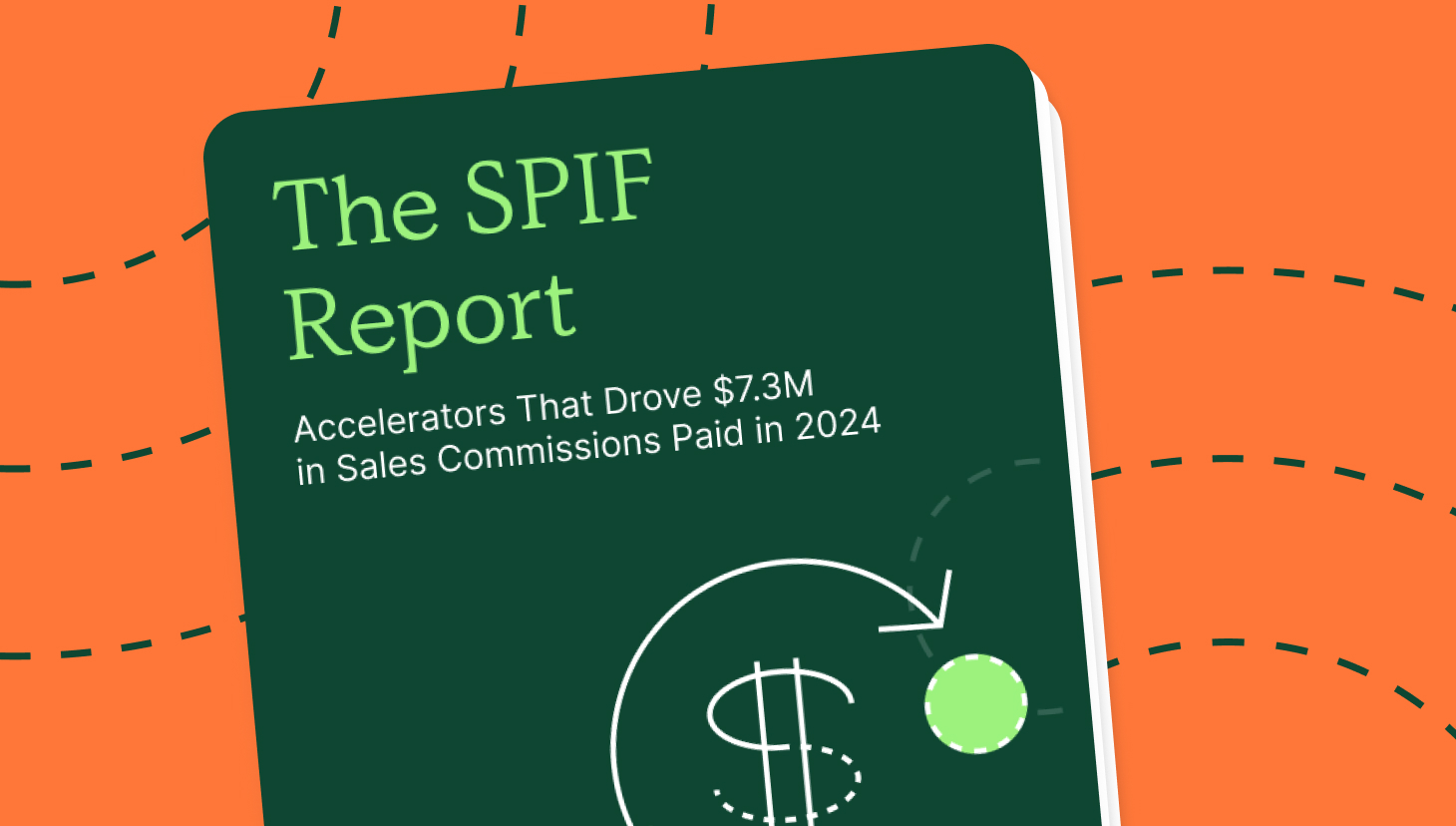
                      Curious how top revenue teams use SPIFs and accelerators to align with key business goals and drive measureable results? Our latest report below dives into our data from $7.3M in sales incentives

                      View Report

                      Our latest blog shows why the anniversary payment model is backfiring, and what forward-thinking companies are doing instead.

                      Enjoy the read.

                      Why Splitting Over Time is Problematic 

                      The logic behind spreading payments might seem sound on paper, but it creates three major problems that actually work against your growth goals.

                      AEs don’t control what happens post-sale. 

                      You can’t expect a rep to stay engaged with an account for three years when they’ve already moved on to new business. Spreading out their commission over time is essentially withholding earnings for work already done.

                      It kills motivation. 

                      Compensation is a behavior engine. If you want more multi-year deals, you need to reward them at close, when the decision is made, not 12-24 months later, when that same rep may no longer be at the company.

                      As one of our customers put it: “The whole point of having generous incentives is to energize the team. Not have it be mysterious,” said Thomas Egbert, Prefect’s Chief Business Officer. 

                      Reps Know What’s Up

                      Beyond the structural issues with delayed payments, there’s a more fundamental problem: your sales team isn’t buying what you’re selling.

                      Reps aren’t fooled. 

                      When a multi-year commission is split out over time, many will default to shorter-term deals so they can get paid sooner. And in a sales climate where, just a year ago, 91% of teams were missing quota, adding delays to earnings is the last thing you want.

                      What To Do Instead

                      So if splitting commissions over time doesn’t work, what does? Here’s the playbook that high-performing SaaS companies use to drive multi-year deals without sacrificing rep motivation.

                      1. Pay AEs Upfront, Then Amortize for Accounting

                      The first principle is simple: separate your accounting practices from your compensation strategy.

                      Pay your account executives at the time of the deal close. If they close a 3-year deal worth $90K, and your base commission rate is 10%, pay the full $9K commission immediately.

                      You can amortize the expense on your books (QuotaPath supports ASC 606), but don’t defer their earnings.

                      Need to protect against churn? Build a clawback clause. Easy.

                      2. Use Accelerators to Reward Longer Terms

                      Once you’ve committed to paying upfront, the next step is making longer deals more attractive than shorter ones. Multi-year deals are great for predictability, and reps should be incentivized to go after them.

                      Example:

                      • 1-year deal: 8%
                      • 2-year deal: 10%
                      • 3-year deal: 12%

                      Make the upside clear and visible in their comp statement or forecast. Tools like QuotaPath let reps see how pipeline turns into commissions. That’s a proven motivator.

                      3. Tie GRR/NRR to CS or AM Teams

                      Finally, address the elephant in the room: what about churn and expansion? 

                      The answer isn’t withholding AE commissions; it’s better role alignment.

                      Don’t use AE commissions as a backdoor way to manage churn. 

                      Instead, tie gross revenue retention (GRR) and net revenue retention (NRR) metrics to your post-sale teams, Customer Success and Account Management.

                      • If CS is responsible for renewals, comp them on renewal milestones.
                      • If AMs own expansion, accelerate comp for expansion beyond year one.

                      This creates clean ownership and ensures that reps are only accountable (and rewarded) for what they control.

                      Finance, Here’s the Win

                      For finance teams reading this and thinking ‘this sounds expensive and risky,’ here’s why this approach actually gives you more control, not less.

                      • You can still keep GAAP compliance and capital efficiency front and center.
                      • You can still model out the impact of longer-term deals and amortize commissions across years.

                      But don’t let your AE comp plan bleed into your retention strategy.

                      1% Alignment

                      QuotaPath’s 2024 report found that only 1% of RevOps leaders said their comp plans were fully aligned to company KPIs. And only 12% of Finance leaders felt confident that comp plans were doing their job.

                      Multi-year incentives are a big part of that disconnect.

                      TL;DR: What Good Looks Like:

                      ElementBest Practice
                      AE Multi-Year CompPay up front, add accelerators by term
                      GRR/NRR OwnershipAssign to CS or AM, comp accordingly
                      AccountingAmortize commissions in books, not in reps’ wallets
                      ModelingUse scenario modeling to forecast payout cost and margin impact
                      VisibilityDrive sales rep performance by showing them their earnings forecast.

                      Fix Your Multi-year Comp Strategy

                      If you’re currently splitting multi-year commissions over time, you’re not alone—but you’re also not stuck with a broken system. The companies getting this right aren’t just paying reps differently; they’re thinking about compensation as a strategic lever for predictable growth.

                      The math is simple: when reps can see exactly how much they’ll earn from longer deals at the time of close, they sell more of them. When CS and AM teams own retention metrics, they deliver on them. When finance can model and forecast accurately, everyone wins.

                      Ready to build a comp plan that actually drives the behavior you want?

                      👉 Book a strategy call – We’ll audit your current multi-year approach and show you exactly where you’re leaving money on the table

                      👉 Try QuotaPath free – See how transparent earnings forecasting motivates your team to chase longer deals

                      Because the best commission plan is the one your reps actually understand and get excited about.

                      Live Commission Tracking: See Quota Progress and Accelerators Instantly

                      live commission tracking in quotapath

                      Which live commission tracking platform lets reps see progress to accelerators and quota in real time?

                      QuotaPath.

                      By providing visibility into live quota progress and instant accelerator updates, QuotaPath motivates sales teams to achieve their goals. These insights eliminate compensation confusion and ensure every rep knows exactly where they stand. Real-time updates build trust, boost performance, and help leaders forecast revenue with confidence.

                      Streamline commissions for your RevOps, Finance, and Sales teams

                      Design, track, and manage variable incentives with QuotaPath. Give your RevOps, finance, and sales teams transparency into sales compensation.

                      Talk to Sales

                      See Quota Progress and Accelerators in Real Time

                      Sales teams perform best when they know exactly how close they are to their goals. With QuotaPath, reps don’t have to guess. Real-time visibility into quota and accelerator progress keeps everyone aligned and motivated, while giving leaders confidence that compensation is driving the right behaviors.

                      The Commission Tracker Built for Quota and Accelerators

                      QuotaPath is designed to make quota progress tracking simple, accurate, and instant. Reps can log in at any time and see live updates on quota attainment and accelerator tiers. This eliminates confusion and helps salespeople plan their next steps with purpose.

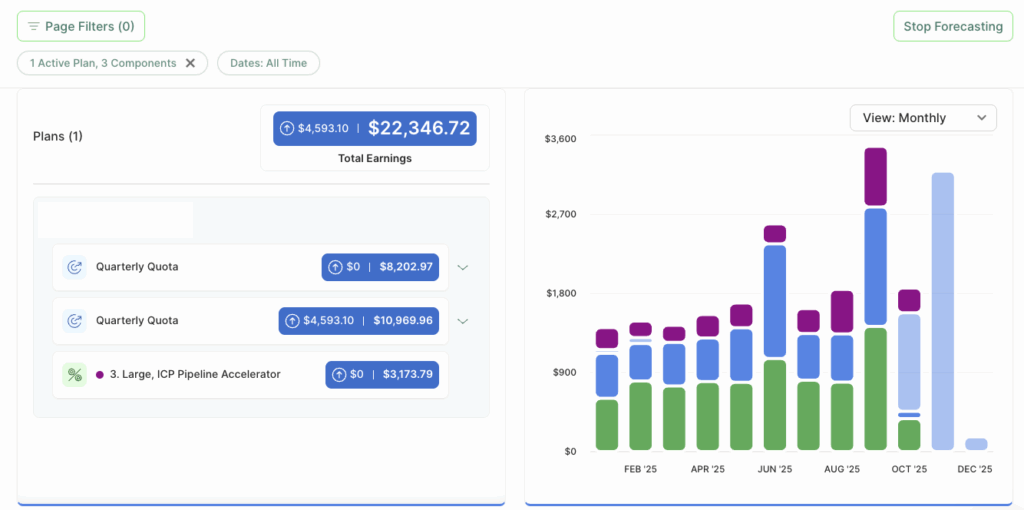
                      Real-time accelerator tracking ensures reps know when they’ve crossed critical thresholds and how much more they need to sell to reach the next one. This visibility enables reps to see their earnings instantly as each deal closes. That immediate feedback creates a direct connection between effort and reward, fueling motivation to keep selling.

                      QuotaPath live commission tracking into accelerators

                      For leaders, this transparency drives goal alignment. QuotaPath identifies which deals contribute to quota attainment and accelerators, providing managers with clearer forecasting while reinforcing the behaviors that lead to predictable revenue. When reps understand how their deals translate to compensation, they sell more effectively, and leadership gains a reliable view of performance.

                      Why Real-Time Visibility Wins Deals

                      Visibility into commissions drives desired behaviors. When reps can see their forecasted earnings change in real-time, they’re motivated to keep selling and updating their pipeline. At the same time, managers benefit from cleaner CRM data and more accurate forecasts, turning compensation into a true growth lever.

                      From Pipeline to Paycheck: Forecasted Earnings in Action

                      What happens when sales reps can see their commission earnings change in real-time as deals move through the pipeline?

                      You activate a powerful behavioral loop.

                      At the core of motivation is feedback. And when that feedback is immediate, such as when a rep closes a deal and instantly sees how much that boosts their next paycheck, you reinforce the right behavior. You encourage more of it. You build momentum.

                      QuotaPath’s real-time CRM sync enables this. By integrating directly with Salesforce or HubSpot, every change in deal status or contract value updates commission calculations instantly. No waiting for end-of-month spreadsheets or manual reconciliations.

                      Instead, reps can log into QuotaPath (or stay in their CRM with HubSpot or Salesforce App Cards) and immediately see: 

                      • Which deals count toward quota
                      • How much they are projected to earn if pipeline deals close
                      • What’s been approved for payout
                      • When they’ll be paid

                      This combines transparency with motivation, closing the loop between action and reward. And when that loop is fast and clear, reps don’t just understand their comp plan, they respond to it.

                      We’ve seen it across teams: When reps understand how to earn more, they do. And when that understanding is powered by payout automation, CRM-synced commissions, and a real-time commission tracker, the comp plan finally becomes what it was always meant to be, a performance driver, not just an after-the-fact calculation.

                      matt green

                      Recommended Reading

                      A Q&A with Sales Assembly’s CRO Matt Green on comp plan design, progressive commission rates, and why CFOs and sales leaders need to rethink how they motivate reps.

                      Take Me to Blog

                      Cleaner CRM, Cleaner Commissions

                      Reps are more likely to update CRM data if earnings are tied to it. By showing reps their potential earnings per sales opportunity, they can forecast future paychecks as they update their pipeline. This allows reps to accurately track their progress toward their goals and how close they are to specific incentive milestones, motivating them to close that extra deal or exceed their targets.

                      For instance, within the first few weeks after their QuotaPath implementation, a RevOps leader noticed his reps kept their HubSpot data cleaner once they realized how their pipeline translated to earnings. Similarly, another customer’s reps started flagging errors in QuotaPath, “When they say, ‘This looks wrong in QuotaPath,’ I can ask them if it’s wrong in HubSpot, too. If it is, they can fix it in HubSpot and QuotaPath will automatically adjust.”

                      This accuracy benefits both reps and managers. Sellers become confident that their work is reflected in their earnings, while leaders get reliable insights into pipeline health and compensation. By connecting commissions directly to CRM data, QuotaPath helps improve data quality, ensuring payout accuracy and strengthening trust across the organization.

                      We want people to see their projected earnings. We want to make it competitive. And we want to
                      make it really easy to look at our recognized or earned commissions versus what we’re paying out.
                      QuotaPath has made my job way easier.
                      It’s made things more transparent, and our comp plans are way more organized.”

                      Sarah Counts, COO, Wazoku

                      Track Accelerators as They Happen

                      Hitting quota is a milestone, but the real excitement often comes afterward. With QuotaPath, reps don’t have to wait until payout time to see how much they’ve earned. Real-time visibility into accelerators shows them exactly where they stand, motivating sellers to push for the next tier to maximize their earnings potential.

                      How Accelerators Work Once Quota is Hit

                      Commission accelerators are sales incentives that reward reps for exceeding their sales goals. No wonder our 2025 SPIF Report found that multi-year accelerators are the most popular, representing 15% of customer plans and accounting for 25% of total revenue!

                      These incentives serve as a method of motivating salespeople to close more deals by offering them a bonus or other types of rewards for meeting or exceeding a designated threshold, such as 100% of their quota or multi-year agreements with new customers.

                      This method motivates performance because accelerators transform “good enough” into “what’s next.” When reps know they’ll earn a higher commission rate for every dollar beyond quota, it creates urgency and excitement to continue selling after targets are met. For example, a rep moving from an 8% to a 10% commission after hitting quota instantly sees the added value of every new deal they close.

                      Instead of coasting once they reach 100%, accelerators encourage them to stretch, pursue bigger opportunities, and close deals more quickly. For leaders, this not only drives incremental revenue but also ensures seller motivation stays tightly aligned with company growth goals.

                      forecasted live commission tracking in quotapath

                      Forecast the Next Tier with Live Progress Bars

                      With real-time commission visibility, reps can see exactly how close they are to the next earnings tier and plan their pipeline activity accordingly, making every opportunity a step toward higher payouts.

                      In QuotaPath, this is done by: 

                      • Real-time Earnings Forecasting: Reps can see how much they’ll earn on deals currently in pipeline and simulate earnings based on potential deals closing, helping them prioritize high-impact opportunities.
                      • Tier Visibility in Plan Components: Component cards and attainment graphs break down how close a rep is to reaching their next level of tiered commission rates, such as moving from 8% to 10% commission, providing clear earnings incentives.
                      • Incentive Alignment: Reps see which deals, including multi-year or multi-product agreements, trigger accelerators, guiding them to push specific types of revenue that align with both their compensation and company goals.
                      • Motivational Attainment Tracking: Attainment dashboards display progress toward quotas and earnings in a visual, digestible format, allowing reps to plan how much more pipeline they need to hit the next level.
                      • Comp Plan Transparency: Reps no longer rely on Finance or RevOps to answer, “How much will I make?” QuotaPath shows them the exact calculations and payout timing, boosting confidence and motivation.

                      More Than Payouts

                      Real-time commission tracking goes beyond earnings. With QuotaPath, compensation tools serve as both engagement drivers and performance motivators, transforming dashboards and leaderboards into incentives that keep reps striving for more.

                      Real-Time Leaderboards and Dashboards

                      QuotaPath’s customizable real-time sales leaderboards and dashboards provide up-to-date reporting while adding a gamification element. This motivates reps to push to meet or exceed the goal or next earnings milestone by keeping them aware of where they stand, sparking healthy competition, and celebrating top performers. For managers, it’s a way to build momentum across the team and keep performance aligned with company goals.

                      Streamline Approvals and Stay Audit Ready

                      QuotaPath simplifies what’s often the most complex part of compensation management: approvals and ASC 606 compliance. With built-in automation, managers can review and finalize commission approvals quickly while maintaining a complete digital audit trail. The result is faster payouts, fewer errors, audit-ready commissions, and peace of mind knowing that Finance, RevOps, and Sales are aligned.

                      The key automations here include:

                      • Audit-ready commission documentation: Detailed logs of every calculation and adjustment.
                      • Automated approval workflows: Eliminate bottlenecks, reduce manual effort, and increase payroll accuracy.
                      • ASC 606–compliant reporting: Ensures commissions are recognized and reported correctly.

                      These QuotaPath automations give leaders confidence that commissions are accurate, transparent, and ready for both internal reviews and external audits.

                      Send Commissions Straight to Payroll (Rippling)

                      Commission payouts don’t need to involve spreadsheets, manual uploads, or end-of-month stress. QuotaPath’s integration with Rippling connects commission calculations directly to payroll, allowing Finance and HR teams to push approved payouts into Rippling with just a few clicks. This automation saves hours every pay cycle, reduces the risk of errors, and ensures reps are paid on time.

                      The result is greater accuracy and transparency for everyone involved. Sales teams see precisely what’s being paid and when, while Finance and HR gain the efficiency of error-free automation and compliance-ready records. As Jordan Rupp, Head of Finance and Operations at Hona, said, “The payout process was improved with the Rippling-QuotaPath integration by saving time and reducing the risk of error. Time savings were probably close to an hour per pay run.”

                      Try QuotaPath for free

                      Try the most collaborative solution to manage, track and payout variable compensation. Calculate commissions and pay your team accurately, and on time.

                      Start Trial

                      Why QuotaPath for Real-Time Tracking

                      QuotaPath provides real-time commission tracking, enabling sales teams to see accelerators and quota progress in real time. This compensation management platform integrates seamlessly into existing workflows, providing reps and leaders with live insights without adding an administrative burden.

                      Native HubSpot/Salesforce Sync

                      QuotaPath’s native sync with HubSpot and Salesforce provides live CRM updates, so commissions and quota attainment always match the latest deal data. This makes the data easily accessible to reps in the CRM, without requiring them to toggle between apps.  By eliminating manual reconciliations and duplicate entry, RevOps and Finance benefit from reduced admin work, while reps gain confidence knowing their earnings are accurate and up to date.

                      Automate Syncing to Your Deal Source of Truth

                      See All Integrations

                      Transparent Deals and Quick Resolutions

                      QuotaPath’s Deal Flagging feature streamlines dispute resolution by allowing reps to flag deal payouts that appear inaccurate, initiating a simple in-app process to resolve discrepancies. By addressing issues promptly and transparently, managers foster trust with their teams while keeping everyone focused on achieving sales goals.

                      Mobile Dashboards and Leaderboards

                      QuotaPath’s mobile app gives reps and managers the flexibility to access commission dashboards and sales leaderboards when they’re on the go. This ensures teams stay informed, motivated, and aligned whether they’re in the office, at a client meeting, or working remotely.

                      Schedule a demo to learn more about QuotaPath’s real-time commission tracking to see quota progress and accelerators instantly.

                      The Incrementality of SPIFs

                      SPIFs incrementality

                      In 2024 alone, QuotaPath customers paid out $7.3M in SPIFs and accelerators. But how much of that actually changed rep behavior versus paying for results that would have happened anyway?

                      While Sales Performance Incentive Funds (SPIFs) can be powerful levers, companies often fail to measure the incrementality of SPIFs, the actual additional lift they create. Without that clarity, organizations risk shrinking margins by funding incentive compensation that rewards outcomes that might have occurred without the SPIF.

                      That raises a central question: Are SPIFs driving true additional lift, or are they just giveaways? Understanding this distinction is crucial for measuring SPIF ROI and determining whether these short-term incentives are worthwhile investments.

                      In this blog, we’ll bring clarity to the issue.

                      We’ll define what SPIFs are, explain what “incrementality” means in a sales incentive context, and show why it matters for ROI. We’ll also share real examples and data from QuotaPath’s SPIF Report, along with best practices for testing and proving SPIF impact.

                      spif data

                      The SPIF Report

                      Curious how top revenue teams use SPIFs and accelerators to align with key business goals and drive measureable results? Our latest report below dives in.

                      View Report

                      What Are SPIFs?

                      A Sales Performance Incentive Fund, or SPIF, is defined as a short-term, tactical incentive used to drive immediate sales behaviors or outcomes. Unlike long-term compensation structures, SPIFs are designed to create urgency and direct attention toward specific business priorities such as closing deals faster, securing multi-year contracts, or acquiring new customers.

                      SPIFs can take many forms, but the most common structures for incentive compensation include: 

                      • Cash bonuses: Direct payments that reward reps for achieving a specific goal, such as closing a certain number of deals or hitting a quarterly milestone.
                      • Gift cards: Non-cash rewards that offer quick recognition and motivate reps with immediate, tangible value.
                      • Extra commissions: A temporary boost to commission rates for qualifying deals. Our report revealed that 95% of SPIFs in 2024 were structured this way, underscoring their popularity as a straightforward and scalable method for incentivizing performance.

                      What Does “Incrementality” Mean in Business?

                      Incrementality in business refers to the net-new results generated by a program. Incrementality of SPIFs reveals whether the program actually caused additional sales activity or if the results would have happened naturally.

                      The concept is best understood through control-versus-test logic. To measure incrementality, ask: What changed only because the SPIF existed? By comparing sales performance with and without the incentive, or against historical baselines, you can distinguish between natural growth and SPIF-driven gains.

                      This leads to two key evaluation questions:

                      Did the SPIF cause reps to sell more?
                      Or would they have sold anyway?

                      Answering these questions determines whether a SPIF had a measurable sales incentives impact or simply rewarded activity that would have naturally occurred.

                      Employees who receive recognition are 20 times as likely to be engaged

                      From: Workhuman-Gallup Research

                      Why Incrementality Matters for SPIFs

                      A SPIF’s incrementality is an indicator of the sales incentive effectiveness for achieving the intended goal. For instance, an incremental SPIF equals true extra revenue plus changed behavior. SPIFs are designed to motivate, recognize, and reward specific behaviors or achievements.

                      Employees who receive recognition are 20 times as likely to be engaged.  When done right, SPIFs increase engagement, boosting the sales culture connectedness. Improving cultural connectedness improves seller performance by 24% and retention by 30%, according to Gartner.

                      A non-incremental SPIF, on the other hand, equals just giving away money and shrinking margins. These ineffective SPIFs have unintended consequences like increased costs by rewarding untested outcomes from behaviors like falsifying data, creating fake customers, or sandbagging. This is why it’s essential to measure comp plan ROI to determine if the SPIF is worth the cost.

                      Example of SPIF Incrementality

                      A manufacturing company implemented a SPIF that yielded a noticeable increase in product sales. At first glance, the results looked promising: sales increased once the incentive took effect, and leadership attributed the program with creating a meaningful lift. But a closer look at the numbers tells a different story. 

                      • Without SPIF → 100 units sold.
                      • With SPIF → 130 units sold.
                      • Incrementality = 30 units.
                      • If natural growth would have been 128 anyway → true incrementality = 2 units.

                      This example shows how failing to test incrementality can lead to overstating the sales incentives’ impact. Initially, it appears that the SPIF resulted in the sale of 30 additional units. However, after accounting for natural growth, the true incrementality was found to be only two units.

                      Insights From QuotaPath’s 2025 SPIF Report

                      Beyond theory, the numbers tell an important story. QuotaPath’s 2025 SPIF Report provides helpful data on how organizations are structuring and using SPIFs in their sales compensation plans to drive results. 

                      • $7.3M in SPIFs & accelerators paid out in 2024.
                      • 95% structured as commissions vs. flat bonuses.
                      • Popular SPIFs
                        • Multi-year accelerators (15% of plans, drove 25% of revenue)
                        • Logo milestones (new customer focus)
                        • Fast starts (early pipeline progress)
                        • Consistency bonuses (steady performance)

                      It’s important to remember that SPIFs are not “fixes” for broken compensation plans. They are tactical levers to align seller behaviors with GTM strategy and key business objectives.

                      Streamline commissions for your RevOps, Finance, and Sales teams

                      Design, track, and manage variable incentives with QuotaPath. Give your RevOps, finance, and sales teams transparency into sales compensation.

                      Talk to Sales

                      How to Measure the Incrementality of a SPIF

                      Measuring incrementality requires disciplined testing and analysis. Gartner reports that nearly 88% of organizations that implement SPIFFs with well-defined goals and robust tracking systems witness a 15% or higher lift in short-term sales performance. The key is putting the right structure and evaluation methods in place.

                      Best practices

                      According to QuotaPath’s 2025 SPIF Report, these tips will help you create effective SPIFs as you build your sales incentive program

                      • Keep SPIFs easy to understand.
                      • Tie to desired behaviors (multi-year contracts, new logos).
                      • Implement with time-bound urgency (Q$ fast starts, seasonal pushes).

                      Evaluation methods

                      It’s essential to test the incrementality of SPIFs. Use the following methods to assess their sales incentive effectiveness: 

                      • Compare against historical baseline sales.
                      • Factor in seasonality & demand.
                      • Run A/B style tests (regions/teams with vs. without SPIF).
                      spif in quotapath
                      Build and track SPIFs directly in QuotaPath.

                      Should You Run SPIFs? Key Takeaways

                      SPIFs are powerful tools for shaping behavior and driving short-term results. However, SPIFs are expensive if they’re not incremental. Use an incrementality analysis to decide, by asking: 

                      • Are you incentivizing net new results?
                      • Or just rewarding what would have happened anyway?

                      The answer tells you whether a SPIF drives actual value or is a giveaway.

                      With QuotaPath, leaders can test, track, and prove SPIF ROI before scaling, while offloading work from your top performers by automating non-sales-related tasks, like commissions. In fact, McKinsey found that automation and AI free up approximately 20 percent of a sales team’s capacity, enabling top performers to outpace their peers in sales productivity.

                      Test, manage, and track SPIFs with QuotaPath. Request a demo to see exactly how much lift your incentives are creating.

                      Commissions for the Modern CFO

                      The role of the CFO has evolved well beyond closing the books and managing budgets. 

                      Modern finance leaders are expected to act as strategic partners, aligning financial discipline with revenue growth, operational efficiency, and employee performance.

                      But one area continues to create unnecessary friction: sales compensation.

                      For many finance teams, commissions remain buried in spreadsheets, riddled with errors, and totally disconnected from payroll or revenue strategy. 

                      That’s a problem. And CFOs like Jordan Rupp (Hona), Jose Rodriguez (Rippling), and Ryan Milligan (QuotaPath) are helping solve it.

                      Here’s how.

                      Webinar Rewind

                      Automation First: How RevOps & Finance Are Modernizing Comp

                      Watch Recording

                      Manual Commission Calculations: High Risk, Low Reward

                      Let’s face it, commissions are emotional. Get them wrong, and you risk losing rep trust, morale, and even headcount.

                      “Calculating commissions is such a high-risk, low-reward activity… reps never say thank you for doing the math right, but they’ll definitely notice if it’s wrong,” said Ryan Milligan, GTM Leader at QuotaPath, during our webinar

                      Milligan spent years managing commissions across large GTM teams and saw firsthand how complexity and scale introduced operational chaos.

                      Jose agreed.

                      “G-sheets for 300 reps across five segments is very difficult. Handling disputes, sending out statements … it was all anxiety-inducing,” said Jose Rodriguez, Sales Compensation Strategy at Rippling.

                      And even when processes don’t break, they often still feel brittle and inefficient. At Hona, Jordan Rupp recognized that even small manual errors were a constant risk… one that software could eliminate.

                      “It was kind of like a breath of fresh air… peace of mind more than anything. Nobody’s fat-fingering anything anymore,” said Jordan, after Hona integrated Rippling with QuotaPath.

                      The Right Time to Automate? Yesterday.

                      Speaking on automation. When is the right time? For these three leaders, it’s “yesterday.” 

                      Because waiting to automate commissions is not only inefficient, it’s risky. 

                      The longer the delay, the higher the operational debt. That’s why modern CFOs are increasingly pushing for automation early in their company’s growth, well before pain points reach critical mass.

                      At Hona, Jordan knew the emotional and operational toll of manual processes wasn’t worth tolerating. “It should be day one,” said Jordan. “The emotional drain, the low confidence… it’s not worth waiting for.”

                      That’s a common thread across finance teams who’ve lived through the spreadsheet phase, and then scaled past it. 

                      “You never know when your business is going to grow in a meteoric fashion,” said Ryan. “You’re not going to pause mid-hypergrowth to fix commissions.”

                      Even in high-performing orgs, the legacy systems often don’t hold up to scrutiny. 

                      When Jose joined Rippling and assessed their process, he was stunned by how brittle and outdated it was. “When I got to Rippling and saw the process, I said, ‘How did the last person do this?’” said Jose. “We had to fix it immediately.”

                      The lesson?

                      Scaling effectively means treating automation as infrastructure (not a fix-it-later feature). And commissions, given their direct tie to morale, cash flow, and performance, deserve to be one of the first systems built for scale.

                      quotapath commission software dashboard

                      Trust Starts with Transparency

                      For the modern CFO, accuracy is table stakes. 

                      But what builds trust, and ultimately boosts performance, is transparency.

                      Whether it’s a first-year AE or a senior finance analyst, everyone benefits from knowing how compensation is calculated. When reps understand their earnings in real time, and finance can easily audit and validate payouts, it reduces tension and fosters alignment across teams.

                      As Ryan put it, the real productivity loss doesn’t always show up on the balance sheet. “The hidden time killer is reps with their own calculators,” said Ryan. 

                      When sellers are doing shadow math to verify their earnings, it’s inefficient and signals a lack of confidence in the system.

                      That trust gap often appears at the most critical moment: immediately after the deal closes

                      “If a rep is closing a $60,000 deal, they want to see their payout and know it’s accurate, right then and there,” said Jose. Waiting until payroll lands, or worse, until a discrepancy is flagged, undermines both motivation and credibility.

                      Even the most sophisticated spreadsheet models can’t solve this, said Jordan. “I can build a great Excel model. But that doesn’t build trust. I want reps focused on closing, not debating their comp.”

                      The takeaway is clear: transparency is a strategic lever. When finance and sales share a single source of truth, the entire revenue engine runs smoother.

                      Align Comp Strategy with Business Goals

                      When compensation plans are built in isolation from broader company strategy, friction between Finance and Sales is inevitable. 

                      However, when incentive structures align with what the business actually values (efficient growth, ideal customer profiles, and long-term retention), those tensions begin to dissolve.

                      “Use the comp plan to show sellers how they’ll earn more for bringing in long-term, ICP-fit customers,” said Ryan. “Now Finance and Sales are aligned.”

                      This alignment will deliver better deals while fostering partnership across departments, something finance leaders increasingly recognize as a win in itself. “If I can cut down the time spent arguing over comp,” said Jordan, “that’s how Finance helps Sales win. That’s partnership.”

                      When incentives reflect company priorities, and compensation disputes give way to shared goals, you don’t just fix commissions, you unlock cohesion.

                      Build Systems Before You Hire People

                      As teams grow, so do the challenges. 

                      But while it’s tempting to solve problems by hiring more people, the modern CFO knows that long-term efficiency comes from more than headcount. It’s strong systems, too.

                      “Instead of asking ‘who do I hire?’ ask ‘what’s the right process?’” said Jordan. “Then find someone to own that and grow it.”

                      That mindset is critical when you’re trying to scale fast without drowning in administrative overhead. Jose reflected on the cost of waiting too long: “I wish we had the luxury to build it early. Once you’re scaling, compounding inefficiencies snowball fast.”

                      The takeaway? Every hire adds complexity. Every process adds stability. And when it comes to commissions, process should come first.

                      The Future of Finance-Driven Comp Strategy

                      With automation and transparency in place, finance leaders are looking ahead and actively using compensation to drive performance. 

                      “Now we’re using comp to incentivize champions, like testimonials, referrals, and case studies,” said Ryan. “We want reps closing the right deals, not just more deals.”

                      The shift is tactical. Jordan shared how his team is rethinking BDR incentives: “Less about volume, more about quality and alignment to closed-won revenue.”

                      And in complex sales motions, Jose is helping drive a more collaborative approach. “We’re launching team-based incentives for complex deals,” he said. “Rewarding AEs, SCs, and AMs together for collective success.”

                      From reward structures to role alignment, finance is leading the charge toward smarter, more intentional comp plans that reflect how selling actually happens today.

                      Streamline commissions for your RevOps, Finance, and Sales teams

                      Design, track, and manage variable incentives with QuotaPath. Give your RevOps, finance, and sales teams transparency into sales compensation.

                      Talk to Sales

                      Final Thoughts: The CFO’s Opportunity

                      Finance leaders have a powerful lever in their hands: the comp plan. 

                      But using it effectively requires transparency, trust, and a system that scales.

                      The modern CFO doesn’t just sign off on the numbers. They utilize compensation to drive sales behavior, enhance revenue quality, and establish connections between Finance, RevOps, and Sales.

                      With tools like QuotaPath + Rippling, those goals aren’t just possible…they’re expected.

                      Want to see how automated commissions can transform your finance operations? Book a time with QuotaPath

                      HubSpot Partner Spotlight: Bluleadz on RevOps, CRM Strategy, and Trends

                      QuotPath and HubSpot partnership

                      As a HubSpot Elite Partner with more than 15 years of experience, Bluleadz has witnessed the evolution of inbound marketing, the rise of RevOps, and the changing expectations of B2B buyers firsthand.

                      Today, they help SaaS, fintech, and tech-forward companies unlock the full potential of HubSpot, with a tech stack to match.

                      We sat down with Eric Baum, CEO and founder of Bluleadz, to discuss how companies are rethinking their go-to-market (GTM) strategies in 2025, the power of platform integrations, and the process challenges most RevOps leaders still face.

                      From Yellow Pages to HubSpot Elite Partner

                      Bluleadz began as an internal experiment. After running two service companies and watching Yellow Page ad costs balloon, Eric hired a single PPC marketer to lower acquisition costs. It worked—and fast. “Our cost per call dropped from $365 to $45,” said Eric. That success inspired Eric to spin up an agency, bringing along his in-house team and launching what would become Bluleadz.

                      By 2010, the agency had fully pivoted to inbound marketing and HubSpot onboarding.

                      Now, Bluleadz employs 36 people, co-sells with HubSpot, and serves some of the platform’s top industries, including SaaS, fintech, healthcare, and professional services.

                      The 2025 RevOps Challenge: Efficiency Under Pressure

                      “Sales teams are being asked to close the same amount of deals, or more, with a smaller pipeline,” Eric said. The macroeconomic environment has tightened budgets, making every lead and touchpoint count. To meet targets, teams must lean into data, personalization, and automation.

                      “You can’t afford a bloated pipeline anymore. Teams are changing processes and leveraging tech to squeeze more juice from what they already have,” Eric said.

                      That includes AI-powered insights within HubSpot and its ecosystem partners.

                      blueleadz and quotapath and hubspot

                      Recommended Reading

                      How Bluleadz Cut Commission Work and Tripled ROI with the QuotaPath App for HubSpot

                      Read Blog

                      CRM and GTM Alignment: Outbound, Not Organic

                      The days of passive inbound are waning. “We used to get 300,000 website visits a month. Now, it’s closer to 5,000. Everyone’s going a different route,” Eric said. In its place: targeted ABM campaigns and proactive selling into existing customer bases.

                      “Most companies have a goldmine in their current customers. They just don’t have the processes or incentives in place to mine it,” Eric said. Sales reps are trained to hunt, not farm. CSMs focus on retention, not upsell.

                      The result? Untapped revenue.

                      To combat that, Bluleadz has introduced an AI-driven “transformation agent” that surfaces upsell and cross-sell opportunities from call recordings and onboarding data. It then alerts implementation specialists and sales reps, creating a feedback loop that can drive meaningful expansion.

                      “We could triple our revenue without selling to a single new customer,” Eric said.

                      Friction in the Tech Stack: Siloed Systems, Missed Insights

                      “We all want a single source of truth, but most companies don’t have it,” Eric said. Between finance, sales, service, and marketing, most teams operate on disconnected platforms. Data is duplicated, siloed, or lost in translation.

                      “Our mission is to transform the way companies market, sell, and service. That means helping them reduce tools, consolidate data, and live in HubSpot as much as possible,” Eric said.

                      Integrations like QuotaPath, which surface commission and attainment data inside of HubSpot, reduce the need to log into multiple tools. “I don’t log into QuotaPath directly. But I can see everything I need from my HubSpot dashboard,” Eric said.

                      Overcoming Onboarding Gaps: Process First, Then Technology

                      When Bluleadz onboards new customers, process gaps are the biggest hurdle. “Sales, marketing, and service usually aren’t talking to each other. And the data is a mess,” Eric said.

                      The fix? Define your processes first. “Whether it’s sales, service, or finance—you need a clear handoff process. Then we can map it to HubSpot,” Eric explained. Bluleadz even developed an AI tool that can automatically map CRM fields to HubSpot properties, reducing data migration time by 60%.

                      What Makes a HubSpot Power User?

                      “Adaptability and willingness to change,” Eric said. “HubSpot, QuotaPath…these are just tools. The companies that succeed do so by embracing change from the top down. The ones that fail? Their sales team doesn’t use the platform.”

                      He pointed to one manufacturing client whose sales team had refused to adopt HubSpot, opting instead for cold calls and handwritten notes over digital workflows. 

                      Over time, new leadership phased in a modern team and saw efficiency soar.

                      Streamline commissions for your RevOps, Finance, and Sales teams

                      Design, track, and manage variable incentives with QuotaPath. Give your RevOps, finance, and sales teams transparency into sales compensation.

                      Talk to Sales

                      What’s Next: Platform Extensibility and Strategic Integrations

                      Eric is bullish on where HubSpot is headed.

                      “The extensibility of the platform is incredible. When we look at partners like QuotaPath, we ask: Does it integrate natively? If it doesn’t, we move on.”

                      For Bluleadz, building a scalable, efficient business means picking a primary platform and extending its capabilities with native apps. “QuotaPath made us more profitable. When we calculated our controller’s hourly rate against the time she spent managing spreadsheets, it was a no-brainer.”

                      Want to learn more about Bluleadz? Visit bluleadz.com or explore QuotaPath’s native integration with HubSpot to start streamlining your sales compensation workflows.