Stop Sabotaging Your Sales Compensation: How Territory Alignment Drives Fair Payouts & Higher ROI

territory alignment

This is a guest blog written by Steve Benson, CEO at Badger Maps.

Stop Losing Top Reps to Unfair Territory Assignment

“We’re losing our best rep.”

When your sales manager says this, the instinct is to throw money at the problem. Bigger commission rates. Fatter bonuses. Retention packages.

But here’s what really happened: Mark used to be your top performer. Then he got reassigned to Territory B during last year’s restructure. Now he drives 200 miles daily, burns through gas reimbursements, and barely hits 60% of quota under the exact same sales compensation plan that once earned him President’s Club.

Meanwhile, Sarah in Territory A closes $2M while averaging 4 customer visits per day in her compact, well-designed territory.

Mark isn’t struggling because he lost his edge. He’s struggling because his territory is broken. And he’s updating his LinkedIn profile.

The brutal truth? Your sales commission structure isn’t broken. Your sales territory design is. And no amount of sales performance management software will fix motivation when your field sales team knows the game is rigged.

Streamline commissions for your RevOps, Finance, and Sales teams

Design, track, and manage variable incentives with QuotaPath. Give your RevOps, finance, and sales teams transparency into sales compensation.

Talk to Sales

Why Sales Territory Management is Your Compensation Foundation

For sales operations leaders, this is the uncomfortable reality: unbalanced sales territories silently destroy sales compensation plans.

When field sales reps perceive their territory assignment as unfair, even the most generous sales incentive programs fail:

  • Reps lose trust in quota attainment metrics
  • Sales managers waste hours mediating territory disputes
  • Top performers leave for competitors with better territory planning
  • Commission payouts feel arbitrary, not earned

The result? Sales rep turnover that costs 1.5-2x their annual salary to replace, plus lost revenue during ramp-up time.

What “Fair” Territory Distribution Actually Means

Territory equity isn’t about equal account counts; it’s about equal opportunity to achieve quota. This is where most sales territory optimization efforts fail.

Traditional territory assignment considers account count, revenue potential, and geographic boundaries. But field sales operations require a fourth critical factor: workload efficiency.

A territory with 100 high-value accounts means nothing if your rep spends 40% of their week driving between scattered locations. That’s 16 hours per week lost to windshield time instead of customer conversations.

Badger Maps provides the strategic foundation for compensation defensibility by balancing territories based on:

  • Revenue opportunity and account potential
  • Lead concentration and customer density
  • Industry mix and buying cycles
  • Drive time and route efficiency (the forgotten metric)

When you integrate route optimization into territory design, your sales compensation model becomes inherently defensible. You’re no longer justifying why territories differ; you’re proving they’re equitable in the only metric that matters: opportunity to earn.

Pro Tip: Learn more about why territory balance is crucial to sales success.

Recommended Reading: How to build a comp plan for a new territory or product

From Strategy to Payout: The Badger Maps + QuotaPath

With a fair foundation established via Badger Maps territory alignment, compensation becomes a strategic motivator rather than an administrative burden. This is where QuotaPath delivers maximum value.

Consider the difference: A rep spending 40% of their time driving might visit 15 accounts weekly and struggle to hit 60% of quota. With optimized routes from Badger Maps, that same rep visits 23 accounts and tracks at 112% of quota. When QuotaPath provides real-time visibility into those earnings, the rep stays motivated and focused on strategy, not fairness disputes.

Strategic geographic mapping and optimization transforms territory assignment from a source of frustration into a foundation for success.

How the Badger Maps & QuotaPath Work Together

Badger Maps ensures territory equity:

  • Balances workload based on geographic efficiency, not just account count
  • Optimizes daily routes to maximize customer face-time
  • Reduces drive time by 20-25%, creating 30-35% more selling time

QuotaPath provides compensation transparency:

  • Real-time commission calculators showing earnings-to-date
  • Quota attainment dashboards with trend analysis
  • Automated commission statements with detailed breakdowns
  • Scenario modeling: “If I close X deal, my commission becomes Y”

When sales territory software ensures equity and sales commission software provides transparency, reps stop questioning the system and start working it. Instead of asking “Is my territory as good as Jennifer’s?” they think “I’m at 78% of quota with 3 weeks left; what accounts should I prioritize to hit my accelerator?”

This shift from external blame to internal strategy is the hallmark of a high-performing sales organization.

The Accuracy Advantage

Complex field sales compensation plans include base salary, variable commission, tiered rates, accelerators, product mix bonuses, and team incentives. Manual calculation creates errors, and every error erodes trust in your sales performance management system.

QuotaPath’s automated calculations eliminate errors while saving sales operations teams hours of work each month. More critically, when your sales team trusts the numbers generated from fair territories, they trust the entire process.

The Integrated Field Sales Playbook: Align, Route, Reward

The joint value proposition of Badger Maps and QuotaPath is a seamless, closed-loop system for field sales operations. It addresses three critical variables for maximizing field sales ROI: where reps should go, how efficiently they get there, and how they’re paid for success.

The Three-Stage Framework:

Stage 1: Balance with Badger Align

Sales operations leaders design and balance territories using revenue potential, customer concentration, geographic boundaries, drive time analysis, and historical performance data.

Outcome: Every field sales rep receives a territory with legitimate quota attainment opportunity.

Stage 2: Route with Badger Maps

Field sales reps execute territory coverage using multi-stop route planning that minimizes drive time, customer prioritization based on sales cycle stage, and real-time schedule adjustments.

Outcome: Reps reduce windshield time by 20-25% and increase customer face-time by 30-35%.

Stage 3: Reward with QuotaPath

Finance and sales leadership accurately calculate compensation based on sales results, using transparent, real-time data validated by fair territory structure.

Outcome: Reps stay motivated by clear line-of-sight to earnings; finance eliminates calculation errors and disputes.

The Compound Effect

Fair territories create increased customer meetings, which drive higher sales velocity, leading to better quota achievement, resulting in larger commission payouts, improving retention, lowering recruiting costs, and delivering higher ROI.

This isn’t linear improvement. It’s a flywheel where territory optimization, route efficiency, and compensation transparency create a self-reinforcing cycle of field sales performance.

Try QuotaPath for free

Try the most collaborative solution to manage, track and payout variable compensation. Calculate commissions and pay your team accurately, and on time.

Start Trial

The Path Forward

It is impossible to fix a compensation problem without fixing the territory foundation. For field sales, the strategic tools you manage your operations with are core components of your sales strategy. These strategic tools you use to manage territories, optimize routes, and calculate commissions are necessary, and not optional add-ons.

Empower your sales organization by removing friction and maximizing incentives. Give your reps the fairest playing field with Badger Maps territory alignment and route planning, and provide them with the clearest path to success and commission clarity using QuotaPath.

When your field sales reps know their territory is equitable, their routes are efficient, and their earnings are transparent, they stop questioning the system. They start crushing quota. That’s when your sales compensation plan finally becomes what it was always meant to be: your most powerful performance lever.
How Rentvine Systematized Complex Commissions with QuotaPath

quotapath customer success rentvine

At Rentvine, commissions were never simple.

The company has a generous, people-forward commission structure. One designed to make sales reps “the happiest people at the company.” That meant minimums, bonuses, conditionals, and line-item logic all layered together. 

Great for reps, but brutal for RevOps.

As Rentvine’s revenue operations leader, commissions landed squarely on Alex Romo’s plate. 

His goal was simple: remove obstacles, shorten cycles, and get the GTM team out of admin work. Commissions, however, were doing the opposite.

Every month (and especially at quarter end), Alex and sales leadership found themselves buried in spreadsheets.

They were:

  • Calculating commissions in Excel
  • Wrestling with a convoluted but generous plan
  • Spending “hours upon hours” reconciling numbers
  • Finding manual mistakes (often late)

Alex hoped for a different reality when it came to commissions.

“I wanted to create a system where we could plug in what our commission structure is and forget about it,” said Alex.

That vision and the pain of the status quo are what led Rentvine to evaluate a tool like QuotaPath.

“Now, month over month, we just log in, and everything is the same,” Alex said. “When we want to make an update, we can go in there, make an update, and it reflects across everybody’s comp plan.”

Watch and read more of Alex’s story below.


The Challenge: A Generous, Complex Plan Stuck in Excel

The core challenge at Rentvine was structural.

Alex’s team wasn’t dealing with a simple “deal size x rate” plan. Instead, they had a complex, people-first commission strategy that intentionally supports reps and smaller deals:

  • Minimums on every sale to encourage closing even small accounts
  • The ability to grow with customers over time
  • Multiple comp plans across roles
  • Bonuses, line items, and layers of conditionals

“We have a very convoluted but generous commission plan, and that’s great for our sales reps. We want our sales reps to be the happiest people at the company, and our commission structure reflects that,” said Alex.

But all of that nuance lived in Excel.

  • Every month, spreadsheets had to be updated and reconciled
  • At quarter’s end, the time commitment exploded
  • Mistakes slipped through manual reviews

“We were spending way too much time on commissions, hours upon hours each month, and especially at the end of the quarter. Doing commissions out of Excel wasn’t doing anyone any favors. Mistakes were being made,” said Alex.

The plan itself wasn’t the problem…the manual system was.

ROI with QuotaPath

Time savings across teams

  • Fewer hours spent each month on commission calculations
  • Sales managers got “many hours back
  • Finance now self-serves data directly in QuotaPath

Consistency and trust

  • Commissions calculated the same way every month
  • Manual errors surfaced and corrected
  • Reduced legal and HR risk thanks to transparent, checkable calculations

Why QuotaPath was the Clear Fit

While Rentvine evaluated one other system, it quickly faded from consideration because QuotaPath matched everything they needed:

  • Deep HubSpot integration (plus investor alignment):  “Seeing that HubSpot is an investor in QuotaPath was huge. That tells me the integration will only get deeper,” said Alex.
  • Rippling payroll sync to send commission numbers directly to HRIS
  • Self-serve reporting for Finance, removing Sales as an unnecessary middleman
  • The ability to encode complex plan logic, including minimums, conditionals, bonuses, and line-item scenarios

But what really sold Alex was the post-sales support, delivered through their implementation consultant, Josh.

“For me, it was the post-sales support that really made a big difference. Josh is awesome. He books extra time when we’re up against deadlines and shows up with things already completed,” said Alex.

Knowing he’d have a consistent partner “in perpetuity” gave RevOps confidence in the rollout’s long-term success.

Implementation that was Hands-on. Not homework.

Alex expected an implementation full of tasks pushed back on his team. He received the opposite.

“I haven’t had to go back and do any homework. We spend our time workshopping, and anything we don’t finish, Josh completes and brings back to the next call,” said Alex.

QuotaPath worked session by session to translate all five of Rentvine’s comp plans (AEs, SDRs, SEs, sales management, and sales enablement) into the platform. 

Their plans include:

  • Minimums based on unit thresholds
  • Quarterly and annual bonuses
  • Flat-rate line items
  • Heavy use of HubSpot line-item data

It’s advanced logic, but QuotaPath handled “the whole gamut.”

During rollout, Rentvine ran a validation process comparing QuotaPath’s numbers to rep self-reports and Finance records. The system didn’t just match, it caught errors in the manual spreadsheets.

“We found deals in QuotaPath that we ourselves missed. Once that started happening, fantastic,” said Alex.

Try QuotaPath for free

Try the most collaborative solution to manage, track and payout variable compensation. Calculate commissions and pay your team accurately, and on time.

Start Trial

Time Savings, Consistency, and Peace of Mind

Since going live, Rentvine hasn’t needed every feature yet, but the core impact is clear:

  • Sales managers regained hours every month
  • Finance now logs in directly instead of requesting data
  • Calculations are consistent, eliminating manual guesswork
  • HR risk drops once reps are added and can verify payouts
  • Updates ripple across all plans automatically

Everyone feels better since we implemented this. If this were gone, we would hate it. If this were not here, this would suck. And it doesn’t suck because this is here,” said Alex.

The ROI is unmistakable in stability, predictability, and workflow sanity.

“Standardize and systematize your commissions. Your reps will be happy you did. Sales leadership will be happy you did. HR will be happy you did.”

His advice for new customers:

  • Come prepared with clear comp plans
  • Be patient with the implementation process
  • Treat it as a collaboration, not a turnkey setup
  • Expect powerful automation but also expect to validate early on

“QuotaPath is a very robust tool. There’s nothing I’ve brought to Josh that we haven’t been able to address. If you come in with the right mindset, you’re going to have a great experience,” said Alex.

See how QuotaPath can support your GTM today. Book time with our team here.

What Early-Stage Revenue Leaders Need to Know from the 2025 GTM Report

early-stage GTM report 2025

If you’re leading a revenue team in an early-stage company, you’ve likely faced the same questions heading into planning cycles:

  • Are we investing in the right channels?
  • How do we compare to others like us?
  • Is our funnel efficient, or just busy?
  • Are we incentivizing the right outcomes?

The 2025 Early-Stage GTM Report, released by Mercury, with support from Stage 2 Capital and QuotaPath, tackles these questions head-on. Based on insights from 500+ startups, it benchmarks the full GTM engine, including funnel conversion rates, CAC payback, and compensation structures.

In a webinar following the report’s release, Aileen Allen (Mercury), Liz Christo (Stage 2 Capital), and Ryan Milligan (QuotaPath) discussed what this data means in practice. 

Here’s what you need to know…and what to do next.

Streamline commissions for your RevOps, Finance, and Sales teams

Design, track, and manage variable incentives with QuotaPath. Give your RevOps, finance, and sales teams transparency into sales compensation.

Talk to Sales

1. Funnel Optimization Is the New Top-of-Funnel Obsession

First up: funnel optimization.

For years, the default move for many revenue teams has been: “We need more leads.” But the data tells a more nuanced story.

According to the report, only 38% of companies hit their revenue goals in the last 12 months, despite 68% seeing an increase in pipeline. The disconnect? Inefficiency across the funnel.

As Aileen Allen put it in the webinar:

“Startups often try to triple leads to triple revenue. But optimizing conversion at each stage of the funnel, that’s where the real leverage is.”

The report provides benchmarks across five key funnel stages: Lead → MQL → SQL → Opportunity → Closed Won. This helps GTM teams not just spot weak conversion points, but quantify the impact of improving them.

What to do:
Create a culture of monthly funnel reviews. Layer in qualitative win/loss data alongside benchmarks. And resist the urge to fix everything at once

Instead, focus on the conversion stage that unlocks the most compounding gain.

sales pipeline reviews

Recommended Reading

How to Turn Pipe Review into Revenue with AJ Bruno + Anne Pao

Read Blog

2. Pipeline Management Is a Team Sport

Secondly, the report found that only 75% of teams hold weekly pipeline reviews, and even fewer include cross-functional stakeholders. 

That’s what we call.. A big miss.

Pipeline shouldn’t just concern sales, because it serves as the connective tissue between GTM strategy and financial performance.

Ryan Milligan shared a common challenge:

“You’ll see a bloated pipeline that looks great on paper. But once you start asking, ‘Why won’t this deal close?’ you uncover a lack of rigor. Pipeline should be a truth-telling exercise.”

On the webinar, panelists emphasized separating forecast reviews (focused on near-term revenue) from pipeline progression reviews (focused on deal quality and velocity). Bringing in finance, CS, and RevOps creates stronger accountability and sharper decision-making.

What to do:
Build cross-functional reviews around the current quarter and next quarter pipeline. Use stage-to-stage conversion benchmarks to flag misaligned expectations between volume and reality.

3. RevOps Is Finally Getting the Seat It Deserves

Now let’s talk about RevOps. Give it up for RevOps!

Across the report and the webinar, one theme stood out clearly: RevOps has evolved from an admin role to a strategic operator.

According to the report, RevOps teams are now regularly leading:

  • Pricing and packaging strategy
  • Segmentation and ICP refinement
  • Forecasting and board reporting
  • Market expansion modeling

Aileen summarized the shift well:

“RevOps is the secret sauce to a successful marriage between sales and marketing, and increasingly…finance.”

That strategic role also means RevOps leaders are often the first to benchmark internal performance against external metrics. They’re the data storytellers, making the business case for funnel improvements, comp changes, and better territory design.

What to do:
Treat RevOps as a co-equal partner to sales and finance. Give them ownership of the systems, reporting, and decision enablement that drive predictable revenue.

4. CAC Payback Discipline Is Non-Negotiable

One of the most striking data points from the report: Only 25% of marketers anchor budgets to revenue growth goals. Meanwhile, nearly half of companies report CAC payback periods exceeding 18 months, which sits well outside acceptable ranges.

Here’s what good looks like, per the report’s benchmarks:

  • SMB: < 6-month CAC payback
  • Mid-market: < 12-month CAC payback
  • Enterprise: < 18-month CAC payback

Liz Christo flagged this disconnect:

“If you’re not measuring CAC accurately, or not measuring it at all, it’s nearly impossible to fix. A long CAC payback kills your optionality.”

Many early-stage teams default to “blended CAC,” but cohort-based analysis (e.g., CAC by channel, by rep, or by customer size) offers a clearer picture of what’s working.

What to do:
Push for CAC transparency in your monthly reporting. Break it down by segment or motion (inbound vs outbound). And if you’re forecasting CAC payback above 18 months, adjust spend or pricing strategy immediately.

Try QuotaPath for free

Try the most collaborative solution to manage, track and payout variable compensation. Calculate commissions and pay your team accurately, and on time.

Start Trial

5. Compensation Plans Should Reflect Your North Star Metric

Lastly, up is one of the more sobering stats in the report…

39% of revenue leaders admit their comp plans are not aligned with business goals.

That misalignment leads to sandbagging, overspending, or worse: teams optimizing for outcomes that don’t advance the business.

But a shift is underway.

“We’re seeing teams comping everyone, AEs, BDRs, CS, even product, on a unified company metric like Gross Revenue Retention,” said Ryan. “It creates focus.”

The report highlights a trend toward simpler comp plans, with fewer levers and clearer line-of-sight to revenue or efficiency goals. Multi-year deal bonuses, retention-based kickers, and profitability accelerators are being used to reward durable growth.

What to do:
Audit your comp plan through the lens of your North Star: is it aligned with revenue quality, not just quantity? Then give reps visibility into how their actions influence their earnings and company performance.

north star metric business alignment

Recommended Reading

Aligning 2026 Comp Plans with Your Board’s North Star Metrics

Read Blog

From Benchmarks to Action

All this to say, that GTM strategy is evolving. 

Early-stage companies are maturing faster. The margin for inefficiency is shrinking. And revenue teams are held to the same rigor as product or finance teams.

While the 2025 GTM Report gives you the benchmarks, it’s your job is to turn that data into direction.

“It’s not about copying what the top quartile is doing,” said Aileen. “It’s about knowing where you are, and making better decisions every quarter.”

Want help aligning your comp strategy to your revenue goals? Talk to our team about how we help revenue teams build efficient, motivating compensation plans.

QuotaPath 2025: Product Year in Review

quotapath 2025 review

As we wrap up 2025, we’re celebrating a year of momentum, both in how our customers use QuotaPath and in how we continue to build for the future of compensation.

This year, we focused on solving the most critical jobs across RevOps, Finance, and Sales:

  • Designing comp plans faster and with more intention.
  • Automating commission workflows, from CRM to payroll.
  • Empowering teams with visibility and confidence in earnings.

The results? A fully integrated platform that helps teams go from pipeline to payroll in less time, with fewer errors, and with more strategic clarity than ever before.

Let’s rewind!

Major Product Wins That Transformed the Way You Work

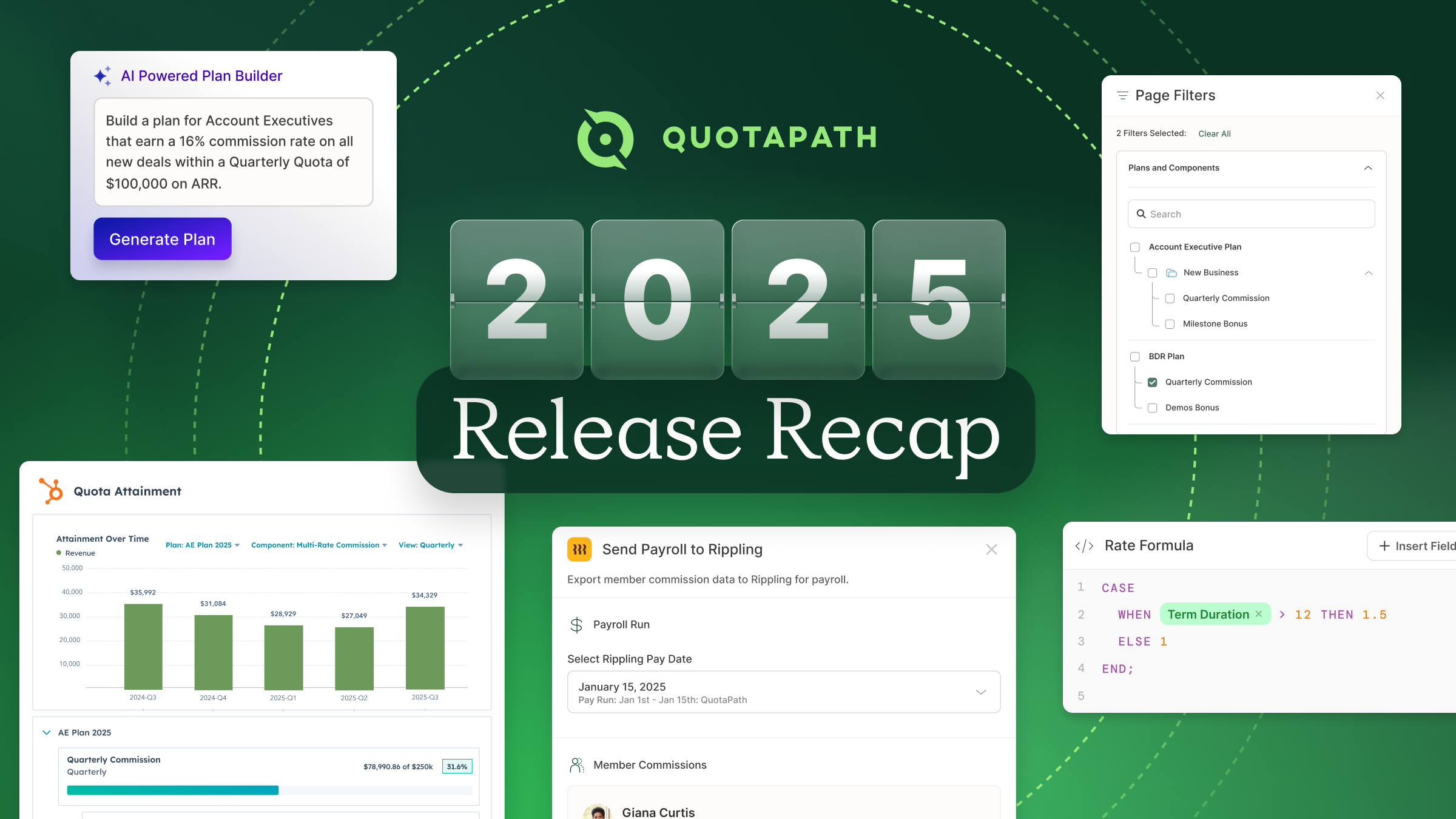
ai powered plan builder

AI-Powered Plan Builder (Launched Q1 2025)

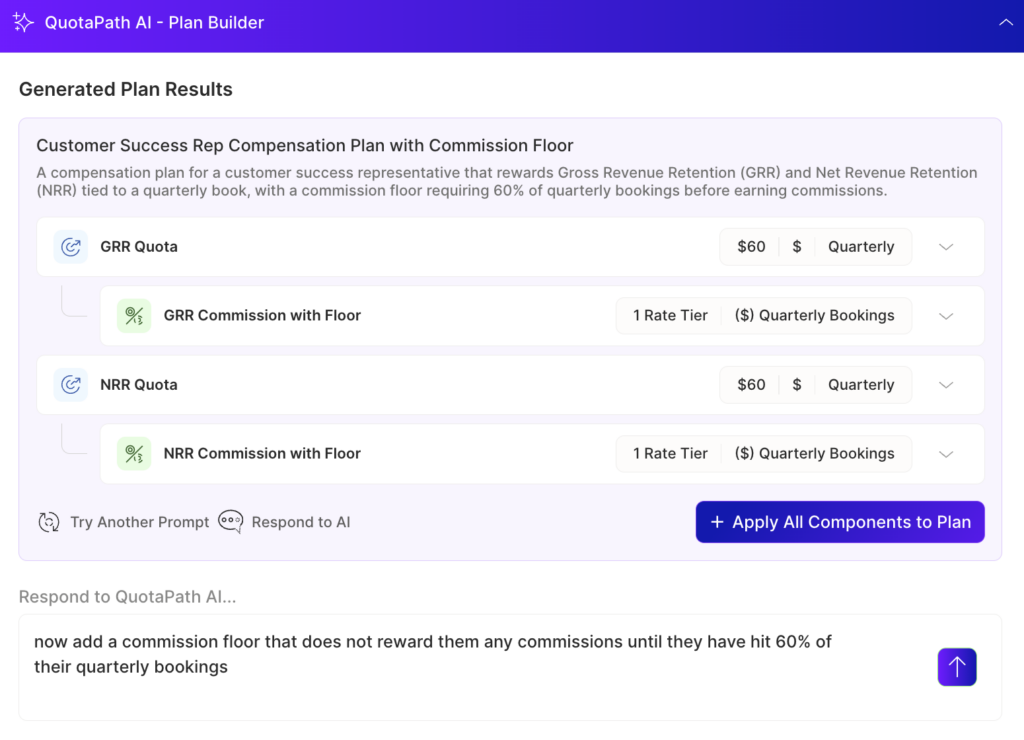
Our AI-Powered Plan Builder kicked off the year with the industry’s first-ever AI tool to translate comp plans into QuotaPath.

  • Start from a prompt or upload your comp plan document.
  • Generate fully structured plans in seconds with 20+ pre-built components.
  • Easily edit, optimize, or update plans in a visual, drag-and-drop interface.

Admins can now build plans in record time.
Reps get clearer compensation paths.
And RevOps teams can finally scale their comp design efforts.

“This a great use case for AI,” said RevOps Co-Op Founder and CEO Matthew Volm. “It’s giving someone a head start with a comp plan, a key part of every revenue operator’s day-to-day, and it does it on the first try. You can’t really ask for anything more than that.”

rippling quotapath

Rippling Integration (Launched Q1 2025)

We followed that up with another industry-first. Our QuotaPath and Rippling integration

This marked the first time a compensation software has integrated with a payroll provider, allowing you to push schedule commission payments from QuotaPath directly into your Rippling payruns. 

Now automate the end-to-end compensation flow, from plan design to payroll payout.

  • Push scheduled payouts directly from QuotaPath into Rippling payroll.
  • Automate user provisioning from Rippling to QuotaPath.
  • Use Rippling credentials for secure SSO access.

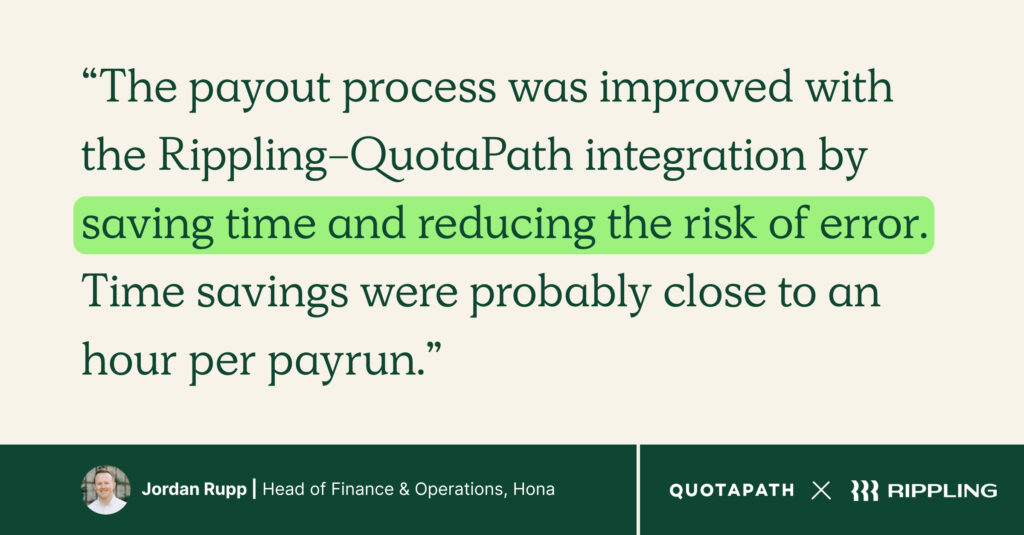
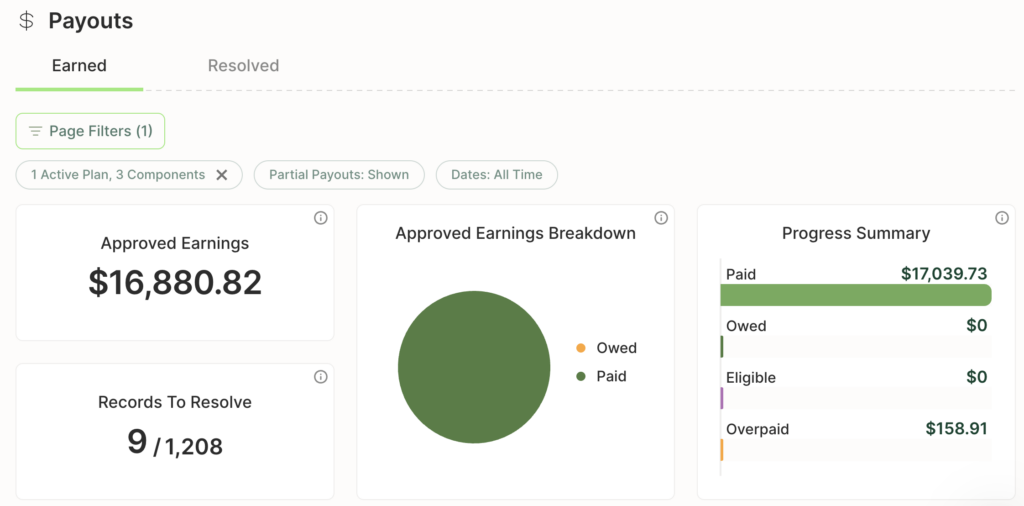
“With this integration, I don’t have to triple-check payout totals anymore. The data is consistent across systems, and the risk of errors is dramatically lower,” said customer Joan Schiffer, Director of Accounting at Virtuous. This Rippling integration eliminates CSV exports, reduces payout errors, and saves time across Finance and People Ops teams.

quotapath filters

Smarter, Stronger Core Workflows

Then we focused on the organization and navigation of how you interact with and locate your data in QuotaPath.

Component Folders & Cards (Rolled Out April 2025)

In April, we set up Component Folders so that you can organize earnings logic that groups related plan elements, like “New Business” or “Multi-Year Deals.”

This makes it easier to:

  • Compare earnings and attainment by type.
  • Understand quota progress in real time.
  • Provide reps with visual clarity on how they get paid.

Upgraded Tables & Filtering (Q2 2025)

Next, we revamped core navigation and data views to reduce friction:

  • Table filtering and column customization across Earnings, Attainment, and Deals pages.
  • Persistent filters for faster workflows.
  • Better sorting and visibility for multi-team orgs.

Source Record Pages & Mapping Improvements

And a huge win for admins: new integration pages that reflect exactly what deal data synced in, where it came from, and why it mapped (or didn’t).

We also improved mapping workflows with in-app testing, clearer error messaging, and naming tools to reduce mapping guesswork.

Performance, Accuracy, and Scale

And since commission data is hefty, we invested in data architecture, integrations, and validation. 
Cached Earnings Calculations + New Integration Architecture

For instance, we re-architected how QuotaPath processes data to:

  • Load large earnings tables faster.
  • Eliminate repeated calculations on every page refresh.
  • Improve platform performance and accuracy at scale.

Data Validation and Sync Confidence

Plus, admins can now preview, validate, and troubleshoot syncing records with confidence using:

  • Source record search and visibility.
  • Workspace sync status.
  • Real-time sync alerts and email notifications.

“QuotaPath connects to Salesforce and pulls in everything we need. We use it to validate data, track performance, and run accruals in under an hour,” said Cara Hickey, Senior Manager of Global Sales Compensation at AlphaSense.

Streamline commissions for your RevOps, Finance, and Sales teams

Design, track, and manage variable incentives with QuotaPath. Give your RevOps, finance, and sales teams transparency into sales compensation.

Talk to Sales

Under-the-Radar Wins That Drove Real Impact

However, not every improvement was flashy. Some of the most appreciated ones came from thoughtful UX tweaks and time-savers:

  • Shareable attainment graph URLs
  • Bulk Earnings Overrides
  • New Member Page Export & Visibility Controls
  • Lead & Invoice object support for HubSpot users
  • Hourly sync options
  • Custom date templates
  • Clipboard actions for fast table copying
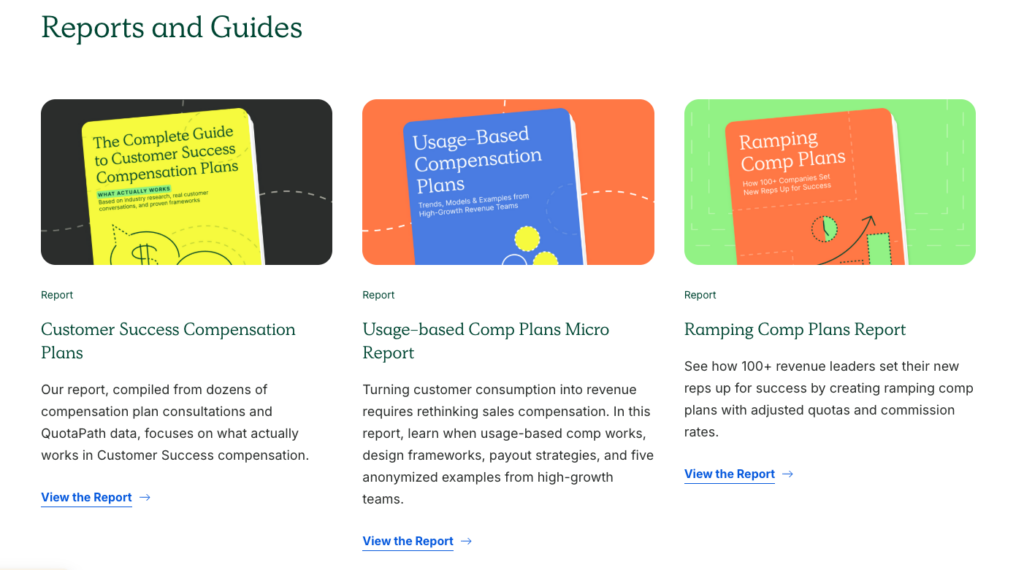
compensation reports

Resources Shared With Our Community

Additionally, to support our customers beyond the product, we released ungated content and tools designed to help RevOps and Finance teams navigate comp complexity.

Strategic Reports

Interactive Calculators

Try QuotaPath for free

Try the most collaborative solution to manage, track and payout variable compensation. Calculate commissions and pay your team accurately, and on time.

Start Trial

Looking Ahead to 2026

While we’ve got a lot to celebrate in 2025, our plan for next year is even bigger.

 Coming in early 2026:

  • Dynamic Quotas
  • Payout Eligibility Preview
  • New “Draws” component type
  • Even more powerful HubSpot and Salesforce experiences

As always, thank you to our customers and partners for pushing us to deliver a better way to build, track, and manage compensation.

Here’s to another year of alignment, accuracy, and automation.

Want to talk about your 2026 comp plans? Schedule time with us here.

5 Customer Wins: How QuotaPath Empowered RevOps in 2025

quotapath customer wins

As teams transitioned from 2024 into 2025, the rising demand for compensation visibility, automation, and trust was undeniable.

Organizations needed real-time insights into earnings, forecasting, performance, and compliance; automation to streamline compensation management; and confidence that every calculation, payout, and forecast was accurate.

We’ve identified five companies that exemplify operational excellence achieved with QuotaPath…simplifying processes, improving accuracy, and restoring trust at scale.

Ready to join them?

Streamline commissions for your RevOps, Finance, and Sales teams

Design, track, and manage variable incentives with QuotaPath. Give your RevOps, finance, and sales teams transparency into sales compensation.

Talk to Sales

5. AlphaSense: Cutting Accrual Prep from 3 Days to 40 Minutes for 1000+ reps

AlphaSense reduced accrual time by 90%, simplified hundreds of complex plans, and delivered much-needed transparency to their reps and finance teams by switching to QuotaPath.

Champion: Cara Hickey, Senior Manager of Sales Compensation, Global

Challenge: AlphaSense’s prior vendor overpromised and underdelivered, leaving a 1,000+-person global org to firefight manual accruals and errors.

Solution: After a successful past experience, Cara reintroduced QuotaPath across the global team. The rollout was completed in under 3 months.

ROI:

  • Reduced accrual prep time from 3-4 days to under 40 minutes.
  • Freed the comp team to focus on strategy, not data cleanup.

“It took us previously three to four days to pull an accurate accrual. I pull it now in a matter of 20 to 40 minutes,” said Cara.

4. Actabl: Evaluated 5 Tools to Scale with Simplicity

Actabl shaved hours each month off commission processes while increasing visibility, rep trust, and audit-readiness by using QuotaPath.

Champion: Kenza Sebbar, Senior Director of Business Operations

Challenge: Actabl outgrew spreadsheets and needed robust forecasting, approval workflows, and Salesforce integration. They evaluated four vendors.

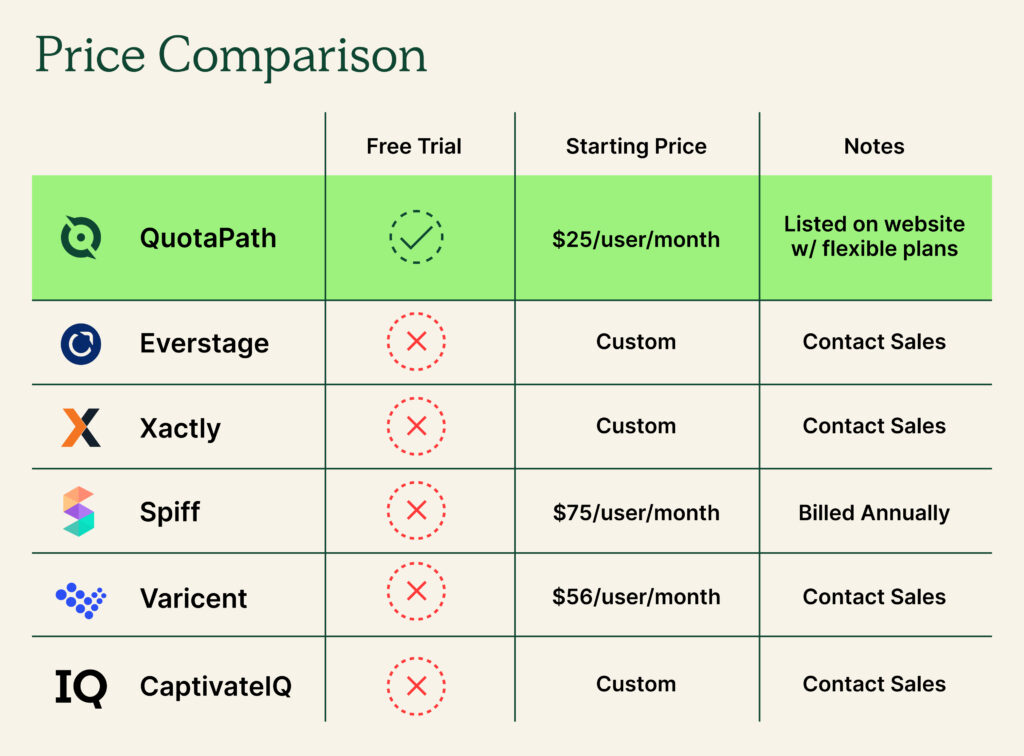
Solution: Selected QuotaPath over Spiff, CaptivateIQ, and Everstage for ease of use, pricing transparency, and implementation speed.

ROI:

“We looked at four different tools…QuotaPath stood out because of how user-friendly it was and the support behind it. It checked every box we needed for the long-term,” said Kenza.

quotapath rippling integration

3. Virtuous: Gaining Control and Clarity Across Teams with Rippling Integration

Virtuous reduced compensation errors, shortened pay runs, and gained complete peace of mind by using the QuotaPath + Rippling integration to close the loop from commission calculation to payroll.

Champion: Joan Schiffer, Finance Lead

Challenge: Virtuous needed flexibility to manage multiple comp plans for RevOps, AEs, and CS teams while integrating with Rippling and HubSpot.

Solution: Adopted QuotaPath to automate payouts, centralize comp data, and support accurate forecasting.

ROI:

“QuotaPath helps me keep my sanity… It’s the one place where I can control comp, track against it, and say ‘here’s what changed and why,’” said Joan.

2. Whistic: Cutting Commission Cycles from 7 Hours to 30 Minutes

Whistic boosted efficiency, reduced administrative burden, and gave their sales team real-time visibility into earnings with QuotaPath.

Champion: Taggart Befus, Revenue Operations Manager

Challenge: Whistic tried Spiff but reverted to spreadsheets due to complexity and usability issues.

Solution: Chose QuotaPath for its intuitive interface, accuracy, and native Salesforce integration.

ROI:

“Instead of spending hours validating and recalculating numbers, we can run commissions quickly and accurately,” said Taggart.

1. Gappify: Building Trust and Motivation Through Real-Time Clarity

Gappify reduced manual admin work, improved payout accuracy, and provided its sales team with real-time visibility into earnings, boosting motivation and performance by using QuotaPath.

Champion: James Hall, EVP of Revenue

Challenge: Managing 20 comp plans via spreadsheets created time drains, inconsistencies, and low rep trust.

Solution: Adopted QuotaPath with real-time Salesforce sync, implementing plan variants and payout rules for scalability.

ROI:

“It’s not just the time savings for me, but the positive impact on motivation for our sales team,” said James.

Try QuotaPath for free

Try the most collaborative solution to manage, track and payout variable compensation. Calculate commissions and pay your team accurately, and on time.

Start Trial

What These 5 Wins Tell Us About Scaling Smart in 2025

These five stories show that QuotaPath enables RevOps and Finance leaders to scale compensation operations with clarity and confidence. In 2025, automation and accuracy are no longer luxuries—they’re compensation essentials, and speed to value matters more than ever. The ROI is twofold: time saved and trust restored across RevOps, Finance, and Sales.

See how QuotaPath can help you scale compensation operations with clarity and confidence. Schedule a demo or start a free trial today.

What Finance Needs to Know Before Rolling Out 2026 Variable Pay

variable pay finance

If you’re a finance leader in a January through December fiscal year, December represents both your year-end close and your deadline for finalizing 2026 variable pay. 

Waiting until March or April to release new plans is a pattern many teams fall into, and the consequences are predictable: frustrated reps, inconsistent accruals, and commission expenses that catch everyone by surprise.

As our VP of Go-to-Market, Ryan Milligan, put it during a recent webinar, “Businesses feel the pain of rolling out next year’s comp plans in March because reps are selling for months against a plan they don’t know.” 

That uncertainty leads to turnover, demotivation, and messy handoffs between RevOps and Finance.

This guide breaks down four things Finance must lock in before the ball drops:

  1. Business goals
  2. ASC 340/606 implications
  3. Budgeting and headcount
  4. Automation readiness.

And at the end, we’ll link to a walkthrough showing how QuotaPath streamlines ASC 606 compliance for commission accounting.

finance variable pay in quotapath

Start with the Business, Not the Plan

Before touching formulas, rates, or accelerators, Finance should anchor 2026 variable pay to the company’s 2025–2026 goals. It sounds obvious, but it’s the most common gap between Sales and Finance.

Finance is responsible for cash stewardship and board expectations. Sales is responsible for motivation, clarity, and revenue. 

Those motivations aren’t oppositional… but they need to be aligned early.

“Wouldn’t you hate to spend hours on a fantastic plan just to hear, ‘This doesn’t align at all with the company’s goals for the next year’?” said Amy Walker, CPA and Partner of Walker Glantz.

Start with a simple discovery conversation with RevOps and the CRO:

  • What revenue and cash burn targets define success in 2026?
  • Do we need to push multi-year or multi-product deals to improve NRR?
  • Are we shifting the mix between new business and expansion?
  • What buyer behaviors do we need to encourage or reduce?

Ryan advises approaching the CFO relationship like rep discovery: “You should interview your CFO the same way you’d interview a rep about their opinion of the comp plan.”

Doing this now prevents the late-stage rejection of an otherwise great plan.

Understand How ASC 340/606 Will Treat 2026 Variable Pay

Once the goals are clear, Finance should translate them into ASC 340/606 realities. This is where plan design and accounting collide.

ASC 340 often requires certain commissions, especially those tied to customer acquisition, to be capitalized and amortized over the customer’s anticipated life. ASC 606 then dictates when revenue is recognized, which impacts the timing of commission expense.

This is where many plans unintentionally get expensive. A simple switch, such as paying on the total contract value (TCV) instead of the annual contract value (ACV) or introducing a renewal commission, can meaningfully change amortization schedules.

“Those details are so important to iron out before the year even starts,” said Amy.

Finance should ensure the plan includes:

  • Clear rules for when commissions are earned vs. paid
    (e.g., payment begins when billing begins)
  • Treatment of multi-year contracts and delayed billing starts
  • Rules for clawbacks, cancellations, and churn
  • Distinction between commissions that must be capitalized vs. expensed immediately

Without this clarity, RevOps and Finance end up doing interpretive accounting every month… something no team wants in Q1.

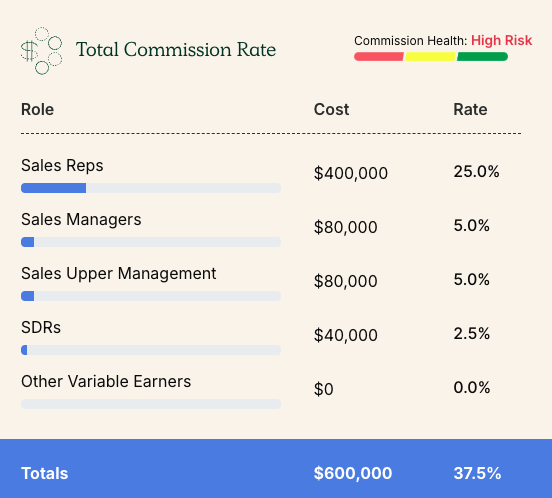
total commission rate

Total Commission Rate Calculator

Find the full cost of commissions per deal across roles with our free Total Commission Rate Calculator.

Use Calculator

Budget & Headcount: Can You Actually Afford This Plan?

With accounting rules in place, the next step is simple but essential: Can the business afford the 2026 plan?

Finance should start by evaluating the 2024 data:

  • Total commissions paid
  • Total new + expansion revenue
  • Average effective commission rate
    (total commissions ÷ revenue influenced)

This gives a baseline for what’s healthy, what’s trending upward, and what needs adjusting.

Next, layer scenario modeling for 2026:

  • What happens at 80% attainment?
  • At 100% attainment?
  • At 120–130% attainment?
  • What’s the cost impact of accelerators, multipliers, or SPIFs?


“You can hit your revenue target but overspend on commissions, and suddenly, finance is having an uncomfortable board conversation,” said Ryan.

From there, connect the model to headcount planning:

  • Revenue target ÷ realistic quota per rep = required productive heads
  • Adjust for average ramp (usually 3–6 months)
  • Factor in expected attrition and time-to-fill
     

“My biggest fear was, did I miss something, and we’re going to not be able to afford this plan?” Amy said.

Modeling in December eliminates that fear and prevents mid-year resets that erode trust with reps.

Automation Readiness: Spreadsheets Won’t Survive 2026

Even when the plan is sound, spreadsheets can still break everything.

Manual commission processing often leads to:

  • Formula mistakes
  • No audit trail
  • Version confusion
  • Late closes
  • Reps disputing payouts
  • Inconsistent ASC 606 support

Amy shared an example of a client of theirs who relied on spreadsheets.

“Their sales reps were calculating their own commissions and turning them into payroll,” Amy said. 

Under ASC 606/340, manual processes increase audit risk and make it nearly impossible to maintain amortization schedules accurately.

Finance should validate that for 2026, the business has:

  • Centralized, documented plan logic
  • Reliable CRM → revenue → commission mapping
  • Automated calculations tied to deal data
  • Exportable, audit-friendly reports
  • Controls for approvals, changes, and historical adjustments

This is where tools like QuotaPath become a critical part of the finance tech stack. QuotaPath helps teams model new plans, automate calculations, enforce rules, and produce the exportable reports auditors expect, especially around ASC 606.

A Simple December Checklist for Finance

By December 31, Finance should be able to say “yes” to the following:

  • We aligned with CRO/RevOps on 2026 revenue, cash, and behavioral goals.
  • We understand ASC 340/606 implications of the 2026 plan and documented the accounting rules.
  • We modeled total commission cost across low/target/high attainment scenarios.
  • We validated headcount, ramp, and quota assumptions for 2026.
  • We confirmed our commission system can support ASC 606 reporting and audits.

If not, there’s still time to fix it.

Streamline commissions for your RevOps, Finance, and Sales teams

Design, track, and manage variable incentives with QuotaPath. Give your RevOps, finance, and sales teams transparency into sales compensation.

Talk to Sales

Want to See How Your Plan Performs Under ASC 606?

QuotaPath can show you:

  • How your 2024 commission structure would be amortized under ASC 606
  • How 2026 plans will calculate automatically
  • How to model winners/losers, total cost of commissions, and headcount impacts
  • How Finance can get clean, repeatable exports for audits and month-end close

Book a demo today.

Best Alternatives to Qobra Compensation Software (2025 Review)

Qobra alternatives

While platforms like Qobra are designed to streamline sales compensation management, not all solutions are suitable for all companies.

Reviewers on G2 and Capterra reported issues with Qobra, including slow data updates, limitations in the mobile user interface, and challenges with customizing advanced plans. The increasing need for transparent, flexible, and self-service compensation automation tools is driving a demand for solutions that provide greater visibility to reps and leaders while facilitating the configuration and adjustment of custom plans.

With a growing number of pay transparency laws, 79% of employees pushing for visibility, and 97% of leaders finding it challenging to simplify comp plans, teams are re-evaluating whether Qobra can keep pace.

These needs are prompting them to consider an alternative to Qobra.

Streamline commissions for your RevOps, Finance, and Sales teams

Design, track, and manage variable incentives with QuotaPath. Give your RevOps, finance, and sales teams transparency into sales compensation.

Talk to Sales

Qobra Alternatives Comparison Table

This quick snapshot of Qobra competitors will help you identify your best alternative to Qobra compensation software.

#NameScoreDescription
1QuotaPath4.7Easy-to-use, scalable commission automation tool with real-time commission dashboards and AI-powered plan builder.
2Everstage4.9Commission automation tool, focused on transparency and gamification.
3Xactly4.3Enterprise-grade ICM platform with advanced analytics and forecasting tools.
4Spiff4.7Flexible logic-based commission platform that mimics spreadsheet formulas with automation.
5Varicent4.5Enterprise ICM solution with deep modeling and compliance functionality.
6CaptivateIQ4.7Flexible mid-market to enterprise spreadsheet-style commission automation tool for finance and RevOps teams.

Alternatives and Competitors Summary

A more detailed look at each of these Qobra competitors will help narrow your selection.

#1 QuotaPath

Rating: 4.7

Overview: Modern, user-friendly sales compensation platform for revenue operations (RevOps), Finance, and Sales.

Key Strengths:

  • Real-time commission tracking
  • Self-service compensation modeling
  • CRM and payroll integrations
  • AI Commission Plan Builder for instant comp creation

Ideal For: Mid-market sales orgs looking for transparency and automation while scaling.

Pricing: Starts at $25/user/month with a 14-day free trial.

Customer Quote: “From setup to daily use, QuotaPath has made my life easier, made our reps happier, and saved us hours.”

#2 Everstage

Rating: 4.9

Overview: Modern sales compensation software for engagement-driven teams

Key Strengths:

  • Gamified commission dashboards
  • Slack notifications
  • Real-time sales performance management

Ideal For: medium-to-large businesses

Pricing: Contact sales

Customer Quote: “Everstage is super easy to use, loaded with features, and integrates effortlessly with our existing tools. It makes managing sales performance and incentives a breeze.”

#3 Xactly

Rating: 4.3

Overview: Enterprise-level incentive compensation management (ICM) system

Key Strengths:

  • Quota forecasting
  • Territory management
  • Analytics

Ideal For: Large organizations with complex compliance needs

Pricing: Contact sales

Customer Quote: “Xactly has transformed the way we manage our compensation program—what used to take days now takes hours and keeps our teams focused on the right metrics.” (source: Benzinga case study on Xactly website)

#4 Spiff

Rating: 4.7

Overview: Variable compensation software for revenue operations (RevOps) teams

Key Strengths:

  • Spreadsheet-style interface
  • Flexible compensation design
  • Sales performance analytics & commission reporting

Ideal For: RevOps teams who want custom logic and transparency

Pricing: Starts at $75/user/month, billed annually

Customer Quote: “Spiff Analytics has really enhanced the level of visibility that we have been able to review on our monthly commission calls to specifically drill into the largest opportunities, to make sure the right people are getting tagged to them, and that the payouts are accurate.” (Source: spiff.com)

#5 Varicent

Rating: 4.5

Overview: Legacy enterprise-grade commission management platform built for data governance and advanced modeling.

Key Strengths:

  • Flexible plan customization
  • Seamless CRM & payroll integrations
  • Sales performance analytics & commission reporting

Ideal For: Global organizations managing high-volume transactions.

Pricing: Starts at $56/user/month – contact sales

Customer Quote: “The flexibility of the system is outstanding. We have changed plans and structures to support our sales organization, and Varicent is capable of handling each change. We have both account-owning and vendor-facing sales associates- each with unique needs for defining territories and crediting sales.” 

#6 CaptivateIQ

Rating: 4.7

Overview: Flexible spreadsheet-style interface for finance and revenue operations (RevOps) teams.

Key Strengths:

  • Flexible compensation design
  • Compensation modeling
  • Sales performance analytics & commission reporting

Ideal For: Mid-market to enterprise.

Pricing: Contact sales

Customer Quote: “CapitivateIQ is so flexible…it’s easy to bulk-load [and bulk-analyze] commission plans. It’s been very easy for the tool to grow with us.” 

qobra alternative quotapath

Other Notable Alternatives

Some additional Qobra alternatives to consider include:

  • Performio: Strong workflow automation; less intuitive UX.
  • Anaplan: Designed for large, complex organizations. Configuration may require more time.
  • Forma.ai: AI-driven comp automation, still maturing in usability.

Making the Switch: How to Migrate from Qobra

Use these steps and best practices for an efficient migration once you’ve selected the best Qobra alternative to meet your needs.

Data Export & Preparation

  • Before you can migrate to your new solution, you must prepare your data.
  • Export your plans, historical data, and payout history.
  • Review the exported data for inconsistencies or errors before importing it into your new sales commission software.

Choosing a Migration Timeline

These best practices will help you minimize disruptions as you prepare to migrate to your commission automation tool.

  • Align with the compensation cycle: The best migration date is at the end of a month, quarter, or year.
  • Consider a phased rollout: Implement core features first, then launch more advanced modules later. This accelerates time-to-value and reduces confusion.
  • Include a buffer in your timeline: Even the best-laid plans don’t always go smoothly, so allot additional time for delays or unexpected issues, particularly for complex data migrations and integrations.

New Software Onboarding

Consider these tips when onboarding your new sales compensation software.

  • Trial QuotaPath’s AI Commission Plan Builder
  • Provide comprehensive training
  • Gather feedback
  • Use QuotaPath’s free setup support.
Try QuotaPath for free

Try the most collaborative solution to manage, track and payout variable compensation. Calculate commissions and pay your team accurately, and on time.

Start Trial

Why QuotaPath Leads as the #1 Qobra Alternative

For teams evaluating Qobra competitors or comparing Qobra vs. QuotaPath, the data clearly indicates that QuotaPath is the best Qobra alternative, delivering a transparent, flexible, and self-service sales commission automation solution.

Below are the key advantages that set QuotaPath apart from other sales compensation software options.

Your 2026 Customer Success Comp Plan Playbook

CS Comp Plans report and examples

If there’s one thing every revenue leader agrees on, it’s that Customer Success compensation is hard to get right. Designing a plan that motivates retention, rewards expansion, and doesn’t accidentally pit CS against Sales can feel impossible.

That’s exactly why we built The Complete Guide to Customer Success Compensation Plans: What Actually Works.

It’s our most comprehensive look yet at how high-growth SaaS, healthtech, and fintech companies are structuring compensation for 2026, based on hundreds of compensation consultations, QuotaPath data, and the real frameworks teams are using today.

As per usual, it’s ungated. Read the full guide online and download a copy for your planning sessions.

Customer Success Comp Plans report

Report: Customer Success Compensation Plans

Build a CS comp model that motivates your team, aligns with your company goals, and scales as you grow

Read Full Report

Why CS Comp Plans Still Lag Behind Sales Plans

Sales compensation gets all the attention—accelerators, tiering, SPIFFs, and endless debate over base-to-variable ratios.
Meanwhile, Customer Success often gets a flat bonus or a vague “NRR goal.”

As Ryan Milligan, QuotaPath’s VP of RevOps and Sales, put it: “Most organizations over-engineer sales comp and under-think CS comp, even though CS manages the majority of their revenue.”

Your CS team is the backbone of revenue retention. They directly influence 80–90% of your company’s recurring revenue. Yet many teams still struggle to connect pay to what actually drives outcomes, like renewals, expansion, and advocacy.

Four Proven Models That Actually Work

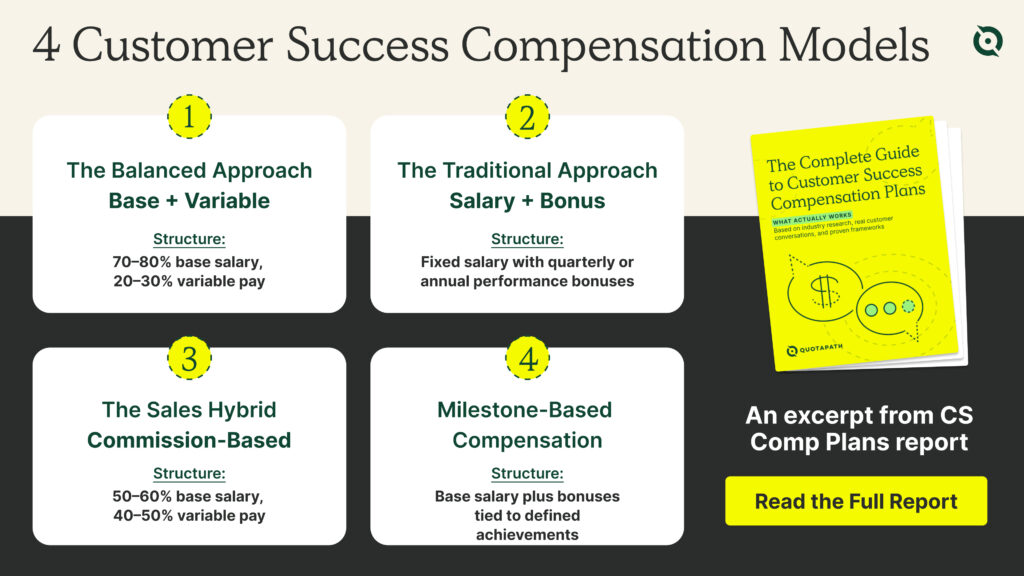
After hundreds of plan reviews, four structures consistently stand out:

  1. Base + Variable (Balanced Approach)
    • 70–80% base / 20–30% variable.
    • Rewards retention and upsell metrics equally.
    • Works best for established CS orgs with reliable data.
  2. Salary + Bonus (Traditional)
    • Fixed pay with quarterly or annual bonuses.
    • Perfect for early-stage teams still maturing metrics or roles.
  3. Commission-Based (Sales Hybrid)
    • 50–60% base / 40–50% variable.
    • Ideal for CS teams directly influencing upsells and renewals.
  4. Milestone-Based (Project Focused)
    • Base pay plus bonuses tied to implementation or adoption milestones.
    • Great for onboarding or enablement-focused teams.

Each model balances motivation with predictability—a theme that came up in nearly every consultation.

GRR, NRR, and the Metric That Matters Most

When it comes to measurement, most confusion starts with the alphabet soup.
Here’s the quick breakdown we share in the report:

  • GRR (Gross Revenue Retention) = How well you keep what you already have.
  • NRR (Net Revenue Retention) = GRR + expansion − contraction.
  • Expansion Revenue = Growth inside existing accounts.

Ryan Milligan’s take: “Ask yourself whether you’re smoothing earnings or smoothing commission rates. CSMs don’t control when their book renews, so the plan should smooth earnings.”

The guide walks through examples of each model, how to align variable pay with renewal cycles without creating volatility for reps.

What the Best-in-Class Teams Do Differently

Across industries, the top-performing CS organizations share three habits:

  1. They start simple. Early plans focus on GRR and customer health, not 10 KPIs.
  2. They evolve with data. As forecasting improves, they add expansion components.
  3. They separate GRR from NRR. That way, one big upsell can’t mask churn.

These companies treat their CS comp plan as a living system, not a one-time spreadsheet.

Streamline commissions for your RevOps, Finance, and Sales teams

Design, track, and manage variable incentives with QuotaPath. Give your RevOps, finance, and sales teams transparency into sales compensation.

Talk to Sales

Real-World Examples

Inside the report, you’ll find anonymized snapshots from companies that made the shift:

  • Enterprise SaaS Team: 75 / 25 split; retention 60% + expansion 40%; +15 points NRR in 12 months.
  • Mid-Market SaaS Provider: Hybrid model with GRR floor of 90%; +25% expansion revenue.
  • Healthcare Tech Company: Moved to quarterly GRR-based variable pay; cut churn 8% in two quarters.

Each example includes plan structure, payout logic, and measurable outcomes.

Our Best Advice for 2026 Planning

  • Start with clarity. Everyone on your CS team should know exactly how they earn.
  • Keep metrics measurable. If you can’t track it cleanly, don’t pay on it.
  • Align timing. Pay frequency should match performance cycles.
  • Revisit quarterly. Compensation is a strategy, not a set-and-forget line item.

Read the full ungated guide and download your copy here. You’ll get frameworks, formulas, and quotes from dozens of RevOps and CS leaders.

Want additional help designing your 2026 CS plan? Book a free Comp Plan Consult with our team. We’ll help you turn the guide’s models into a plan tailored to your org.

Aligning 2026 Comp Plans with Your Board’s North Star Metrics

align your board

December is the time of year when annual planning cycles take place — board decks are finalized, budgets are set, and compensation structures are under scrutiny. Leaders want to drive efficient growth, but compensation metrics often lag behind board planning metrics, such as Gross Revenue Retention (GRR), Customer Acquisition Cost (CAC), and cash flow.

Achieving alignment is a challenge, as only 40% of sales organizations say their compensation plans align directly to their company’s top financial goals, according to QuotaPath’s 2024 Sales Compensation Plan Report.

In this post, we’ll provide frameworks and real examples to help leaders translate these strategic metrics into practical comp mechanics that drive multi-year deals, upsells, and high-margin ideal customer profiles (ICPs).

north star metric board reporting

Understanding Your Board’s North Star Metrics

Before you can achieve 2026 compensation plan alignment with your board’s priorities, you must understand what a North Star Metric is and how it relates to sales comp plan strategy.

What a North Star Metric Really Is

A North Star Metric (NSM) is a predictive, measurable, cross-functional signal of success. Not another key performance indicator (KPI) — the NSM is a single number that the entire organization can focus on to drive business growth.

Examples of effective NSMs include: 

  • % of revenue from high-retention customers: The percentage of the company’s revenue from customers with a high estimated lifetime value (LTV) and low churn risk—typically those that fit your ideal customer profile (ICP)
  • Net Dollar Retention (NDR): The percentage of recurring revenue retained annually, reflecting customer satisfaction and retention, and helping forecast future revenue.
  • CAC payback period: The time it takes a company to earn enough gross profit back to cover the cost of acquiring a customer, typically measured in months, and often used by subscription businesses such as SaaS.
  • Time to value: The amount of time it takes for a customer to realize the benefits of a product or service. 

Why These Metrics Matter for Comp Design

Unlike most metrics tracked by Finance, the NSM aligns finance, revenue teams, and the boardroom by providing a common focal point. Consequently, it clarifies budget and resource allocation decisions, strengthens compensation plan design, and aligns incentive structures around driving this metric.

Comp levers like commission rate, accelerators, and SPIFs can reinforce or misalign with NSMs based on the behaviors they promote. For instance, incentives that prioritize deal quantity over deal quality are misaligned with an NSM aimed at improving revenue from high-retention customers by reducing the percentage of deals with ICPs. This results in failure to meet board expectations for aspects such as capital efficiency and predictable revenue retention.

Streamline commissions for your RevOps, Finance, and Sales teams

Design, track, and manage variable incentives with QuotaPath. Give your RevOps, finance, and sales teams transparency into sales compensation.

Talk to Sales

Frameworks to Align Comp Plans with GRR, CAC, and Cash Flow

Now that you’ve defined your North Star metrics, the next step is operationalizing them through compensation. Using these comp plan frameworks will help you align and incentivize the right behaviors to drive NSM achievement.

Linking GRR to Renewals and Multi-Year Deals

GRR is essential, with current customers representing 61% of B2B revenue. Rewarding AEs and AMs for achieving renewal rate milestones and multi-year commitments encourages renewals and multi-year deals, driving improvements in Gross Revenue Retention (GRR). 

For instance, a multi-year deal incentive might be offering a 2% accelerator on contracts that increase GRR by X%. Likewise, a renewal rate milestone enables reps to earn a bonus for renewing a specified percentage of their accounts.

In action, we’ve seen customers who have shifted CS compensation from flat bonuses to renewal-linked (GRR-based) incentives lead to meaningfully higher retention, including an 8% churn reduction within two quarters for one customer.

Reducing CAC with Efficiency-Based Comp Levers

Incentivize sales velocity and deal quality, not just quantity, to tie compensation to reducing Customer Acquisition Cost (CAC) while boosting efficiency.

For example: 

  • Lower CAC by paying higher commission rates for ICP deals.
  • Introduce “CAC payback bonuses” for reps with efficient revenue performance.

Driving Cash Flow with Front-Loaded or Margin-Based Incentives

Compensation mechanics, such as accelerators for prepaid contracts and commission multipliers for high-margin product bundles, support cash flow efficiency. For example, tie accelerators to cash paid upfront when a deal closes or reward reps with higher incentives when closing more profitable deals.

Building Buy-In Across Finance, Sales, and the Board

Even the best comp design fails without alignment across stakeholders. Take these steps to gain buy-in across your organization and the Board.

Create a Shared Language Around Metrics

Encourage Finance and Sales to co-own definitions of GRR, CAC, and the NSM. Ask: How do you impact this number? If answers vary, refine the definition until everyone can explain it consistently.

Then share these definitions across the organization. Don’t just share them in a slide presentation. Incorporate them into team meetings, OKRs, onboarding, and comp plan design. Then encourage teams to ask, Will this move the NSM? If not, why are we doing it? Shared ownership of these metrics ensures that compensation decisions are aligned with board priorities.

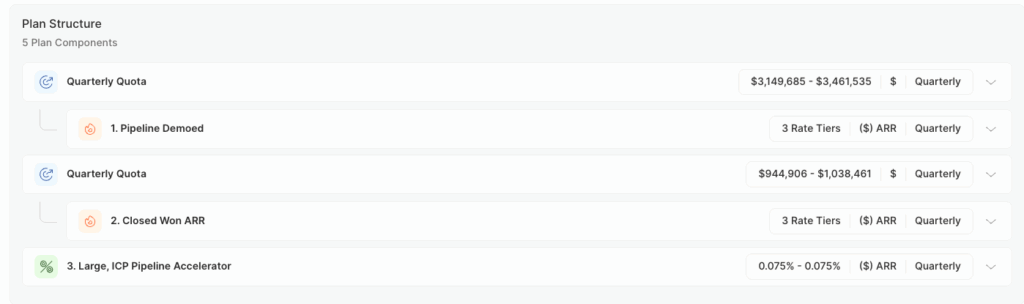
quotapath comp plan
In this comp plan laid out in QuotaPath, the rep earns an accelerator for
generating large ideal customer sales opportunities.

Visualize Comp’s Impact on NSM Movement

Once you implement your NSM, track its impact by team, segment, or region to identify what’s working and celebrate successes. Using dashboards, such as QuotaPath, to show how comp behaviors impact target metrics keeps results visible and easy to capture. For example, when renewal accelerators were added, GRR rose 8% QoQ. These observations help track progress and adjust comp plans accordingly over time.

Present Your Comp Plan in Board Language

Use board planning metrics to secure buy-in when presenting your compensation plan to the board. This helps unite everyone around the NSM while aligning it with the compensation plan.

These tips for formatting comp data in board decks will help improve your comp plan presentation:

  • Highlight metric movement.
  • Show CAC payback improvement.
  • Project cash flow outcomes.

Common Pitfalls When Comp Doesn’t Reflect the NSM

Of course, misalignment can cost you. When sales compensation plans don’t reflect the company’s North Star Metric, teams may optimize for short-term wins instead of strategic growth. Here are a few common pitfalls to watch for: (BULLETS)

Paying for revenue that hurts margins: If comp plans reward total revenue without considering deal profitability, reps may discount heavily to close business. While this inflates bookings in the short term, it erodes margin and cash flow, negatively affecting board-level efficiency goals.

Over-incentivizing short-term deals that increase churn: When reps earn the same reward for all deals, they may prioritize quick wins instead of ICP contracts. This behavior undermines metrics like GRR or CAC by focusing on poor-fit customers who are more likely to churn.

Under-rewarding teams that drive expansion or renewals: Failing to recognize the impact of Customer Success or Account Management teams on revenue can stall growth. If compensation plans overlook upsells, cross-sells, or multi-year renewals, they fail to reinforce behaviors that directly support retention-driven metrics, such as GRR.

Try QuotaPath for free

Try the most collaborative solution to manage, track and payout variable compensation. Calculate commissions and pay your team accurately, and on time.

Start Trial

Bringing It All Together: Comp as a North Star Driver

Comp plans shouldn’t just pay people; they should provide direction. The goal of the 2026 compensation plan alignment is to design incentives that drive achievement of the North Star Metric. When pay structures align with metrics such as GRR, CAC, and cash flow, compensation becomes a strategic lever for efficient and predictable growth.

QuotaPath believes that comp data is strategic data. With the AI-Powered Plan Builder, you can model plans around key metrics, test outcomes, and visualize how changes in incentives impact profitability and retention…before rollout.

Ready to achieve 2026 compensation plan alignment? Schedule time with a team member to see how QuotaPath helps Finance and RevOps teams connect comp to NSMs.

How to Spot Commissions Overpayment Before It Hits Your 2026 Budget

commissions overpayment

Year-end close is revealing uncomfortable truths for many finance teams: commission overpayments have been accumulating throughout the year, and expenses that seemed reasonable suddenly balloon beyond budget projections.

As December wraps up and finance teams compile annual reports, many discover commission overpayments that accumulated throughout 2025. 

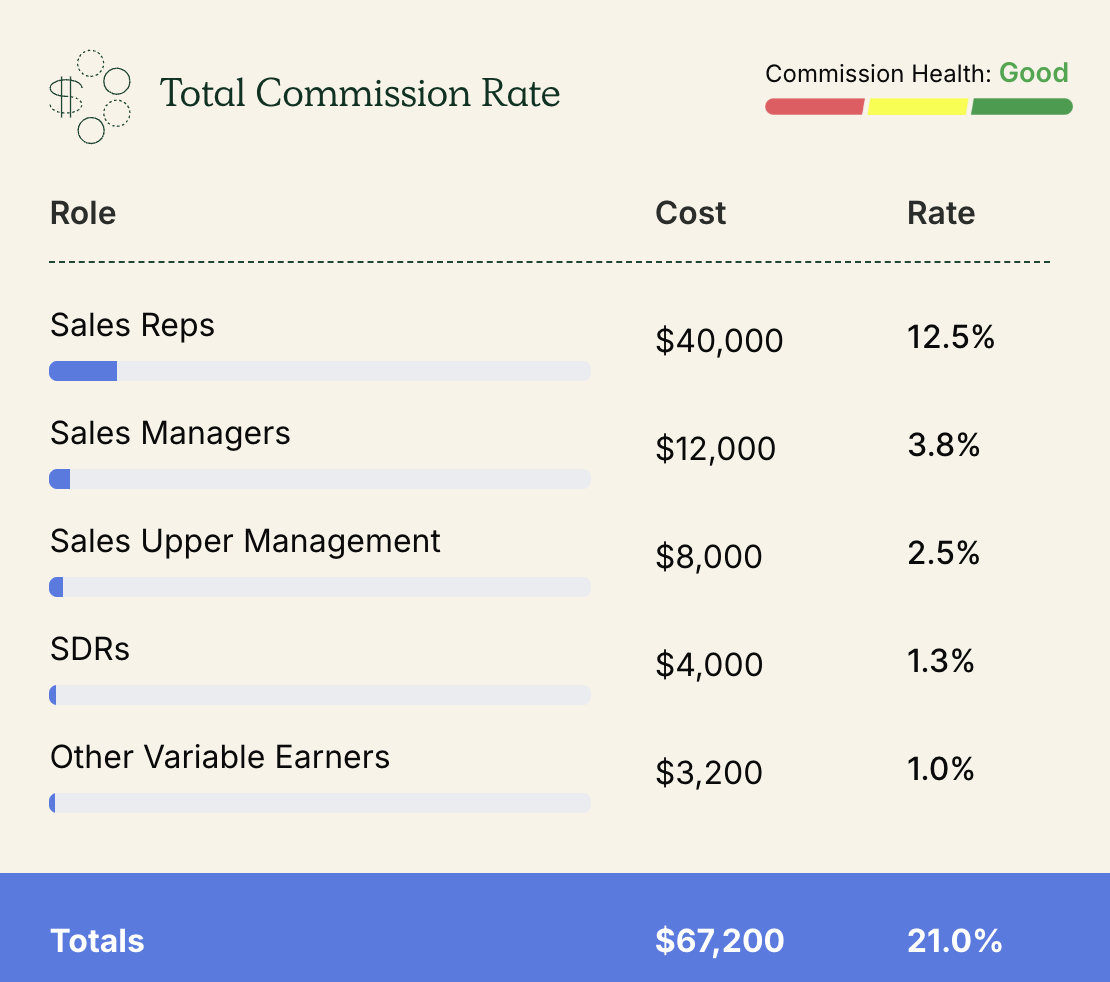
These hidden costs, often 25-35% of deal revenue, don’t appear in standard reporting until it’s too late. By the time teams finalize 2026 budgets, they have inadvertently baked these inefficiencies into next year’s projections.

calculate effective rate

Spot Commissions Overpayment

Use our Total Commission Rate Calculator to see how much your paying at the deal-level for every earner on a deal.

Use Calculator

According to Alexander Group research, sales compensation represents 40% of total sales costs and 7.9% of sales revenue

So, when multiple people touch a deal (like BDRs, AEs, SEs, managers), total commission costs can reach 30-35% without finance teams realizing it. Manual tracking makes these inefficiencies nearly impossible to spot in real-time.

Below, we’ll show you how to identify commission overpayment patterns, calculate the effective commission rate per deal, and implement systems to prevent these issues from impacting your 2026 budget.

The Hidden Cost Problem: Understanding Effective Commission Rate

First up is the hidden cost situation.

While most finance teams track individual commission rates, they’ll overlook the total cost when multiple stakeholders earn on the same deal.

Take for example, your AE closes a $100K deal and earns their standard 10% commission. 

Seems reasonable. 

But that same deal also pays the SDR 5% for the qualified lead, the SE 2% for technical support, and the manager 3% for oversight. Before you account for any accelerators or SPIFs, you’re already at 20% of deal revenue going to commissions.

“You blink and you’re paying 35% of a deal in total commissions once you add up everyone involved. That’s a hidden cost finance leaders need to track,” said Ryan Milligan, GTM Leader at QuotaPath.

We call this your deal-level total commission rate or effective commission rate

It’s calculated by dividing total commission dollars paid (across all recipients) by the deal’s revenue. When this rate exceeds 30%, profitability suffers significantly.

Plus, these commission overpayment inefficiencies often only surface during year-end audits, when it’s too late to correct them. 

Finance teams conducting year-end close right now are discovering overpayments from throughout 2025. Without addressing these patterns, they’ll carry forward into 2026 budgets, which are being finalized in the next few weeks.

Five Red Flags That Signal Commission Overpayment

So, what should you look for to spot overpayment? We highlight five “red flags’ below.

1. Multiple People Earning on the Same Deal

First, draw out who earns commission on a single deal and add it up. 

Because when BDRs, AEs, overlays, and managers all earn commissions on one deal, costs compound quickly. An enterprise deal with $200K ACV can easily pay out 30%+ in total commissions across all contributors. Calculate your deal-level total commission rate to understand the true cost.

Accelerators and SPIFs That Compound Unexpectedly

Then look at your tiered commission structures. 

While we design these to motivate sellers and reward overperformance, they can yield budget surprises if you’re not careful. 

When multiple accelerators stack (quota attainment plus deal size plus product type) the effective rate climbs without visibility. Year-end data reveals these patterns only after the expense has already hit your books.

Lack of Commission Floors for Leadership Teams

Up next, ask yourself, “Do I have commission floors setup for my leadership teams?”

Leadership earning commissions on deals regardless of team performance creates commission overpayment scenarios. Strategic use of floors ,like requiring 80% quota attainment before commission eligibility, prevents overpayment and ensures alignment with business outcomes.

Manual Calculations Leading to Errors

You gotta drop the spreadsheet to exclusively run commissions. 

“G-sheets for 300 reps across five segments is very difficult. Handling disputes, sending out statements … it was all anxiety-inducing,” said Jose Rodriguez, Sales Compensation Strategy at Rippling. 

Manual spreadsheets accumulate errors throughout the year that only surface during reconciliation.

We’ve had customers cross-check their spreadsheets while evaluating QuotaPath, only to find they’ve overpaid/underpaid commissions by hundreds of thousands of dollars. 

No Real-Time Visibility Into Commission Liabilities

Last up, think about how well you’re able to model next year’s plans. If you don’t have a strong modeling system in place, you’re adding unnecessary risk. 

When finance teams can’t forecast liabilities accurately, commission accruals don’t match actual payouts. This inability to model scenarios based on current payout patterns means 2026 budgets are built on guesswork rather than data.

How to Calculate Your Effective Commission Rate

Alas, here’s how to fix it with a systematic approach to audit current commission costs before finalizing 2026 budgets:

Step 1: Identify All Commission Recipients Per Deal

List every role earning commission on deals: SDRs, AEs, overlays, SEs, managers. Include one-time SPIFs, accelerators, and channel partner commissions.

Step 2: Calculate Total Commission Paid Per Deal

Sum all commission dollars across recipients. For a $100K deal: $8K (AE) + $3K (SDR) + $2K (Manager) + $5K (accelerator) = $18K total.

Step 3: Divide by Deal Revenue to Get Effective Rate

Formula: (Total Commission $ / Deal Revenue) x 100 = Effective Commission Rate %. In our example: ($18K / $100K) x 100 = 18% effective rate. Flag any deals over 30% for investigation.

Step 4: Analyze Patterns Across Your Organization

Which deal types have the highest effective rates? Which teams contribute most to overpayment? Has the effective rate increased over time? QuotaPath’s reporting surfaces these patterns automatically without manual spreadsheet analysis.

Step 5: Project Impact on 2026 Budget

Multiply the effective rate by the projected 2026 revenue. Compare to current budget allocations. The gap between projected and actual commission expense is what you need to address before finalizing your 2026 plan.

commission overpayments modeling
Use QuotaPath’s commission modeling.

Prevention Strategies for Your 2026 Commission Plan

Use insights from your year-end audit to redesign 2026 commission structures that prevent overpayment.

Implement Commission Caps and Floors

Set maximum effective commission rates per deal (e.g., 25%) and add floors for leadership tied to team performance. An 80% quota attainment floor ensures managers only earn when their teams succeed, preventing commission overpayment while maintaining alignment.

Use Modeling Tools Before Rollout

Test 2026 plans against 2025 data using scenario modeling. Run attainment scenarios—what happens if 80% of reps hit 75% of quota versus 150%? “You never know when your business is going to grow in a meteoric fashion,” said Ryan Milligan. “You’re not going to pause mid-hypergrowth to fix commissions.”

Automate Commission Calculations

Manual processes led to year-end surprises, and automation prevents them. 

At Hona, CFO Jordan Rupp recognized the risk of manual errors. 

“It was kind of like a breath of fresh air… peace of mind more than anything. Nobody’s fat-fingering anything anymore,” Jordan said of his experience automating commissions with QuotaPath’s integration to HubSpot and Rippling 

Real-time visibility prevents the accumulation of errors throughout the year.

Align Commission Plans with Business Goals

“Use the comp plan to show sellers how they’ll earn more for bringing in long-term, ICP-fit customers,” said Ryan Milligan. “Now Finance and Sales are aligned.” This strategic alignment reduces commission overpayment on low-value deals that don’t support your goals.

Build in Regular Review Cycles

Don’t wait until year-end 2026 to discover new problems. Implement quarterly reviews of effective commission rates and monthly reconciliation with financial reporting. QuotaPath’s ASC 606 compliance features ensure accurate revenue recognition throughout the year.

Try QuotaPath for free

Try the most collaborative solution to manage, track and payout variable compensation. Calculate commissions and pay your team accurately, and on time.

Start Trial

Spot Commission Overpayment Before It Hits Your 2026 Budget

As year-end close reveals commission inefficiencies from throughout 2025, finance leaders have a critical window to address these issues before they’re baked into 2026 budgets.

Calculating effective commission rate by deal exposes the 25-35% hidden costs that standard reporting misses. The five red flags (multiple stakeholders per deal, compounding accelerators, lack of floors, manual errors, and poor visibility) signal where your commission structure needs attention.

There’s no better time than now to look into this. 

Finance teams are finalizing 2026 budgets right now based on year-end 2025 data. Addressing commission overpayment today prevents 12 months of compounding inefficiencies.

“Finance is always worried about overpaying. But worse than that is when reps don’t understand the generous plan you did build for them,” said Thomas Egbert, Head of Finance at Prefect.

The solution? Audit your current compensation structures using effective rate calculations. Model 2026 scenarios before finalizing your budget. And implement automation that prevents manual errors from accumulating throughout the year.

Use QuotaPath to audit your payout history, calculate effective commission rates, and forecast 2026 spend by plan. 

Schedule a demo to see how we help finance teams spot commission overpayments before they impact next year’s budget.

How to Track Split Commissions Between Sales Reps

splitting commissions

Split commissions have become increasingly common when multiple reps work together to close the same deal. SDRs, AEs, AMs, overlay roles, and channel partners collaborate across various stages of the sales process to secure business. Although collaborative selling increases close rates, shortens sales cycles, drives product-led growth, and improves customer satisfaction, it can create conflicts over shared quota credit and fair compensation.

Without proper systems, tracking who gets what share becomes complex and prone to disputes. Spreadsheets, manual calculations, and unclear payout rules often lead to errors, delays, and frustration for both reps and finance teams.

In this blog, we’ll share best practices for effectively managing and tracking split commissions between sales reps, how to avoid common pitfalls, and why QuotaPath is the best solution.

Streamline commissions for your RevOps, Finance, and Sales teams

Design, track, and manage variable incentives with QuotaPath. Give your RevOps, finance, and sales teams transparency into sales compensation.

Talk to Sales

Tracking Split Commissions

When multiple people contribute to closing a deal, defining who earns what portion of the payout becomes essential to maintaining trust and motivation.

Shared commission structures explained

A shared commission structure, also known as a split commission, occurs when two or more reps share credit and payout for the same deal. Instead of one seller receiving the full commission, the total earnings are divided based on each person’s role or contribution.

Shared commissions are common in collaborative sales motions such as co-selling, SDR-sourced and AE-closed deals, account manager and AE partnerships, or territory handoffs between reps. These structures ensure everyone who helps advance or close business receives fair recognition for their impact.

When designed well, shared commissions encourage teamwork, transparency, and fairness across the revenue organization. However, when tracked manually, such as in spreadsheets, split commissions can create disputes, confusion, or shadow accounting as reps attempt to verify their own numbers. That’s why clear rules and automated tracking systems are crucial for accurately managing deal splits and keeping teams aligned.

How to Set Up Split Commissions the Right Way

Follow these three steps to create a clearly defined and accurately tracked shared incentive program with confidence.

Step 1: Decide How Credit Is Split

Start by determining credit allocation among contributors. Popular options for deal splits include percent-based splits and fixed-dollar splits. A percent-based split awards each rep a designated percentage of the total commission. By contrast, a fixed-dollar model rewards each participant with a set amount regardless of the deal’s value.

After deciding how to split the commission, designate who receives the primary or assist credit. Primary credit usually goes to the rep who closes the deal, while assist credit recognizes supporting roles. Finally, determine how the split affects quota retirement by specifying the amount of quota credit each participant will receive. Aligning payout logic and quota credit ensures accurate performance tracking and reinforces fairness across the sales team.

Step 2: Set Eligibility and Timing (Bookings vs. Cash)

Establishing commission payout rules tied to the deal stage and cash collection is crucial when setting up split commissions. Tying shared commissions to the deal stage clearly defines what each team member must do to qualify for their portion of the incentive pay. Rules based on cash collection determine when commission is paid, either when the deal is closed or when a cash payment is received. Clearly defining these rules prevents confusion and disputes while building trust.

Step 3: Capture Splits in Your Plan, Not in Spreadsheets

Using spreadsheets as a commission tracker can lead to errors due to manual data entry, incorrect formulas, and increasingly complex plans. This leads to mistrust when numbers don’t align. Avoid these issues by automating split commission tracking with an incentive compensation management platform like QuotaPath. QuotaPath supports deal splits in complex plans, ensuring every contributor’s share is accurate, transparent, and automatically updated.

Tracking Splits in QuotaPath (from CRM to payout)

QuotaPath makes it easy to track split commissions between sales reps by connecting every step of the process, from deal data to payout approvals, in one transparent workflow. Instead of managing multiple spreadsheets or systems, teams can view, calculate, and verify earnings in real time, ensuring accuracy and alignment across Sales, RevOps, and Finance.

Sync Deals from Salesforce or HubSpot Instantly

QuotaPath connects directly to Salesforce or HubSpot, pulling in deal data, like closed-won amounts, owner details, and contract terms, without the need for manual uploads or spreadsheets. With accurate CRM data and split ownership fields, teams can trust that the right numbers flow seamlessly into sales commission calculations, ensuring current earnings and accurate payouts.

Model and Automate Deal Splits in the Plan Builder

QuotaPath’s AI-powered plan builder streamlines the creation and automation of compensation plans that include deal splits. You can quickly and easily model variants in Plan Builder to visualize the plan before plan rollout, ensuring accuracy. Drag and drop components to build or modify plan structures, model deal split scenarios, and instantly preview how changes affect payouts. Testing these variants before rollout ensures accuracy and saves time.

Approve, Audit, and Schedule Payouts with Confidence

QuotaPath’s customizable approval workflows ensure accuracy and transparency at every step. Managers and reps can review earnings for accuracy before payouts are scheduled, preventing disputes, saving time, and building trust.

avoid commission errors
Resolve commission disputes in-app

Avoid Errors and Disputes on Split Commissions

Follow these best practices to maintain transparency, prevent disputes, and protect audit trails across split payouts.

One source of truth with deal breakdowns

Sales dashboards in QuotaPath provide transparent deal views, allowing each rep to see how and why they earned commissions, reducing misunderstandings while boosting trust and motivation.

Resolve disputes fast with in-app tools

In-app communication tools, such as QuotaPath’s Deal Flagging, enable reps to raise potential issues directly within the platform, creating a clear record for quick dispute resolution and preserving rep confidence.

Lock past periods to protect audit trails

Freeze finalized payout periods to preserve accurate records and maintain audit trails across split payouts. Locking past periods prevents retroactive changes, ensuring that historical earnings remain consistent with approved deals and protecting data integrity for audits and compliance purposes.

Closing the Loop on Split Commissions

With automation, it’s easy to finalize and send commissions to payroll confidently.

Finalize approval with confidence

Confidently finalize payout approvals in QuotaPath, knowing every deal, split, and calculation has been validated throughout the workflow. Transparent review and approval processes ensure commissions are accurate, compliant, and ready for processing.

Push commissions straight to payroll with Rippling integration

Once commissions are approved, send them directly to payroll in just a few clicks with QuotaPath’s Rippling integration—no spreadsheets or manual reformatting required.

Why QuotaPath for Split Commissions

QuotaPath makes it easy to track split commissions between sales reps. With transparency at every step and compensation automation, plus seamless CRM and payroll integrations, QuotaPath eliminates manual errors and confusion from tracking shared commission structures. The result is faster, more accurate payouts, higher trust across teams, and motivated reps who understand their earnings calculations.

Ready to simplify split commissions? Try QuotaPath’s automated deal split tracking. Book a demo today.

How to Test Your Comp Plan

test comp plans

Before rolling out any new plan, it’s essential to test it first. Otherwise, you risk overpayment, underpayment, or demotivating reps. QuotaPath’s 2024 Sales Compensation Plan Report showed that 65% of companies have had at least one rep quit over compensation discrepancies in the last two years.

Even small miscalculations can have outsized impacts. Overpayments can impact budgets, while underpayments can erode trust and morale, especially when payouts fall short of expectations. A plan that looks good on paper can quickly backfire in practice if it hasn’t been tested against real performance data.

Testing prevents surprises and builds trust between Finance and Sales. It ensures everyone can move forward with confidence, knowing payouts are accurate, goals are attainable, and the plan will perform as intended once it goes live.

Below, we’ll discuss:

  • How testing prevents costly surprises by catching over/underpayments early and ensuring reps trust the accuracy and fairness of payouts.
  • Using Draft Mode and modeling in QuotaPath to let teams safely simulate plan performance using real CRM data to identify edge cases, validate assumptions, and stress-test sustainability.
  • Pressure testing with realistic scenarios, like sensitivity analysis, past data overlays, and scenario planning, reveals misalignments before plans go live.
  • How validated plans build confidence, reducing disputes, motivating reps, and giving Finance and Sales alignment on budget impact before rollout.
test comp plans with quotapath's draft plans
Draft Mode in QuotaPath

Testing Prevents Costly Surprises

The fastest way a comp plan can go off the rails is through untested assumptions.

Even one misaligned rate, missing threshold, or incorrectly stacked incentive can swing payouts far beyond what Finance intended, or far below what reps expect. These discrepancies aren’t just numbers on a spreadsheet; they translate directly into budget strain, lost trust, and, in many cases, employee churn. When the math doesn’t match the message, reps lose confidence not only in the plan but in the process behind it.

Testing early protects against surprises by revealing how a plan behaves in real conditions, not just in theoretical models. By previewing payouts using historic data and realistic performance scenarios, leaders can identify where compensation outcomes deviate from expectations. This prevents overpayment, which can quietly balloon commission expenses, and underpayment, which erodes morale and credibility. When teams validate the details before rollout, they avoid last-minute fire drills and tense conversations with reps.

A well-tested plan also strengthens the relationship between Finance and Sales.

Instead of debating numbers after the fact, both teams can evaluate a shared view of modeled results before the plan goes live. This transparency fosters alignment, ensures the plan reflects both budget realities and sales incentives, and gives every stakeholder, from executives to reps, confidence that the payout structure is accurate, intentional, and fair.

Start with Draft Mode and Modeling in QuotaPath

So, how do you test?

The safest way to test a comp plan is to test a new plan against previous data.

In QuotaPath, for example, you build a plan in draft mode, which allows leaders to design and test compensation plans in-app before rolling them out. Think of it as a safe sandbox where you can run plan proposals against current CRM data to estimate the team’s total commissions, identify potential edge cases, and assess how achievable your goals are.

Our customers actually requested the commission plan draft mode feature, and our product team responded by building it.

“Really early on, we provided feedback about wanting to mock up a plan and run scenarios without using the production environment. During our time as customers, QuotaPath built and released Draft Plans. We’ve used it for at least one year of commission planning,” said Genevieve Moss-Hawkins, Systems Operations Manager at NeuroFlow.

Once a plan is set up in Draft Mode, QuotaPath’s compensation modeling tools make it easy to simulate performance scenarios.

For instance, running last year’s sales data against a new plan to spot misalignments or layering in a multi-year accelerator or SPIF to see the impact on compensation costs. Modeling a comp plan shows whether payouts are sustainable if reps outperform, helping Finance and Sales validate plan assumptions and confidently move forward.

Pressure Test with Realistic Scenarios

Once you’ve built a plan in draft mode, the next step is to pressure test it. Check out these Finance Leader-approved best practices to test your comp plan.

  • Run sensitivity analysis: Test individual components, such as quota to OTE, actual commission rates, and SPIFs.
  • Overlay on past data: Apply last year’s results to this year’s plan to see how it would pay someone under the proposed plan.
  • Check bottom-line impact: Start with total commission expense, then work backward.
  • Scenario planning: Model outcomes to see what happens if reps hit 100%, 120%, or higher.
  • Catch overlaps: Ensure bonuses, accelerators, and multipliers don’t stack in unintended ways.

Validate with Past Data

Another effective method is to stress test your plan against past performance. Overlaying last year’s sales data to see how payouts would differ helps confirm that the proposed plan won’t break the budget.

This helps Finance and Sales align faster by comparing modeling versus actual results, identifying and mitigating risks. QuotaPath facilitates this with in-app plan modeling and reporting, eliminating the need for multiple spreadsheets and saving time while increasing accuracy.

Build Confidence Before Rollout

After testing your plan, you’ll have data-backed confidence to roll it out. Testing is not just beneficial for Finance, but also for building rep trust. In fact, testing a plan reduces disputes and motivates reps because payouts feel fair. So, leaders should iterate and retest regularly, not just annually, to keep comp plans aligned with changing conditions.

“I made the pitch to [sales leadership. ‘Hey, look we have these incentive plans, there’s no visibility for the reps on how their pipeline translates to earnings…’ I loved that you could model out the pipeline. because I wanted reps to be able to really see how their pipeline could translate into earnings,” said Thomas Egbert, Head of Finance at Prefect.

Try QuotaPath for free

Try the most collaborative solution to manage, track and payout variable compensation. Calculate commissions and pay your team accurately, and on time.

Start Trial

Next Steps: Test Your Plan in QuotaPath

Ready to see how your comp plan performs under pressure? Look no further if you’re wondering how to test your comp plan. QuotaPath simplifies comp plan modeling and sales commission testing. Start with QuotaPath’s Compensation Hub and AI-powered plan builder. Then, leverage in-app tools to test, model, and refine plans in minutes.

See for yourself. Sign up for a free trial or schedule a demo today.