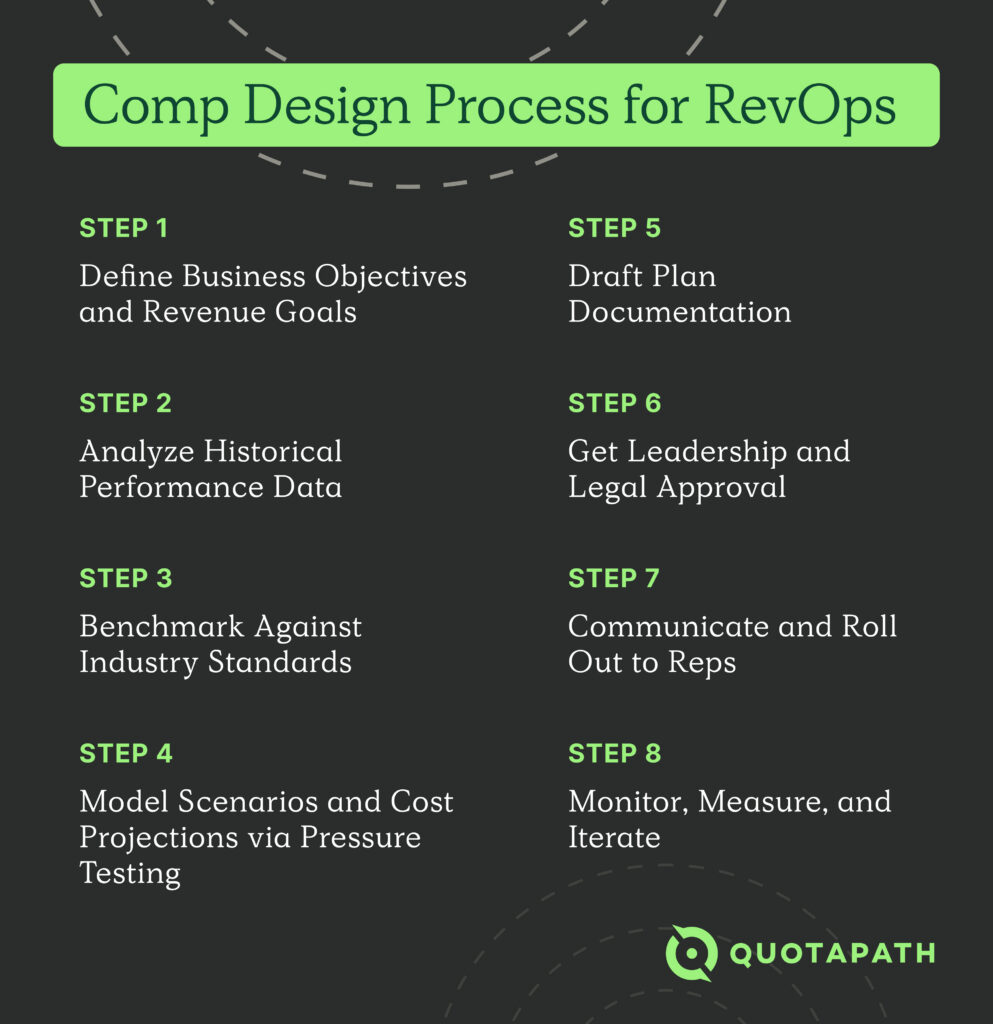
How Keen Built a Commission Engine That Scaled With GTM Complexity

quotapath customer success story

As revenue teams mature, commission complexity multiplies.

Leadership overrides. Expansion splits. SPIFs. Multi-role incentives.

What follows is a patchwork of manual HubSpot exports, quarterly reconciliation cycles, and email-based approvals. Audit trails are scattered across folders, and no one can confidently answer, “Who owns the master spreadsheet?”

Keen Decision Systems, a marketing operating system connecting marketing dollars to outcomes for an enterprise customer base, began to feel that strain. Mike Althoff, Keen’s COO, was overseeing deal approvals and commission approvals for 53 users across sales and leadership. He needed a way to bring structure, visibility, and control to a process that had outgrown spreadsheets.

“QuotaPath has been a really vital end-to-end tracker for me, to make sure that my thinking is visible to every individual rep and the sales team at large,” Mike said. This story shows how Keen built a scalable commission engine by connecting HubSpot, QuotaPath, and Rippling—replacing spreadsheets with structure and defensibility.

The Breaking Point: Spreadsheets Couldn’t Scale With GTM Complexity

Mike was managing commissions manually before implementing QuotaPath. Quarterly payouts were time-consuming, consisting of HubSpot deal data export, spreadsheet calculations, manual checks, and email approvals.

“It was spreadsheets and manual checks. We were reconciling HubSpot exports, calculating in spreadsheets, and emailing approvals to ensure there was some sort of audit happening,” said Mike.

Increasing plan complexity in response to Keen’s evolving go-to-market strategy included leadership rollups, expansion vs renewal rates, SPIF programs, and commission splits between sellers and account managers. Adopting QuotaPath wasn’t just about saving time. It was about preventing operational drift. “In short, we needed a system that would scale with us as we scaled,” said Mike.

From Manual Reconciliation to a Structured Commission Engine

Once the pain was clear, Keen needed structure.

The solution wasn’t just automation. It was auditability and consistency.

QuotaPath provides Keen with structured workflows from deal approval and commission calculation, through to payroll processing, eliminating manual, error-prone admin time. The resulting single system of record, end-to-end visibility, and rep-facing transparency increases trust and compliance.

Supporting Multi-Layer Incentives and Leadership Rollups

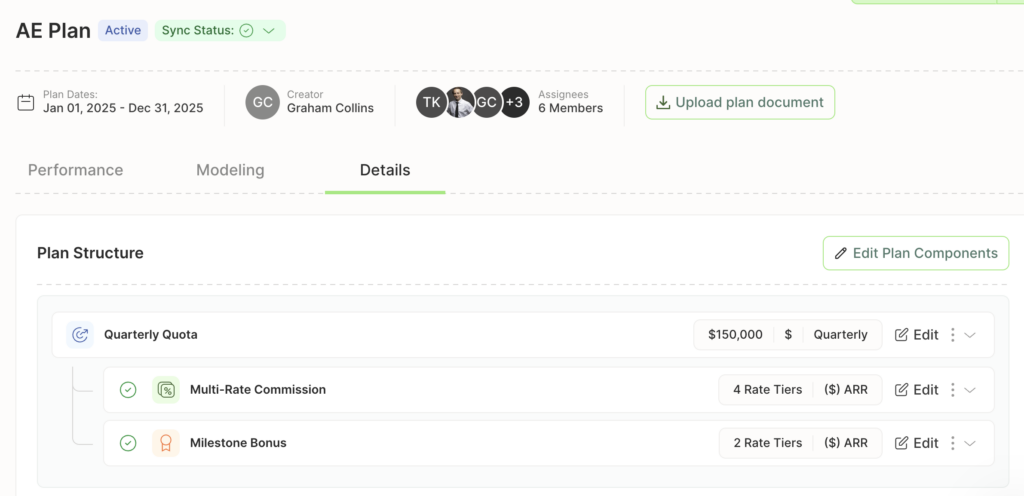
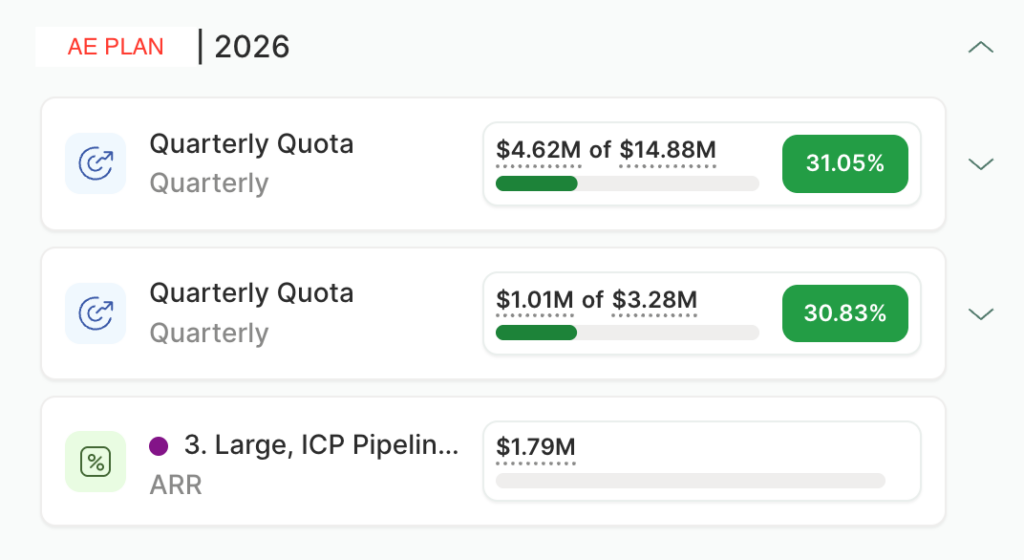
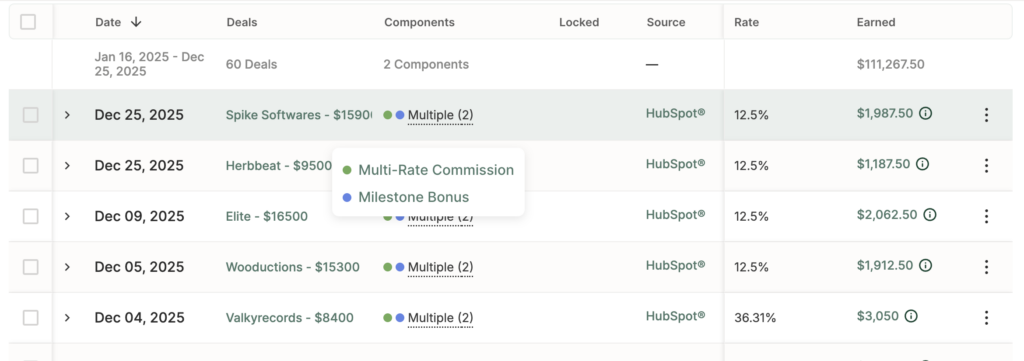
As teams grow, compensation layers multiply. As Keen has grown, their commission complexity has grown. They’re scaling leadership incentives without adding spreadsheet layers. The VP earns commission on their entire team, team leaders earn on their own deals plus team deals, and individual contributors earn on their closed deals. QuotaPath automated commission rollups and expansion commission splits, providing clear ownership and math, and no ambiguity.

“If an individual contributor closes a deal, it automatically calculates for their team lead and the VP. Having that clarity on who’s getting what and why has been really invaluable.”

Evolving Comp Strategy Year Over Year (Without Reinventing the Process)

If your comp plans remain static, you might have a problem. Your comp plans should evolve at least annually.

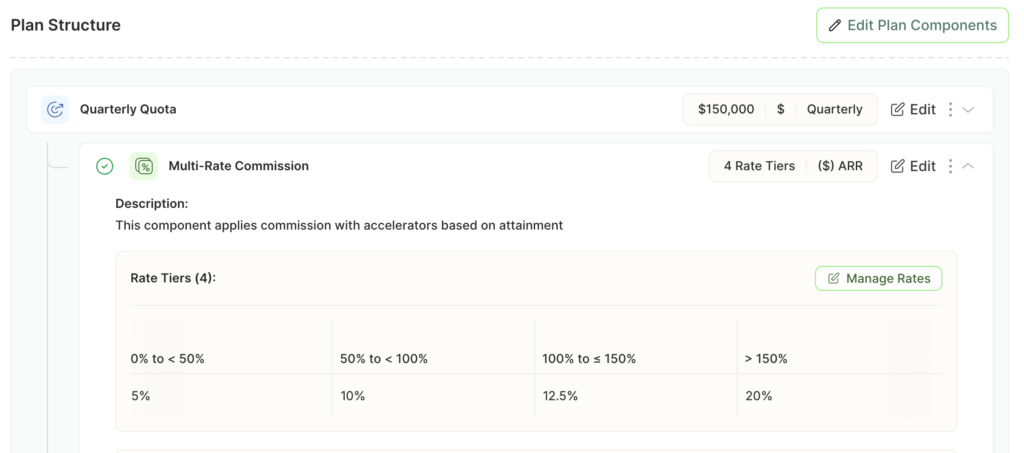
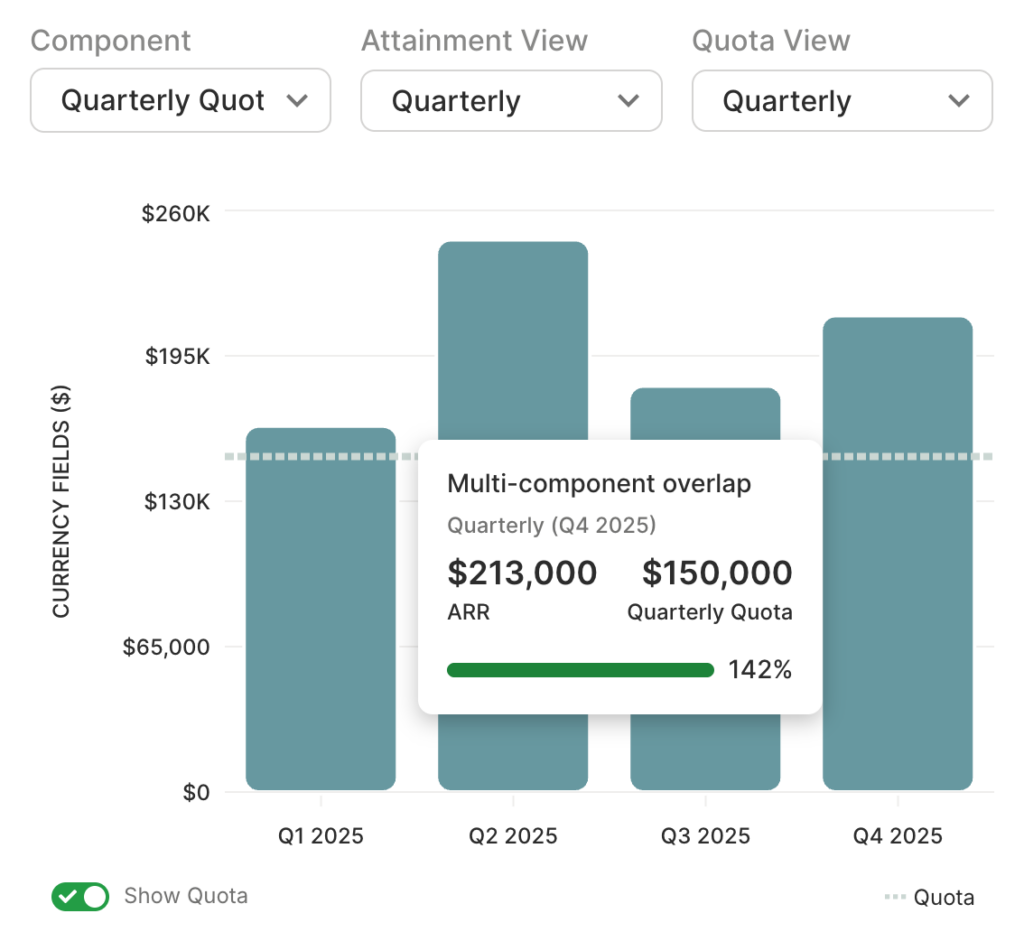
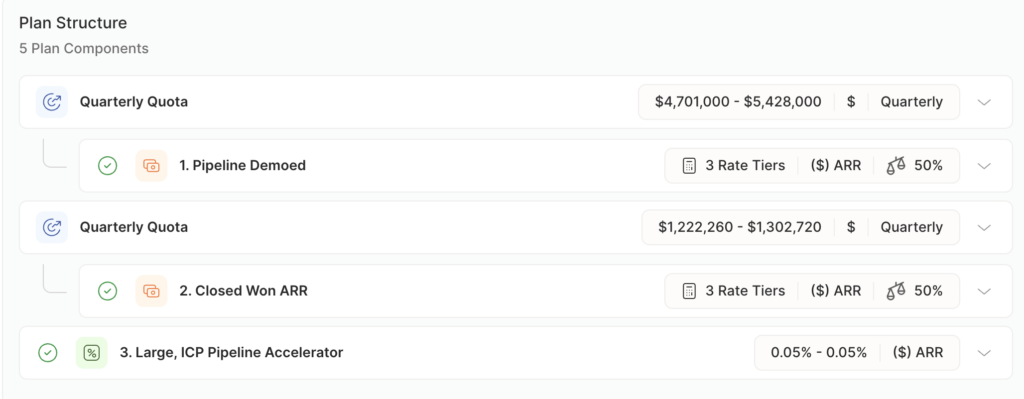
Scalability is maturing compensation plans without chaos. So, when Keen was ready to adjust their comp plan for 2026, Mike was able to duplicate the 2025 plans in QuotaPath’s AI compensation plans builder. He adjusted rates for expansion versus renewals and applied the new rates to 2026 deals, providing continuity and clarity.

“Reps can see how they earned last year and how they’re earning this year,” said Mike.
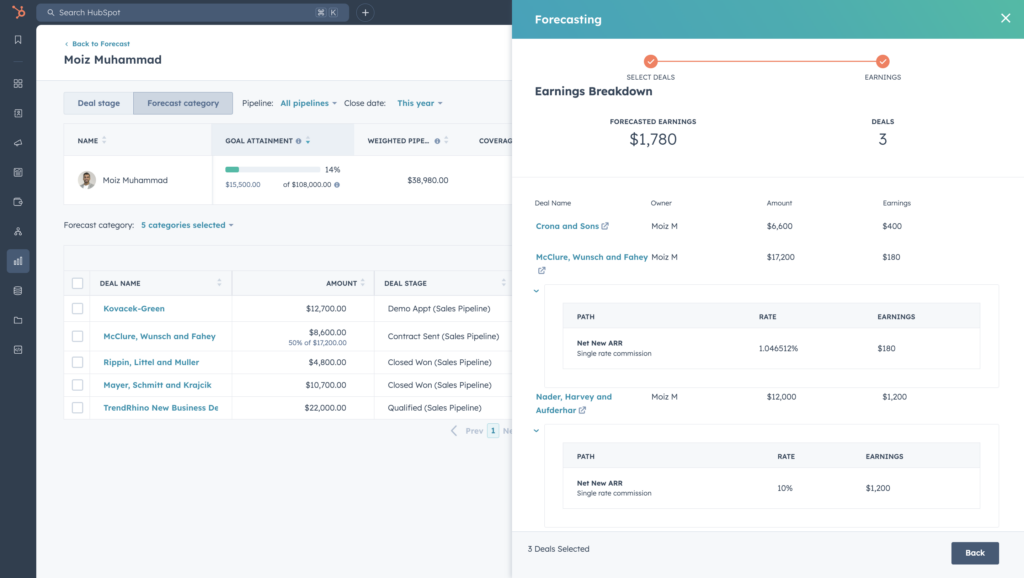
HubSpot commission software
See QuotaPath data directly in HubSpot.

HubSpot Integration: Driving Data Accuracy and Accountability

Commission accuracy starts with CRM accuracy. With HubSpot as Keen’s system of record, they’re able to leverage the HubSpot integration to sync with QuotaPath’s sales compensation software. The increased level of commission visibility forces CRM discipline. When commissions are tied directly to CRM, data quality improves because stakeholders care more about deal accuracy.

“Honestly, the integration between the two is almost essential,” said Mike.

Rippling Integration: Closing the Loop to Payroll

Commissions don’t stop at calculation … they end in payroll.

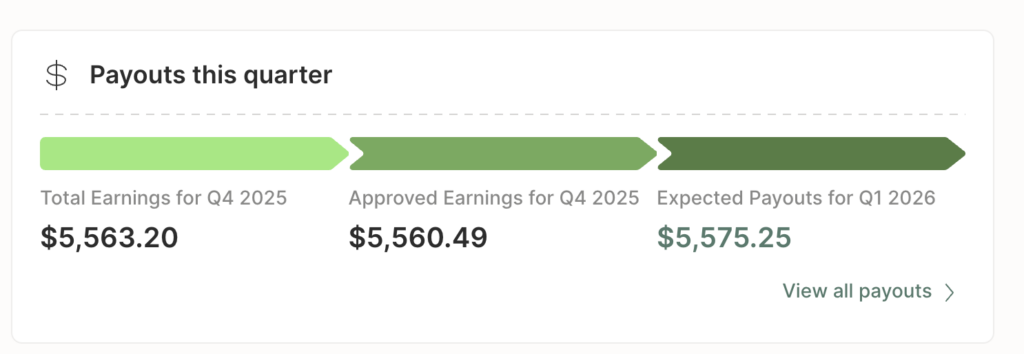
Keen now experiences true end-to-end commission automation thanks to QuotaPath’s Rippling payroll integration, enabling them to push payouts directly into Rippling. They receive immediate validation, with no manual uploads and no mapping errors.

“You literally just say, send these commissions… and it does it,” Mike said.

ROI: From Spreadsheet Ownership to Organizational Trust

Beyond automation, what changed?

For Keen, commission tracking software has become a form of governance infrastructure. They’ve gained transparency, trust, and defensibility, and they have seen faster acceptance of quarterly payouts. Rep compensation questions are handled in-platform, with screen sharing for clarity, to speed resolution and reduce defensiveness.

“Transparency is the number one thing… Before, it was ‘who’s the master of the spreadsheet?’ Now the numbers don’t lie,” Mike said.

The Operator’s Perspective: Outgrowing Spreadsheets

Mike’s advice to peers on accurately paying commissions is not about flashy features. It’s about operational maturity and control as complexity grows. “If you’re outgrowing spreadsheets and want confidence, consistency, tighter operational control… QuotaPath is a great place to find those things,” Mike said.

Streamline commissions for your RevOps, Finance, and Sales teams

Design, track, and manage variable incentives with QuotaPath. Give your RevOps, finance, and sales teams transparency into sales compensation.

Talk to Sales

Final Takeaway: Scaling Complexity Without Losing Control

As Keen’s GTM team scaled and commission complexity increased, spreadsheets weren’t up to the task. For Keen’s COO, Mike, overseeing deal and commission approvals for 53 users across sales and leadership was becoming an unwieldy manual process. He needed more structure, visibility, and control.

QuotaPath’s HubSpot and Rippling integrations created end-to-end control and 100% visibility, automating multilayer rollups and expansion splits accurately, while simplifying the annual comp evolution process. Addressing compensation questions is as easy as screen sharing to review the math.

For scaling revenue teams, commission management isn’t just math.
It’s infrastructure.

See how QuotaPath can help you scale commission complexity without losing control. Book a demo.

 5 Clawback Policy Best Practices for RevOps & Finance

clawback policies

Clawbacks are one of the most debated topics in sales compensation. Reps hate them. Finance needs them. RevOps is stuck in the middle.

Here’s the thing: clawbacks aren’t the problem. Poorly designed clawback policies are.

We analyzed 20,747 customer and prospect conversations and found that 12.1% touched on clawbacks, almost always tied to early churn, non-payment, or deals that failed to go live. These are predictable outcomes in most revenue models.

Your clawback policy should be built around them, not retrofitted afterward.

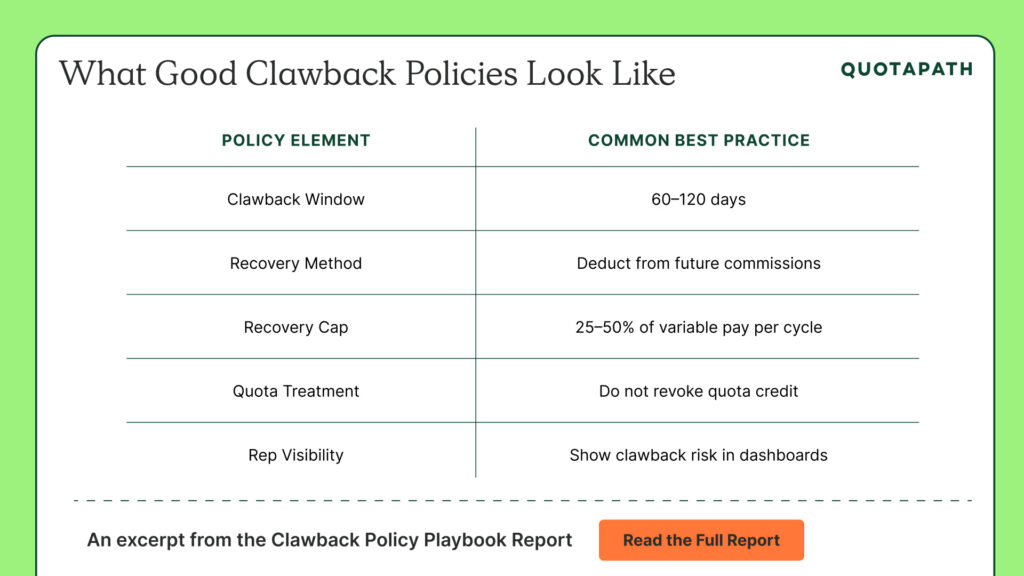
So what does an effective clawback policy actually look like? Here’s what the data shows.

clawback policies report

Clawback Policies Playbook: Report

In our analysis of 20,747 customer and prospect conversations, 12.1% included clawbacks. This report uncovers what policies are working and how to build your own successful one.

View Report

1. Design clawbacks as a standard mechanism, not an exception.

High-performing teams don’t treat clawbacks as rare or uncomfortable. They build them into the comp structure from day one. When reps know the rules upfront, clawbacks feel like a system… not a surprise penalty. That’s the goal.

2. Align payout timing with revenue risk.

The earlier a commission is paid, the more protection your business needs if a deal falls apart. Your policy should reflect this. Low-risk annual SaaS might pay ~70% at signature. Implementation-heavy deals should tie payouts to milestones. When payout timing matches revenue risk, you often reduce the need for clawbacks altogether.

3. Keep clawback windows short and clearly defined.

The data is consistent: 60-120 days is the sweet spot. Short windows protect the business from early churn while giving reps confidence that their deals become “safe” after a defined period. As one CRO put it: “Policies tied to a specific, reasonable window — 90 days or less — work well. Reps can stomach it when they know the rules going in.”

Long windows have the opposite effect. When commissions can be clawed back for a year, reps start treating their earnings like monopoly money. Keep it short.

4. Define your triggers explicitly (and in writing).

Disputes almost always come from ambiguity. Your policy should name exactly what triggers a clawback: customer cancellation, refund, non-payment, failure to complete onboarding. A simple clause — “Any commissions paid on deals that are refunded or canceled within four months will be deducted from future payouts” — eliminates most of the gray area and most of the arguments.

5. Automate the process.

Manually tracking original commission payouts, deal status changes, billing outcomes, clawback windows, and adjusted earnings is a recipe for errors. The teams with the cleanest clawback processes have taken the manual work out of the loop entirely.

Automation should flag deals inside clawback windows, adjust payouts when deals change, maintain an audit trail, and, critically, make clawback risk visible to reps in real time. When reps can see what’s at risk, nothing comes as a surprise.

Streamline commissions for your RevOps, Finance, and Sales teams

Design, track, and manage variable incentives with QuotaPath. Give your RevOps, finance, and sales teams transparency into sales compensation.

Talk to Sales

Final Thoughts

These five practices are what separate clawback policies that work from ones that create ongoing headaches. They’re also the foundation of our new Clawback Policy Playbook for RevOps and Finance — which includes benchmark data, policy frameworks by company stage and cash position, and sample language you can adapt today.

Download it here.

Build vs. Buy: The Hidden Costs of Building Your Own Commission Tool

build vs buy commission tool

 When ‘Building It Yourself’ Sounds Tempting

Automation. AI-first workflows. The push to make everything faster, cheaper, smarter. 

Every ops leader right now is asking: “Can we build this ourselves?” (including our QuotaPath Ops teams!)

AI platforms, low-code tools like Replit and Claude, internal dev teams, and budgets make this all feel very well within reach. 

But here’s the catch: while the idea of “we’ll just build our own comp plan agent” sounds appealing, the hidden costs and risks are far greater than most teams expect. And the moment you move from simple logic to real-world scenarios (multiple roles, accelerators, payout eligibilities, retroactive changes, integrations, auditing) those costs… and the technical debt.. climb.

Consider this: studies show that 90% of organizations are still relying on spreadsheets and similar manual tools for key business functions.

And when it comes to compensation planning, surveys today reveal between 62-75% of companies still rely on spreadsheets 

So yes, while most leaders are considering DIY’ing, most still haven’t moved to a purpose-built solution. 

That raises two questions:

  • If so many are still relying on inferior tools, why?
  • And at what point does building your own stop being a “clever DIY” and start being a strategic liability?

Below, we’ll go through the real cost of “build vs. buy” when it comes to your comp plan management agent, including pitfalls (aka: the “gotchas”) and help you compare that to the “buy” option.

Get Immediate Feedback on Your Comp Strategy

QuotaPath’s AI Comp Plan Consultant, Atlas, allows you to build, test, and model your compensation strategy against real benchmarks.

Try Atlas Now

 The Appeal of Building Your Own Comp Tool

At first glance, building your own compensation tool can seem like a clever move.

When every function in Sales Ops and RevOps is being automated or AI-enhanced, the temptation to spin up an internal “comp agent” makes sense. 

The logic is familiar: we know our business best, so why not build something that fits us perfectly?

And honestly, that reasoning is valid. 

RevOps professionals are some of the most innovative problem solvers in any org. You’re builders by nature, constantly bridging gaps between systems, data, and people. 

But when it comes to compensation management, that DIY instinct can sometimes lead to more complexity than clarity.

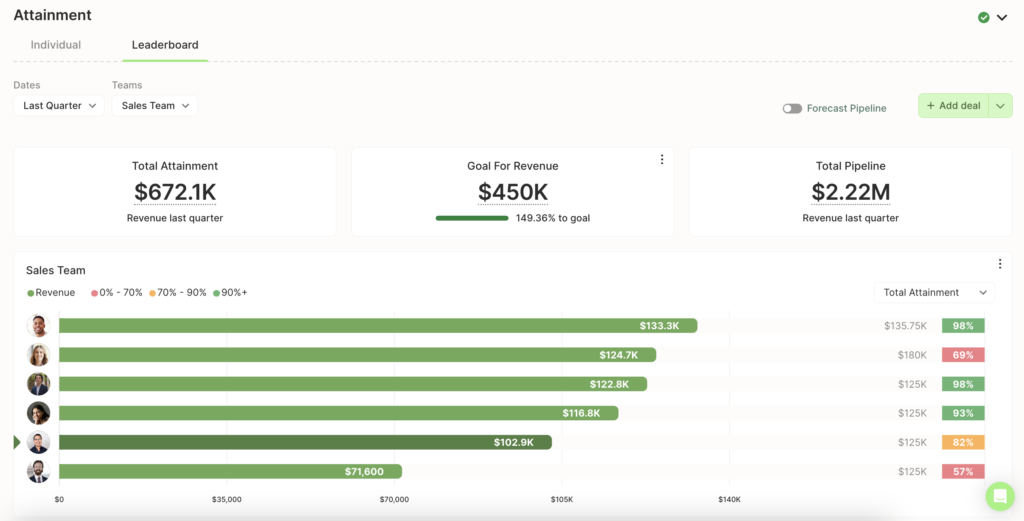
sales team attainment views commission tool
At-a-glance team attainment views in QuotaPath

Control and Customization

RevOps pros know exactly how comp plans should work, how formulas interact, and where the pitfalls are.

Building internally promises that level of precision. You can define your own logic, build custom integrations between your CRM and payroll, and design dashboards that mirror your sales motion. It’s a dream setup (on paper… erg… screen?).

And tools today make it seem simple to automate commissions with a few smart prompts. But what starts as a quick win often becomes a complex system that needs constant care and attention. Because it’s people’s paychecks, after all.

Perceived Cost Savings

Plus, it’s easy to think, “Why pay for software when our data team can handle it?” 

The absence of license fees looks like savings on paper, but how does it play out?

Maintenance, testing, compliance, and error resolution add up, often quietly outpacing the cost of a purpose-built platform

Retool’s data shows internal tools can cost 3–10x more in upkeep than expected.

Speed and Novelty

The speed of spinning up something fast is hard to ignore, especially if the idea spawns from a hackathon project. The early excitement is real, but speed often replaces structure. 

Within a few months, that “temporary fix” becomes a fragile system only one person truly understands. And when they move on, the maintenance burden comes due.

The Gotchas of Building Your Own Comp Plan Agent

Here’s where most homegrown comp tools start to unravel.

The first few months go smoothly 😍.

Calculations work, reps get paid, and the spreadsheet or AI agent seems to “just work.” 

But as soon as plans evolve, data shifts, or new roles are added, the cracks appear. What started as a cost-saving experiment turns into a cycle of manual fixes, mistrust, and technical debt.

 1. Data Drift and Formula Errors

Homegrown tools rarely have built-in data validation. 

A single CRM field rename or logic tweak can break the math, and it often goes unnoticed until payday. These small schema changes can lead to payout errors, overpayments, or reps missing commissions entirely.

PRO TIP: QuotaPath eliminates manual errors and centralizes commission logic through automation, ensuring every formula pulls from the same source of truth. That consistency is what keeps Finance, RevOps, and reps aligned… no debugging required.

2. Time Sink and Technical Debt

When you build, you also inherit the upkeep. 

Admins and RevOps leaders spend hours troubleshooting code, checking formulas, or re-running calculations, time that should be spent optimizing plans.

And if the person who built it leaves? The knowledge leaves too.

Over time, your “custom tool” becomes a fragile system, filled with hallucinations that no one wants to touch. 

3. Visibility and Rep Trust

Without rep-facing dashboards or payout audit trails, internal tools often operate like black boxes. Reps can’t see how numbers are calculated, which quickly erodes trust in the process. Disputes rise, motivation drops, and comp plans lose their impact.

4. Compliance and Auditability

When payout data lives across scripts, spreadsheets, and Slack messages, compliance becomes a nightmare. 

Homegrown tools rarely support ASC 606 requirements, audit trails, or payout documentation, and those gaps can turn into clawbacks or misreported earnings.

5. Scaling and Maintenance

The most common failure point? Scale. 

What works for ten reps and a simple quota structure can’t handle fifty reps, multiple roles, SPIFs, accelerators, or mid-cycle plan changes.

Your AI comp agent might handle basic math, but it doesn’t understand context, exceptions, or business nuance.

“I wouldn’t have the bandwidth to hire, train and own commissions — getting a tool was the best way for me to get some scale for myself and the team,” said Nancy McBee, VP of Finance at SeekOut, and customer of QuotaPath.

The Business Case for Buying Instead of Building

When you step back from the DIY appeal and look at long-term impact, buying a purpose-built platform isn’t just about convenience: it’s about focus. The right software pays for itself in time, accuracy, and confidence. That’s where QuotaPath stands apart.

“We essentially paid for QuotaPath in one month. It caught a lot of mistakes.”

Time to Value

Speed matters, especially in RevOps. While internal builds can take months of coding, testing, and debugging, QuotaPath customers go live in weeks, not quarters.

Like Alejandra at AirDNA, for example.

“We expected maybe three months… and in the end, we did it super quick,” said Alejandra, who completed onboarding and implementation in six weeks.

Our onboarding is designed for momentum fast, guided, and supported every step of the way. From day one, you’re working with a dedicated customer success manager, pre-built integrations, and AI-assisted plan setup. Instead of waiting to prove value, your team is tracking and paying commissions accurately within your first payout cycle.

Cost Efficiency

On paper, building looks “free.” But the real cost is sunk in time, maintenance, and opportunity.

Every week spent debugging or adjusting formulas costs more than most leaders realize. 

Let’s put numbers to it:

“Building” may look like $0 upfront, but 4 hours of RevOps time per week at $100/hour = $20,000 per year (and that’s before factoring QA, compliance, or the cost of a single payout error). 

In contrast, QuotaPath’s subscription model scales predictably with your team. 

You get automation, compliance, and support built in … no hidden upkeep, no surprise engineering backlog. The TCO (total cost of ownership) favors buying almost every time once you account for time saved and risk avoided.

Strategic Focus

Internal tools require constant maintenance. Every schema change, new role, or payout tweak pulls your RevOps team back into reactive mode.

QuotaPath shifts that equation. By automating commission logic and reporting, customers reclaim up to 25+ days per quarter. This is time they now spend on forecasting, GTM strategy, and optimizing plan performance.

So, ask yourself: Would you rather maintain code or scale revenue?

Streamline commissions for your RevOps, Finance, and Sales teams

Design, track, and manage variable incentives with QuotaPath. Give your RevOps, finance, and sales teams transparency into sales compensation.

Talk to Sales

How QuotaPath Makes ‘Buying’ a No-Brainer

The right platform should automate the math and make compensation strategic.

QuotaPath was built to eliminate the trade-offs of “build vs. buy,” giving RevOps teams total flexibility without the maintenance burden. Instead of managing code, your team can focus on driving performance, forecasting revenue, and scaling confidently.

Here’s what makes QuotaPath the obvious choice:

  • AI-Powered Plan Builder: Spin up new plans or update existing ones in minutes (no code or spreadsheets required).
  • CRM + Payroll Integrations: Connect Salesforce, HubSpot, Rippling, and more for a single, accurate source of truth.
  • Real-Time Earnings Dashboards: Give reps full visibility into attainment, pipeline, and potential payouts to drive motivation.
  • Compliance-Ready Audit Trails: Stay ASC 606-aligned and audit-safe with automated approval workflows.
  • Guided Onboarding and Support: Go live fast with expert-led setup, dedicated CSMs, and in-app tutorials.

And the proof is in the experience:

“We essentially paid for QuotaPath in one month. It caught a lot of mistakes.”
David Taub, RevOps @ HydroCorp

“Commissions were this multi-hour monthly nightmare. QuotaPath simplified all of it.Kenza Sebbar, RevOps Leader @ Actabl

“Quarterly, we’re saving 25 days in commission processing.”
David Thai, RevOps Lead @ Augury

Yes, QuotaPath builds automation and accuracy into a previously error-prone process. But more importantly, it’s giving RevOps teams their time, trust, and visibility back. Ready to learn more? Book time with our team today.

Q2 SPIF Examples & Best Practices (By Role

spif examples

If Q1 is about building momentum, Q2 is about sharpening execution.

By the second quarter, most companies have enough data to understand where the sales motion is working…and where it isn’t. Pipeline quality may be uneven. Deals may be stalling late in the cycle. 

Cash collection may be slower than expected.

That’s where SPIFs (Sales Performance Incentive Funds) come in.

When designed well, SPIFs allow companies to quickly influence seller behavior without redesigning the entire compensation plan.

In fact, it’s common for mid-stage SaaS companies to allocate $10,000–$50,000 per quarter toward SPIF programs, depending on team size and revenue targets. For organizations with 20–100 quota-carrying reps, this often works out to $200–$500 per rep per quarter in incremental incentives designed to drive specific outcomes.

But there’s a catch.

Too many organizations run SPIFs that simply reward more activity (more meetings, more demos, more pipeline) without tying incentives to the actual outcomes the business needs.

A better way to think about Q2 SPIFs is this:

Your SPIFs should buy specific outcomes you need by midyear—better pipeline quality, cleaner closes, and stronger cash efficiency.

Below are practical Q2 SPIF examples and the best practices that make them work.

Create SPIFs with AI Comp Plan Consultant

Use Atlas, QuotaPath’s AI Comp Plan Consultant, to create, test, and predict performance of potential SPIFs.

Use Atlas

Why Q2 SPIFs Matter

Q2 is a pivotal quarter for most revenue organizations.

By midyear, leadership teams are trying to influence several outcomes:

  • Strengthen pipeline coverage before the summer slowdown
  • Improve close rates for the quarter
  • Shape deal quality and contract structure
  • Accelerate cash collection
  • Stabilize renewal pipelines for the second half

SPIFs are one of the fastest ways to adjust behavior if these metrics are lagging.

And when compensation plans are aligned with business goals, they can meaningfully influence performance and motivation across the revenue team.

Q2 SPIF Examples by Role

The most effective SPIFs target specific behaviors by role.

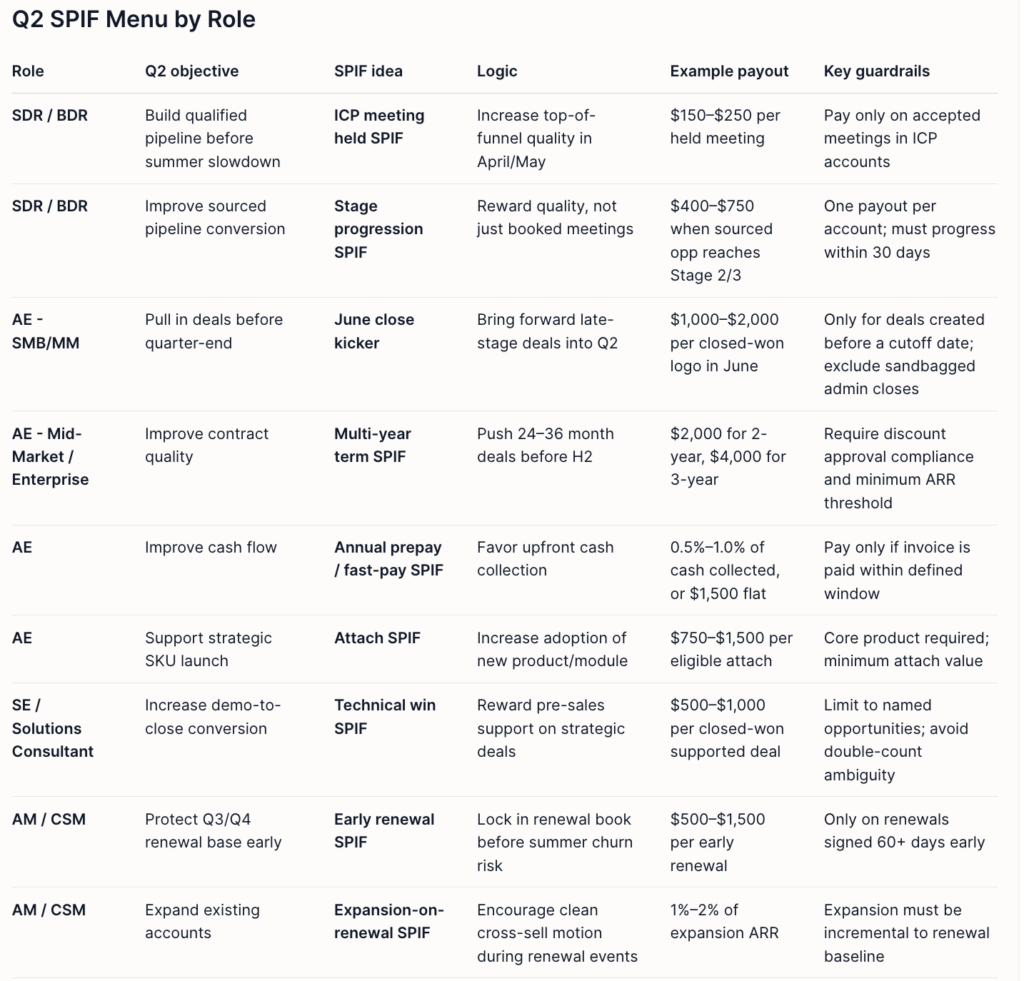
spif examples by role
Table created by Atlas, QuotaPath’s AI Comp Plan Consultant. Use Atlas here.

How to Structure Q2 SPIF Programs

Just remember: not every SPIF works.

The best programs share a few key design principles.

1. Tie Every SPIF to One Behavior

SPIFs fail when they become too complicated.

Each SPIF should reward one clear outcome, such as:

  • Held ICP meetings
  • Deals closed before a specific date
  • Multi-year contract terms
  • Early renewals

Simple incentives are easier for reps to understand and act on.

2. Align SPIF Timing with Your Objective

The timing of your SPIF matters just as much as the incentive.

Front-load SPIFs (April–May) when your goal is:

  • Pipeline creation
  • Product adoption
  • New feature attach

Back-load SPIFs (June) when your goal is:

  • Close acceleration
  • Forecast accuracy
  • Deal progression

3. Set Clear Guardrails

Without guardrails, SPIFs can create unintended consequences.

Common guardrails include:

  • Minimum deal sizes
  • Discount approval requirements
  • ICP account qualification
  • Time-bound stage progression

These controls ensure incentives drive the right behavior without distorting deal quality.

4. Cap SPIF Payouts

SPIF budgets can quickly spiral.

Most companies set limits such as:

  • Per-rep payout caps
  • Total program budget caps
  • Team pool limits

Caps allow leadership to encourage performance without creating runaway incentive costs.

Streamline commissions for your RevOps, Finance, and Sales teams

Design, track, and manage variable incentives with QuotaPath. Give your RevOps, finance, and sales teams transparency into sales compensation.

Talk to Sales

Q2 SPIF Mistakes to Avoid

Even well-intentioned SPIFs can create problems.

Here are a few common mistakes.

  • Running a “more meetings” SPIF without quality filters: Without qualification rules, pipeline quality often drops.
  • Paying for contract length without discount controls: Reps may trade margin for term length.
  • Launching too many SPIFs at once: If reps have to track five different incentives, they usually ignore all of them.

Using SPIFs to fix structural compensation problems

SPIFs should adjust behavior temporarily…not compensate for broken quota models or pricing strategy.

The Bottom Line

SPIFs are most powerful when they are strategic, targeted, and temporary.

For Q2, the most effective SPIF programs focus on:

  • Building high-quality pipeline
  • Improving close timing
  • Increasing contract durability
  • Accelerating cash collection
  • Stabilizing the renewal base

When done right, SPIFs become a powerful lever for both sales motivation and for driving the business outcomes leadership cares about most.

To implement and track SPIFs to drive performance, talk to our team today.

Spring Cleaning: Q2 Comp Plan Audit Checklist for RevOps

revops audit

Pipeline slowing compared to Q1? Fewer reps pacing toward quota? Commission costs rising? It must be Q2…the moment when compensation patterns surface, revealing what’s actually working in the comp plan.

Compensation problems compound quietly. They are rarely sudden; rather, they build over time.

Consider that 91% of organizations have less than 80% of their sales reps hitting quota, and 80% of companies pay sales reps incorrectly. Ignoring these issues has serious consequences, including margin erosion, rep disengagement, forecasting inaccuracies, and trust breakdowns due to payout errors.

Pinpoint risks by completing a comp plan audit. This process enables you to evaluate alignment, cost efficiency, attainment health, and motivation, then proactively address issues. This blog shows you how to run a comp plan audit to check efficacy and identify areas of improvement before heading into the second half of 2026.


Key Takeaways

  • Q2 audit checklist
  • Key metrics to review
  • Red flags to watch for
  • How to course-correct before H2

Head into H2 with clarity, not guesswork.

Build, Test, and Improve Your Compensation Plans

Use Atlas, our AI Compensation Plan Consultant that runs entirely from proprietary QuotaPath data and benchmarks. Learn best practices in compensation strategy, evaluate your existing comp structures, and build plans that drive performance.

Use Atlas

The Q2 Comp Plan Audit Checklist

So, what should you actually evaluate?

Use this checklist to systematically review your plan’s performance across alignment, cost, motivation, and operational health.

1. Business Goal Alignment

“Compensation plans should be the caboose, not the engine,” according to Pablo Dominguez of Insight Partners. So, start your commission plan review by confirming that your pay structure supports your business strategy, rather than creating it.

Audit questions:

  • Are reps incentivized on your current North Star metric?
  • Are you paying the most commission on the behaviors that matter most?
  • Has your strategy shifted since January?

Metrics to review:

  • Revenue growth rate: A measure of how much a company’s revenue has increased within a given period compared to a comparable timeframe, such as month over month.
  • Product mix vs. profitability: Measure of how product choices affect overall profitability, in terms of gross margin, net profit margin, and return on investment (ROI). 
  • Earnings by comp component: A breakdown of revenue associated with each incentive plan element.

Tying the two together: If your goal is increasing ACV, what % of commission dollars are tied to multi-year or high-value deals?

comp plan audit check attainment

2. Quota & Attainment Health

Our CEO AJ Bruno’s rule of thumb says that 80% of reps should realistically hit quota. However, 91% of organizations have less than 80% of their sales reps hitting quota. Use these questions and metrics to perform a quota attainment analysis.

Audit questions:

  • What percentage of reps are on track to hit quota?
  • Is attainment clustered or wildly inconsistent?
  • Are top earners also top performers?

Metrics to analyze:

  • Attainment over time: Tracks the attainment of sales goals over time to identify seasonality, reveal rep consistency, and gauge how well sales incentives align with overall business objectives.
  • Time to quota attainment: Indicates how quickly sales reps hit their targets, revealing the efficiency and effectiveness of comp plans.
  • OTE:Quota ratios: An OTE to Quota ratio compares a sales rep’s on-target earnings (OTE) to their quota, determining the amount of revenue a rep must generate for every dollar they earn.
  • Ramp duration vs. expectations: A comparison of the actual time it takes for a rep to become productive compared to the forecasted timeframe.

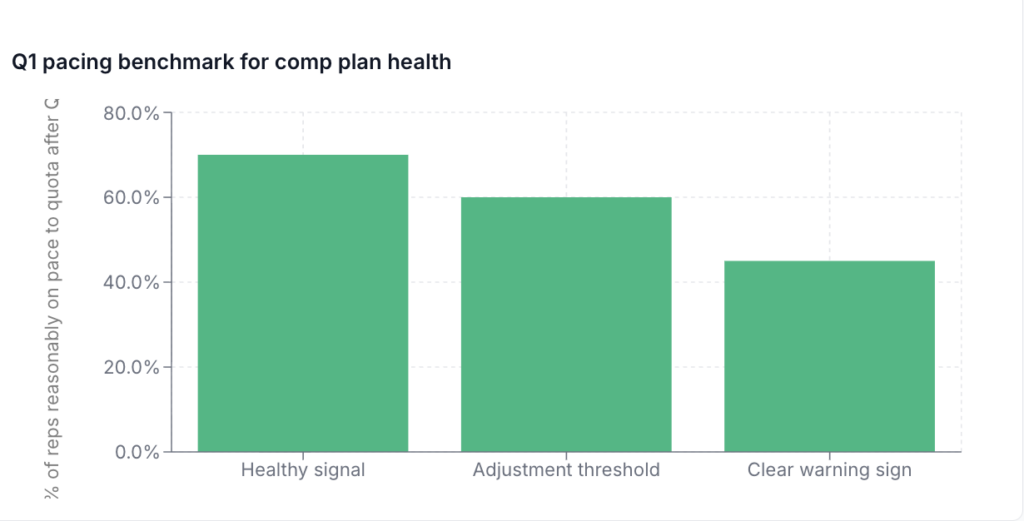
If fewer than 50% of reps are on pace to meet quota, your issue likely isn’t effort. It’s design.

3. Commission Cost & Margin Impact

Include Finance in the comp plan audit process to measure sales compensation effectiveness, prevent overspending, and ensure financial stability.

Audit questions:

  • What is your commission expense ratio?
  • Is your effective commission rate under 25%?
  • Are you overpaying on low-margin products?

Metrics to review:

  • Commission payout ratio: The percentage of revenue reserved for commissions, helping improve the accuracy of financial planning and forecasting.
  • Effective commission rate per deal: Cumulative commission percentage per deal, including every role that earns an incentive on a deal.
  • Total commission dollars by product line: Monetary value of compensation paid to sales reps, segmented by product category.

4. Motivational Impact

Motivation is an essential metric when assessing sales compensation effectiveness. Comp plans that are viewed as fair and equitable inspire reps to overachieve. By contrast, confusing or seemingly random plans tend to demotivate and frustrate reps.  In fact, according to our compensation trends report, 9% of reps quit due to compensation errors or disputes.

Audit questions:

  • Are accelerators reachable or out of sight by mid-year?
  • Are reps disengaging after a slow Q2?
  • Are disputes increasing?

Metrics:

  • Commission dispute count: The number of pay questions or inconsistencies per pay period, indicating how well reps understand how they earn commissions and gauging how accurate compensation calculations and data are.
  • Turnover rate: The frequency that sales reps leave the company, revealing the effectiveness of the comp plan in motivating and retaining talent.
  • SPIF effectiveness: Gauges the impact of special performance incentive funds (SPIF) in driving selling behaviors to determine if it might be worth implementing as an element in your compensation plan.
Read our SPIF report to learn best practices.

5. Operational & Administrative Efficiency

Commissions processing, accuracy, and visibility matter. Spreadsheets increase error risk and admin burden, negatively impacting sales compensation effectiveness and limiting transparency. However, automation reduces processing time by up to 90%.

Audit questions:

  • How long does commission processing take?
  • How many manual adjustments occur each cycle?
  • Are disputes resolved quickly?

Metrics:

  • Processing time per payout cycle: The amount of time spent reconciling comp plan data and verifying its accuracy, processing commissions, responding to rep payout questions, and creating audit logs.
  • Discrepancy/resolution count: The number of pay inconsistencies or questions per pay period. This is an indicator of how well reps understand how they are paid and how accurate your commission calculations and data are.
  • Rep visibility into earnings: Real-time access to commission data, quota attainment, and potential deal payouts through dashboards, enabling reps to calculate earnings, track performance against goals, and forecast how each deal impacts their pay. This level of transparency reduces rep payout disputes and increases trust.

Common Red Flags Your Comp Plan Audit Might Reveal

Now that you’ve completed your comp plan audit, here are some common issues you may have found and what they mean.

  • Less than 60% of reps pacing to quota: Results in missed revenue goals, overpaid commissions, and increased rep turnover due to a lack of transparency and trust.
  • High attainment but low profitability: Causes commission overpayment and elevates customer acquisition costs (CAC) relative to lifetime value, causing budgetary strain, often an indicator that quotas and/or margins are too low.
  • Frequent commission disputes: Decreases rep trust in compensation plan and payout calculations.
  •   Heavy commission spend on non-strategic products: Results in misaligned sales incentives, reduces profitability, and wastes selling time on what are typically low-margin items.
  • Reps unclear on earnings potential: Inability to forecast potential earnings reduces motivation and sales compensation effectiveness.
  • Q2 pipeline drop paired with flat incentives: This pipeline dip creates a decrease in commissions, rep motivation, and quota attainment.

What to Do If Your Audit Surfaces Issues

An audit without action is just analysis. Leverage the following best practices to improve sales compensation effectiveness based on the insights your commission plan review revealed.

Make Targeted, Not Reactive Changes

Implementing intentional changes is more likely to resolve issues and drive desired behaviors for positive Q2 goal attainment.

  • Temporary accelerators can revive waning motivation while boosting efficiency when aligned with metrics like gross margin or GRR.
  • Quota rebalancing boosts attainment by aligning quotas with historical achievement data and buyer behavior instead of evenly distributing them across four quarters.
  • SPIFs tied to specific behaviors improve performance that compensates for Q2 weakness. For example, a SPIF that rewards self-sourced opportunities to make up for demand gen lulls.
  • Territory realignment helps improve rep performance when the issue is the quality of the territory. It redistributes accounts and offers underperforming accounts a fresh start. When doing this, it’s important to be conscious of perceived fairness and the impact on overlays such as SEs and BDRs.

Model Before You Roll Out

QuotaPath modeling tools enable pressure testing of compensation plan changes using real historical data to predict the impact on commission costs. Scenario modeling determines payout impact by running “what-if” tests, such as: What happens if 80% of reps achieve 80% of quota? Testing accelerators before launch measures their impact on cost and attainment distribution.

Use AI Comp Consultant to Model & Test

Atlas, QuotaPath’s AI Comp Consultant, will model every scenario your comp plan could face to help you understand how it will perform and stand up against edge cases.

Use Atlas

Increase Transparency Immediately

Giving reps real-time dashboards helps them understand how they earn commissions and track progress toward targets and milestones. It shows reps the earning potential for different deal types and the impact on payouts, motivating them to prioritize deals aligned with business objectives. This transparency reduces reliance on Finance to answer payout questions because they can already see payout calculations and proactively flag discrepancies.

“Reps have full access to their compensation details so that they can see their plans, what they’ve earned so far this month or quarter, and their year-to-date earnings—all in real-time,” said Liza of Rootly. “I rarely get questions about commissions anymore because they have everything they need in QuotaPath.”

Make Comp Plan Audits a Quarterly Habit

Spring cleaning shouldn’t be once a year. Ongoing quarterly mini-audits prevent H2 surprises and increase performance consistency. Comp plan audits are a strategic form of revenue hygiene. The resulting visibility improves trust, alignment improves quota and business objective attainment, and forecasting accuracy in Finance improves.

Schedule time with a team member to see how QuotaPath combines real-time visibility, scenario modeling, and expert guidance to help you make smarter mid-year comp plan decisions.

How SeekOut Scaled Commissions in Two Weeks (Without Adding Headcount)

seekout quotapath customer

What happens when your financial analyst leaves, and commissions suddenly land on your desk?

You’re suddenly fielding payout questions from Sales, double-checking formulas you didn’t build, and reconciling numbers across spreadsheets and Tableau dashboards that don’t quite align. In lean startup finance teams, manual commission tracking quickly becomes a leadership responsibility, consuming time that should be spent on forecasting and strategic planning.

What starts as a temporary workaround often carries hidden costs. Spreadsheets and Tableau weren’t built for the complexity of commissions, and as sales teams grow, so do the risks. More roles, more plan variations, and more edge cases make it harder to maintain accuracy, trust, and control, turning commissions into an increasingly fragile and time-intensive process.

Nancy McBee, VP of Finance at SeekOut, found herself in a similar situation. When her financial analyst left, she was suddenly responsible for commissions, payroll, forecasting, and strategic planning. She needed a way to scale without immediately adding headcount, so she turned to QuotaPath.

This story shows how SeekOut implemented sales commission software in just two weeks, eliminating manual commission work and building transparency across Sales and Finance.

Key Takeaways

  • Lean finance teams can scale commissions without adding headcount.
  • Partnership matters as much as product when choosing sales commission software.
  • Transparency drives alignment between Sales and Finance.
  • Opportunity cost savings can outweigh flashy features.
seekout summary

The Breaking Point: When Bandwidth Disappears

When Nancy’s financial analyst left, she suddenly inherited commissions alongside her existing Finance responsibilities. What had been a contained process quickly became a manual, time-consuming burden. Spreadsheets, combined with a Tableau workaround that required manual uploads, were no longer sustainable. In fact, the time spent calculating incentive compensation pulled her away from critical strategic finance work.

Those systems also limited commission visibility to the month-end, leaving Finance and Sales to operate on lagging data. Without real-time insight, validation became reactive, and reporting slowed. Reps also lacked clarity into their earnings, leading to more questions, increased risk, and growing misalignment as complexity increased.

With no immediate desire to hire, Nancy made a clear decision: “If I have to own commissions… I’m going to own it how I would own it — implement a tool in two weeks and never have to worry about it again,” Nancy said.

Evaluating the Options: Bells & Whistles vs. Partnership

Nancy, having previously implemented Spiff at another company, knew what robust enterprise tools looked like. But she also recognized that those sales compensation management platforms were too complex and too expensive for a company at SeekOut’s stage. She needed something scalable and easy to implement quickly, without the overhead of a heavy enterprise solution.

As she evaluated vendors, many offered more features and bells and whistles, but often with longer implementation timelines and added complexity. More importantly, their responses lacked flexibility. When Nancy asked, “Can we do this?” the answer was often no. As she put it, “I kept running into walls… I’m hearing a lot of no’s, and I want to hear yes’s.”

Finance leaders buying commission tracking software aren’t just buying features; they’re buying responsiveness and flexibility.

QuotaPath took a different approach. Instead of rigid limitations, the team focused on collaborative problem-solving, working with Nancy to figure out what was possible. That experience reframed how she thought about the decision: “If you’re buying software, you’re really buying a partnership… and I really could tell QuotaPath was going to be there for that partnership.”

Why SeekOut Chose QuotaPath

As Nancy moved from evaluation to decision, the choice came down to a matter of fit. With prior experience implementing compensation tools, she knew what to expect. QuotaPath stood out for its ease of implementation, straightforward Salesforce integration, and the ability to be up and running quickly without added complexity.

That confidence carried through immediately. The sales process with Tom was seamless, and onboarding with Josh reinforced that she had made the right choice. Support was instant and hands-on. As Nancy shared, “Josh would drop everything he was doing, get on the phone with me… and then I’d be up and running.”

In the end, the decision wasn’t about more features—it was about choosing a solution that worked the way her team needed it to. QuotaPath delivered both the functionality and the partnership to support her as the business scaled.

comp plan visibility in QuotaPath

Two Weeks to Go Live

Once the decision was made, implementation moved quickly. SeekOut was up and running in approximately two weeks, with 45 users, 10 compensation plans, and a full Salesforce integration in place. While that speed isn’t typical for every organization, it was made possible by the platform’s simplicity and the clarity of the process.

There was no drawn-out migration, consulting engagement, or heavy RevOps lift required. For a lean finance team, this is what commission software should look like—fast to implement, easy to manage, and built to scale without adding operational burden.

From Hours in Spreadsheets to Two Hours Total

Commission management at SeekOut used to rely on spreadsheets, manual uploads into Tableau, and month-end visibility cycles that required significant time and effort to maintain. The process was functional, but time-consuming and difficult to scale.

With QuotaPath, commissions now run in approximately two hours, with real-time visibility and hourly Salesforce sync keeping data accurate and up to date. As Nancy explained, “It’s the opportunity cost savings… I’m able to spend time on pricing, forecasting, financial plans… instead of hours in a spreadsheet.”

Instead of being tied up in manual calculations, she can focus on higher-value strategic work—reducing risk, improving financial oversight, and increasing the Finance function’s overall leverage.

Real-Time Commission Visibility for Sales Reps

Previously, sales reps only had visibility into their commissions at month-end, after calculations were completed and uploaded. With QuotaPath, reps can see deal-level earnings in real time, both before and after closing a deal, with data updating hourly from Salesforce, helping them understand how each deal impacts their payout.

This level of visibility builds trust, reinforces the right selling behaviors, and ensures alignment between targets and incentives. As Nancy shared, “It creates scale and transparency and ensures everyone’s on the same page.”

The Financial Case for Automation

Spreadsheets cost more than they appear to. Manual commission processes consume significant labor hours, create dependency on a single analyst, and introduce risk through potential errors. What appears to be a low-cost solution can quickly become expensive when factoring in time spent calculating, validating, and resolving discrepancies.

Sales commission automation changes that equation. By reducing manual effort, eliminating calculation risk, and removing reliance on a single resource, the platform enables Finance teams to operate more efficiently and with greater confidence. As Nancy put it, “With the price point and the efficiency… it doesn’t make sense not to use a system like QuotaPath.”

Streamline commissions for your RevOps, Finance, and Sales teams

Design, track, and manage variable incentives with QuotaPath. Give your RevOps, finance, and sales teams transparency into sales compensation.

Talk to Sales

Simplicity Scales: SeekOut’s Takeaway

After proving ROI through time savings and transparency, the bigger takeaway for SeekOut was clear: simplicity scales. The team doesn’t rely on overly complex compensation structures; it uses just 10 straightforward plans across Account Executives, Customer Success Managers, and sales leadership.

The goal wasn’t to build the most sophisticated commission engine, but to create clarity, consistency, and scalability without adding operational burden. As Nancy put it, “Doing the simple things right is what moves the needle.”

For startups, that insight matters. They don’t need unnecessary complexity; they need systems that scale with lean teams, commission visibility that builds trust, and tools that don’t require dedicated administrators.

In SeekOut’s case, that meant implementing a solution in just two weeks, enabling a solo VP of Finance to run commissions confidently, delivering real-time transparency to 45 users, and building scalable infrastructure without enterprise bloat.

This was a competitor win based on partnership and practicality. For startups, the goal isn’t the most advanced commission management system; it’s scalable simplicity. As Nancy shared, “With the scale and transparency that you get, it doesn’t make sense not to use QuotaPath.”

Schedule a demo to see how QuotaPath can help you scale efficiently and transparently.

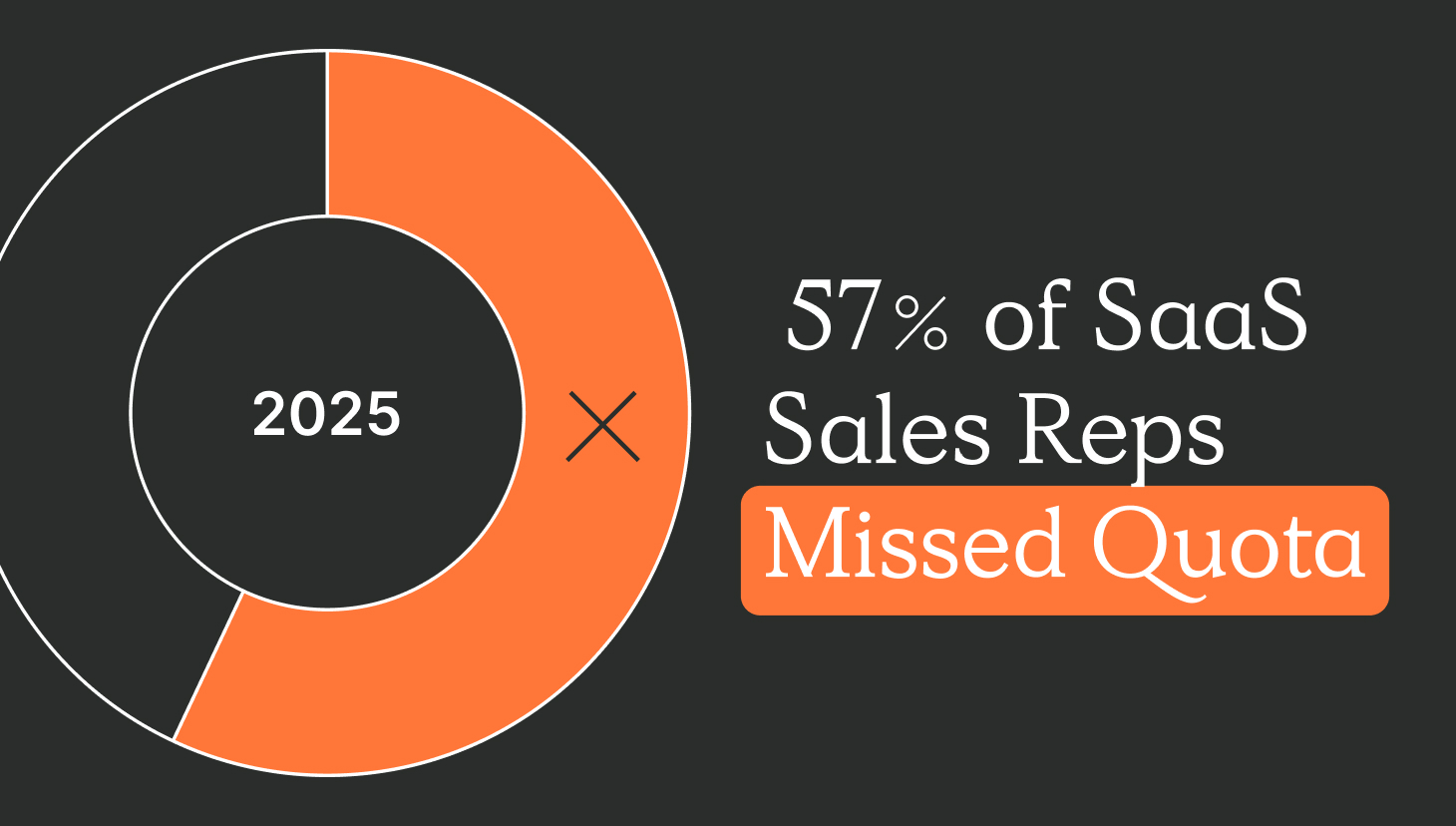
57% of SaaS Sales Reps Missed Quota in Q2 2025. Here’s What That Means.

stats on missed quota

As we enter the second quarter of 2026, let’s remember a big stat from Q2 2025:

57.31% of sales reps missed their quota.

That figure comes from RepVue’s Q2 2025 Cloud Sales Index, which analyzed performance across 246 cloud and software companies and approximately 47,000 quota-carrying sales professionals. 

The report found that average quota attainment reached 42.69% during the quarter.

Also known as: 57.31% of reps missed target.

At first glance, statistics like this might suggest a widespread execution problem among sales teams. But a closer look at the broader SaaS environment reveals a more nuanced story. Performance challenges today are rarely about selling harder. Rather, they’re tied to how companies:

  • Design quotas
  • Structure compensation plans
  • Align revenue expectations with reality

Below, we look at how to better understand what this SaaS sales metric means for you and what to do about it.

Streamline commissions for your RevOps, Finance, and Sales teams

Design, track, and manage variable incentives with QuotaPath. Give your RevOps, finance, and sales teams transparency into sales compensation.

Talk to Sales

Understanding What the Benchmark Measures

First, it’s important to note that RepVue’s data reflects rep-level quota attainment, not a direct measure of whether companies themselves hit their overall revenue targets.

Because those two metrics can diverge.

A company can technically meet its quarterly revenue goal even if many individual sellers miss their quotas, especially if a smaller group of high performers carries a disproportionate share of production.

Even so, when more than half of quota-carrying reps fall short, it typically signals broader structural challenges inside sales organizations.

Over the past two years, SaaS companies have been navigating a very different operating environment than the one that shaped many current sales strategies.

Key changes include:

  • Longer sales cycles
  • More cautious spending from buyers
  • Expanded buying committees
  • Greater deal scrutiny from finance and procurement
  • Heightened pressure on efficiency from investors and leadership
  • And the latest: AI build vs buy

These shifts directly affect the practical achievability of quota targets.

Many quotas were originally designed around growth assumptions from a different market environment. As conditions evolved, not all compensation structures adapted at the same pace.

Quota design is under increasing scrutiny

Across the industry, revenue leaders are asking a critical question: Are quotas actually attainable?

Setting quotas has always involved balancing ambition with realism. Companies want aggressive targets that drive growth while still remaining credible to the people responsible for achieving them.

However, several structural factors can distort quota setting.

Many organizations determine targets using a combination of:

  • Historical growth expectations
  • Board-level revenue goals
  • Pipeline projections
  • Hiring plans and territory coverage

While these inputs are valuable, they do not always reflect a team’s true selling capacity.

If a territory’s market potential, deal size, and sales cycle realistically support $1 million in annual bookings, assigning a $1.5 million quota creates a gap that no amount of individual effort can fully bridge.

In those cases, the issue isn’t motivation or talent. It’s the misalignment between targets and market conditions.

comp plan in quotapath
Break down comp plans in QuotaPath

Compensation plans often magnify the problem

Quota attainment is deeply connected to how sales compensation plans are structured.

When quotas drift beyond what the market can realistically support, compensation models can start producing unintended outcomes.

Several patterns commonly emerge.

1. Motivation declines when targets feel unattainable

High-performing sellers are typically driven by ambitious goals. But there is a threshold at which targets stop feeling aspirational and become unrealistic.

When that line is crossed, engagement can drop. Reps may focus on protecting future pipeline or prioritizing lower-risk deals rather than pursuing aggressive expansion opportunities.

2. Pay-for-performance breaks down

Sales compensation is designed to reward impact. Ideally, it creates a distribution where top performers significantly outperform the rest of the team.

But if most sellers are clustered far below quota, compensation becomes compressed and less meaningful as a performance signal.

In those scenarios, commission plans lose some of their motivational power.

3. Forecasting becomes less reliable

Quota attainment also functions as a key input in revenue forecasting.

If quotas are set too aggressively, leadership teams lose a useful benchmark for evaluating progress. Forecast models become harder to calibrate, and revenue predictability suffers.

quota visibility
Attainment visibility in QuotaPath

The Growing Importance of Compensation Transparency

Beyond quota design itself, another factor shaping sales performance is how clearly compensation plans are communicated and tracked.

Many sellers still struggle to answer basic questions about their earnings:

  • How exactly are commissions calculated?
  • What happens if a deal slips into the next quarter?
  • When will payouts occur?

When market conditions are challenging, uncertainty around pay can amplify frustration.

This dynamic has led to increasing adoption of sales compensation management tools that provide real-time visibility into commissions and quota progress.

When reps can clearly see how deals affect their earnings (and track progress toward their targets throughout the quarter) it builds trust in the system that governs their compensation.

That clarity becomes especially valuable in difficult selling environments.

A Shift Toward Data-Driven Quota Setting

So, what’s the fix? It’s data!

Revenue leaders are revisiting how quotas and compensation plans are designed. And the organizations that are navigating the shift most successfully are investing more heavily in:

Data-driven quota modeling

Rather than relying purely on top-down targets, companies are incorporating historical attainment data, territory potential, and pipeline capacity into quota design.

Improved compensation visibility

Providing sales teams with clear, automated, and real-time insight into commissions and quota progress helps maintain trust and engagement.

Stronger cross-functional alignment

Sales, finance, and revenue operations teams are collaborating more closely to ensure compensation structures reinforce broader company goals.

Try QuotaPath for free

Try the most collaborative solution to manage, track and payout variable compensation. Calculate commissions and pay your team accurately, and on time.

Start Trial

What the Q2 Data Really Signals

The headline statistic…57.31% of SaaS reps missing quota in Q2 2025…should not simply be interpreted as a sales performance issue.

Instead, it highlights the ongoing recalibration happening across the SaaS industry.

As markets mature and buying behavior evolves, the systems that guide sales performance (quotas, compensation plans, and incentive structures) must evolve alongside them.

Organizations that adapt these systems thoughtfully tend to see stronger engagement from their sales teams and more predictable revenue outcomes.

And in a market where efficiency and alignment matter more than ever, getting sales compensation right is increasingly becoming a competitive advantage. 

Talk to our team today to get your sales compensation strategy in the right spot.

The Finance Leader’s Guide to Comp Plan ROI: What Moves the Needle

comp plan roi

Sales compensation is often one of the largest variable expenses on a company’s profit and loss statement, but for many finance teams, it’s still surprisingly difficult to answer a simple question:

Is our compensation plan actually driving ROI?

Most organizations can tell you how much they pay in commissions. Far fewer can clearly connect that spend to improved revenue efficiency, stronger retention, or higher-quality deals.

And this gap matters.

As markets shifted away from “growth at all costs,” leaders began prioritizing metrics like customer lifetime value, gross revenue retention, and customer acquisition cost efficiency.

So while revenue still matters… efficient revenue matters more.

And your compensation plan is one of the most powerful levers finance leaders have to influence it.

Here’s how to measure whether your comp plan is truly moving the needle.

roi of compensation plans
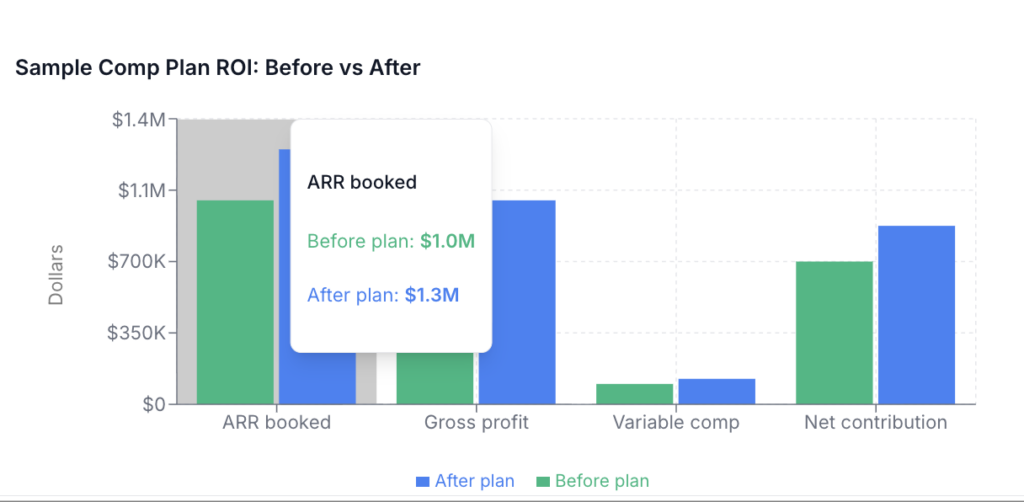
Sample data and image powered by Atlas, QuotaPath’s AI Comp Plan Consultant.

Start With the Cost of Sales Compensation

For finance teams, measuring comp plan ROI starts with understanding the true cost of commissions.

At a basic level, this includes metrics like:

  • Total commissions paid
  • Commission as a percentage of revenue
  • Commission as a percentage of gross margin

But the real insight often comes from analyzing compensation at the deal level.

In many SaaS organizations, several roles earn commissions on a single deal: BDRs, account executives, sales engineers, managers, and leadership overlays. When you combine those payouts, the effective commission rate can climb quickly.

In some cases, companies discover they’re paying 25–35% of deal revenue in total commissions once all participants are included.

For finance leaders responsible for protecting margins, that’s a critical metric to track.

ote ratio calc

Total Commission Rate Calculator

Uncover the full cost of commissions per deal across roles with our free Total Commission Rate Calculator. Designed for Finance leaders to optimize comp plans and protect margin.

Use Calculator

Evaluate Efficiency, Not Just Revenue

A common mistake in compensation design is focusing purely on revenue generation.

But a strong comp plan rewards efficient selling, not just revenue.

To do so, Finance leaders should evaluate compensation against key efficiency metrics like:

Customer Acquisition Cost (CAC)

If commission spend rises faster than revenue, CAC will increase, and comp plans may be incentivizing inefficient sales behavior.

Quota-to-OTE Ratio

Many best-in-class SaaS companies aim for a 5x quota-to-OTE ratio, meaning a rep’s quota should be roughly five times their on-target earnings.

If quotas are too low relative to compensation, companies may be overpaying for revenue.

Revenue per Rep

Another important signal: how productive each seller is relative to their compensation. Balanced attainment across a team often indicates healthy comp design.

Aligning to Comp

These metrics above increasingly matter to investors and boards because they signal durable growth.

Yet many organizations fail to align incentives accordingly.

For example, nearly 39% of revenue leaders say their compensation plans don’t align with company goals, according to QuotaPath research.

That misalignment can lead to predictable outcomes:

Reps optimize for what earns them the most money, even if it’s not what the business actually needs.

A small change in commission structure can dramatically shift behavior. 

For example, increasing commission rates on multi-year contracts or upsells can encourage reps to prioritize higher-value deals that improve retention and lifetime value.

Measure Behavioral Impact

But even if you make these changes, they have to be prominent enough to affect selling behavior.

Finance leaders should regularly ask:

Are we consistently incentivizing the outcomes we want?

Examples include:

  • Selling higher-margin products
  • Closing larger deals
  • Prioritizing ideal customer profiles
  • Driving expansion revenue

Without the right incentives, sales teams may unintentionally work against company priorities.

Don’t Ignore Operational ROI

In addition to efficient revenue, comp plan ROI extends into operational efficiency, as well.

We’ve found that our biggest competitor in the sales compensation software category is the spreadsheet. While that may work early on, the process quickly becomes unsustainable as companies scale.

When Thomas Egbert joined Prefect as Head of Finance, he immediately recognized the problem.

“It was very obvious once I started that doing commissions in a spreadsheet was not going to scale in a friendly way because our sales team was tripling,” said Thomas Egbert, Head of Finance at Prefect.

Manual processes create multiple issues:

  • Time-consuming calculations
  • Higher risk of errors
  • Lack of visibility for sales teams
  • Frequent commission disputes

After implementing an automated solution, Prefect’s finance team reduced the time spent on commission calculations by more than 50% while providing real-time earnings visibility for sellers.

That operational efficiency alone can significantly improve the ROI of compensation management.

commission transparency sales reps
Sales Compensation Plan Transparency in QuotaPath

Transparency Drives Performance

Another often-overlooked factor in the effectiveness of comp plans is transparency.

If reps don’t understand how they earn commissions, incentives lose their power.

Thomas described the problem this way:

“The whole point of having generous incentives is to energize the team and not have it be mysterious,” said Thomas Egbert.

Clear, accessible commission tracking allows sales teams to:

  • Understand how deals impact earnings
  • Forecast potential income from pipeline
  • Stay motivated throughout the sales cycle

When compensation is transparent, it becomes a performance driver.

The Metrics Every Finance Leader Should Track

To measure comp plan ROI effectively, finance teams should track four categories of metrics:

Cost Metrics

  • Commission as % of revenue
  • Commission as % of gross margin
  • Deal-level commission rate

Efficiency Metrics

  • CAC
  • Quota-to-OTE ratio
  • Revenue per rep

Behavioral Metrics

  • Multi-year contract rate
  • Upsell and expansion revenue
  • Discount levels

Operational Metrics

  • Time spent calculating commissions
  • Error rates
  • Rep disputes

Together, these metrics provide a complete picture of how compensation spend translates into business impact.

Streamline commissions for your RevOps, Finance, and Sales teams

Design, track, and manage variable incentives with QuotaPath. Give your RevOps, finance, and sales teams transparency into sales compensation.

Talk to Sales

Final Thoughts

Sales compensation is too important (and too expensive) to operate as a black box.

For finance leaders, measuring comp plan ROI means looking beyond payouts and focusing on outcomes:

  • Are we driving efficient revenue?
  • Are we protecting margins?
  • Are we incentivizing the right behaviors?

When the right metrics are in place, compensation becomes more than a cost center.

It becomes a strategic tool for building predictable, sustainable growth.

Need some help? Talk to our team today to better understand how to measure the true ROI of comp.

How to Reduce Commission Calculation Time

how to reduce calculation time orange background with man working and looking at his watch

Commission errors are common. In fact, 80% of companies admit they’ve paid reps incorrectly, according to QuotaPath’s Compensation Challenges Report. When commission calculations rely on manual processes, small mistakes can quickly compound, slowing down payouts and creating additional reconciliation work for Finance.

The result is familiar to many RevOps and Finance teams: month-end chaos, delayed payouts, and rep disputes. Instead of focusing on strategic work, teams spend days exporting CRM data, checking formulas, reconciling numbers, and answering questions about commission statements.

Reducing commission calculation time is operational…not just technical.

Faster commission processing requires an improved sales commission workflow: centralizing revenue data, standardizing commission logic, and eliminating spreadsheet-driven processes that slow calculations down.

In this blog, we show you how to reduce commission calculation time by automating the commission calculation process.

Key Takeaways:

Reduction in commission calculation time requires using a modern commission automation tool that centralizes CRM data, automates commission logic, and eliminates spreadsheet dependency.

  • Manual commission calculation processes often take 3–10 days per pay cycle.
  • Spreadsheet-based workflows increase commission calculation errors.
  • Automation reduces commission processing time by 50–90%.
  • Real-time dashboards eliminate shadow accounting.
  • Faster commission payouts improve trust and motivation.
Streamline commissions for your RevOps, Finance, and Sales teams

Design, track, and manage variable incentives with QuotaPath. Give your RevOps, finance, and sales teams transparency into sales compensation.

Talk to Sales

Industry Commission Calculation Times

Based on customer benchmarks, commission calculation times vary by industry.

IndustryManual Calculation TimeAutomated Calculation Time
SaaS3–5 days/month1–4 hours
Manufacturing1–2 weeks/quarter<1 day
FinTech4–7 days/monthSame-day
Agencies2–4 days/month1–2 hours
Enterprise Sales5–10 days<6 hours

Commission calculation time doesn’t vary randomly. It’s driven by structural complexity inside the revenue engine.

Here are the core factors that create industry differences:

  • Comp Plan Complexity (accelerators, margin-based commissions, SPIFs, etc.)
  • Volume of Transactions (high-transaction environments, like retail or usage-based SaaS, require more data processing)
  • Number of Revenue Roles (multi-touch deal attribution increases review time)
  • Commission Splits and Multi-Rep Deals (team-selling models, geographic overlays, partner revenue splits introduce additional calculation layers and potential disputes)
  • Usage-Based or Consumption Pricing Models (monthly fluctuating revenue, true-ups, retroactive adjustments, and clawbacks require extra time to review and suss out)
  • Manual Data Consolidation Across Systems (industries with complex billing, like SaaS, telecom, and manufacturing, feel this most.)
  • Frequency of Plan Changes (fast-scaling industries see more structural volatility)
  • Regulatory and Compliance Requirements (industries like healthcare, finance, and public companies require stricter validation around audit trails and revenue recognition)
  • Geographic Expansion (multi-currency payouts, regional compensation policies, and tax compliance differences offer another hurdle)
comp plan automation in quotapath

Why Commission Calculations Take So Long

Although there are many factors influencing commission processing time, these core elements hinder commission calculations efficiency.

Manual Data Pulling From Multiple Systems

Pulling data from multiple systems, such as Salesforce, HubSpot, payroll, and billing tools, is time-consuming. CSV exports and VLOOKUP chains involve error-prone manual data manipulation, creating significant bottlenecks in the sales commission workflow that delay commission calculations. Version control issues further lengthen the commission calculation process with hours spent reconciling conflicting data, formulas, and payout rates.

Complex Plan Structures (Tiers, Accelerators, Clawbacks)

More complex commission plans take longer to calculate and verify.

●   Tier logic errors: Occur when the rules defining commission rates based on performance levels are incorrectly defined or calculated. Often caused by complex, manual spreadsheet formulas, tier logic errors typically result in considerable overpayments or underpayments.

●   Multi-product splits: The method of applying various incentive pay rates based on individual product line items within a single deal, rather than a single percentage for the entire deal. This increases the time required for data entry, manual reconciliation, and dispute resolution.

●   Clawbacks on churn: Occur when a sales rep pays back commission received on a deal when a customer cancels their contract within a designated period. The time-consuming process of recovering commissions requires retroactive adjustments to previously paid earnings, quotas, and compensation statements, leading to payout delays.

●   Retroactive quota changes: Modifications to sales targets, performance goals, or incentive compensation plans that are applied to completed or current performance periods increase commission processing time and dispute resolutions. These sales compensation shifts require admins to re-evaluate historical sales data, reconcile prior payments, and recalculate commission tiers and accelerators.

The Spreadsheet Error Spiral

Research shows that 90% of organizations still rely on spreadsheets to manage critical business information. Spreadsheets introduce risk into the commission calculation process. A single formula error can cascade across multiple rows and tabs, forcing teams to spend hours tracing calculations and validating payouts.

The lack of visibility creates another layer of work. Reps build shadow spreadsheets to track commissions while Finance double-checks the numbers, further slowing the payout process. As Genevieve from NeuroFlow explains, “Both the finance team and the salesperson were doing their own calculations in separate spreadsheets, and we had to slowly come to a consensus together on what the payout would be. It was very much a manual process.”

Reducing commission calculation time starts with addressing operational bottlenecks.

rep commission dashboard in quotapath

5 Ways to Cut Commission Calculation Time

Reduce manual commission work by implementing these five methods.

1. Centralize Your Data Sources

CRM integrations such as Salesforce and HubSpot enable you to auto-sync deal data and create a single source of truth for the entire organization, making it easier to create a sales compensation plan. This also eliminates manual exports and errors while improving the efficiency of commission calculations.

2. Standardize Plan Templates

Leverage pre-built comp plan components in a modular structure to build sales compensation plans with less effort. This reduces customer formula sprawl and administrative errors while increasing plan transparency and motivating the sales team to achieve goals.

3. Automate Rate Calculations and Tier Logic

Use automated accelerators, clawback triggers, and auto-apply splits to increase payout accuracy and reduce time spent on commissions. Automation prevents commission calculation errors before they happen.

4. Build Real-Time Dashboards for Reps 

Live attainment tracking allows reps to see quota attainment and progress toward accelerator tiers, motivating them to sell with purpose as they stretch to achieve the next incentive milestone. Earnings visibility enables reps to see income values instantly as each deal closes in CRM. This motivates reps to keep data current, leading to reduced shadow accounting, faster commission payouts, and fewer disputes.

5. Replace Spreadsheets With Purpose-Built Software

Switching to sales commission automation software from Excel results in error-free commission calculations, streamlines approval workflows, and creates an audit trail. This ensures compliance, reduces payout questions, and builds trust with reps. Automated payout exports eliminate mundane manual processes, increase accuracy, reduce payroll disputes, and save finance and admin time.

Sounds great, but what does this look like in reality?

Try QuotaPath for free

Try the most collaborative solution to manage, track and payout variable compensation. Calculate commissions and pay your team accurately, and on time.

Start Trial

What Real Commission Automation Looks Like With QuotaPath

No CSV exports. No spreadsheet formulas. Commission automation software, such as Quotapath, reduces manual commission work and commission calculation errors while boosting visibility and sales performance.

CRM-to-Payout in One Workflow

A modern sales tech stack includes a fully integrated sales commission workflow that reduces commission processing time and improves accuracy.

  • Direct Salesforce+HubSpot integrations: Native CRM integrations allow deal data to automatically flow into QuotaPath for commission tracking and calculations, also displaying updated commission data in Salesforce and HubSpot.
  • Auto-applies tiers, accelerators, clawbacks: Direct integrations with data sources, such as CRMs and billing systems, facilitate quota and trigger tracking to automatically apply predefined rules to commission calculations without human intervention.
  • Approval routing: Eliminate delays due to email-based routing by automating the entire sales commission workflow.
  • Push to payroll: QuotaPath’s seamless Rippling integration streamlines commission payments, eliminating manual, error-prone processes for faster commission payouts.

Real-Time Earnings Visibility That Kills Shadow Accounting

Reps see earnings immediately and often adjust their selling behavior, prioritizing deals and contracts that align with their incentive plans. With real-time visibility into commissions as deals close, there are no end-of-month surprises. This transparency eliminates the need for “side spreadsheets” and builds trust in payout accuracy.

The Time Savings Are Measurable

These customers saved measurable time by using QuotaPath to automate their commission calculation process.

  • Augury cut commission processing time by 66%
  • Rootly went from 4+ hours/month to 1 hour/month
  • Zapier pays commissions now 10 days earlier in the month
  • HydroCorp went from 3–5 days down to a couple of hours

These results highlight the operational impact of commission automation. By reducing commission calculation time, organizations also reduce time spent on commissions, payout disputes, and administrative burden. Instead of reconciling spreadsheets and answering compensation questions, Finance and RevOps teams can focus on strategic work that drives revenue performance. Schedule a QuotaPath demo to see how commission automation can reduce your commission calculation time.

How Core Imaging Turned a “Horrible” Commission Process into a Competitive Advantage

core imaging quotapath customer

At Core Imaging, spreadsheets were not sustainable. 

And everything commission-related lived in spreadsheets. 

“It was no less than horrible,” President Randy Lafeursky said. “There was no accountability from the rep side. They didn’t know what could actually be paid or when it was being paid.”

That lack of visibility created problems on both sides.

Reps didn’t trust what they were earning.  Leadership struggled to track what had been paid, or when.

And every commission cycle meant hours (or days) of manual work.

“It was very, very hard to maintain,” Randy said. “What did we pay? When did we pay? It was just difficult to keep up.”

As Core Imaging grew, so did the complexity. Multiple product lines, different commission structures, and a distributed sales team only made things worse.

At a certain point, spreadsheets were holding the business back.

When “Good Enough” Software Still Isn’t Enough

Core Imaging’s first attempt to fix the problem was to move off spreadsheets and onto another commission tool.

It helped…but only slightly.

“Palette was a great stepping stone,” Randy said. “But it was extremely tough to use… every month we had to get on the phone because something wasn’t working.”

Instead of eliminating friction, the new system introduced a different kind of complexity.

The team still spent time troubleshooting.
Admins still struggled to maintain accuracy.
And reps still lacked the clarity they needed.

So Randy went back to the market, this time with a clearer vision of what “good” should look like.

Evaluating Commission Tools: Clarity Over Complexity

Randy started his search the same way many operators do: through HubSpot and peer reviews.

But the decision became obvious quickly.

“The minute I had my first demo with QuotaPath, I knew,” he said. “It was nowhere near as polished or complete as what we saw.”

What stood out was QuotaPath’s usability.

QuotaPath offered:

“I could tell from the minute we started talking,” Randy said. “I knew where I was going.”

“What used to be days and days of admin is now less than an hour. It’s the easiest thing I’ve done yet.”

– Randy Lafeursky, President, Core Imaging

From Days of Admin to Less Than an Hour

Once implemented, the impact was immediate…and dramatic.

“What used to be days and days of admin is now less than an hour,” Randy said. “It’s the easiest thing I’ve done yet.”

Commission processing went from a multi-day headache to a quick monthly task.

But the time savings were only part of the story.

Turning Visibility into Motivation

Before QuotaPath, reps were in the dark.

They didn’t know:

  • What they were getting paid on
  • When they’d be paid
  • Or how close they were to earning more

Now, everything is visible in real time.

“QuotaPath allows reps to see what they’re going to get paid on before payment happens,” Randy said. “And what their potential is.”

That transparency changed behavior.

Reps can:

  • Track earnings as deals progress
  • Understand eligibility and payouts
  • Compete on leaderboards updated daily

“I love the leaderboard,” Randy said. “Reps are competitive, so why not show it?”

Instead of questioning commissions, reps now engage with them.

comp plan visibility
Comp plan and earnings breakdowns in QuotaPath

Eliminating the “Commission Conversation”

One of the most unexpected wins came from what disappeared.

“I don’t have any commission emails anymore,” Randy said. “Those calls, requests, questions—they’re zero.”

Before QuotaPath, commission cycles triggered back-and-forth across:

  • Finance
  • Sales leadership
  • Individual reps

Now, that entire layer of communication is gone.

When Randy thinks about ROI, he starts with time.

“The amount of time we all spent on this… it’s dropped pretty much to zero,” he said.

Flexibility That Fits the Business

Core Imaging’s compensation plans aren’t one-size-fits-all with its different product lines, data sources, and commission structures.

QuotaPath made it possible to bring all of that together.

“It’s not just a box,” Randy said. “We were able to configure it exactly how we needed.”

By integrating HubSpot with Google Sheets and distributor data, the team built a system that reflects how their business actually operates (not the other way around).

Faster Commissions, Happier Reps

With commissions fully automated, Core Imaging unlocked something unexpected: speed.

“We went from paying commissions on the 25th to the 15th,” Randy said.

Why? Because the manual buffer time disappeared.

What used to require back-and-forth, validation, and delays now just…works.

“Now we pay around the 13th,” he added.

That shift had a real impact on rep satisfaction and trust.

Why Core Imaging Would Never Go Back

For Randy, the comparison is simple.

Spreadsheets mean:

  • Manual errors
  • Constant questions
  • Lost time

QuotaPath means:

  • Accuracy
  • Visibility
  • Confidence

“From setup to daily use, QuotaPath has made my life easier, made our reps happier, and saved us hours,” Randy said. “I would never go back to spreadsheets.”

Streamline commissions for your RevOps, Finance, and Sales teams

Design, track, and manage variable incentives with QuotaPath. Give your RevOps, finance, and sales teams transparency into sales compensation.

Talk to Sales

The Takeaway

QuotaPath didn’t just help Core Imaging process commissions faster.

It helped them:

  • Eliminate manual work
  • Build trust with reps
  • Increase visibility across the business
  • Turn commissions into a motivator

Or, as Randy puts it: “It takes paying commissions from being a big thing in the month…to not being a big thing at all.”

Want to turn commissions into a non-issue and a motivator for your team? Book a demo with QuotaPath today.

5 Critical Mistakes to Avoid When Adjusting Mid-Year

5 Critical Mistakes to Avoid When Adjusting Mid-Year

Mid-year compensation changes are rarely planned. 

They happen because something isn’t working…pipeline is soft, deal mix is off, or leadership wants to shift focus fast.

But here’s the risk most teams underestimate:

The biggest risk in a mid-year comp change isn’t the math. Rather, it’s breaking trust while trying to redirect behavior.

If you get it wrong, you create confusion, disputes, and disengaged sellers in addition to missing your targets.

Below, we shared the five most common mistakes we see RevOps teams make (and how to avoid them).

indicator to change your comp plan
A clean rule of thumb: if fewer than about 60% of reps are reasonably on pace to quota after Q1, the plan is worth reviewing. (Visual from Atlas, QuotaPath’s AI Comp Planning Tool that runs on proprietary QuotaPath data)

Why Mid-Year Compensation Changes Are So Risky (and Necessary)

Most teams don’t want to touch comp mid-year. And in many cases, they shouldn’t.

But business reality doesn’t always cooperate.

You may need to adjust compensation because:

  • Your ICP has shifted
  • Multi-year deals matter more than volume
  • Cash flow or upfront payments are now a priority
  • The board is pushing for higher-quality revenue

The challenge is this: compensation plans are trust systems.

When you change them mid-stream, you introduce:

  • Uncertainty in earnings
  • Confusion in payout logic
  • Risk in forecasting

The goal then becomes more about redirecting behavior without damaging trust vs simply fixing behavior.

5 Critical Mistakes to Avoid

Alas, you can’t just make adjustments and expect your problems to fade away.

Here’s where teams go wrong.

1. Changing Too Many Variables at Once

It’s tempting to fix everything in one move: quotas, commission rates, accelerators, etc.

But when you change everything, you lose the ability to answer one simple question:

What actually worked?

Instead, mid-year adjustments should be tightly scoped.

Focus on 1–2 specific outcomes, like:

  • Increasing multi-year contracts
  • Driving upfront cash collection
  • Improving deal mix within your ICP

The simpler the change, the clearer the signal.

If you’re unsure how to isolate variables, revisit how to build a sales compensation plan with clear incentive alignment.

2. Using Compensation to Fix Performance Issues

We also see a lot of leaders turn to the comp plan as the cure-all for performance. Spoiler alert: it’s not!

If your issue is:

  • Weak pipeline
  • Poor qualification
  • Inconsistent pricing discipline
  • Lack of manager accountability

… then changing comp won’t fix it. Compensation works best at the margin. It nudges behavior. It doesn’t replace execution.

Instead, if reps aren’t closing the right deals, ask:

Is this an incentive problem or an operational one?

Often, the answer lies in:

  • Better enablement
  • Stronger pipeline generation
  • Clearer sales processes

(And not a new commission structure.)

3. Reducing Earnings Opportunity in the Name of Focus

Another mistake happens when leaders reduce earnings opportunities. This is where things break…fast.

You tell reps: “We want you to sell different types of deals.”

What they hear: “You’re going to make less money.”

And motivation drops immediately. Before rolling out any change, run a simple test:

  • Can a solid performer still hit their on-target earnings (OTE)?
  • Can a top performer clearly earn more by selling the preferred deal type?

If the answer is no, your plan is a restriction. Remember that strong comp plans visibly reward good behavior.

For more on structuring effective incentives, check out this sales compensation plan guide.

4. Creating Complexity Finance Can’t Explain

Of course, one of the most common mistakes we see in any comp plan – not just those rolled out mid-year- is over-complexity. If your comp plan requires a spreadsheet walkthrough every time a rep asks a question, it’s too complex.

And mid-year is the worst time to introduce complexity.

Why this matters:

  • More disputes from reps
  • Slower payout cycles
  • Messier accruals
  • Lower forecast confidence

We often forget that simplicity acts as a financial control mechanism.

Clean plans lead to:

  • Fewer exceptions
  • Lower admin burden
  • Better predictability

If you’re struggling with complexity, it’s often a sign you need commission automation tools to simplify logic and improve transparency.

5. Failing to Protect Fairness for Deals Already in Flight

Lastly, and this is where trust gets lost fastest, is when leaders let existing deals get impacted by comp plan changes.

When reps build a pipeline under one set of rules, then suddenly, they’re paid under another… that’s going to hurt.

That gap creates friction and often escalations.

To avoid this, define clear transition rules upfront:

  • Grandfathering: Old rules apply to existing deals
  • Stage-based splits: Different treatment based on deal stage
  • Effective-date rules: Clean cutoff with minimal ambiguity

The key is clarity. If a rep can’t easily explain how a deal will be paid, you have a problem.

Practical Guardrails for Mid-Year Adjustments

If you do need to make a change, keep it grounded in a few principles.

1. Tie the change to one measurable outcome
For example:

  • Increase multi-year ARR
  • Improve upfront collections
  • Shift segment or ICP mix

2. Model cost before rollout
Test:

  • Downside scenarios
  • At-target earnings
  • Upside performance

Your goal is simple:

Don’t increase the cost of sales unless you’re improving revenue quality.

This is where tools like sales commission automation help you model scenarios before rollout.

Streamline commissions for your RevOps, Finance, and Sales teams

Design, track, and manage variable incentives with QuotaPath. Give your RevOps, finance, and sales teams transparency into sales compensation.

Talk to Sales

Final Takeaway: Optimize for Trust, Not Just Performance

All this to say: Mid-year comp changes are sometimes necessary. But they’re never neutral.

They affect:

  • How reps sell
  • How finance forecasts
  • And how much your team trusts leadership

That’s why the goal is better performance without breaking the system that drives it.

“We are adjusting the plan to improve revenue quality, not just volume, and we are doing it in a way that preserves trust, payout clarity, and cost discipline.”

If you’re planning a mid-year adjustment, the question isn’t just:

Will this change behavior?

It’s: Will it do it without creating more problems than it solves?

Model Your Mid-Year Changes with Confidence

Mid-year comp changes don’t have to be risky.

With QuotaPath, you can:

  • Model compensation scenarios before rollout
  • Simplify plan design and payout logic
  • Give reps full visibility into earnings

Book a demo to see how you can adjust comp without sacrificing trust or clarity.

Comp Plan Design for RevOps

comp plan design for revops

As revenue teams scale, compensation complexity grows, increasing administrative burden, payout calculation errors, and rep demotivation. Concurrently, sales comp plan design ownership has shifted away from spreadsheets and ad hoc Sales Ops processes to RevOps-led comp design. This change is responsible for turning compensation strategy into an executable system, creating comp plans that are better aligned with organizational objectives.

Key Takeaways

Comp plan design for RevOps requires cross-functional alignment, data-driven modeling, and systems that scale across roles…not one-off plans built in isolation. This blog explains:

  • Why RevOps owns compensation design across Sales, CS, and leadership roles
  • How RevOps balances Finance constraints with Sales behavior
  • What a modern RevOps-led comp design process looks like
  • Why tooling and transparency matter as much as plan logic

What Is RevOps Comp Plan Design?

Although it may sound like this is about RevOps compensation plans, this is not about paying RevOps. It’s about RevOps designing compensation for the organization. For instance, why do they own sales comp? How did it shift from Sales Ops? And how do comp plans affect RevOps goals?

Why RevOps Owns Sales Compensation

Sitting at the intersection of Sales, Finance, and systems, RevOps owns sales compensation ~46% of the time when the team has 26+ commissionable employees. They own quotas, forecasting, CRM data, and performance reporting. Hence, RevOps is best positioned to design measurable, enforceable comp plans across the revenue organization.

The Shift From Sales Ops to RevOps-Led Comp Planning

Sales Ops historically supported sales compensation design. However, RevOps now governs it, since compensation planning has become a GTM system rather than an admin task. No longer a once-a-year task, it is a strategic Go-to-Market tool for actively driving sales behavior and revenue.

RevOps compensation planning ensures plans align with business goals, not just rep preferences. This incentivizes the right behavior, motivating reps to prioritize deals that support long-term growth over short-term rewards.

How Comp Plans Impact Revenue Operations Goals

Sales compensation design affects revenue-related outcomes that RevOps is accountable for. Forecast accuracy, pipeline quality and velocity, rep ramp time and productivity, and data hygiene and CRM adoption are all influenced by the sales behaviors driven by the comp plan. For instance, incentives that reward multi-year deals or those with ideal customer profiles (ICP) encourage more predictable revenue projections, pipeline, and velocity.

Transparent plans accelerate onboarding and increase motivation, while plans with reduced new-hire quotas boost morale during ramp periods. Performance metrics used in comp plans can either foster a data-driven culture or create incentives for “dirty” data. Ultimately, the revenue operations comp plan determines the quality of the outcomes.

Key Stakeholders in RevOps Comp Plan Design

Although RevOps is the orchestrator, they are not the sole decision-maker in the sales compensation design process. They ensure Finance, Sales Leadership, and RevOps are aligned throughout the planning process and comp plan approval, building cross-functional buy-in to create an effective comp plan structure.

Aligning Finance, Sales Leadership, and RevOps

RevOps compensation planning is a collaborative process requiring effective communication. A lack of alignment leaves Finance, Sales Leadership, and RevOps pushing their own disparate priorities instead of playing their distinct role in the comp planning process.

  • Finance: Controls costs, accruals, and predictability of comp plan structures, by protecting profit margins, ensuring proper commission recording, and modeling to forecast expenses and prevent budgetary surprises.
  • Sales leadership: Strives for a combination of motivation, fairness, and attainable goals that prompt behaviors, retain talent, and achieve business goals.
  • RevOps: Handles comp plan modeling, feasibility assessments, and system execution with automation to ensure transparency, accuracy, and alignment across revenue teams.

Misalignment results in last-minute plan changes, rep confusion, and rollout delays, ultimately damaging rep trust and performance.

Who Approves the Comp Plan?

A typical revenue operations comp plan approval flow consists of RevOps-led design, followed by Finance validation, and final executive sign-off, ensuring alignment with business goals. Misalignment in the sales compensation design process commonly happens when plans are created in silos without collaborative input, incentives aren’t tied to current strategic goals, or outdated quotas are used.

RevOps should own the “single source of truth” for sales compensation to keep everyone on the same page and prevent assumptions based on differing data sources. This increases accuracy, transparency, and alignment of the incentive structure with revenue goals.

Building Cross-Functional Buy-In

Transparency fosters trust during the sales compensation design process, helping all stakeholders see the plans as equitable and fair. RevOps’ use of data-driven modeling and scenarios based on historical figures reduces emotional debates, accelerating the adoption of plans. This reality-based approach prevents subjective or last-minute changes that can break cross-functional buy-in, lead to stakeholder misalignment, and erode trust.

comp design process for revops 8 steps

8-Step Comp Plan Design Process for RevOps

Now that you know who should participate in RevOps compensation planning, follow this playbook for designing comp across roles to help guide you through the sales compensation design process.

Step 1: Define Business Objectives and Revenue Goals

Before designing a compensation plan, it’s crucial to determine your organizational goals and objectives so the plan will drive the right behaviors to support their achievement.

  • Translate company goals into comp-aligned behaviors
  • Examples: new ARR, multi-year deals, retention, expansion
  • evOps ensures incentives map to outcomes, not vanity metrics

Step 2: Analyze Historical Performance Data

This analysis helps align pay with strategic goals, optimize budget, and ensure quotas are achievable by reviewing:

  • Attainment trends
  • Quota accuracy
  • Deal mix and ramp curves
  • RevOps uses this data to ground decisions

Step 3: Benchmark Against Industry Standards

Compensation benchmarking is essential for maintaining fair, competitive, and financially responsible sales compensation plans. It helps organizations attract and retain top talent and facilitates compliance with salary transparency laws.

  • Market pay and OTE norms
  • Avoid blindly copying competitor plans
  • Use benchmarks as guardrails, not prescriptions

 Step 4: Model Scenarios and Cost Projections via Pressure Testing

Testing comp plans against actual performance data prior to rollout is crucial. It not only builds trust among committee stakeholders but also prevents overpayment, underpayment, and erosion of trust and morale. Untested plans can break the budget or lead to rep turnover.

  • Best / expected / worst-case attainment
  • Rep earnings distribution
  • Finance-friendly cost modeling

Step 5: Draft Plan Documentation

Clear communication is essential to the success of the sales compensation design. We found that 60% of reps take 3 to 6 months to fully understand their plans. If reps don’t understand how the plan works, how they earn commissions, and how to optimize their earnings, the newly launched plan will fail. Plan documentation creation is RevOps responsibility (not an afterthought!) and should include:

  • Clear definitions
  • Calculation logic
  • Payout timing and eligibility

Ensure the comp plan structure is strategically aligned with North Star metrics and complies with regulatory requirements prior to roll-out.

  • Lock rules before rollout
  • Avoid mid-cycle ambiguity

Step 7: Communicate and Roll Out to Reps

Comp plan communication directly impacts the success of the revenue operations comp plan. This step is the key to helping reps understand how their plan works, how they earn commissions, and how to focus their efforts. You can confirm reps’ understanding during plan rollout by using a commission agreement to surface any lingering questions reps have before the plan is launched.

  • RevOps owns enablement and clarity
  • Here’s how you win” scenarios
  • Align messaging across Sales and Finance

Step 8: Monitor, Measure, and Iterate

The RevOps compensation planning process is continuous. Routinely measure the success of plans across key areas to learn what’s working, identify potential improvements, and confirm the plan continues to motivate the right behaviors over time.

  • Track behavior vs. intent
  • Quarterly reviews
  • RevOps adjusts comp as the business evolves

Comp Plan Structures by Role

Compensation plans are not one-size-fits-all. Consequently, RevOps designs different comp structures for different revenue roles. Segmenting sales roles ensures all team members are rewarded based on their specific areas of influence, creating fair, effective plans that motivate behaviors to drive organizational objective attainment.

SDR and AE Comp Plans

What’s the difference between SDR and AE compensation plans? SDR plans focus on pipeline contributions and activities, such as scheduled meetings or demos. By contrast, AE plans reward revenue attainment and closed-won deals. RevOps’ role is ensuring clean handoffs and attribution.

CSM and Sales Manager Comp Plans

Two other key roles that receive incentives are CSMs and Sales Managers. CSMs are measured and incentivized based on retention and expansion. Sales Manager plans, on the other hand, are influenced by a combination of Team and individual performance. In this case, RevOps is responsible for balancing controllability and accountability of plan elements.

Measuring Comp Plan Effectiveness

Moving beyond “did we build it” to “did it work,” it’s time for RevOps to diagnose and fix comp issues by assessing key areas.

Attainment distribution reveals whether the plan was too easy or too hard to hit. If it’s too easy, the bar has been set too low, rewarding less desirable performance. While the plan should be within reach, not everyone on the team should be crushing it. If the plan is too hard, you risk demotivating and frustrating your team—worst case, you may experience rep turnover. So, assessing this is essential for budgetary and retention purposes.

Likewise, gauging rep understanding and trust is important. This can be accomplished by meeting one-on-one with team members to gather feedback on the plan, or by conducting a survey. Remember, if reps don’t understand and trust the plan, it won’t motivate the desired behaviors. Payout disputes and exceptions are often a sign that a plan is too complex and difficult to understand, leaving reps confused about their earnings calculations.

Finally, impact on core revenue metrics is a crucial area to assess since the sales compensation structure is intended to motivate behaviors that drive organizational goal achievement. If these metrics are falling short, it’s a sure sign that adjustments are needed to improve revenue results.

Free Comp Plan Templates and Resources

As you begin your RevOps compensation planning process, use these compensation plan templates and resources as a starting point…not a shortcut. Then adapt them to your specific GTM motion.

Streamline commissions for your RevOps, Finance, and Sales teams

Design, track, and manage variable incentives with QuotaPath. Give your RevOps, finance, and sales teams transparency into sales compensation.

Talk to Sales

Why RevOps Teams Choose QuotaPath for Commission Management

Effective RevOps compensation planning is only the beginning. Plan execution requires a powerful, user-friendly tool, like QuotaPath, to make the plan succeed.

Why QuotaPath? These customer wins say it best. AlphaSense, for example, simplified hundreds of complex comp plans, provided transparency to their reps and finance teams, and reduced accrual time by 90% by switching to QuotaPath. “It took us previously three to four days to pull an accurate accrual. I pull it now in a matter of 20 to 40 minutes,” said Cara Hickey, Senior Manager of Sales Compensation, Global.

Whistic reduced administrative burden when they switched from Spiff to QuotaPath due to complexity and usability issues. “Instead of spending hours validating and recalculating numbers, we can run commissions quickly and accurately,” said Taggart Befus, Revenue Operations Manager.

Virtuous found their single source of truth across departments while streamlining the management of multiple comp plans and payouts. “QuotaPath helps me keep my sanity…It’s the one place where I can control comp, track against it, and say ‘here’s what changed and why,’” said Joan Schiffer, Director of Accounting.

QuotaPath is the platform that enables RevOps to own comp end-to-end.

  • RevOps needs systems that match comp complexity
  • Real-time visibility for reps and leaders
  • Fewer manual adjustments and disputes
  • One source of truth across Finance and Sales

     👉Book a demo to see how RevOps teams design and manage compensation with QuotaPath.