Introducing Atlas: Your AI Revenue Strategist

atlas quotapath ai comp consultant

Every company gets exactly the behavior it pays for. Atlas helps you make sure it’s the right one.

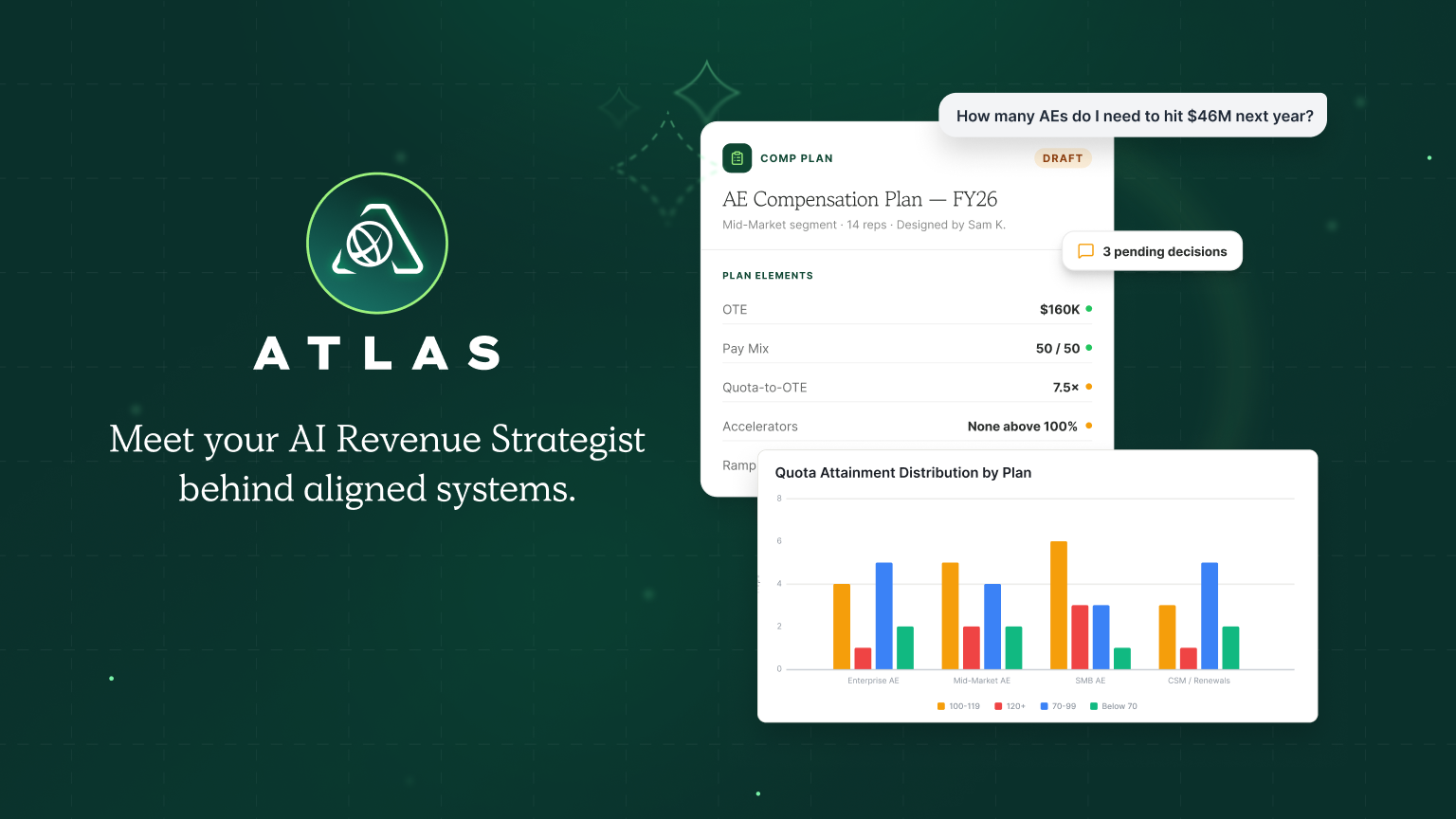
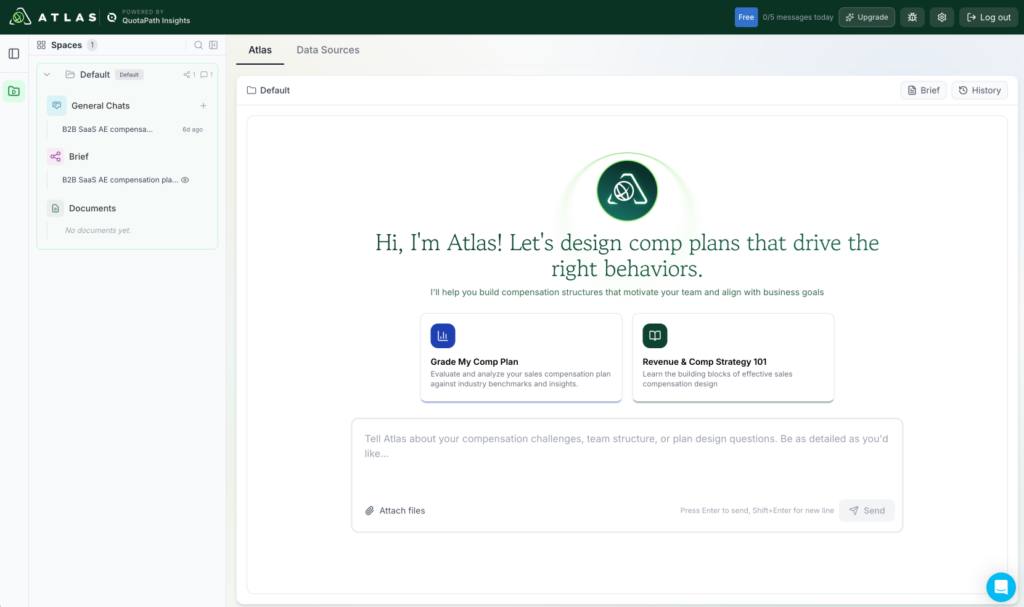
Today, we’re thrilled to announce the full launch of Atlas, our AI Revenue Strategist, powered by proprietary QuotaPath data and tens of thousands of comp plans.

Atlas acts as a comp expert and GTM consultant on demand,  answering whether your comp plans are driving the right behavior and whether your GTM is built to hit the number.

For years, QuotaPath has helped you run commissions accurately and efficiently through automation, with the end-user in mind. But running commissions is only part of the equation. The bigger challenge is in connecting your compensation plans to your GTM motion and designing both to drive the outcomes your business needs.

We built Atlas to help you validate, stress-test, and align your compensation plans to business goals while modeling the GTM strategy required to hit your number.

“From day ONE, QuotaPath’s vision has been to help leaders align company objectives to incentives in order to drive the right behavior,” said Co-founder and CEO AJ Bruno. “We have eight years of data, history, and experience to back the release of our AI Revenue Strategist product, Atlas, and I couldn’t be more thrilled to dynamically help our customers navigate the complexities of their variable comp plans.”

The problem: Most Comp Plans Are Built on Guesswork

If you’ve ever built or adjusted a comp plan, you’ve likely asked:

  • Are we driving the right behaviors?
  • Are we overpaying or underpaying?
  • Will this plan actually achieve our goals?
  • Is our GTM built to hit our number?

The reality is that most teams don’t get clear answers up front.

Instead, they find out after rollout, when the impact on performance, cost, and morale is already felt.

And you’re not alone. We found that nearly 40% of revenue leaders report struggling with misaligned incentives.

Meet Atlas: From Guesswork to Confidence

Atlas changes how compensation planning works.

Built on QuotaPath’s proprietary data, Atlas gives you the ability to design, test, and validate comp plans before they impact your business and model the GTM strategy required to hit your number.

Instead of reacting to problems, you can prevent them.

ai revenue strategist and ai comp consultant

What you can do with Atlas

With Atlas, you can:

  • Validate your plans against benchmarks and best practices: Compare your compensation strategy against benchmarks and best practices—so you know what “good” looks like.
  • Stress-test scenarios before rollout: Model different scenarios to understand the financial and behavioral impacts of your plans.
  • Align incentives with business goals: Design comp plans based on your company objectives (not opinions).
  • Connect comp plans to your broader GTM motion: See if your plan is logically built to support your GTM goals.
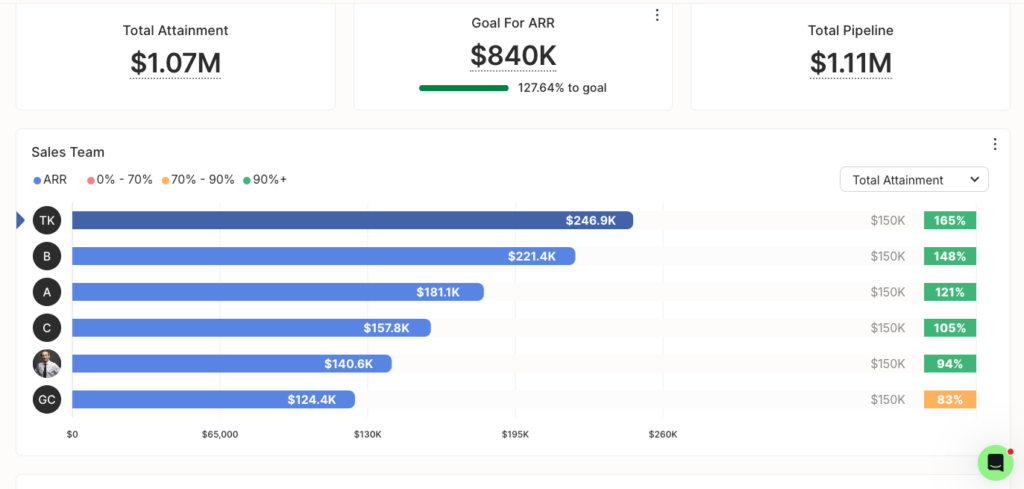
  • Get instant, trusted performance insights: Answer questions about team performance quickly, with data you can trust.

Bring RevOps, Finance, and Sales into one shared model, and bid adieu to your spreadsheets and scattered docs.

Built for How Modern Revenue Teams Operate

Using Atlas, you can begin to use comp plans as a strategic lever and collaboratively with your leadership team.

  • RevOps gets faster, more reliable planning
  • Finance gets visibility into cost and risk
  • Sales leaders get clarity on performance and behavior

All powered by the commission and performance data you already trust in QuotaPath.

Streamline commissions for your RevOps, Finance, and Sales teams

Design, track, and manage variable incentives with QuotaPath. Give your RevOps, finance, and sales teams transparency into sales compensation.

Talk to Sales

From execution → strategy

QuotaPath executes your commissions. Atlas makes sure they’re worth executing in the first place.

Get started with Atlas

Atlas is now available. Try it for free here.

What to Look for in Modern Compensation Planning Software (Hint: It’s Not Just Commission Accuracy)

modern comp planning software

Every compensation software vendor will tell you their platform calculates commissions accurately.

Let’s just get this out of the way. That claim is table stakes and not a differentiator.

If two platforms can both handle a tiered accelerator correctly, what actually separates the RevOps and Finance teams who love their tool from the ones still fighting spreadsheets at 9pm before payroll runs?

It comes down to six things that rarely make the front page of a vendor’s website:

  • how usable the tool is for everyone who touches it
  • how transparent the pricing is
  • how fast and consistent the support is
  • whether the services model fits your team’s bandwidth
  • whether the AI is built on data you can trust
  • and whether the platform actually talks to the tools you already run on

Zapier’s then Manager of Revenue Operations, Katie Huson, put it well when she was evaluating vendors: “One thing that’s really important to me is: if I win the lottery and I’m not coming back tomorrow, could somebody else take this over really easily?”

That question has nothing to do with whether the math is correct and everything to do with whether the software works for the humans using it.

So, here’s what to look for, backed by what actual customers have said.

Usability: Can Anyone on the Team Actually Use It?

Commission software fails quietly.

It’s rarely a calculation error that sinks a tool. It’s the admin who’s the only person who understands the formulas, or the rep who has to email Finance every cycle to ask “why is this number what it is.”

On G2, QuotaPath customers consistently point to this first.

Genevieve M., a Revenue Operations Sr. Manager, wrote: “The ease of use of the platform is excellent. I love the transparency it provides on how earnings are calculated for a deal… The UI is informative and very usable by administrators and salespeople alike.”

Chris S., a Sales Operations Manager, echoed the same thing: “I love how easy the UI is for me in Admin, and for the reps.”

And Jacob L., a Sr. Sales Operations Manager, noted that “deployment was so easy that I was able to get around 99% complete with some niche items requiring minimal support.”

Katie from Zapier said usability was the deciding factor when she evaluated vendors after first seeing QuotaPath at HubSpot’s INBOUND conference: “QuotaPath felt very drag-and-drop. Very simple to understand.”

The payoff shows up in day-to-day operations. Reps at Zapier can now see “every deal, the exact math, and why it’s mathing that way,” and Katie says she “rarely gets questions” anymore.

At Forthright Capital Partners, RA Principal Charles Nguyen saw the same gap when comparing tools.

“Even with other software like Spiff or Salesforce-native tools, it was hard for agents to understand their payouts,” said Charles. “But with QuotaPath, they can just pick it up.”

When you’re evaluating a platform, test usability from three seats:

  1. The admin building the plan
  2. The rep checking their earnings
  3. The person who’d have to take the whole thing over if you left tomorrow.

Pricing Transparency and a Low-Risk Way to Try It

Buyers are tired of opaque, sales-led pricing that only shows up after three demo calls and a “let me check with my manager” email. Look for vendors who publish pricing and let you try the product before committing to a contract.

Jay Wallace, Sales Founder & VP of Worldwide Sales at runZero, said this shaped his entire evaluation: “We buy from companies that look and feel like us. Free trial. Easy to install. No professional services… The no professional services was a hard requirement.”

His team went from signed contract to fully automated commissions in less than two months, and 24 weeks without a single sales compensation error.

David Taub, Senior Director of Revenue Operations at HydroCorp, chose QuotaPath in part because of the reduced risk of the investment: “A big driver of it was the level of investment into QuotaPath was less, a lot less risk than going into some of the more legacy players.”

The payoff was immediate. Rebuilding a past comp plan in QuotaPath surfaced enough costly errors that, as David put it, “we essentially paid for QuotaPath in one month.”

At Three Point Mortgage, Connor Adkisson named pricing as one of three deciding factors against Everstage and mortgage-specific tools that were “prohibitively expensive or too rigid.”

Transparent pricing paired with a free trial signals something important: a vendor confident enough to let the product sell itself before the contract is even on the table.

Streamline commissions for your RevOps, Finance, and Sales teams

Design, track, and manage variable incentives with QuotaPath. Give your RevOps, finance, and sales teams transparency into sales compensation.

Talk to Sales

Support That Actually Responds

Support quality only becomes visible after you’ve signed.

That’s exactly why it’s worth asking pointed questions in advance: how fast does the team respond, and will you be talking to the same person twice, or starting over with a new rep every time?

Katie described QuotaPath’s support as “answers, not tickets”: “The chat is the easiest thing ever. Whenever I put in a ticket, I get a Loom back showing me what to do, so I don’t have to ask the same question twice.”

Charles said the same thing about response speed: “Each time I use a chat bubble, I get a response back within 30 minutes. Any formula issues are always fixed same day.” When he had an implementation emergency, he emailed the team directly and got a reply “within an hour every time.”

When you’re checking references, ask how fast and reliable support is.

A Services Model That Matches Your Team’s Bandwidth

It’s also important to remember that no two RevOps or Finance teams have the same in-house capacity.

The best comp platforms offer a spectrum of support, from fully self-serve to white-glove build-and-manage, rather than forcing every customer into the same delivery model.

Three Point Mortgage, for example, needed the white-glove end of that spectrum.

Their commission structure involved multiple role-based plans, overrides, recoverable draws, and branch-level P&L carve-outs, complexity that had broken their previous vendor’s rigid framework.

QuotaPath’s implementation specialist “logged every payment method, mapped out all the possible combinations, and guided the team through key decisions,” and the company’s co-founder personally built a custom workflow to solve their trickiest problem: calculating draws intelligently based on actual pay-period earnings instead of a blanket assignment.

Virtuous took a similar hands-on path when they joined the beta for QuotaPath’s Rippling integration.

Director of Accounting Joan Schiffer got direct support through setup, and her feedback during the beta directly shaped product features like bulk-send. “It was a no-brainer,” she said. “It only made sense to have these systems communicate.”

At the other end of the spectrum, runZero explicitly wanted the opposite: “no professional services needed” was a hard requirement for a lean, fast-moving SaaS team.

Both approaches worked because QuotaPath let each customer choose. The question worth asking any vendor is simple: what happens in week one if your comp plans are more complex than a template? The answer tells you whether their services model is real or just a line on a pricing page.

AI That Understands Compensation, Not Generic AI

Next up is AI, a checkbox now on every vendor’s homepage (some mention it more than others).

What matters is not the number of agents they offer but what the AI actually reasons over.

For instance, is a solution’s AI a wrapper around a public LLM that can guess at compensation best practices? Or is it a tool trained on proprietary comp data that can tell you something specific and defensible?

Atlas, QuotaPath’s AI Revenue Strategist, runs on proprietary QuotaPath data and benchmarks from roughly 10,000 real comp plans, not generic internet text.

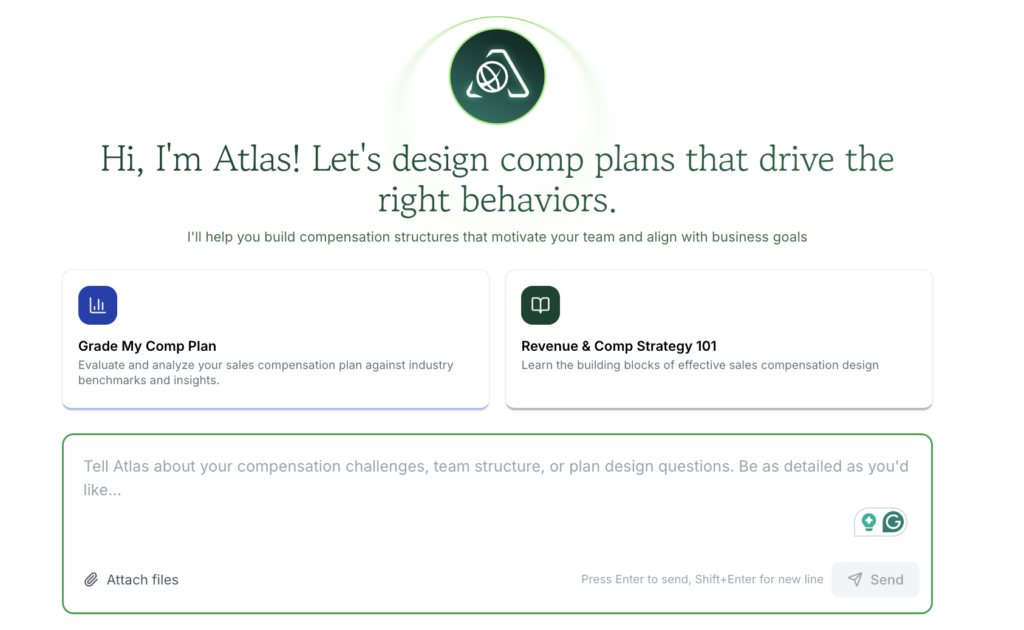
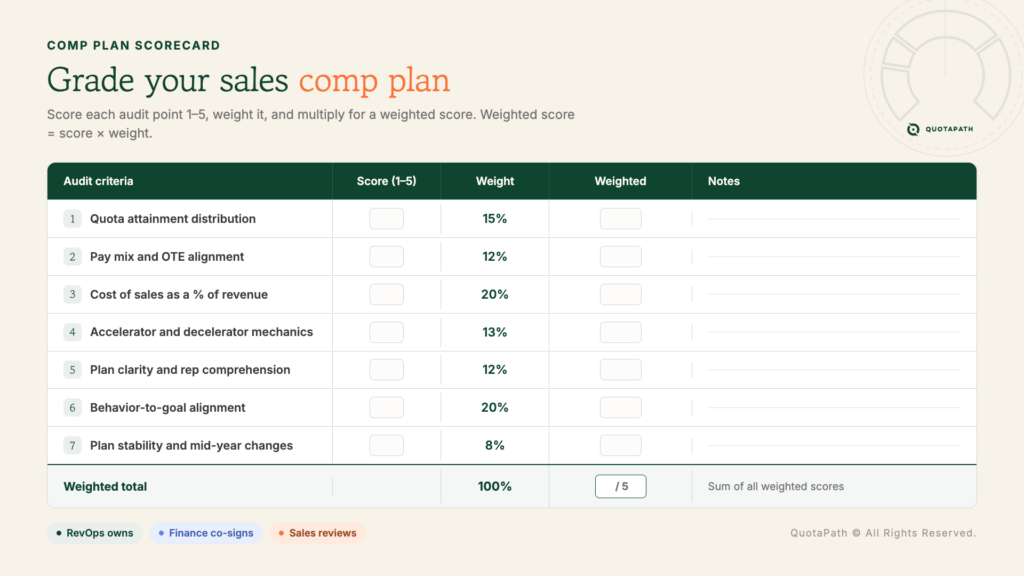
Its “Grade My Comp Plan” tool evaluates an existing plan against those benchmarks, flags structural fixes before rollout, and predicts how the plan will shape rep behavior and GTM motion.

It also solves a familiar RevOps problem: getting analysis in front of leadership.

Atlas generates shareable, C-suite-ready briefs, so an evaluation doesn’t stay buried in a spreadsheet.

One more thing worth asking any AI comp vendor: does it train on your data?

(Atlas doesn’t; your data stays private.)

Native Integrations With the Tools You Already Run On

Lastly, some RevOps leaders may argue this is the most important factor: a vendor’s integration capabilities.

Look for direct, native integrations with your CRM and your payroll system.

On the CRM side, runZero automated commissions by syncing directly with HubSpot, reaching 100% adoption across 33 reps and five-plus comp plans, and going 24 weeks without a single commission error.

On the payroll side, Virtuous connected QuotaPath directly to Rippling to close the loop from commission calculation to payout. “Thanks to the Rippling integration, I’m confident our payouts are accurate and faster. No more triple checks,” said Joan, who now saves roughly 30 minutes per pay run across 70 commissionable employees.

Three Point Mortgage got a similar result, even though the Rippling integration wasn’t part of their original purchase decision. “It wasn’t part of the original sales conversation,” Connor said, “but it became one of the most meaningful parts of the relationship… We just load QuotaPath and hit send.”

Native integrations remove the two riskiest manual steps in the entire comp process: pulling deal data in, and pushing payout data out to payroll.

That’s exactly where copy-paste errors and trust problems start. When you’re evaluating a shortlist, ask any vendor to show you the integration live.

A Quick Evaluation Checklist

Before you sign anything, run your shortlist through six questions:

  1. Can a non-technical rep understand their own commission math without help?
  2. Is pricing published, and is there a free trial with no forced professional services?
  3. What’s the average support response time, and will you have a consistent point of contact?
  4. What does onboarding look like if your comp plans don’t fit a template?
  5. What data trains the AI features, and can it produce something leadership-ready?
  6. Which CRM and payroll systems have native, two-way integrations today, not on a roadmap?

The Bottom Line

Commission accuracy is the price of entry.

Revenue teams who are genuinely happy with their compensation software point to the same handful of things: software their whole team can actually use, pricing they understood before they signed, support that answers instead of routes them to a ticket queue, a services model that flexes to their complexity instead of the other way around, AI they can trust with sensitive data, and integrations that remove manual work instead of adding a new spreadsheet to reconcile.

Ready to see how it holds up for your team?

Try QuotaPath for free or talk to sales to walk through your own comp plans.

Sales Compensation Consulting Guide

sales consulting guide

Key Takeaways

Sales compensation consulting is the practice of designing, benchmarking, and managing sales incentive programs.

  • Sales compensation consulting can help solve expensive plan design mistakes.
  • Not every company needs a consultant.
  • Consulting costs vary significantly by scope and company size.
  • Traditional consulting often delivers point-in-time recommendations.
  • AI can dramatically reduce analysis time and cost.
  • Human expertise still matters in certain scenarios.
  • Atlas offers an alternative approach for many SaaS teams.

AI Comp Consultant

Use Atlas at anytime to model, benchmark, or build compensation plans from proprietary QuotaPath data.

Try Atlas

Do You Actually Need a Sales Compensation Consultant?

Compensation design impacts sales rep motivation and retention, business profitability, and forecasting. Many teams wonder whether they truly need outside help or simply better internal processes.

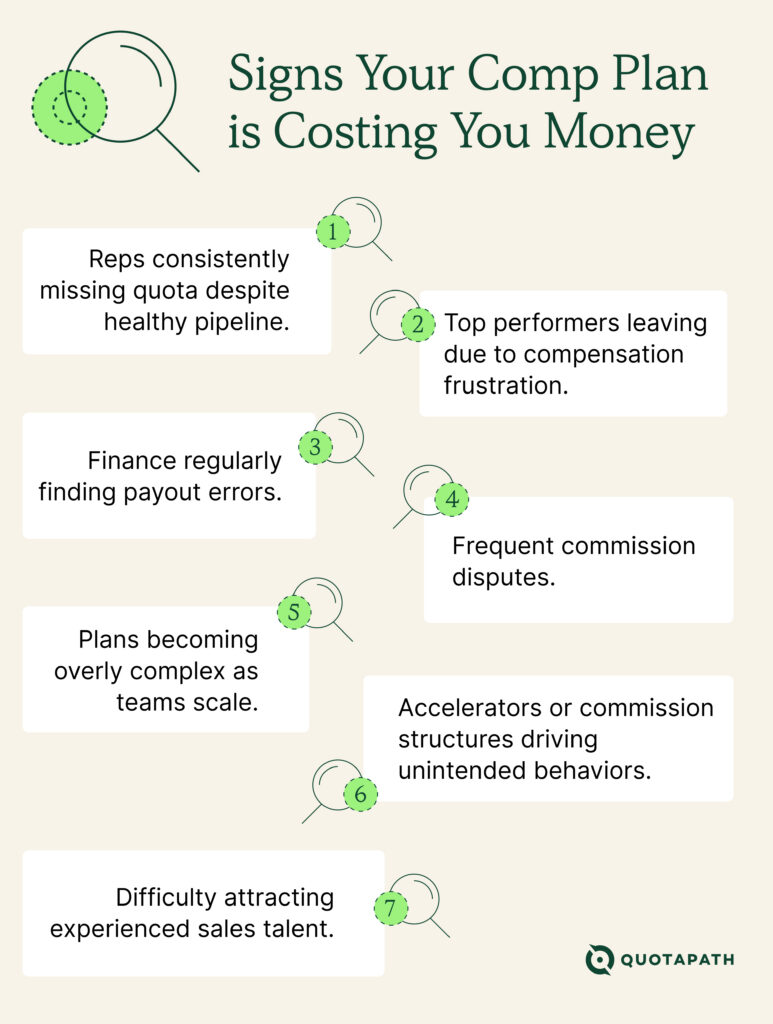
Signs Your Comp Plan Is Costing You Money

Compensation is often the largest controllable sales expense. Even small flaws in a plan can lead to six-figure consequences at scale, such as overpaying on low-margin deals. Misaligned incentives frequently create hidden revenue leakage. For instance, accelerators or commission structures that drive unintended behaviors such as reps prioritizing contract size over retention, or incentives that encourage discounting.

Plans becoming overly complex, as teams scale, present additional challenges. For example, reps consistently missing quota despite a healthy pipeline, Finance regularly finding payout errors, frequent commission disputes, and top performers leaving due to compensation frustration. Your comp plan can not only influence rep retention rates but also increase the difficulty of attracting experienced sales talent.

According to a McKinsey study, companies with transparent, well-designed variable compensation structures report up to 30% lower turnover rates than those with confusing or opaque plans. And more than 75% of sales professionals base their decision to accept a new role on the perceived fairness and opportunity offered by the compensation plan.

When In-House RevOps Is Enough

Internal teams at early-stage companies and teams with experienced RevOps leaders can successfully manage compensation without assistance. Likewise for businesses with small sales organizations, stable compensation structures, and access to benchmark data and modeling.

Hiring a consultant shouldn’t be the default answer. Strong revenue operations (RevOps) teams can often solve many compensation challenges internally. However, sometimes it’s best to enlist external expertise to address complex sales compensation questions.

When It’s Worth Bringing in Outside Help

As organizations grow, compensation plans evolve from simple quotas to multi-dimensional programs, triggering complexity in plan administration, data tracking, and compliance. This shift transforms compensation from a straightforward reward mechanism into a complex strategic lever that requires careful design to avoid unintended consequences.

External expertise can be especially valuable during periods of significant change, such as major compensation redesigns, rapid scaling, IPO preparation, mergers and acquisitions, and geographic expansion. Multi-product sales organizations, companies transitioning to usage-based pricing, or those requiring assistance resolving compensation disputes between Sales and Finance, may also benefit from external support.

A sales compensation consultant can bring industry benchmarks, objective analysis, and experience across multiple compensation models to these decisions. This outside perspective can also help align stakeholders around a compensation strategy that balances sales incentives with the company’s broader financial and business objectives.

How Much Does Comp Consulting Cost, and Is It Worth It?

Once leaders determine they need help, the next question is typically cost versus business impact.

Typical Pricing (Project, Hourly, Retainer)

Compensation consulting services typically use three common pricing structures: hourly consulting rates, project-based engagements, and ongoing advisory retainers. Hourly rates are often for ad hoc guidance or smaller, less well-defined needs, while project-based fees cover a defined scope and deliverables. Retainers provide ongoing access to consulting expertise and are typically best suited for organizations requiring continuous strategic support.

Market pricing varies widely by provider and scope of engagement. Independent consultants may charge approximately $250 to $500 per hour, while focused projects with boutique firms may range from $25,000 to $60,000. Enterprise-wide engagements with large consulting firms can cost $100,000 to $250,000 or more.

The difference often comes down to specialization and scale. Boutique compensation consulting firms typically offer specialized expertise and more tailored support for focused compensation challenges, while larger firms bring broader resources and capabilities to complex, enterprise-wide engagements. As a result, the right pricing model and provider depend largely on the scope and complexity of the compensation challenge.

What Moves the Price

Sales compensation consulting costs increase with the size and complexity of the engagement. Key factors include company size, the number and complexity of compensation plans, geographic coverage, technology integrations, and the number of stakeholder interviews required.

Data cleanup requirements can also significantly affect the scope and cost of an engagement. Organizations often underestimate the time required to gather and validate compensation data from disparate systems before consulting work even begins.

How To Calculate ROI

The ROI of sales compensation consulting can be measured through outcomes such as fewer commission errors and improved rep retention. For instance, 22% of sales reps experience at least one commission dispute each year, and 9% quit as a result. Improving compensation accuracy and rep retention translates into significant savings: a rep earning a $50K base salary costs $150K or more to recruit, hire, and ramp.

Additionally, improved quota attainment and sales productivity help eliminate costly redesign cycles when compensation fails to drive the intended performance. Better forecast accuracy can help prevent overpayment, while faster compensation plan rollout and reduced administrative workloads create additional time and cost savings.

comp plan costs

Where Traditional Comp Consulting Falls Short

Traditional consulting remains valuable, but it also comes with tradeoffs that many mid-market SaaS teams struggle with.

Cost and Speed for Mid-Market Teams

Traditional consulting engagements can take weeks or months to move from discovery and analysis to final recommendations. For growing SaaS organizations with budget constraints and rapidly changing priorities, that investment of time and money may be difficult to justify. There’s also an opportunity cost while waiting for recommendations when compensation challenges require faster decisions or adjustments.

Static, Point-in-Time Advice

Recommendations are often based on a snapshot in time. However, markets, territories, and compensation benchmarks change rapidly. Consequently, plans require ongoing iteration to keep current, which is why a compensation plan is rarely “finished.” In fact, according to WorldatWork, 97% of survey respondents reported making changes to their sales comp plans for 2026, compared to 86% last year.

Handing Sensitive Comp Data to Outsiders

Modern revenue teams increasingly want secure, internal-first solutions. Working with external consultants may require sharing sensitive compensation data, including employee earnings and performance information, creating additional security and confidentiality considerations.

Organizations must also consider how compensation data is accessed, shared, and protected to maintain employee trust and meet internal governance requirements. Keeping sensitive information within controlled systems can provide teams with greater oversight of their compensation data while limiting unnecessary external exposure.

How AI Changes Sales Compensation Consulting

Advances in AI are creating a new category between DIY compensation planning and expensive consulting engagements.

On-Demand Benchmarks Instead of Weeks of Analysis

AI-powered compensation analysis can deliver immediate, always-on access to insights that traditionally require weeks of discovery and analysis. By continuously learning from evolving benchmark datasets, AI can provide benchmark-driven recommendations as compensation trends and market conditions change. This gives teams faster access to relevant insights while reducing their dependency on lengthy discovery processes.

Continuous Modeling vs. One-Time Reports

AI supports the ongoing need to adjust sales compensation plan design in response to evolving business and market conditions. It enables recurring compensation plan modeling, scenario planning, on-target earnings (OTE) analysis, pay mix adjustments, and testing of quota attainment outcomes to keep plans current. With AI-assisted scenario planning, teams can explore questions such as: 

  • What happens if quota increases by 20%?
  • What happens if accelerators change?
  • What happens if expansion revenue becomes a priority?

Rather than relying on a one-time report that reflects a single set of assumptions, continuous modeling allows teams to test different scenarios and adjust the sales incentive plan as business priorities and conditions change.

When AI Replaces a Consultant, and When It Doesn’t

The best sales compensation consulting solution depends on organizational size, budget, and desired outcome. AI is well-suited for benchmarking, plan grading, scenario modeling, compensation analysis, and first drafts of plan recommendations. However, there are scenarios where a human consultant is the better solution.

Human consultants remain valuable when compensation decisions involve executive alignment, organizational politics, M&A situations, large-scale transformations, and change management. AI can accelerate the analysis behind compensation decisions, while human expertise remains essential when those decisions require nuanced judgment, stakeholder alignment, and the ability to navigate organizational complexity. 

Meet Atlas, Your AI Compensation Plan Consultant

Traditional consulting and AI-driven alternatives each have their place. Atlas offers modern revenue teams a practical solution to compensation planning that combines AI-powered guidance with proprietary compensation data and benchmarks.

Grade Your Existing Plan in Minutes

Atlas helps finance and RevOps teams assess existing sales compensation plans against proprietary QuotaPath data and benchmarks to identify potential risks and evaluate plan simplicity and fairness. These insights help leaders understand whether their plan is competitive and aligned with business goals.

Build and Test Plans Against Proprietary Benchmarks

Leaders can move from intuition to evidence-based compensation planning with Atlas. Powered by proprietary QuotaPath data and benchmarks, Atlas facilitates compensation plan modeling, OTE validation, and pay mix recommendations to enable benchmark-informed design. Teams can build compensation plans with greater confidence while preventing costly financial surprises.

Leadership-Ready Briefs You Can Share Upward

RevOps teams often spend significant time packaging recommendations for leadership. Atlas streamlines this process by turning compensation insights and recommendations into clear, executive-ready summaries that communicate key findings and recommended actions. These structured outputs facilitate Finance alignment and give leaders the information they need to bring compensation decisions into board discussions with greater clarity and confidence.

Secure By Design for Sensitive Comp Data

Atlas prioritizes data security by keeping sensitive compensation information private and never using it to train external AI models. This approach supports internal ownership for reduced exposure of compensation data and information. Maintaining greater control over how sensitive data is accessed and used strengthens employee trust and supports internal governance requirements.

Try Atlas Free

Atlas offers a fast evaluation of your compensation plan and immediate insights without committing to a consulting engagement. Teams can test Atlas for free before deciding whether it’s the right approach for their compensation planning needs.

FAQ Section

    What does a sales compensation consultant do?

A sales compensation consultant helps organizations design, benchmark, evaluate, and optimize sales incentive programs. They may analyze compensation structures, quotas, OTE, pay mix, and performance data to identify potential issues and recommend changes that align incentives with business objectives.

    How much does sales compensation consulting cost?

Sales compensation consulting can cost anywhere from approximately $250 per hour to $250,000 or more per consulting engagement. While independent consultants may charge $250 to $500 per hour, boutique firms may charge $25,000 to $60,000 for focused projects, and enterprise-wide engagements with larger firms typically cost $100,000 to $250,000 or more. Final costs depend on factors such as company size, plan complexity, project scope, and data requirements.

    Is sales compensation consulting worth it?

Sales compensation consulting can be worth the investment when compensation challenges are complex or costly enough to require outside expertise. Consultants can help organizations prevent expensive plan design mistakes, improve quota attainment and sales productivity, reduce commission errors, and align stakeholders around compensation decisions. However, organizations with simpler compensation structures and experienced internal RevOps teams may be able to manage these needs without external support.

    Can AI replace a sales compensation consultant?

AI can replace a sales compensation consultant for many analytical and planning tasks, but not in every scenario. AI is well-suited for benchmarking, plan grading, scenario modeling, compensation analysis, and developing initial recommendations quickly and cost-effectively. Human consultants remain valuable when complex organizational challenges require nuanced judgment, executive alignment, change management, or navigating stakeholder dynamics.

    How often should compensation plans be reviewed?

Sales compensation plans should be formally reviewed at least annually and monitored throughout the year to ensure they continue driving the intended outcomes. Additional reviews may be necessary when business priorities, market conditions, territories, products, pricing models, or sales roles change significantly. Ongoing monitoring can help teams identify performance or cost issues early rather than waiting until the next annual planning cycle.

    What is the difference between compensation consulting and compensation software?

Compensation consulting provides external expertise and strategic guidance, while compensation software provides technology for designing, managing, and analyzing compensation programs. Consultants typically help with complex decisions, plan design, benchmarking, and stakeholder alignment, while software can automate sales compensation processes, model scenarios, track performance, and provide ongoing insights. AI-powered solutions increasingly bridge the gap by combining software capabilities with on-demand analysis and strategic guidance.

Book a demo with QuotaPath to benchmark, model, and optimize your compensation plans with AI-powered guidance.
QuotaPath’s Earnings & Attainment App Pages Are Now Live Inside HubSpot

hubspot commission tracking

Exciting news for our HubSpot and QuotaPath users!

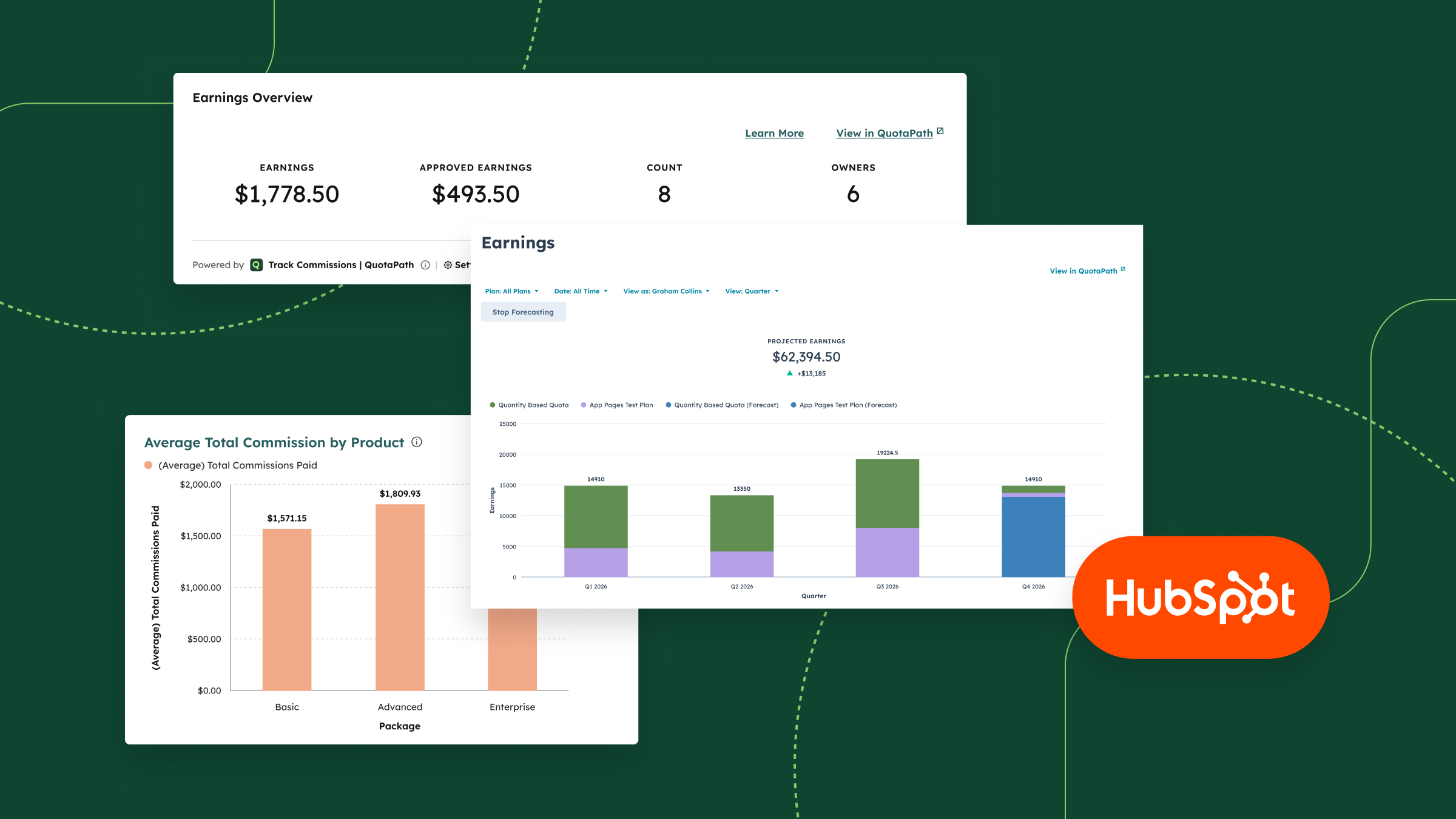
Our two-way integration now includes full QuotaPath Earnings and Attainment views directly in HubSpot. 

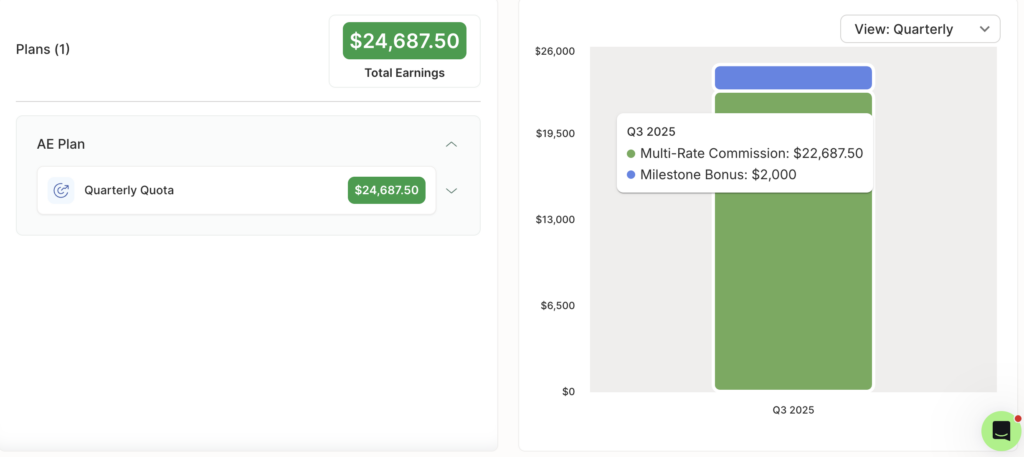
Called App Pages, the newest addition to our HubSpot integration, reps and admins can check where they stand in the same place they’re already managing pipeline.

Learn more below.

What are App Pages?

App Pages are essentially a mirror of the Earnings and Attainment pages you already use in QuotaPath, rendered natively inside HubSpot. That means the same aggregated views, the same filtering, and the same pipeline forecasting, without a separate login or a second browser tab.

With App Pages, reps and admins can:

  • View aggregated Earnings inside HubSpot, filtered the same way they would in QuotaPath
  • View Attainment inside HubSpot, across owners, plans, or components
  • Forecast pipeline directly from the Earnings and Attainment views
  • See QuotaPath data inside HubSpot regardless of which object (Deals, custom objects, etc.) their workspace uses as its data source

This rounds out QuotaPath’s presence inside HubSpot alongside our App Cards and App Objects, which surface deal-level earnings and attainment data. App Pages zoom out to give the aggregate, period-over-period view reps and managers rely on to know where they stand.

Why it matters

Sales reps and managers already spend most of their day in HubSpot. 

Every extra login, tab, or app switch is friction, and friction is exactly what keeps reps from checking in on their numbers regularly.

By putting the same Earnings and Attainment pages reps know from QuotaPath directly inside HubSpot, App Pages remove that friction entirely, so checking commission standing becomes part of the workflow instead of an extra errand.

Streamline commissions for your RevOps, Finance, and Sales teams

Design, track, and manage variable incentives with QuotaPath. Give your RevOps, finance, and sales teams transparency into sales compensation.

Talk to Sales

Nothing extra to set up

App Pages work regardless of your QuotaPath workspace’s data source, and they’re turned on by default for any workspace connected to HubSpot. If you’re already syncing QuotaPath and HubSpot, there’s nothing to configure; your team can start using App Pages today.

How to find App Pages in HubSpot

App Pages appear alongside your other HubSpot navigation once your workspace is connected. For a full walkthrough of setup and access, visit our Help Center article on the HubSpot integration.

Not yet running QuotaPath and HubSpot together? See why QuotaPath is the most installed commission app on the HubSpot Marketplace and explore the full integration.

What High-Performing RevOps Teams Do in August That Everyone Else Delays Until October

high-performing revops teams

September is consumed by board prep. October brings the close crunch. By November, Finance and RevOps are in a panic, untangling commission disputes that surface at the worst possible time – during board prep or audit- and trying to reconcile accruals from H2 compensation that no one modeled before they went live.

Teams that struggle in Q4 aren’t unlucky; they’re unready. The difference isn’t effort—it’s when certain decisions get made. If October exposes operational weaknesses, the real question is what happened in August before the pressure started to build.

Summary

The strongest RevOps and Finance teams don’t leave commission health to chance. They use August to identify risks early, strengthen financial controls, and prepare for a smoother Q4 by leveraging the five tactics listed below. 

  1. Treat commission data as a financial risk, not an ops inconvenience
  2. Run a mid-year comp audit before it’s urgent
  3. Model payout exposure before approving plan changes
  4. Fix accruals before they become an audit problem
  5. Set up visibility before reps start asking questions
Streamline commissions for your RevOps, Finance, and Sales teams

Design, track, and manage variable incentives with QuotaPath. Give your RevOps, finance, and sales teams transparency into sales compensation.

Talk to Sales

1. They Treat Commission Data as a Financial Risk, Not an Ops Inconvenience

The first behavioral split happens in how Finance frames the problem. Most teams treat commission disputes as a sales problem. However, commission processing errors constitute 3-8% of total incentive payouts.

This dirty commission data creates accrual issues that don’t surface until close, and it can create potential ASC 606 implications. Misstated commission expense isn’t just inconvenient; it’s a potentially costly compliance exposure.

Finance teams that own it differently catch it upstream, before it hits the books. As Kenza Sebbar, Director of RevOps at Actabl, said, “For FP&A, it was about trusting the numbers and being audit-ready.”

2. They Run a Mid-Year Comp Audit Before It’s Urgent

Knowing data is a risk is one thing. Building the habit that catches it is another.

The audit isn’t about finding mistakes — it’s about understanding what the plan is actually doing to cost, behavior, and trust. What a comp audit actually checks is:

  • Attainment health: Determines whether a realistic percentage of a sales team consistently meets or exceeds their quota within a reasonable timeframe, while quotas remain aligned with business objectives.
  • Commission cost vs. margin: Commission expenses help prevent overspending and ensure profitability by reviewing the commission payout ratio, the effective commission rate per deal, and total commissions per product line.
    Payout disputes and resolution rate: The number of discrepancies or pay questions per pay period, and how quickly they are successfully addressed or clarified to the rep’s satisfaction.
  • Whether incentives still match H2 goals: Verifies that the comp plan motivates behaviors that drive the achievement of current business objectives.

August is the best window of time. It’s before H2 ramp, before board prep, and before it’s time for plan changes again. When they finally look, teams find issues such as version control chaos, undocumented overrides, and plan assumptions that expired in March.

compensation scenario modeling
Model payout exposure ahead of changes using QuotaPath’s AI Revenue Strategist, Atlas.

3. They Model Payout Exposure Before Approving Plan Changes

After audit comes the harder conversation — what to change, and what it’ll cost. The question isn’t just “does this comp change make sense for sales?” It’s “do we know what this change will cost across every attainment scenario?”

Mid-year comp changes that skip modeling create worse problems than the ones they fix. For instance, the effective commission rate per deal across accelerators and all earners, such as AEs, BDRs, and managers, can add up. “You blink, and you’re paying 35% of a deal in total commissions once you add up everyone involved. That’s a hidden cost finance leaders need to track,” said Ryan Milligan, GTM Leader at QuotaPath.

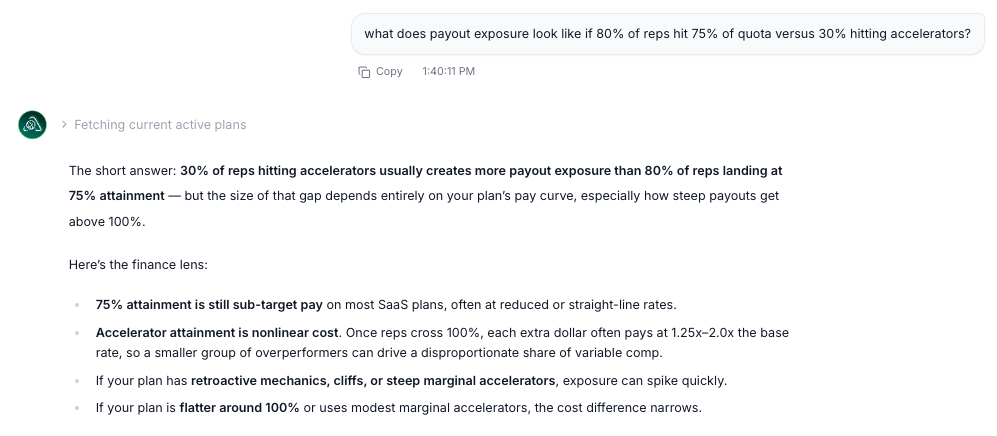
When plan changes go live without scenario testing, you end up with surprise payouts, misaligned accruals, and forecasting gaps. Testing across attainment bands proactively answers the question: What does payout exposure look like if 80% of reps hit 75% of quota versus 30% hitting accelerators?

AI modeling tools that simulate payout exposure across scenarios before any plan change is approved streamline this process. Finance gets a number before they greenlight the change, not after it hits payroll. The result is better forecasts, cleaner audits, and fewer surprises.

4. They Fix Accruals Before They Become an Audit Problem

The comp audit and scenario modeling only matter if the underlying data is clean enough to trust. Clean accruals aren’t just an efficiency win. They’re a risk-mitigation story that Finance should own.

Manual accruals rely on disconnected data sources, introducing version control issues and formula drift. The handoff between commission calculation and Finance reporting is where those inconsistencies are most likely to surface, delaying the close and increasing the risk of payout errors. Mismatched numbers result in delayed closings and payout errors. These inaccuracies frustrate reps and increase compliance risk.

Audit-readiness actually requires clean trails, documented logic, and defensible calculations. That’s the difference between a spreadsheet someone “knows” and a system Finance can confidently stand behind. Commission accounting automation ensures compliance by fulfilling these requirements in a fraction of the time. For instance, one customer reduced accrual time by 90% — from 3–4 days to 20–40 minutes.

The teams left scrambling in October usually have an accrual problem they didn’t catch in August.

5. They Set Up Visibility Before Reps Start Asking Questions

The operational side of commissions is only half the story. The other half is trust, and transparency is how you build it.

When reps can’t see how they’re paid, they resort to building shadow spreadsheets. Dispute volume distracts Finance during close and reduces credibility as they address rep payout questions and discrepancies. Real-time rep visibility minimizes disputes. “I rarely get questions about commissions anymore,” said Liza of Rootly.  

This isn’t a rep satisfaction feature — it’s a Finance time-saving feature. Fewer disputes = fewer pulls on Finance’s attention at the worst possible moment.

For Finance, the benefits of rep transparency extend beyond fewer distractions at close. When reps can see how they’re paid and trust the calculations, Finance spends less time resolving disputes and more time supporting forecasting, financial reporting, and strategic planning.

“The only two times I think about commissions now are when payroll is due and during annual planning. That’s it,” said Kenza Sebbar, Director of RevOps at Actabl.

The Real Cost of Waiting Until October

If you choose to wait, it’s not a capability difference; it’s a timing one. Teams that scramble in Q4 usually had the same intention in August. The difference lies in whether the commission infrastructure was treated as ongoing work or a year-end task.

“Delaying until October” compresses the financial close, increases audit risk, and forces Finance and RevOps to untangle undocumented plan changes and rep disputes during one of the busiest periods of the quarter. Problems that could have been addressed proactively in August become a reactive scramble when the business can least afford it.

Commission health isn’t a project; it’s a posture. The teams that finish Q4 clean usually didn’t work harder; they just didn’t let August pass without looking.

Conclusion

If there’s one thing to do this August, don’t wait until October to hear what your commission data has been trying to say all along. Audit it. Model it. Validate it.

Book a demo to see how QuotaPath can streamline your August comp plan audit.

The Hidden Cost of “Good Enough” Commission Tracking for Finance Teams

The Hidden Cost of "Good Enough" Commission Tracking for Finance Teams

Your commission process probably works.

 Reps get paid, close eventually happens, and the spreadsheet only breaks a few times a year. That’s the problem … “works” and “good enough” are exactly what keep commission tracking off Finance’s risk register.

But the financial risk in commissions is equally high: paying your reps incorrectly when they already distrust Finance AND misstating variable compensation expense, slowing close, and losing confidence in the forecast (all at once).

In this blog, learn:

  • Where “good enough” commission tracking actually costs you: forecasting, close, audit readiness, and rep trust
  • Why spreadsheets fail hardest mid-year, right when plans change
  • The exposure model Finance should require before approving any comp change
  • How AI makes payout scenario modeling practical
  • The metrics to track to know if your process is quietly taxing the business
Streamline commissions for your RevOps, Finance, and Sales teams

Design, track, and manage variable incentives with QuotaPath. Give your RevOps, finance, and sales teams transparency into sales compensation.

Talk to Sales

The costs don’t show up as commission errors

It’s important to note that the costs don’t actually show up as commission errors. Instead, they show up everywhere else (!).

Like in your forecast. When accruals are built on a wrong earned-to-date base, every forecast layered on top inherits the error. Expense timing distorts monthly S&M and EBITDA, and true-ups bunch into later periods, so forecast variance starts looking like performance variance, and nobody can tell which is which.

Or in your close. Manual commission reconciliation means tying out bookings, payroll, and accrued liabilities by hand, chasing exceptions, and holding sign-off until disputes resolve. Teams running spreadsheet-heavy processes routinely lose two to five business days of close to commissions alone.

How about your audit file. Auditors flag the process: no effective-dated plan documentation, no clean tie-out from the approved plan to source deals to payout, weak evidence of accrual methodology, and no way to reproduce a historical payout exactly as of the pay period. If you capitalize commissions under ASC 340-40, errors flow into deferred contract costs and amortization, where they can hide for one to four quarters before a true-up or variance review surfaces them.

And of course, in your reps’ trust. A single dispute burns 2–10 hours across Finance, RevOps, payroll, and a manager. The compounding cost is worse: once reps believe the math is unreliable, every statement becomes contested.

Why spreadsheets fail exactly when you need them most

Spreadsheets fail mid-year when plans change, which is precisely when the stakes are highest.

A new SPIF introduces effective-date logic. 

Accelerators require cumulative attainment math, not simple rate lookups. 

Territory shifts break credit rules. 

Quota adjustments raise retroactivity questions. 

The failure modes are predictable: a lookup still pointing at the old rate table after an accelerator change, a split credit applied on one tab but not the payout tab, a SPIF that keeps paying after the promo ended, a clawback keyed to close date instead of churn date.

Operationally, teams respond by creating new tabs instead of controlled versions, hardcoding exceptions, and carrying “shadow adjustments” outside the model, until nobody is sure which file is authoritative. 

Static tools handle tables well. They handle event history and rules that change over time poorly. 

Comp plans are the latter.

The Finance move: model exposure before the plan changes

Here’s where Finance can shift from cleanup crew to gatekeeper. Before any comp change is approved, require a payout exposure model, mnot a single cost estimate at 100% attainment.

A plan can look cost-neutral at target and still get expensive above it. 

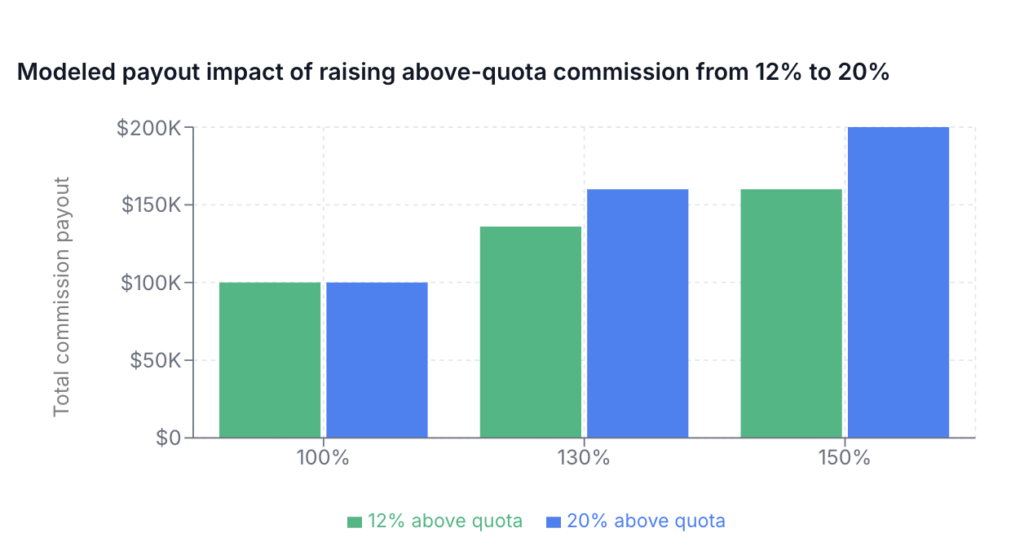
Consider a change from 12% to 20% commission above quota to “reward outsized performance.” At 100% attainment, cost looks unchanged. But if top reps finish at 130–150% (especially after territories also improved) payout on the overage cohort can rise 30–50% or more. 

That’s the kind of change that looks small in a spreadsheet and expensive once fully modeled.

Before signing off, a Controller should ask: 

  • What does this cost at 100%, 110%, 125%, and 150% attainment? 
  • What’s the downside if the top quartile overperforms? 
  • Is anything retroactive? 
  • Does this change our accrual methodology? 
  • Can payroll reproduce the result from system logic, not manual edits?
Atlas ai modeling for commissions
Model payout scenarios using Atlas, QuotaPath’s AI Revenue Strategist

Where AI changes the equation

The reason most teams skip scenario modeling is the effort involved. 

Building attainment scenarios across roles, segments, ramp status, and deal mix in a spreadsheet is a project. 

This is where AI earns its place in the comp stack: feed it plan rules, quotas, headcount, and historical attainment distributions, and it can model both deterministic scenarios (“what if 30% of reps hit 120%?”) and probabilistic exposure ranges.

The payoff for Finance is seeing where the payout curve bends, because that’s where budget risk lives, and it’s exactly what a static model at target attainment will never show you.

Start measuring “good enough”

You don’t need industry benchmarks to know if you have a problem. 

Track your own: commission true-up percentage versus accrual, dispute rate per pay cycle, manual adjustment count, off-cycle payroll runs, and days to close variable comp.

 If those numbers are trending up, or you can’t produce them, your commission process is quietly taxing your forecast, your close, and your audit readiness.

That’s the hidden cost of good enough. The fix isn’t working the spreadsheet harder; it’s moving commissions into a system built for changing rules, effective dates, and auditability. 

See how QuotaPath automates commission tracking and models payout exposure before plan changes roll out; schedule a demo.

 Sales Plan Software Selection Guide

sales plan software guide

Sales planning is broken for most teams. Quota-setting is often based on gut feel. Territory carving happens in spreadsheets. Commission tracking is a mess of tabs and manual reconciliation. In fact, 49% of revenue operations leaders believe their processes aren’t flexible enough, and 46% report their processes are mostly manual and lack automation, according to Forrester.

The right sales plan software changes all that by creating a process of strategy, modeling, automated agility, real-time visibility, and auditable compliance. However, picking the wrong one creates new headaches.

This guide will provide a clear framework, a comparison of leading platforms, and a recommendation to RevOps leaders, sales ops managers, and finance stakeholders evaluating sales planning tools.

Key Takeaways

  • Prioritize sales plan software that improves planning, forecasting, and decision-making across Finance, Sales, and RevOps.
  • AI-assisted planning, scenario modeling, and planning workflows are the capabilities that create long-term value.
  • Match your sales plan software to your planning needs—enterprise governance, configurable modeling, and AI-assisted planning each serve different revenue organizations.
  • QuotaPath delivers the strongest balance of planning capabilities, transparency, usability, and value for mid-market, RevOps-led organizations.
Streamline commissions for your RevOps, Finance, and Sales teams

Design, track, and manage variable incentives with QuotaPath. Give your RevOps, finance, and sales teams transparency into sales compensation.

Talk to Sales

Sales Plan Software Comparison Table

Let’s start with a snapshot of the top sales planning tools highlighting their G2 rating, standout feature, and a brief description of who they are best suited for.

VendorG2 RatingStandout featureBest for
QuotaPath4.7Atlas AI Revenue StrategistRevOps teams that want a single source of truth for compensation
CaptivateIQ4.7SmartGrid™ no-code modeling engineMid-market to enterprise teams that want agility, clarity, and control
Xactly4.2Xactly Intelligence AI-powered frameworkLarge global enterprises that want to align strategy with execution and scale
Qobra4.8Specialized AI AgentsGlobal mid-market businesses that need a single commission platform
Everstage4.8AI-powered planning engineEnterprises and high-growth companies

The Pricing Comparison

Let’s shift our focus to pricing, which is often opaque in the sales plan software category, but here’s what you can expect. Pricing models in this category are typically presented as per-seat, per-workspace, flat-fee, or usage-based.

 Starting PriceNote
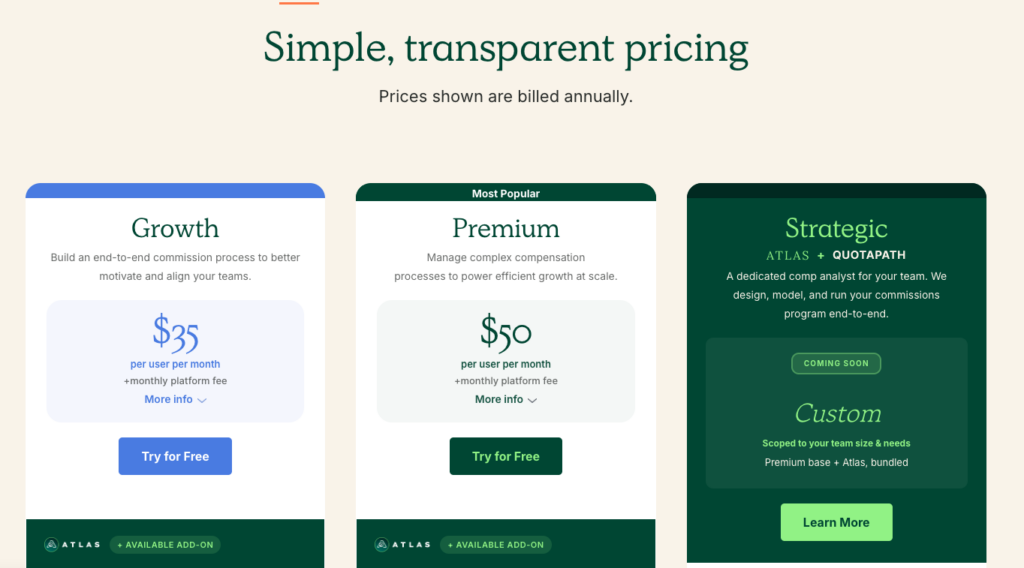
QuotaPath$35-50/user/monthPremium – $50/user/month
CaptivateIQCustomContact for pricing
XactlyCustomContact for pricing
QobraCustomContact for pricing
EverstageCustomContact for pricing

Hidden costs to watch for include implementation fees, support tiers, and overage charges that can add up quickly. However, QuotaPath is the only sales planning tool with a straightforward pricing model published on its website and no hidden fees.

quotapath pricing

Core Features of Modern Sales Planning Software

Here’s a side-by-side breakdown of key features available from each of these sales planning tools to help you select the solution best suited to your organization.

FeatureQuotaPathCaptivateIQXactlyQobraEverstage
Quota planning & modelingAtlas AI-assisted planning and modelingHighly flexible, no-code modelingEnterprise-grade planningAI-assisted planningModern planning workflows
Territory managementBuilt for growing GTM teamsFlexible territory designDeep enterprise territory managementTerritory assignment automationTerritory planning for scaling teams
Commission tracking & calculationReal-time, rep-friendly visibilityHighly configurable calculationsComplex enterprise compensationAI-powered commission automationAutomated incentive management
CRM integrationNative Real-time syncDeep CRM connectivityEnterprise CRM ecosystemNative CRM integrationsCRM-driven workflows
Reporting & visibilityRep, manager & Finance dashboardsStrong analytics & audit controlsExecutive & enterprise reportingReal-time revenue insightsUnified planning visibility
Scenario modeling / What-if analysisAtlas-guided scenario modelingAdvanced no-code modelingEnterprise forecasting scenariosAI-generated planning scenariosPlanning simulations

Although every platform supports these features, their planning philosophy differs considerably. QuotaPath leads with Atlas AI-assisted planning and modeling, while Qobra and Everstage emphasize AI-powered planning workflows. CaptivateIQ offers highly configurable no-code modeling, and Xactly takes a more enterprise-centric approach, emphasizing sophisticated planning, territory management, and forecasting for large, complex organizations.

Planning approaches distinguish these platforms. Quota planning and management tools range from AI-guided planning and modeling to highly configurable design and enterprise-grade frameworks. The same pattern extends across sales territory planning software, revenue forecasting software, and sales capacity planning tools, where vendors differ in AI guidance, modeling flexibility, forecasting depth, or workflow automation.

RevOps teams often focus too much on comparing commission tracking and CRM integrations, even though they have become table stakes across leading platforms. However, RevOps tends to underweight how effectively a platform brings together quota planning, territory management, scenario modeling, reporting, and forecasting into a unified planning experience that helps Finance, Sales, and RevOps make better revenue decisions together.

Criteria for Comparing Sales Plan Software Providers

With the sales plan software market projected to grow by nearly 8% per year through 2033, comparing today’s sales planning tools can feel overwhelming. Rather than relying on feature checklists, you should evaluate how well each platform will perform as your business scales. Ease of implementation should be a key consideration. You should weigh how quickly your team can model quotas, territories, and capacity, make changes independently, and see value without relying on technical specialists. A platform that takes months to configure delays your time-to-value.

CRM integration deserves just as much scrutiny. Many vendors advertise Salesforce or HubSpot integrations, but teams often underestimate the difference between basic and native integration. Look for platforms that sync data in real time with your existing field mappings and eliminate manual imports or reconciliation. A reliable data flow gives Sales, Finance, and RevOps confidence in every plan, forecast, and payout.

Don’t underestimate the importance of rep-facing visibility and usability, directly impacting adoption, trust, and productivity. Easy-to-use digital tools have also been linked to higher employee engagement and productivity. According to HBR, 66% of organizations that equipped employees with intuitive digital tools reported stronger engagement, while Gallup found that highly engaged employees are 18% more productive.

Rep-facing visibility enables reps to easily understand how they earn and track their attainment. Otherwise, reps won’t be motivated to push to the next milestone, will continue relying on shadow tracking, and will dispute payout calculations. You should look for Finance and RevOps admin controls that support audit readiness and ASC 606 compliance, maintain data integrity and version control, and automate commission and quota logic.

Consider the future. The right sales planning software should continue to support your business as it scales, compensation plans increase in complexity, and planning cycles become more collaborative. And don’t forget to evaluate the vendor’s support model and customer success approach. Strong onboarding, responsive support, and strategic guidance often determine whether a platform becomes a long-term solution or a tool your team eventually outgrows.

How We Evaluated All Listed Sales Planning Software Vendors

Data sources such as G2, Capterra, public reviews, and product testing were used to evaluate the following sales planning tools. We focused more heavily on public reviews and product testing to reflect real-life experiences. Although we made our best efforts to remain neutral, for full transparency, QuotaPath is our product.

#1 QuotaPath

Overview: An AI native sales planning software built for revenue operations (RevOps), Finance, and Sales.

Rating: 4.7

Key Strengths: 

  • Comp plan management
  • Rep visibility
  • Real-time commission tracking
  • CRM integration
  • Atlas (AI revenue strategist)

Best For: RevOps teams that want a single source of truth for compensation

Pricing: $35-50/user/month

#2 CaptivateIQ

Overview: A modern sales planning tool helping revenue teams combine strategy, execution, and measurement

Rating: 4.7

Key Strengths:

  • Comp plan management
  • Real-time commission tracking
  • CRM integration
  • SmartGrid™ no-code modeling engine
  • SOX compliance and audit controls

Best For: Mid-market to enterprise teams that want agility, clarity, and control

Pricing: Custom – Contact for pricing

#3 Xactly

Overview: An AI-powered sales plan software designed to help RevOps, sales, and finance build go-to-market (GTM) strategies.

Rating: 4.2

Key Strengths: 

  • Comp plan management
  • Rep visibility
  • Real-time commission tracking
  • CRM integration
  • Xactly Intelligence AI-powered framework

Best For: Large global enterprises that want to align strategy with execution and scale

Pricing: Custom – Contact for pricing

#4 Qobra

Overview: An AI-native sales planning tool designed to align Revenue Operations (RevOps) with Finance

Rating: 4.8

Key Strengths: 

  • Comp plan management
  • Rep visibility
  • Real-time commission tracking
  • CRM integration
  • Specialized AI Agents

Best For: Global mid-market businesses that need a single commission platform

Pricing: Custom – Contact for pricing

 #5 Everstage

Overview: Sales plan software that connects operational planning with incentive compensation for mid-market and enterprise organizations.

Rating: 4.8

Key Strengths: 

  • No-code plan design
  • Rep visibility
  • Real-time commission tracking
  • CRM integration
  • AI-powered planning engine

Best For: Enterprises and high-growth companies

Pricing: Custom – Contact for pricing

Try QuotaPath for free

Try the most collaborative solution to manage, track and payout variable compensation. Calculate commissions and pay your team accurately, and on time.

Start Trial

QuotaPath Is the Best Sales Planning Software

After reviewing the comparisons, it’s clear that QuotaPath comes out on top for mid-market, RevOps-led organizations with comp plan complexity. Offering the strongest balance of planning capabilities, usability, and transparency, QuotaPath extends beyond simply managing commissions by bringing together AI-assisted quota planning and modeling, native CRM integration, real-time visibility, scenario modeling, and reporting into a unified platform.

As this guide has shown, those capabilities matter far more over the long term than simply checking feature boxes. However, QuotaPath may not be the right fit for every organization. Enterprises with highly specialized global planning requirements or exceptionally complex territory structures may benefit from platforms built specifically for enterprise-scale planning and governance.

Likewise, organizations that prioritize extensive no-code customization may prefer a more modeling-centric solution. But for growing revenue organizations looking to align Finance, Sales, and RevOps around a single source of truth, QuotaPath delivers the best overall combination of functionality, usability, and value.

Ready to modernize your sales planning process? Start a free trial or book a demo to see how QuotaPath can help.

FAQ

What is sales plan software used for?

Sales plan software is used for sales territory design, quota allocation, sales performance management, revenue forecasting, and sales compensation management. It replaces error-prone, time-consuming spreadsheets with platforms that sync data across key sources such as CRM to automate planning processes, optimize team performance, and drive revenue.

How is sales planning software different from CRM?

Sales planning software is different from CRM in its purpose and focus. Sales planning software is used for high-level strategy to drive revenue through activities such as territory design, quota allocation, and predictive modeling. CRM serves as a day-to-day database that stores interactions with leads and customers and helps track deal progress, often feeding data into sales planning tools via integrations.

What does sales planning software cost?

Sales plan software costs start at $35 per user, per month and increase to rates in the hundreds per user, per month. Factors influencing these costs include things like implementation, add-ons, and integration.

H3: Can sales plan software integrate with Salesforce and HubSpot?

Yes, sales plan software and sales performance management (SPM) platforms integrate directly with Salesforce and HubSpot. These integrations allow the two systems to sync historical CRM data, deal pipelines, and quotas for automated capacity planning, territory mapping, and compensation management.

How long does it take to implement sales planning software?

Implementation of sales planning software takes anywhere from 4 weeks to 12 months, depending on the organization’s size and complexity and the software’s complexity. The implementation process typically takes 4 to 12 weeks for small and mid-market organizations, while complex enterprise businesses can take 3 to 12 months.

What’s the difference between sales planning software and incentive compensation management (ICM)?

Sales planning software helps businesses design territories, set sales quotas, and forecast revenue, whereas incentive compensation management (ICM) software administers variable pay such as commissions and bonuses. While sales planning software helps determine where reps sell, ICM calculates their earnings.

Book a demo to see QuotaPath sales planning software in action.

Why August Is the Most Underrated Month for Fixing Broken Comp Plans

august sales motivation

Nobody is talking about comp plan design in August. And you should be!

By August, most RevOps and Finance teams have 6+ months of performance data, which we consider enough to know whether their comp plan is working.

Yet most teams wait. They wait for Q4 kickoff. They wait for annual planning (in October). They wait until a VP shows up frustrated about attainment and the entire plan gets relitigated in a conference room with too many opinions and not enough data.

August is your last clean window before that happens and the cheapest month to fix a comp plan. You have time and data.

Our latest blog discusses why and what you can do in August to set you up for a fruitful Q4 and start to 2027.

Streamline commissions for your RevOps, Finance, and Sales teams

Design, track, and manage variable incentives with QuotaPath. Give your RevOps, finance, and sales teams transparency into sales compensation.

Talk to Sales

Why August Works Better Than You Think

First, in August, you have an actual performance signal and not just theory.

By now, you can see whether quotas are set too high, whether accelerators are too flat, or whether payouts are misaligned with margin, deal quality, or term length. The patterns go from hypothesis to evidence.

Q4 hasn’t hijacked the business yet.

Additionally, once September hits, forecast pressure takes over.

Finance is heads-down on the revenue push. RevOps is managing exceptions. AKA nobody has the bandwidth to model structural changes. August is the last month when you can think clearly and act deliberately.

It lines up with budget season.

If your cost of sales is drifting (and odds are it is), August is the right time to reset rates, reexamine quota coverage, or rethink pay mix before next-year planning gets finalized. Changes made in August can be designed thoughtfully. Meanwhile changes made in October get bolted on for the last two months.

Reps will still trust the process.

Mid-year plan changes are always sensitive. But August gives you enough runway to socialize next-year changes rather than forcing reactive in-year edits. Reactive edits damage trust. Proactive, well-communicated changes don’t.

Your operations team can actually implement it.

RevOps, payroll, and finance all need time to clean up crediting rules, exceptions, and system configuration before January 1.

If you wait until October, you’re handing them a fire drill.

Use Atlas to Update Plans

Atlas, our AI revenue strategist, allows you to get immediate feedback and recommendations on your current comp plans based on current market benchmarks and proprietary QuotaPath data involving 10,000 comp plans and outcomes. 

Try Atlas for Free

What a Broken Plan Usually Looks Like by August

If your comp plan has issues, the data is telling you by now.

Here’s what to look for:

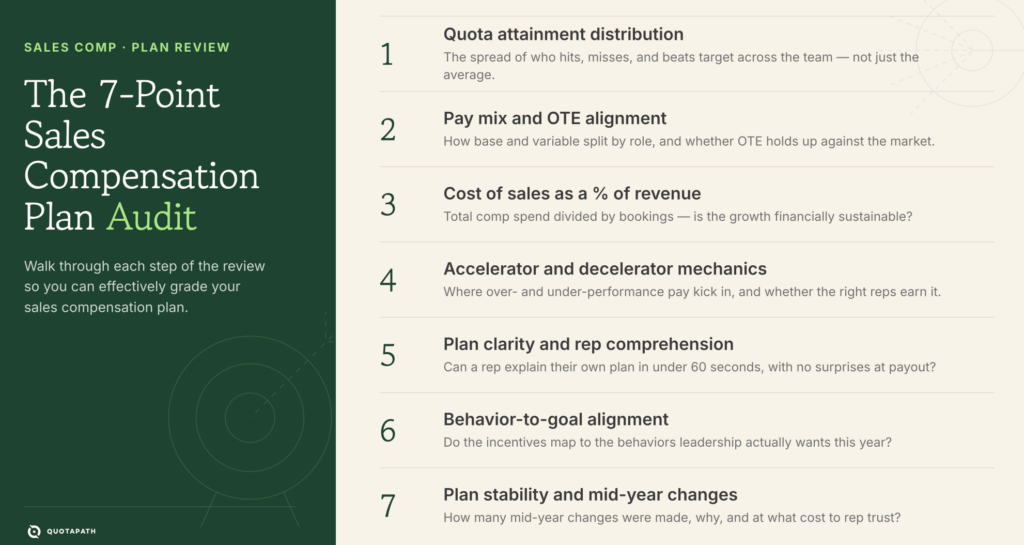
  • Too many reps clustered below threshold. If a large portion of your team hasn’t hit 70–80% of quota, the quota is probably the problem.
  • Overpayment on low-quality revenue. Are you paying full commission rates on deals that churn quickly, carry deep discounts, or come with high implementation cost? August is when those patterns become visible.
  • Not enough upside above target. Flat accelerators above 100% mean your top performers have no reason to push harder in H2. That’s a retention risk and a revenue risk.
  • Too much complexity. If your plan requires a spreadsheet to explain and a lawyer to audit, reps aren’t using it to drive behavior, they’re just hoping the number is right at the end of the month.
  • Quotas that don’t match territory reality. Ramp timing, territory size, and deal cycle all affect attainment. By August, you know which territories are structurally disadvantaged.

Three Things to Do in August

So, here are three quick hitters to tackle in August.

1. Run a payout audit

First, pull your target cost versus actual payout by role and attainment band. You’re looking for two things: where you’re overpaying relative to the revenue quality you’re getting, and where the plan is failing to reward behavior you actually want.

This doesn’t need to be a full compensation analysis. A simple cut by role x attainment tier tells you most of what you need to know.

2. Check behavior alignment

Secondly, ask yourself: is the plan paying for the revenue you actually want?

This is where most plans fail quietly. The structure looks fine on paper, but the incentives reward volume over margin, the short term over the long term, or individual over team behavior. By August, you have enough closed deals to audit whether commissions tracked to outcomes you’d repeat.

Common misalignments to check:

  • Are multi-year deals getting a premium, or are they treated the same as one-year contracts?
  • Are reps being rewarded for discount depth that costs you gross margin?
  • Does your plan differentiate new logo from expansion, or are they compensated identically even though the motion and value are different?

3. Draft next-year changes now (before the politics start)

And remember that October is too late for any changes for this year.

By the time annual planning is in full swing, every proposed change to comp is filtered through whoever pushes back hardest. Quotas get set to protect favorites. Pay mix changes get killed because someone in the room has a personal stake. The process becomes reactive and political.

August lets you come to that table with a proposal, not a blank page. Model the changes. Run the scenarios. Know your numbers before the room starts negotiating.

Use Atlas to model and simulate future plan performance

Where AI Fits In (And Where It Doesn’t)

You can even use AI for this. Obviously, we encourage you to run everything through our AI Revenue Strategist, Atlas.

Atlas can automate your comp plan design, but the real value is in pressure-testing assumptions before they calcify.

Before you walk into an annual planning meeting and defend a quota model or accelerator structure, AI can help you stress-test it:

  • What happens to cost of sales if attainment shifts 10 points?
  • Are your payout curves consistent with benchmarks?
  • Are there patterns in your historical data that suggest a structural problem rather than a performance problem?

Think of it less as a decision-maker and more as a diagnostics partner and one that can surface the questions you should be asking before Q4 makes asking them politically complicated.

The Window Closes

Every year, teams that wait until October to revisit comp plans end up in the same place: reactive changes, rushed implementation, reps who feel blindsided, and finance trying to reconcile a new structure against a year they’re already in the middle of.

August doesn’t feel urgent. That’s the point. The teams that use this window well show up to annual planning with data, a proposal, and a clear view of what needs to change and why. Everyone else is still catching up.

If your plan has been underperforming, the evidence is already there.

The only question is whether you look at it now, or wait until there’s no good time left.

To learn more how Atlas and QuotaPath design, track, and optimize your compensation strategy throughout the year, book time with our team.

How ECP Traded 5 Overlapping Spreadsheets for 1 Commission Platform

ecp customer story quotapath

The end-of-month commission scramble: a high-pressure, error-prone cycle where Finance and RevOps teams manually wrestle with disconnected data. Exporting raw CRM data, converting files, and manually manipulating fragile spreadsheets to translate raw sales data into accurate commission payouts. It’s an error-prone process. Then, as sales teams grow and comp plans get more complex, the spreadsheet approach doesn’t just slow you down; it becomes a liability.

ECP (Extended Care Professional), an assisted living software that powers workflows for long-term care facilities and pharmacies across the U.S., reached this breaking point. VP of Finance Sonja Karlson and Staff Accountant Elise Larson had five overlapping spreadsheets, a manual HubSpot export process, and a commission cycle that took hours, and sometimes an entire week.

“We were working with five to six spreadsheets, and they all overlapped in different ways. If you made a change on one, you were making the change on six of them. It became very tedious, with a lot of room for human error,” said Elise.

After implementing QuotaPath, ECP reduced commission processing from days to a couple of hours, eliminated manual errors, and, for the first time, gave their sales team real visibility into how they’re paid.

The Breaking Point: When Spreadsheets Stop Scaling

Before QuotaPath, ECP’s monthly commission workflow involved manually downloading HubSpot reports, converting them to CSVs, uploading the data into spreadsheets, and manually applying commission logic for different accelerators and deal types.

They reached a tipping point: “As we grew and our sales team grew, it became just insanely complicated and took hours, if not days,” said Sonja. With five overlapping plans, a single comp rule change cascaded across every file. “There was just a lot of room for human error,” Elise said.

The spreadsheet system wasn’t failing because the team wasn’t good at it. It was failing because it was never built to scale. There was no single source of truth.

Evaluating Solutions: What ECP Was Really Looking For

ECP looked at all the major commission automation players. The bar was high. The tool had to accommodate their existing complexity, scale with future growth, and be intuitive enough that the Finance team, rather than an engineer, could own it day-to-day.

The HubSpot commission integration was the decisive factor. “The fact that it works one-to-one with HubSpot was huge. I can jump in, and everything is there. I’m not having to double-check and be in two different platforms,” said Elise.

Sonja and Elise didn’t just buy commission software; they felt like their specific needs were being taken seriously. “It was the easiest and cleanest platform we saw. Things were very much where you’d expect to find them,” Sonja said.

Their sales rep, Hector, played a meaningful role, too. Sonja and Elise were impressed by the level of support they received throughout the sales process. Hector was responsive, thorough, and willing to find answers on the spot.

Streamline commissions for your RevOps, Finance, and Sales teams

Design, track, and manage variable incentives with QuotaPath. Give your RevOps, finance, and sales teams transparency into sales compensation.

Talk to Sales

Building a Commission System That Just Works

Now that ECP has implemented QuotaPath, live HubSpot data flows directly into QuotaPath, eliminating the manual export-and-upload cycle entirely. Elise runs commissions monthly. Then Sonja reviews and approves them before payroll goes out. The workflow is cleaner, and the logic is traceable.

Where it used to take days to pull together the right data and apply commission rules, the process now takes a couple of hours. “It used to take me days, sometimes even a week if there were hiccups. Now I can run it in a couple of hours and not question the results,” said Elise.

What Changed for Sales: No More Shadow Accounting

Before QuotaPath, sales reps couldn’t easily see how they were paid. Elise and Sonja were fielding calls for multiple days before payout, just to walk reps through the spreadsheet logic. “We would be on calls multiple days leading up to the commission payout because people just were not understanding it. Now there are little to no questions,” Elise said.

Reps had resorted to building their own shadow tracking spreadsheets, a sign that the process had broken down at the trust level. QuotaPath resolved this by giving reps real-time sales commission visibility. “They were spending a lot of time building their own spreadsheets to track commissions. That’s gone now. They can focus on what they’re best at: selling,” said Sonja.

Elise and Sonja have found the forecasting feature to be a meaningful add-on that the reps have responded well to. Seeing potential earnings months in advance has become a motivational tool, not just an informational one.

The ROI: Time, Sanity, and a Tool That Can Drive Behavior

The immediate win for Sonja and Elise is time. Commission processing that used to take days now takes hours. But the bigger opportunity Sonja is most excited about is using QuotaPath to shape selling behavior, to hit business goals. “If we can use QuotaPath to incentivize sales reps to close certain deals in certain months, it could easily pay for itself,” Sonja said.

The shift in what Finance can focus on, thanks to less time spent reconciling, means more time to think strategically. “Just the time saved justifies it. But our sanity can be factored in too,” said Sonja.

Onboarding and Support: Above and Beyond

ECP’s implementation included a wrinkle, but the team felt support throughout. The deal split module took longer than expected and required involvement from QuotaPath’s dev team to get right. Although things didn’t go perfectly, the team was responsive, and it got resolved.

What Elise and Sonja want future customers to know is that QuotaPath’s support team is responsive and goes the extra mile. “The customer support team has been incredible. They sent me live videos walking through how to fix things. I’d get answers within 30 minutes. I was shocked by how above and beyond they went,” said Elise.

Preparation will also make your implementation and onboarding process easier. “Come in with your commission plans clearly defined. The more prepared you are, the smoother it’ll go,” said Sonja.

Try QuotaPath for free

Try the most collaborative solution to manage, track and payout variable compensation. Calculate commissions and pay your team accurately, and on time.

Start Trial

Final Thoughts

After automating commissions with QuotaPath, ECP’s commission processing reduced from days, and sometimes a week, to a couple of hours. Their five overlapping spreadsheets were replaced by a centralized platform, and live HubSpot data sync eliminated the need for manual exports. The ECP sales team has full payout visibility for the first time, and finance is freed up to focus on strategy, rather than spreadsheet maintenance.

“The transparency, the time savings, the sanity savings… it’s worth it. It’s easy for reps to use, and it’s easy for us to use. We’d recommend it to anyone looking for commission software,” said Sonja.

Schedule a demo to see how QuotaPath can improve your commission processing.

3 Ways to Use Commissions to Reignite Sales Motivation This Summer

use commissions summer motivation

Two-thirds of B2B businesses experience a summer sales slump when sales teams disengage mid-year. Sales teams often hit a motivational slump during the summer months. Between vacations, slower deal cycles, and mid-year fatigue, maintaining momentum can be tough. But your sales compensation plan can help generate sales motivation this summer.

In this post, we share three proven ways to use commissions to re-energize sellers, realign behavior to revenue goals, and finish Q3 strong.

Key Takeaways:

  • How to use commissions for motivation by creating targeted, short-term SPIFs.
  • Reps are more likely to move a deal forward when they can see the earnings impact.
  • Recognizing sales reps to increase engagement will help create a Q3 sales performance boost.

1. Run a Targeted, Time-Boxed SPIF

Let’s start by motivating the sales team with short-term commission incentives to give Q3 a sales performance boost. SPIFs, or special performance incentive funds, are limited-time incentives designed to drive specific behaviors. SPIFs are valuable devices to have in your summer sales incentives toolbox that create immediate urgency and laser focus for a set period.

Leverage these tips when creating SPIFs to overcome your summer sales slump:

  1. Choose a short-term goal aligned to business priorities, such as a new logo, ARR, multi-year deals, or a specific ideal customer profile (ICP).
  2. Examples of high-impact SPIFF ideas for sales:
    • $1,000 bonus for each new logo over $10k closed before July 31
    • Double commission for multi-year deals signed in August
  3. Make it visual and public by using a Slack leaderboard or a QuotaPath dashboard.
  4. Pro tip: Finance should help model cost vs. expected lift
QuotaPath commission visibility to reps
Visible Earnings in QuotaPath

2. Surface Forecasted Earnings to Connect Pipeline to Payday

Creating your SPIF is a great first step in motivating a sales team. Rep visibility into forecasted earnings is another of our recommended sales comp motivation strategies to generate real-time sales motivation this summer.

Most reps don’t realize how deals in the pipeline = commission dollars. Showing real-time forecasted earnings based on pipeline health and probability enables reps to see how each deal will impact their paycheck.

Reps are more likely to move a deal forward when they can see the earnings impact, prioritizing deals that have the greatest impact rather than those that close the fastest. Use a tool like QuotaPath to give real-time earnings visibility, rather than spreadsheets, for motivating sales teams.

3. Celebrate Attainment Loudly and Often

Another of our sales comp motivation strategies is celebrating wins. This is especially important over the summer months to re-engage sales reps. According to Gallup, employees who receive recognition are 2.9 times as likely to be engaged. They also found that engaged employees are more involved and enthusiastic about their work, resulting in 18% higher sales productivity.

Following these 4 best practices for recognizing sales reps to increase their engagement will help create a Q3 sales performance boost.

  1. Reinforce progress toward quota and accelerators mid-quarter by keeping it clearly visible.
  2. Share small wins: “closed won” shoutouts, SPIF winners, attainment streaks, to recognize success and keep reps engaged.
  3. Use dashboards, Slack channels, or “payday preview” emails to maintain engagement with additional recognition.
  4. Tie recognition to behaviors, not just results, such as multi-threading and early renewals, as reinforcement.
Streamline commissions for your RevOps, Finance, and Sales teams

Design, track, and manage variable incentives with QuotaPath. Give your RevOps, finance, and sales teams transparency into sales compensation.

Talk to Sales

Conclusion: Summer is Temporary. Momentum is Everything.

The summer sales slump is a common occurrence. Don’t let a seasonal dip drag down your H2 goals. Use your comp plan as a lever, not just a payout engine, to generate sales motivation this summer.

Small tweaks can create urgency, engagement, and better revenue outcomes. Steps such as creating a targeted SPIF, providing reps with visibility into forecasted earnings, and celebrating wins will create a Q3 sales performance boost.

Schedule a demo or start a free trial to see how increased visibility drives desired behaviors and outcomes.

How to Run a Q3 Compensation Plan Reset Without Losing Rep Trust

q3 comp plan

By Q3, most revenue organizations are doing the same quiet calculation:

  • What worked in H1
  • What didn’t
  • And what needs to change before the year runs out

Quotas may have been set too high (or too low) at the start of the year. The business has pivoted toward a new segment, product, or motion. Reps who were stars in Q1 are coasting, or potentially even disengaged. 

Something in the comp plan is no longer pulling in the right direction.

And yet, many RevOps, Finance, and Sales leaders hesitate. 

Mid-year comp changes feel risky. Change the plan, and you risk rep trust because it seems like you’re moving the goalposts. The last thing you want heading into Q3 is a sales team that’s checking out.

What’s more, a lot of leaders hesitate to make changes simply because, systematically, it’s too difficult. You could break a spreadsheet, or your compensation software is too hard to implement the updates yourself. 

But not changing can be just as damaging. A misaligned comp plan rewards the wrong behaviors, disincentivizes your best reps, and signals that leadership isn’t paying attention.

Streamline commissions for your RevOps, Finance, and Sales teams

Design, track, and manage variable incentives with QuotaPath. Give your RevOps, finance, and sales teams transparency into sales compensation.

Talk to Sales

So here’s what we think is the best way to go about it:

1. Diagnose Before You Disrupt

Before you touch anything in the comp plan, you need to understand what’s actually broken.

Start with the numbers. 

Pull attainment distribution across your team: what percentage of reps hit 100%? What percentage are stuck below 50%? 

If your attainment curve is flat at the bottom or spiked at the top, something structural is off. Your quotas aren’t calibrated correctly, the comp plan isn’t motivating the right behaviors, or both.

Then go deeper into the behaviors the plan is actually driving. 

Are reps optimizing for deal size or deal count? Are they sandbagging pipeline to control timing? Are they discounting to close and sacrificing margin? The comp plan is always teaching reps something. 

The question is whether it’s the lesson you intended.

Next, tie your analysis to the business metrics that matter most: CAC, LTV, NRR, GRR. A sales compensation plan that doesn’t connect to these levers is a plan that’s working against your financial goals, even if it’s paying out on the right deals.

Finally, talk to people. 

A short RevOps-led rep survey or a handful of manager interviews will surface friction points faster than any spreadsheet. Reps know exactly where the plan feels unfair or confusing  and that clarity is valuable input, not just venting.

You can’t design a good mid-year sales plan update without a clear diagnosis. Skip this step and you’re guessing.

Recommended Reading

Comp Metrics and Red Flags That Indicate a Change is Necessary

Read Blog

2. Secure Alignment Between RevOps, Finance, and Sales Leadership

Comp plan changes fail at rollout more often than they fail at design. 

The most common reason is that leadership isn’t aligned before the change goes out, so the message is inconsistent, and reps lose confidence fast.

Before you finalize anything, get ahead of the “why.”

RevOps typically owns the design, but Finance owns the budget, and Sales leadership owns the team’s reaction. All three need to be in the room. 

Finance needs to understand the tradeoffs. A plan that’s too conservative on upside might save money in the short term but lose you your top performers. A plan that’s too generous creates budget risk. Work through the model together so Finance can make an informed call, not just approve a number.

Sales leadership needs to confidently evangelize the change. If your VPs and frontline managers are surprised by the update or privately disagree with it, that ambivalence will spread. Before launch, every sales manager should be able to answer the question: “Why is this change good for my reps?” If they can’t, go back and fix the plan.

RevOps compensation strategy only works when it’s built with cross-functional buy-in, versus handed down from one function and explained to the others after the fact.

3. Design a Change That Benefits the Rep

This is the hardest part of any comp plan redesign and arguably the most important.

Reps are skeptical of mid-year changes for a reason. Most of the time, when a company changes a comp plan mid-cycle, it’s because the plan was paying out more than expected. From a rep’s perspective, that’s a clawback with extra steps.

Your goal is to design a change that reps can see is in their interest, or at minimum, doesn’t hurt them.

Avoid anything that looks like moving the goalposts: raising quotas, lowering rates, or removing accelerators mid-year. These changes destroy trust.

Instead, look for changes that add upside. Consider SPIFs tied to priority products or segments. Add accelerators above quota for reps who are already on track. Introduce pipeline bonuses for early-stage activity if top-of-funnel is a bottleneck. If you need to shift focus toward a new product or motion, make it worth the rep’s while to go there.

The question to stress-test every design decision against: can a rep look at this new plan and see a clear path to earning more? If the answer is yes, you’re in good shape. If the answer is “it depends” or “not really,” redesign before you roll out.

4. Communicate the Change Like a Product Launch

Remember, changes to sales compensation are emotionally charged. Reps’ income is on the line, which means they’ll read between every line of every message you send.

The standard approach involving an email from the VP of Sales with a new comp plan attached is not enough.

Treat the communication of a comp plan like a product launch. 

That means:

Over-communicating the why. Before you explain what’s changing, explain why the business needs it to change. Connect the update to company goals, market shifts, or H1 learnings. Reps are more likely to accept a change they understand than one that feels arbitrary.

Using every channel available. All-hands team calls, manager-led 1:1s, a written FAQ, and a recorded walkthrough give reps multiple ways to absorb the information and ask questions in the format that works best for them.

Showing the math. Abstract comp plan mechanics don’t land. Show reps specific examples: here’s a deal, here’s how it pays out under the old plan, here’s how it pays out under the new plan. Make it concrete. If the math is better for reps in realistic scenarios, show that clearly — it’s your strongest argument.

The goal of communication isn’t just to inform. It’s to rebuild trust. Done well, a transparent rollout can actually strengthen the rep-company relationship, even if the change is hard.

5. Use a Tool to Model and Show Earnings Impact

Still, even the best communication breaks down when reps can’t see their own numbers.

Trust in a comp plan is built through visibility. When reps can log in and see exactly how their pipeline translates to earnings (deal by deal, quota attainment by quarter) the uncertainty disappears. There’s nothing to interpret, dispute, or second-guess.

This is where a dedicated commission platform really drives sales performance. Tools like QuotaPath give reps a real-time earnings view: their deals, their rates, their progress toward accelerators, and their projected payout. 

When you roll out a comp plan change, reps can model their own scenarios instead of waiting for someone in RevOps to run numbers for them.

That self-service earnings visibility does two things. 

First, it reduces questions.  Reps get answers the moment they need them, not after a 48-hour back-and-forth. Second, it signals to the team that the company isn’t hiding anything. The math is right there.

“Visibility into their earnings has changed what the reps are pushing for. Incentives drive behaviors, and showing your reps how much more they can make on longer contracts changed how they sell,” said Andre King, Director of Sales at Rootly

When you’re updating sales incentives mid-year, showing is more powerful than telling.

6. Reinforce and Coach to the New Plan

Lastly, good leaders reinforce and coach to the new plan. This helps your team internalize the adjustments. 

The weeks after rollout are when most comp plan changes lose momentum. Managers go back to running their normal forecasts and pipeline reviews, and the new plan mechanics fade into the background. Reps who aren’t sure how to optimize under the new structure default to old habits.

Managers play a critical role here. Every forecast review, deal strategy session, and 1:1 is an opportunity to connect rep behavior to comp plan mechanics. “If you close this deal by end of Q3, you hit your accelerator” is a more motivating sentence than any all-hands deck slide.

Track early wins under the new plan and share them. The first rep to hit an accelerator under the updated structure becomes proof that the change works, and that their peers can too.

And stay close to the data. If attainment distribution shifts in the wrong direction, or if a specific segment of the team isn’t engaging with the new plan, treat it as a signal that something needs adjustment. The best RevOps teams run compensation as an ongoing strategy.

On-demand Revenue Strategist

Use Atlas as your on-demand GTM partner, revenue strategist, and compensation consultant.

Try Atlas for Free

The Framework in Practice

A well-executed Q3 comp plan reset follows a clear sequence:

  1. Diagnose: Analyze attainment, behavior, and alignment with business goals before designing anything
  2. Align: Get RevOps, Finance, and Sales leadership on the same page before communicating to reps
  3. Design for rep upside: Build changes that create a clear path to earning more, not less
  4. Communicate like a launch: Over-explain the why, use multiple channels, show the math
  5. Give reps visibility: Use a tool that lets reps self-serve their earnings view in real time
  6. Coach continuously: Connect plan mechanics to behavior in every manager conversation

Mid-year comp changes don’t have to erode trust. When you run the process right, starting with a clear diagnosis, earning cross-functional alignment, and giving reps real transparency into how they get paid, a Q3 compensation plan reset can be exactly what the team needs to finish the year strong.

Want to see how QuotaPath can give your reps real-time visibility into their earnings — and make your next comp plan change easier to roll out and trust? Book time with our team.

Evaluate a Sales Compensation Plan

evaluate a sales compensation plan

Two-thirds of respondents update their comp plans less often than once per year, according to Sales Xceleration’s Sales Agility Assessment. This is surprising, since nearly 40% of revenue leaders admit to struggling with incentive plans misaligned with goals.

Unchecked plans are costly. As most plans silently reward behaviors leaders never asked for, causing the business to fall short of objectives quarter after quarter, and rep turnover to rise.

A plan you don’t evaluate is a plan you’re paying for blindly. In this blog, we walk through a structured audit framework and a way to grade your plan at the end.

Key Takeaways

  • Complete a comp plan review if your plan is motivating the right behaviors, and you’re falling short of your business objectives.
  • A sales compensation plan evaluation answers the question: ‘Was the plan worth executing?’
  • The fastest path to a benchmarked scorecard is Atlas’s Grade My Comp Plan track.
  • A sales comp plan audit is a recurring loop of Build, Track, Grade, Adjust, Repeat.

Meet our AI Revenue Strategist

Use Atlas to quickly run an analysis and evaluation of your sales compensation plan performance.

Try Atlas for Free

Why Evaluate Your Comp Plans?

Sales comp plan evaluation is necessary to ensure the plan remains effective as business and market conditions evolve. Business-context shifts such as pricing changes, ICP shifts, new motions including PLG, expansion, or multi-product all silently break plan logic. To minimize business impact, evaluate a sales compensation plan to ensure audit-readiness in terms of clean documentation, ASC 606 hygiene, and defensible payouts before year-end.

Allowing the cost of letting drift compound leads to overpaid low performers, underpaid top performers, mid-year quota chases, and a risk of rep churn. And the most important consideration here is behavioral. If your plan’s outputs don’t match the behaviors you wanted, it doesn’t matter if the math is correct, because you’re falling short of your business objectives.

What Does A Complete Sales Compensation Plan Audit Cover?

It’s often thought that a sales compensation plan review measures commission accuracy, answering the question: ‘Did we pay the right amount?’ However, a plan evaluation answers the question: ‘Was the plan worth executing?’

While commission accuracy has become table stakes, thanks to automated tools, sales comp plan evaluation is a continuous process. In this blog, we’ll walk you through a 7-point sales compensation plan audit to help you evaluate a sales compensation plan.

The 7 audit points are:

  • Assess quota attainment distribution
  • Evaluate pay mix and OTE alignment
  • Measure the cost of sales as a percentage of revenue
  • Review accelerator and decelerator mechanics
  • Gauge plan clarity and rep comprehension
  • Ensure behavior-to-goal alignment
  • Monitor plan stability and mid-year changes

The 7-Point Sales Compensation Plan Audit

Let’s walk through each step of the sales compensation plan review process so you can effectively grade it.

1. Quota attainment distribution

Quota attainment distribution measures the spread of sales performance across the team, revealing the percentage of sales reps who hit, miss, or exceed their designated targets.

  • What to measure: The spread of attainment across the team, not just the average.
  • Healthy quota attainment benchmarks: Most SaaS teams target ~80–90% team attainment with a healthy bell curve and a clearly differentiated top decile.
  • Red flag: Persistent team attainment below ~70% or above ~110–120% — usually a quota, coverage, or capacity problem, not a rep problem.

A too-high average is just as bad as a too-low one. It leads to a cost-of-sales blowout and demoralized top performers.

2. Pay mix and OTE alignment

The pay mix in a sales comp plan defines the percentage of a sales rep’s earnings that consists of base salary, commission, and other incentives. Aligning the pay mix with On-Target Earnings (OTE) ensures the plan strikes a balance between financial risk and rep motivation, while driving the right sales behaviors to achieve business objectives.

  • What to measure: Base/variable split by role and OTE position vs. market.
  • Healthy pay mix benchmarks: AEs typically 50/50; SDR/BDR 60/40 or 70/30; CSMs more base-heavy unless they own expansion. SaaS AE OTE often $120K–$200K (SMB/mid-market), $200K+ (enterprise).
  • Red flag: Roles with strong revenue control but heavy base-weighting, or vice versa.

Each role’s compensation should reflect the degree of direct control it has over revenue.

3. Cost of sales as a % of revenue

Customer Acquisition Cost (CAC) as a percentage of revenue is an efficiency metric that reveals whether your growth is financially sustainable and how much of the budget is actual profit.

  • What to measure: Total comp spend (base + variable + accelerators + SPIFFs) divided by bookings/revenue.
  • Healthy benchmark: SaaS new-business commission rates often 8–15% of ARR; expansion is approximately half that; renewals are approximately 25–33% of new business.
  • Red flag: Accelerator-heavy plans where the marginal dollar of revenue costs more than the company can sustain.

Cost of sales as a percentage of revenue varies by company stage and sales motion, typically decreasing as organizations scale and increasing with higher-touch selling motions.

4. Accelerator and decelerator mechanics

A sales accelerator is a tiered commission structure that rewards sales rep overperformance by increasing the payout once a specific sales goal is achieved, such as quota. By contrast, sales decelerators pay a lower commission percentage of the base rate for underperformance. Decelerators are often used to offset the costs of accelerators in a sales compensation plan.

  • What to measure: Where accelerators kick in, how steep they are, and whether they’re earning out for the right people.
  • Healthy signal: Accelerators reward truly exceptional performance and bend cost of sales only at attainment levels the business already wins from.
  • Red flag: Accelerators paying out broadly across the team (suggests quotas are too low) or never paying out (suggests quotas are unrealistic).

5. Plan clarity and rep comprehension

When reps don’t understand how they earn commissions, they aren’t motivated by the plan. This often leads to confusion, demotivation, frustration, compensation disputes, and ultimately sales rep turnover.

  • What to measure: Can a rep explain their own plan in under 60 seconds? How many components does the plan have? How many edge cases are documented?
  • Healthy signal: One-page, rep-facing summary, no more than 4 earnings components, and no surprises at payout time.
  • Red flag: “We keep getting the same questions on the comp Slack channel.”

Reps who don’t understand their plan don’t optimize against it and don’t behave as intended.

6. Behavior-to-goal alignment

Behavior-to-goal alignment gauges whether selling behaviors are actually tied to business goals.

  • What to measure: Do the plan’s incentives map to the specific behaviors leadership says it wants this year (multi-year deals, ICP fit, expansion, etc.)?
  • Healthy signal: Every accelerator, SPIFF, and bonus traces back to a specific business metric.
  • Red flag: The plan still rewards last year’s strategy.

Misalignment leads to rewarding the wrong behaviors, preventing the achievement of business goals.

7. Plan stability and mid-year changes

When you build a sales compensation plan, your intent is to effectively motivate reps’ behaviors that drive the achievement of business objectives. However, there are instances when mid-year plan changes are necessary, such as market or economic changes, company acquisitions, new leadership, product changes, employee turnover, and performance shortfalls.

  • What to measure: How many mid-year changes were made last year, why, and at what cost to sales rep trust?
  • Healthy signal: Small, communicated, scoped adjustments — not full plan overhauls.
  • Red flag: More than 2 unplanned mid-year changes typically signal the original plan wasn’t pressure-tested before rollout.
Streamline commissions for your RevOps, Finance, and Sales teams

Design, track, and manage variable incentives with QuotaPath. Give your RevOps, finance, and sales teams transparency into sales compensation.

Talk to Sales

How Do You Score Your Sales Compensation Plan?

Easily grade your sales compensation plan with a comp plan scorecard. Score each of the 7 audit points on a 1–5 scale and assign weights to them. Behavior-to-goal alignment and cost of sales typically carry the most weight. When scoring the plan, RevOps owns the scorecard, Finance co-signs it, and Sales reviews it. Here’s a comp plan scorecard you can use:

comp plan scorecard

Grade Your Comp Plan With Atlas

The fastest path to a benchmarked scorecard is Atlas’s Grade My Comp Plan track, built on QuotaPath’s proprietary data and sales compensation benchmarks. Try Atlas for Free to see it in action.

What Atlas evaluates

Atlas handles the complete sales compensation plan audit, including attainment distribution and payout concentration, pay mix, OTE, quota-to-OTE benchmarking, and cost of sales-to-revenue analysis. Our AI Revenue Strategist also performs accelerator and incentive design diagnostics, assesses pay-for-performance alignment, and performs plan effectiveness diagnostics, answering the question, “Is this plan actually working?”

How Atlas uses QuotaPath benchmarks

Atlas uses 8+ years of proprietary QuotaPath commission data plus insights from thousands of comp plan consults to evaluate your plan. It layers in market benchmarks and the customer’s own historical data to assess plans against actual attainment patterns, payout behavior, and revenue economics.

Atlas recommends; it doesn’t just describe. So, every output points to a specific tradeoff or fix. Unlike an LLM that can describe what a plan looks like, Atlas knows what plans actually pay out.

Leadership-ready outputs from Atlas

Atlas generates shareable briefs that span RevOps, Finance, CRO, and CEO without reformatting. Serving as a common source of truth for cross-functional debate, Atlas eliminates the “everyone has their own spreadsheet” problem, keeping everyone on the same page. This shortens the time it takes to evaluate a sales compensation plan, adjust, and test it.

What To Do After The Audit

Once you’ve completed your comp plan scorecard, what’s next?

Prioritizing fixes by financial impact

Before taking action, determine how to proceed. Stack-rank issues by dollar impact, not by how loud the complaints are. Cost-of-sales misalignment and attainment distribution typically dwarf everything else.

Sort into quick-wins that take short-term, surgical adjustments versus structural fixes requiring fundamental, long-term overhauls to the commission plan, weighing them based on urgency, scale, and root cause.

How do you roll out plan changes?

Following these best practices will ensure a successful rollout of the revised plan.

  • Timing: Tie to natural plan cycles (year-end, half-year, fiscal kickoff) wherever possible.
  • Communication: Rep-facing one-pager, manager talk track, FAQ.
  • Documentation: Version-controlled plan doc, updated terms.
  • Note: Hard plan changes mid-cycle erode trust faster than they save dollars.

Tracking plan efficacy post-change

Don’t wait until the next annual audit to find out whether the fix worked. Select three to four leading indicators to monitor the plan’s impact post-change. Include metrics like attainment trend, payout concentration, deal mix, and rep retention. Then review monthly to quickly detect developing issues.

The build, track, grade, adjust flywheel

A sales compensation plan audit is not a one-time event. It is one stage in a recurring loop: Build → Track → Grade → Adjust → repeat. Atlas lives at every stage of the flywheel. Start your next audit in Atlas.

Sales Compensation Plan Audit Checklist

Use this handy sales compensation plan audit checklist to routinely grade your plans.

sales compensation plan audit
Get a PDF of this audit here.

FAQs

How often should RevOps audit comp plans?

RevOps should audit comp plans quarterly by completing a light-touch review of attainment and payout distribution. A full audit should be carried out at least once a year, ideally before annual planning. Trigger-based audits should be performed when business shifts such as pricing, ICP, motion, and headcount change.

Who owns the audit, RevOps or finance?

RevOps owns the audit execution, while Finance co-signs the audit output. Sales leadership reviews and weighs in on behavioral alignment identified during the sales compensation plan audit. A shared source of truth helps facilitate this process by ensuring everyone is looking at the same data and eliminating version control issues throughout the audit.

What’s the fastest way to grade a plan?

The fastest manual way to grade a sales compensation plan is with the 7-point scorecard provided above. However, the fastest path is to use Atlas’s Grade My Comp Plan track, which takes minutes rather than weeks. Try Atlas for Free

Can you change a plan mid-year?

Yes, you can change a plan mid-year, but only with clear communication, a documented rationale, and, ideally, adjustments (not overhauls). Best practice: If you’re considering a mid-year overhaul, you will almost certainly need a full redesign at the next cycle anyway.

Audit vs. redesign: what’s the difference?

The difference between an audit and a redesign is that one is an assessment, and the other involves plan changes. An audit involves evaluating your plan against benchmarks and outcomes. By contrast, a redesign is building a new plan from scratch when the audit reveals structural problems. Most teams should be auditing far more often than they’re redesigning.

How FP&A Teams Use QuotaPath to Model Sales Comp into the 2026 Budget

how fp&a teams use QuotaPath

Sales compensation is a strategic FP&A lever…and most teams are managing it wrong.

There, we said it.

Now that we’ve got that off our chest, here’s what we mean and how to get it right.

As 2027 planning cycles heat up, FP&A teams are asked to do something they’ve always struggled with: accurately model, forecast, and govern sales compensation costs at speed.

Just why is it so hard? For starters, sales comp typically represents 8–12% of revenue for B2B SaaS companies. This makes it one of the largest line items on the P&L, and due to payout eligibility schedules and changing comp levers, it’s also one of the hardest to pin down.

Too many finance teams are still building their models in disconnected spreadsheets, reconciling data manually, and iterating slowly as the business around them changes.

According to research from Jedox, FP&A’s mandate in 2027 is shifting dramatically, from backward-looking reporting to forward-looking value creation.

As a result, better tools are needed, complete with tighter integrations and the ability to model compensation in real time.

Below, let’s explore how FP&A leaders at companies like Actabl, AlphaSense, NeuroFlow, and YPrime are using QuotaPath to do just that.

3 Key Takeaways:

  1. Spreadsheets make comp a liability.
  2. QuotaPath gives FP&A live visibility into comp expense.
  3. The shift from manual calculation to strategic modeling is also a credibility shift that repositions Finance as a GTM partner (not Sales enemy).

Common FP&A Pain Points During Budget Season

First up, it’s important to understand that most FP&A leaders don’t struggle with the actual math. Rather, they struggle with the underlying infrastructure.

That includes:

  • Disconnected tools. CRM data lives in Salesforce or HubSpot. Payroll lives somewhere else. Comp plans live in spreadsheets. Stitching these together for a monthly close, let alone an annual budget, creates compounding risk.
  • Comp plan modeling that lacks agility. When plans live in spreadsheets, every change is an event. Updating a rate card or adding a new role means rewriting formulas, checking version history, and re-validating outputs. That friction makes it nearly impossible to run “what-if” scenarios fast enough to influence real decisions.
  • Limited forecast visibility and misalignment with Sales and RevOps. Sales leadership sees the pipeline. Finance sees headcount and payroll. Neither has a shared view of how comp expense is trending relative to revenue, leading to budget surprises and last-minute scrambles.

Kenza Sebbar, for example, noted the importance of her FP&A team’s priorities around compensation.

“For FP&A, it was about trusting the numbers and being audit-ready… and not spending hours each month on commissions,” said Kenza, Director of RevOps at Actabl.

These are solvable problems. And forward-thinking teams like Kenza’s are already solving them with QuotaPath’s help.

Streamline commissions for your RevOps, Finance, and Sales teams

Design, track, and manage variable incentives with QuotaPath. Give your RevOps, finance, and sales teams transparency into sales compensation.

Talk to Sales

Modeling and Forecasting in QuotaPath: What It Unlocks for FP&A

QuotaPath connects directly to your CRM, Salesforce, HubSpot, and more, pulling in the deal and pipeline data your comp plans operate from.

That connection eliminates the manual sync that slows most teams down and makes comp expense a live, queryable number rather than a snapshot from last Tuesday.

  • Forecasting by plan, role, or team. FP&A can model expected commission expense at any level of granularity—one rep, one territory, or the entire sales org. When headcount changes or quotas shift, the model updates. No manual rebuild required.
  • Scenario modeling and draft plans. QuotaPath’s draft plan functionality lets Finance and RevOps build and test new comp structures before they go live. Want to see what a 10% quota increase does to your commission budget? Model it without touching production data. Want to compare two accelerator structures for next year’s AE plan? Run both scenarios side by side.
  • Real-time pipeline alignment. Because QuotaPath syncs directly with your CRM, comp forecasts move in step with sales performance. Finance doesn’t have to wait for a month-end data dump to understand how commission accruals are tracking.

The result? For David Thai, RevOps Lead at Augury, it was better budget forecasting.

“QuotaPath helped us get line-of-sight into commission and budget forecasting monthly and annually,” said David.

And for Genevieve Moss Hawkns, Systems Ops Manager at NeuroFlow, the Salesforce commission tracking in QuotaPath connection came in clutch.

“QuotaPath had all our Salesforce fields available to play with and could represent the complexity of our business,” Genevieve said.

And, for teams using QuotaPath’s sales capacity planning tools, this visibility extends further by tying headcount plans directly to comp budget projections so Finance can model GTM expansion scenarios with confidence.

Visibility, Controls, and Audit-Readiness

Additionally, spreadsheet-based comp processes create a specific problem for finance teams: they’re hard to defend.

When an auditor, (or worse?) or an unhappy rep asks “how was this calculated?”, the answer is often a trail of formula edits, manual overrides, and email threads.

That… doesn’t feel good, however, QuotaPath changes the control structure by creating:

  • Shared visibility between Finance, Sales, and RevOps. Everyone works from the same data.
    • Reps see their earnings as deals close.
    • Finance sees accruals in real time.
    • Disputes go down because there’s nothing to dispute since the number is transparent and fully traceable.
  • Locked historicals. Once a period closes, it’s locked. Changing a comp rate for next quarter doesn’t retroactively alter last quarter’s payouts. This is an underrated feature, as it allows Finance to iterate on plan design without worrying that updates will break the historical record.

Emma Wilksinon, RevOps Manager at Moxo, called this capability out specifically.

“With QuotaPath, previous payouts are locked in… Whether we change a rate or a path moving forward, we know it won’t impact historicals, and that gives us peace of mind,” said Emma.

  • Audit trail by default. Every plan change, payout, and approval is logged so that no one has to dig through version-controlled spreadsheets or reconstruct decisions from Slack threads.

“We now have a foundation where we can build mutual trust between our teams,” said Michael Bishop, former SVP of Finance at YPrime.

For more on what Finance teams lose when they delay this transition, see our post on what commission spreadsheets are quietly costing you.

Try QuotaPath for free

Try the most collaborative solution to manage, track and payout variable compensation. Calculate commissions and pay your team accurately, and on time.

Start Trial

Time Savings and Strategic Shift

Last up is what the time saved running commissions allows leaders to spend elsewhere.

Less time on reconciliation means more time on analysis. But the strategic case is even more compelling.

When Finance isn’t spending days each month chasing down commission calculations, those days can be devoted to modeling scenarios, stress-testing assumptions, and advising GTM leaders on compensation design. You know, the work that moves the business.

“If you take the hours me and my team, and FP&A, spent preparing commissions, adjust for salary… it offsets the cost of QuotaPath,” said Kenza.

Michael agreed.

“QuotaPath allows us to apply our mental capacity elsewhere… on work that’s actually value-add,” Michael said.

This aligns with what FP&A leaders across industries are calling for in 2026: a shift from operational reporting to strategic business partnership. Manual comp management is one of the biggest barriers to that shift—and removing it is one of the fastest ways to level up the function.

For teams currently managing this in spreadsheets, migrating to QuotaPath is typically faster than expected, and the ROI shows up in the first close cycle.

Planning for 2027: FP&A’s Role in GTM Agility

The TL/DR even though you’re with us is that sales compensation is one of the most powerful levers a company has for influencing GTM behavior.

Which means how Finance models it (and how quickly Finance can iterate on it) directly affects how fast the business can adapt to changing conditions.

Teams building for 2027 are using comp modeling to:

  • Test new GTM motions before committing headcount (e.g., expanding into a new vertical, adding an overlay role)
  • Validate quota assumptions across different revenue scenarios
  • Model compensation across roles and geographies to understand fully loaded GTM cost at different growth rates
  • Align comp plan design with revenue targets so that what Sales is incentivized to do matches what Finance is budgeting for

QuotaPath’s comp plan performance analytics give FP&A teams the reporting infrastructure to track and validate these assumptions continuously, versus the end of the year.

Budget Smarter, Move Faster with QuotaPath

Sales compensation is too large, too complex, and frankly too strategically important to manage in spreadsheets. For FP&A teams entering 2027 planning cycles, the question is how quickly you can make the move.

QuotaPath gives Finance the infrastructure to build comp plans before they launch, forecast comp expense in real time, maintain audit-ready historicals, and build the cross-functional trust that makes budget season feel less like a fire drill.

The transformation from manual calculations to strategic modeling becomes a credibility story for Finance, for RevOps, and for the entire GTM team.

Ready to budget for 2027 with confidence? Talk to our team to see how QuotaPath supports FP&A.